13 Vet Checks That Catch Senior Cat Problems Before They Start
Most cat owners assume their eight-year-old cat is just "slowing down with age." Veterinary data says something far more urgent is happening underneath.
Kidney disease, thyroid disorders, and high blood pressure quietly take hold years before any symptom appears. By the time an owner notices, real damage has usually already been done.
The checks that catch these problems early aren't rare or expensive - they're routine. Most owners have never heard of half of them, and the most overlooked one comes first.
#13 - The Biannual Exam Schedule Switch
Most cat owners visit the vet once a year. For a cat over seven, that gap is way too wide.
The American Animal Hospital Association classifies cats as mature adults at seven and seniors at ten. It now recommends wellness exams every six months starting at age seven, specifically to catch diseases that develop silently at this stage.
"We recommend checkups at a minimum of every six months for senior cats."
Dr. Heather Loenser, DVM, AAHA Chief Medical Officer
After age seven, cats go through accelerated physical changes that often go unnoticed until they've already progressed. A six-month gap between visits for a senior cat is roughly the equivalent of skipping years of check-ups in human terms.
The single biggest habit shift you can make for a senior cat is booking that second yearly appointment. Everything else on this list happens inside that visit.
But what actually happens during that exam is where it gets interesting - the next check is one most owners don't even know exists.
#12 - Full Physical Nose-to-Tail Assessment
Your vet's hands are a diagnostic tool no blood test can replace.
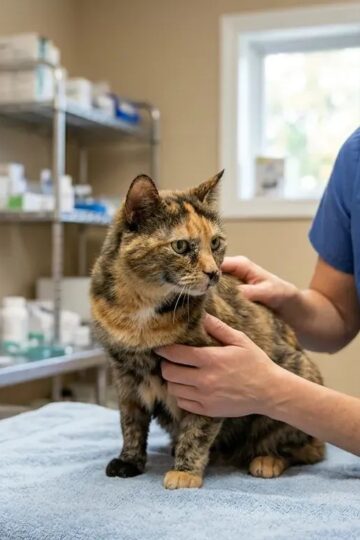
During the exam, your vet gathers a full medical and behavioral history, then checks every organ system, weight, and body condition. Changes between visits - not a single reading - are what tell the real story.
A senior wellness exam casts a much wider net than a routine check-up. Vets check lymph nodes, the thyroid gland, skin, coat texture, and muscle mass, all before a single blood test is even ordered.
A dull or matted coat is often the first physical sign of arthritis - cats stop grooming hard-to-reach spots when their joints hurt. Most owners just chalk it up to laziness.
What the physical exam can't see requires the lab - and the next test is the one most vets now consider non-negotiable.
#11 - Complete Blood Count (CBC)
A complete blood count sounds basic. It's anything but.
It helps diagnose infection, anemia, and bleeding problems, and gives a window into your cat's immune system. In senior cats, unexplained anemia is often an early warning sign of chronic kidney disease - long before your cat feels tired or drinks more water.
The test measures red cells, white cells, and platelets in one draw. Shifts in white cell counts can flag hidden infections or immune dysfunction that a physical exam would completely miss.
The CBC matters because cats are master illness-hiders. Their survival instincts suppress visible symptoms even as disease quietly progresses - but a blood count cuts straight through that disguise.
Still, the CBC is only one layer. The next test looks even deeper into your cat's organs.
#10 - Biochemistry Profile
This is the organ function report card - and for senior cats, it's essential.
One blood draw measures liver enzymes, blood sugar, protein levels, and electrolytes together. It's used to assess the liver, kidneys, pancreas, and other organs all at once.
A creeping rise in glucose or liver enzymes - even within a "normal" range - can signal early disease when tracked over time. That's why comparing this year's numbers to last year's matters more than any single result.
What most owners miss is that the trend matters more than the number. A glucose level slightly higher than last year's, paired with thirst you mentioned in passing, can tell an attentive vet a very different story.
The biochemistry profile never works alone, though. The next check targets the one organ that fails silently in more senior cats than any other.
#9 - Kidney Function Testing (Including SDMA)
Chronic kidney disease is, bluntly, the number one killer of senior cats - and it hides exceptionally well.
It's one of the leading causes of death in cats over twelve. The kidneys gradually lose their ability to filter waste, and most cats show zero outward symptoms until function has already declined significantly.
The standard creatinine test has a serious flaw: it doesn't flag kidney disease until 75% of kidney function is already gone. That's exactly why the newer SDMA test is such a breakthrough.
SDMA can detect kidney disease months to years earlier than standard screening. It's also not thrown off by muscle loss, which makes it more reliable in cats with hyperthyroidism or advanced CKD.
Quick Compare
- Creatinine: Doesn't rise until roughly 75% of kidney function is already lost
- SDMA: Flags decline at an average of 40% loss, sometimes as early as 25%
- Real-world gap: In one longitudinal study, SDMA caught kidney disease about 17 months earlier than creatinine, on average
Ask your vet directly whether SDMA is included in your cat's panel. Many basic senior panels still leave it out.
Before you can treat kidney disease, though, you need to rule out what's driving it - and that's exactly what the next test does.
#8 - Urinalysis
A urine sample is one of the cheapest tests at the vet. It also delivers some of the most critical information.
Vets use it to assess kidney health and screen for urinary infections, certain cancers, and other illnesses. Dilute urine - a sign the kidneys can't concentrate waste properly - is often the earliest detectable clue of renal decline, showing up before bloodwork changes at all.
Urinary issues are common in cats, especially males. Protein in the urine can also point to kidney damage that bloodwork hasn't caught yet.
The combination of bloodwork and urinalysis is what gives vets the full kidney picture. Either test alone can miss what the other one catches.
But kidneys aren't the only organ operating in stealth mode. The next check covers a gland that quietly hijacks a cat's entire metabolism.
#7 - Thyroid Hormone Testing (T4)
Hyperthyroidism is one of the most common diseases in cats over ten - and it's routinely mistaken for normal aging.
The overactive thyroid floods the body with hormones and ramps up metabolism. Your cat may seem more energetic and eat voraciously, yet still lose weight - signs many owners read as positive.
Fast Facts
- Hyperthyroidism affects an estimated 6% to 10% of cats over age ten
- Up to roughly half of hyperthyroid cats may also have underlying chronic kidney disease
- A bigger appetite and more energy are often mistaken for signs of good health
Many cats with hyperthyroidism have masked kidney disease that only becomes visible once thyroid treatment starts. That's exactly why the order these tests happen in matters so much.
A simple T4 blood test is all it takes, and it's usually bundled into a senior panel - though it's worth confirming. Left untreated, the condition puts severe stress on the heart and kidneys, but caught early, medication, radioactive iodine, or surgery are all highly effective.
Speaking of silent damage - the next check is one most cat owners have never even thought to ask for.
#6 - Blood Pressure Measurement
High blood pressure in cats doesn't cause headaches or flushing. It causes blindness - sometimes overnight.
Cats with hypertension usually show no outward signs until damage has already hit the kidneys or eyes. When a cat suddenly goes blind, hypertensive retinal detachment is a leading cause - and it was almost always preventable with regular screening.
High blood pressure is closely linked to both hyperthyroidism and chronic kidney disease, so these conditions often spiral together undetected. It silently damages the eyes, kidneys, and heart all at once.
Blood pressure in cats is measured with a small cuff on the leg, the same basic idea as a human blood pressure check. It takes just minutes and costs very little.
Now here's a check that often gets dismissed as purely cosmetic - but the next one will change how you think about your cat's teeth entirely.
#5 - Dental and Oral Health Evaluation
Dental disease isn't just about bad breath. It's a systemic threat.
By age three, most pets already show some degree of dental disease, and by senior years it's nearly universal. Untreated infections can spread bacteria into the bloodstream and affect the heart, kidneys, and liver.
For a cat whose kidneys are already working overtime, that added bacterial load is a compounding crisis. A cat with painful teeth will quietly stop eating properly and stop grooming - two signs owners notice but rarely connect to tooth pain.
A cat with severe dental disease may be in chronic pain every single day without one obvious symptom. Cats don't cry - they just eat a little less and lose weight slowly, which often triggers a kidney workup when the real culprit was a broken molar.
As critical as dental health is, the next check uncovers a condition that's radically underdiagnosed - one that affects most cats over twelve.
#4 - Arthritis and Mobility Assessment
Vets now believe arthritis may affect up to 90% of cats over 12 years old - and most cases go completely undiagnosed.
The exam involves watching how a cat walks and checking for pain when joints are gently moved. The catch is that cats almost never limp the way dogs do - they adapt, compensate, and quietly stop jumping onto furniture they used to love.
Worth Knowing
- Reluctance to jump up onto counters, beds, or windowsills
- Stiffness right after resting that eases once moving
- Hesitating at the litter box edge or missing it entirely
- Less grooming, especially along the lower back and tail
A dull, matted coat can be one of the clearest clues here. A cat that can't comfortably twist to groom its lower back simply stops trying.
The vet's real job is catching what owners have already normalized as "just getting older." Newer pain medications can dramatically restore a senior cat's quality of life once arthritis is actually identified.
But the next check addresses something even less visible: what's happening inside the chest.
#3 - Chest Radiographs and Cardiac Screening
Most owners have no idea their cat's heart could be quietly failing.
Chest and abdominal X-rays let vets assess the heart, lungs, kidneys, and liver directly. A heart enlarging from cardiomyopathy - the most common heart disease in cats - often causes zero symptoms until fluid starts building in the lungs.
Feline heart disease is notorious for staying silent right up until a cat collapses or struggles to breathe. By that point, it's an emergency, not a checkup.
Chest X-rays aren't always part of a basic senior panel. If your cat has a new heart murmur or a hyperthyroidism diagnosis, ask specifically about cardiac screening.
The next check is one most owners assume their vet handles automatically - but often doesn't.
#2 - Weight Tracking and Body Condition Scoring
A number on a scale sounds simple. In a senior cat, it's one of the most powerful early warning signals there is.
Unexplained weight loss or gain is often the very first indicator of underlying disease. But a single weigh-in tells you almost nothing - it's the trend across visits that reveals a slow decline before it becomes a crisis.
Weight loss can point to hyperthyroidism or kidney disease, while weight gain feeds diabetes and joint strain. Body condition scoring goes further than the scale, checking muscle mass over the spine and hindquarters, where senior cats lose muscle first.
Muscle wasting is a completely different problem from simple weight loss. A cat can hold steady on the scale while losing real muscle and gaining fat - something a scale alone will never catch.
And the final check is one almost no owner requests, and almost every vet wishes more people did.
#1 - Cognitive Function Evaluation
The check that tops this list is the one vets still have to prompt owners about: screening for feline cognitive dysfunction.
It's essentially the cat version of dementia, and it's far more common than most people realize. Signs include nighttime yowling, disorientation, staring at walls, forgetting the litter box, and disrupted sleep cycles.
Cognitive decline intersects with nearly every other issue on this list. What looks like a behavior problem can actually have a measurable physical root underneath it.
A cat labeled "difficult" or "senile" may actually be in pain, hyperthyroid, or hypertensive - all treatable conditions. The screening itself just takes a detailed questionnaire and careful observation, no expensive equipment required.
This is the check most likely to get skipped. It's also the one most likely to reveal what's really going on with a senior cat who "just seems off."
The Bottom Line
Wellness testing exists to catch hidden disease in pets that still look perfectly healthy. For a senior cat, "looking healthy" means almost nothing - these animals are biologically wired to mask illness until it's advanced.
These 13 checks work as a system, not a checklist. Bloodwork catches what the physical exam misses, imaging catches what bloodwork misses, and cognitive screening catches what everything else overlooks.
The difference between catching kidney disease at Stage 1 versus Stage 3 is measured in years of quality life, not months. Early intervention doesn't always cure a disease, but it almost always slows it down.
Start with the six-month appointment. Then ask your vet, point by point, which of these checks are actually part of your cat's plan - because the ones missing are usually the ones that mattered most.