16 Signs a Cat Is Relaxed Enough to Sleep Through Anything You Do
Most cat owners assume their pet is just "being a cat" when it dozes off on the couch. The truth is stranger than that. A genuinely relaxed cat is one of the rarest things you'll ever witness in your own living room, because cats are wired as predators whose nervous systems stay tuned to react in milliseconds, even at rest.
So when a cat actually powers down completely and stops tracking every sound in the room, that's not laziness. That's the highest form of trust a feline can offer, and most owners misread the signals entirely - mistaking a half-alert doze for genuine peace. Here's how to actually tell the difference.
#16 - They Sleep on Their Side With Legs Loosely Stretched Out
This is the one position that separates a truly relaxed cat from a merely resting one.
A cat lying on its side with limbs outstretched is in deep, restful sleep. It means they feel safe, stress-free, and completely at ease in their environment - a pattern usually seen in confident, well-adjusted cats.
This posture leaves a cat fully open and unguarded. It's not an accident - it's a deliberate choice driven by the total absence of threat.
The moment your cat stops tucking its legs underneath its body, it has decided the room is safe. That's a real vote of confidence in you and your home.
But that's nothing compared to what's happening in sign #15.
#15 - They Expose Their Belly Without Being Touched
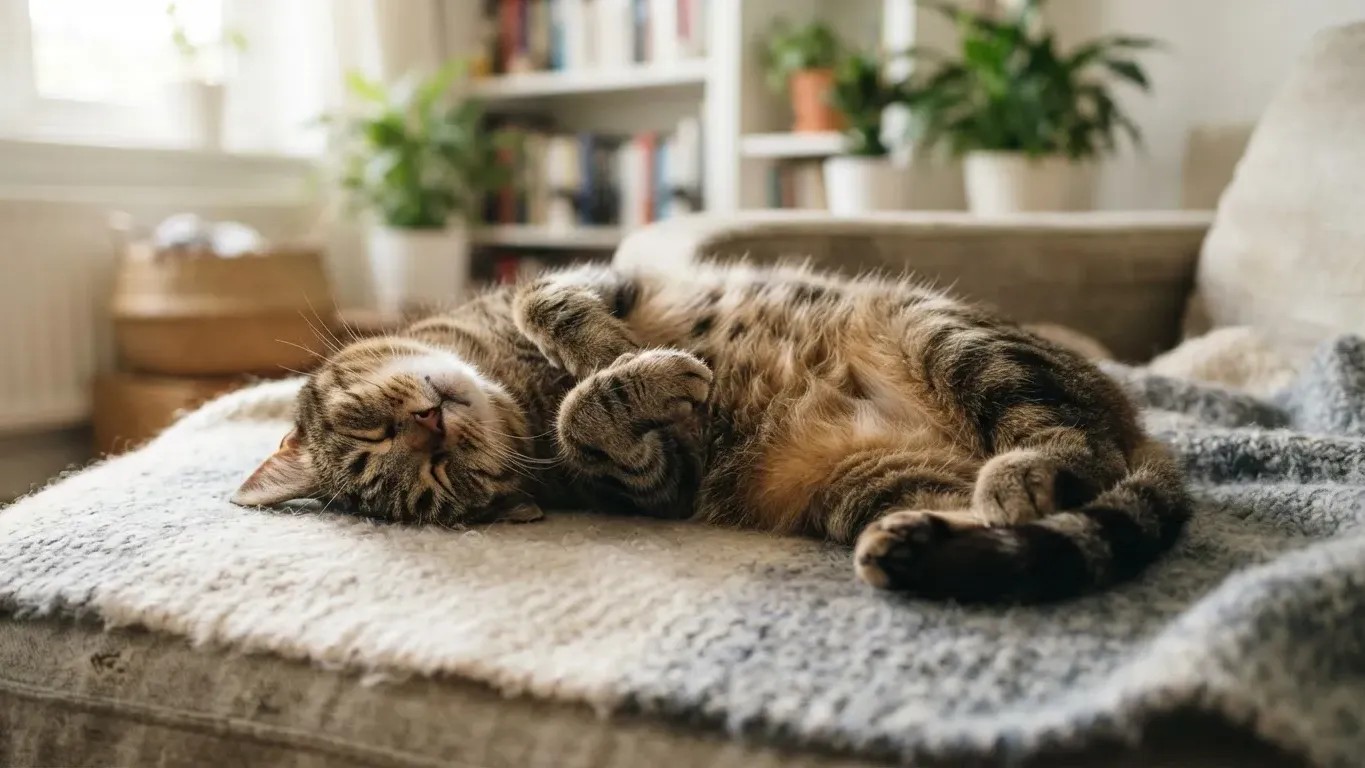
A cat that rolls belly-up while sleeping isn't just cute - it's communicating something profound.
Sleeping with the tummy facing the sky means your cat trusts you and their environment completely. It's an especially vulnerable pose, since a cat's vital organs are left totally unprotected.
Few cats present themselves like this to anyone. When it happens to you, it's a genuine cause for joy - your cat has decided its most vulnerable spot is safe in your presence.
This is arguably the single most powerful trust signal in the entire feline behavioral repertoire. Most cats will never do this around strangers, and some never do it at all.
Wait until you see what #14 reveals about your cat's breathing.
#14 - Their Breathing Slows to Almost Nothing
You have to look carefully to catch this one - and it's worth the wait.
During deep sleep, cats stop purring and go completely quiet. Their breathing slows so much that their body barely moves with each breath.
This is the feline equivalent of a human in dreamless sleep, where the body has fully powered down its defensive systems. A cat's natural instinct is to stay alert for predators, so this kind of stillness only happens when they feel completely safe.
Slow, barely-visible breathing is one of the clearest physiological signals that your cat has fully surrendered to relaxation. If you can watch their sides for thirty seconds and barely detect movement, you're witnessing something rare.
Sign #13 is even harder to catch - but just as telling.
#13 - Their Paws and Whiskers Twitch During Sleep
Those tiny flinches and flickers aren't random - they're actually a sign of the deepest sleep possible.
During REM sleep, a cat's body normally goes into complete muscular relaxation. Occasional nerve signals slip through that paralysis, causing a twitch of a paw or whisker.
Even though the body is still, the brain stays busy processing the day's events. Cats show brain activity patterns similar to humans during this phase, which is why researchers believe cats dream.
Fast Facts
- Adult cats typically sleep 12 to 16 hours every day.
- Roughly 25 percent of that time is spent in true REM sleep, the dreaming stage.
- A cat's REM stretch may last only about 6 minutes at a time, compared to a human's 90 to 120 minutes.
A twitching paw or flickering whisker means your cat is likely dreaming - and only the most relaxed cats ever reach this stage. Next time you see those little flinches, resist the urge to wake them.
Here's where it gets counterintuitive: sign #12.
#12 - They Go Fully Silent (No Purring)
This one surprises most cat owners, because they assume purring means maximum relaxation. Turns out, that's only half the story.
Cats don't purr when they're deeply asleep. Most of their daytime rest is actually light sleep, which conserves energy - and it's only during this lighter state that purring happens.
As a cat drifts between light sleep cycles, the purring is usually soft and intermittent. It stops entirely once the cat shifts into true deep sleep.
When the purring stops completely and your cat goes pin-drop silent, they've crossed from light dozing into genuine deep sleep. That silence is actually louder than any purr.
Sign #11 shows the exact moment sleep takes over.
#11 - They Knead Before Settling, Then Go Limp
Kneading is the wind-down ritual that signals a cat is about to fully commit to sleep.
In almost every case, a cat kneads because it feels safe, bonded, and content. It's a comforting instinct carried over from kittenhood, tied to affection, trust, and pure relaxation.
The cat climbs onto a soft spot, kneads, circles, and curls up. That cozy pre-sleep ritual only happens when a cat feels secure enough to fully let go.
Watch for the moment the kneading slows and the body goes heavy - that's the exact transition point from alert to fully surrendered. It's a privilege to witness it up close.
Sign #10 looks almost too weird to be real.
#10 - They Sleep in Bizarre Contorted Positions
If your cat looks like they've been folded by someone who doesn't understand anatomy, congratulations - that's actually a great sign.
Cats that twist themselves into odd, contorted positions are usually in complete relaxation. It may look uncomfortable, but it signals deep sleep and total physical ease.
Limbs twisted in every direction, head at an impossible angle, and somehow deeply asleep - what looks uncomfortable to us is perfectly natural for them. This kind of sprawl only happens when a cat feels no need to protect itself.
An uncomfortable-looking sleeping position is, counterintuitively, one of the strongest signals of complete safety. A defensive cat never sleeps like this.
Sign #9 is hiding in plain sight - on your cat's ears.
#9 - Their Ears Stay Neutral and Forward (Not Scanning)
Most people never notice this - but a cat's ears tell the whole story.
During light sleep, you might notice your cat's ears twitching in response to noises, one eye cracking open now and then. When those ears go still and settle into a natural, forward-facing position, that's when you know they've truly let go.
Relaxed, forward-facing ears signal comfort and security. A cat whose ears are still rotating like tiny radar dishes is still on duty.
Quick Compare
- Light sleep: ears rotate toward sounds, one eye may crack open, easily startled.
- Deep sleep: ears settle forward and still, eyes stay shut, everyday noise barely registers.
Ear position is one of the fastest ways to distinguish genuine deep rest from a cat that's just pretending to ignore you. Check the ears first, always.
Sign #8 lives in the eyes.
#8 - They Have Half-Closed or Drooping Eyes Before Nodding Off
Those heavy, drooping eyelids right before sleep aren't just adorable - they're loaded with meaning.
Half-closed or drooping eyes convey relaxation and friendliness. When a cat lets its eyelids fall without snapping back to full alertness, nothing in the environment has registered as a threat.
Soft eyes, neutral ears, and a loose body together form the feline trifecta of genuine calm. Most casual observers miss the combination entirely.
A cat that holds drooping eyelids without startling awake has essentially decided you're safe enough to be unconscious around. That's not nothing.
Sign #7 is the one behaviorists love talking about.
#7 - They Give You a Slow Blink Right Before Dropping Off
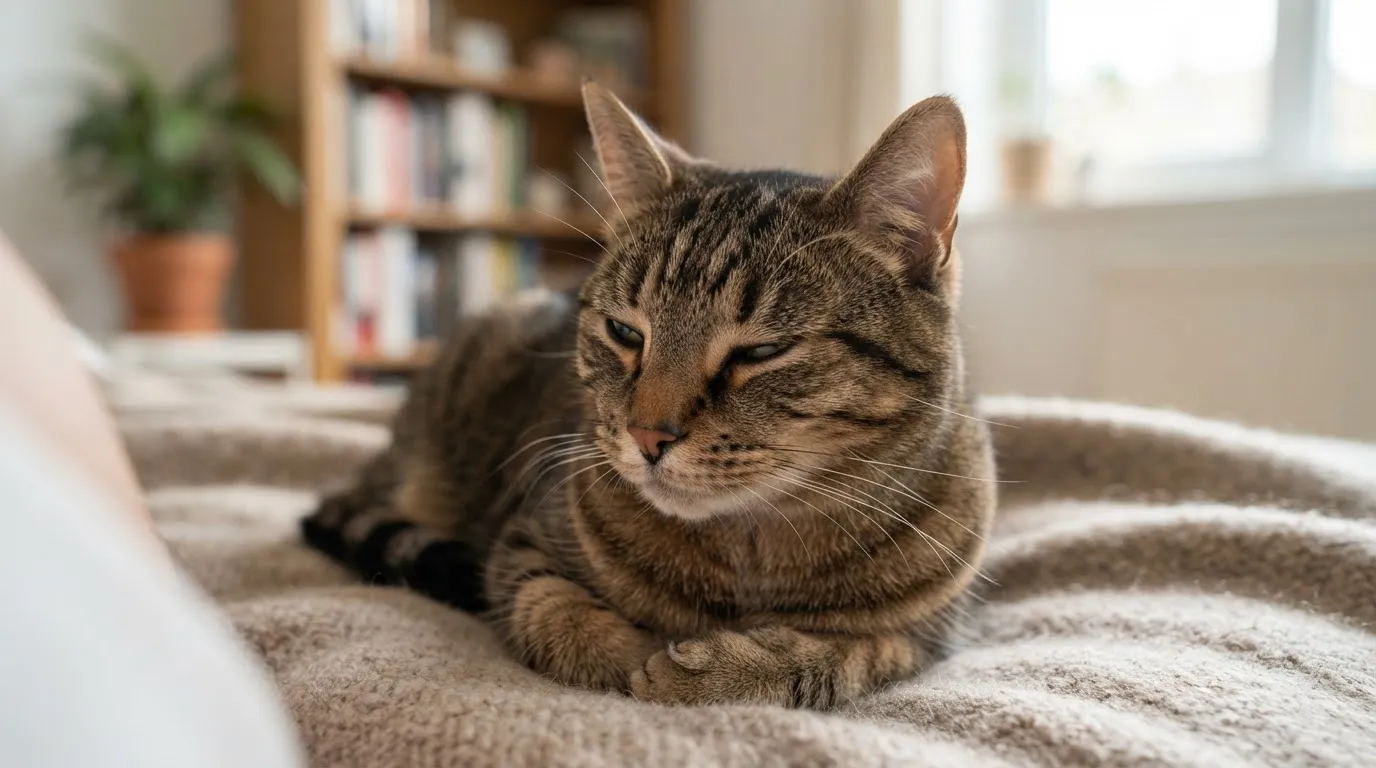
This is the gesture that cat behaviorists get genuinely excited about - and for good reason.
Slow blinking is a sign of trust and relaxation, often called a "cat kiss." Dilated pupils can signal excitement, fear, or pain, while narrowed eyes usually mean irritation.
In the animal kingdom, closing your eyes near another creature is a sign of trust - it means you feel safe enough to let your guard down. The next time your cat gives you a long stare followed by a slow blink, try blinking back.
"It's something that many cat owners had already suspected, so it's exciting to have found evidence for it."
Karen McComb, University of Sussex psychologist
A slow blink directed at you moments before your cat falls asleep is essentially a feline "good night, I trust you completely." And you can return the gesture.
Sign #6 happens right in front of you, and you probably missed it.
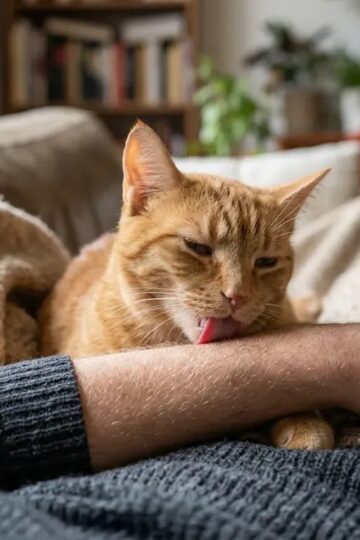
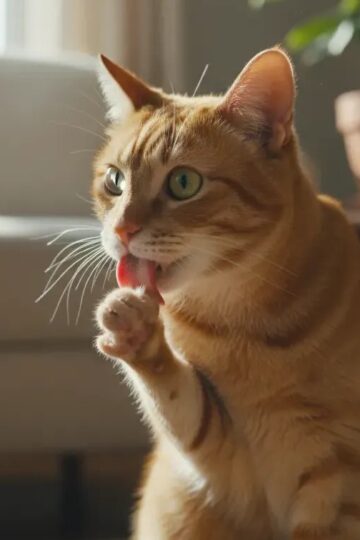
#6 - They Groom Themselves in the Middle of Activity
A cat that pauses to bathe while people are moving around them has genuinely stopped caring about threats.
A comfortable cat starts taking up more space, sleeping in ridiculous positions, and grooming in the middle of family activity. Normal household noise becomes background sound instead of a possible emergency.
Grooming requires a cat to drop all defensive posture, lower its head, and focus entirely inward. That's not a small thing for an animal built to stay alert.
A cat that grooms itself while the TV is blaring or the kids are running around has mentally categorized your home as zero-threat. That level of comfort takes real time to earn.
Sign #5 is about space - literally.
#5 - They Stretch Out and Take Up Way More Space Than Necessary
A tightly curled cat is a cautious cat. A sprawled-out cat is a different story entirely.
Relaxed cats start taking up more room. They sleep on their sides, extend their front paws over their heads, let their back legs trail behind them, or stretch diagonally across a bed clearly designed for humans.
Some sploot with both hind legs straight out behind them. Others twist into positions that make you briefly wonder if cats have the same number of vertebrae as everyone else.
The moment a cat stops conserving space and starts claiming it, they've stopped operating in survival mode. That's the exact opposite of a cat curled tight to protect its organs.
Sign #4 takes trust to a whole new level.
#4 - They Choose to Sleep Directly ON You
This is a step beyond sleeping near you - and the difference matters.
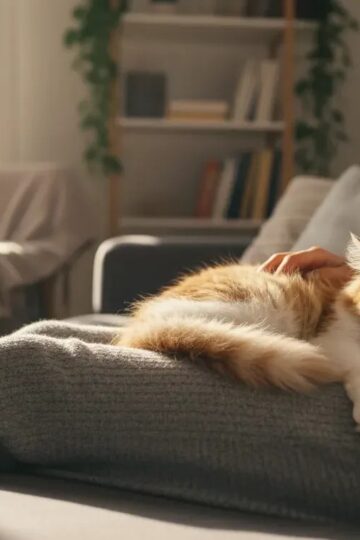
The ultimate compliment is when a cat wants to sleep on you. Being close to you at their most vulnerable is a definite sign you've earned their trust.
A lap-napping cat that enters deep sleep - evidenced by twitching whiskers or paws - is paying you the highest compliment possible. They're betting you'll protect them while they're defenseless.
A cat that falls into twitching REM sleep on your lap has essentially decided you are a safe structure in their world. You're not just tolerated - you're load-bearing.
Sign #3 is the ultimate test of trust.
#3 - They Don't Wake Up When You Move Around Them
Here's the one that truly separates a deeply trusting cat from one that's merely comfortable.
Cats only allow themselves to relax and sleep deeply when they feel safe. If they feel threatened in any way, they'll keep half an eye on the world around them, just in case.
A cat that stays asleep while you walk past, open a cabinet, or change the TV volume has mentally filtered your presence out of the "possible danger" category entirely. Constant awareness is part of being a cat, which is exactly why real relaxation is so rare to see.
When your daily movements register as background noise rather than a potential threat, your cat has reached the deepest level of environmental trust possible. Most cats take months, even years, to reach this point with a new owner.
Sign #2 feels rude. It isn't.
#2 - They Sleep With Their Back to You (And Don't Care)
Most people find this one rude. Experts say it's the opposite.
Sitting near you but facing away is actually a sign a cat likes you. When a cat turns its back on you to sleep, it's not dismissing you - it's assigning you a role.
You've become the part of the room that requires no monitoring. They've decided the direction you're in is already covered, safe by default.
A cat that sleeps facing away from you has promoted you from "person in the room" to "trusted guardian." Don't take the cold shoulder personally. Take it as a compliment.
And #1 is the rarest sign of all.
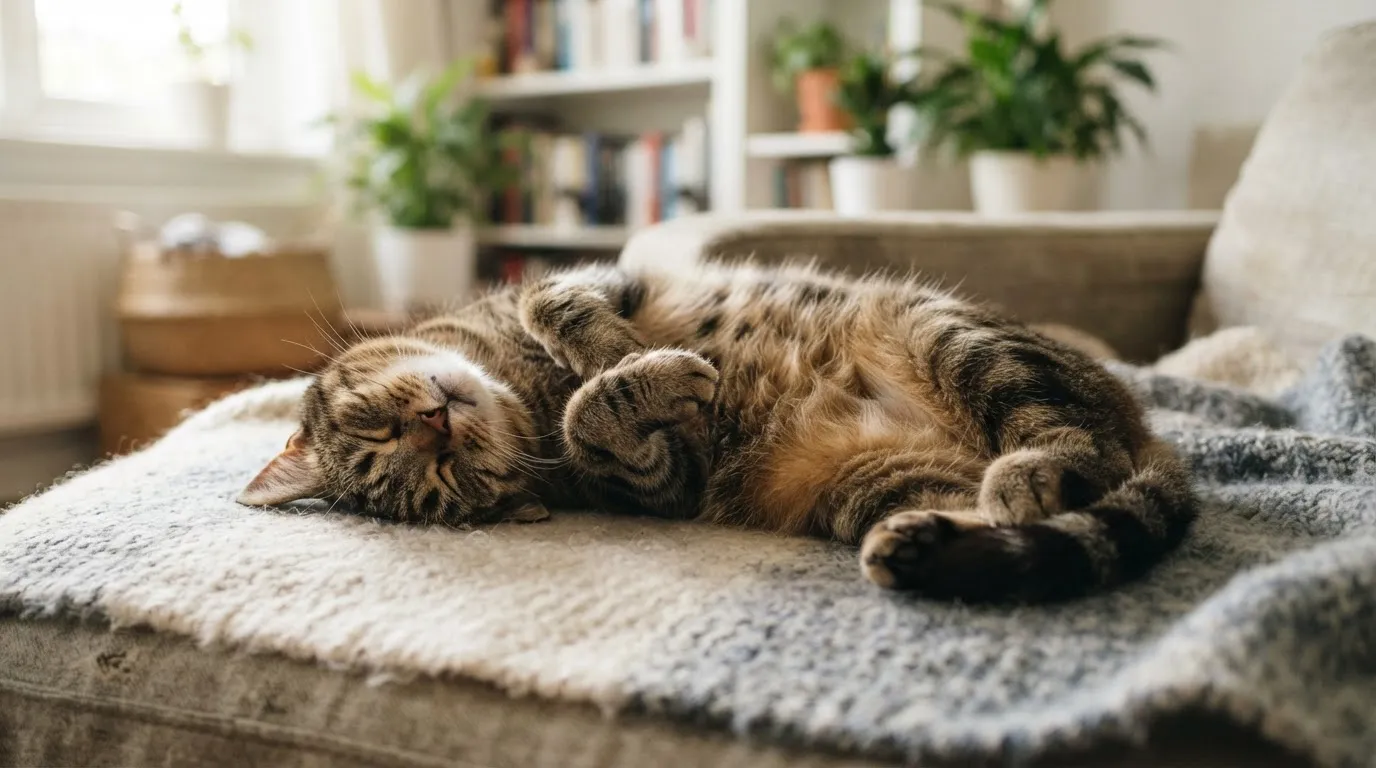
#1 - They Fall Asleep on Their Back, Belly Fully Exposed, and Don't Flinch at Anything
This is the holy grail. Most cat owners never see it, and if yours does this regularly, you've achieved something genuinely rare.
Belly-up sleeping means feeling safe, relaxed, and deeply bonded with the space and humans around them. It's common in cats with predictable routines and calm environments.
Few cats present themselves like this to anyone. Showing the belly - the single most vulnerable spot on their body - tells you they feel completely, unshakably safe with you.
Why It Stands Out
- Belly exposed - the single most vulnerable pose a cat can offer.
- No flinching at noise, movement, or light in the room.
- Loose limbs paired with slow, steady breathing.
- Shows up only with consistent routines and calm surroundings.
A cat sleeping belly-up, unresponsive to normal household noise, with loose limbs and twitching paws, is in the deepest possible sleep - and has decided, with full feline conviction, that you are the safest thing in their world. That didn't happen by accident. You earned it.
The Bottom Line
Most people think a sleeping cat is just a sleeping cat. Turns out, every position, every ear angle, and every twitch tells a detailed story about how safe your cat actually feels.
The real signs - belly-up sleeping, REM twitching, going fully silent, sleeping through your noise - are rare, and they take time and consistency to earn. A cat that sleeps through anything you do hasn't gotten lazy.
It's decided, after careful evaluation, that you're worth trusting completely. That's the highest review a cat will ever give you.
Did your cat make the list - or do they have a relaxation habit we missed? Drop it in the comments.