Humanity’s quest to understand its cosmic beginnings just took a remarkable leap forward. Scientists analyzing a pristine rock sample returned from the asteroid Bennu have detected a molecule typically associated with human well-being — an essential amino acid linked to the production of serotonin — offering tantalizing clues about the chemistry that may have seeded life on Earth.
The discovery comes from NASA’s OSIRIS-REx mission, a groundbreaking effort that collected and returned fragments of the carbon-rich asteroid Bennu to Earth’s laboratories. While Bennu is a small, rocky body hurtling through space, its molecular contents might hold answers to one of science’s oldest questions: how life’s building blocks formed in the early solar system.
A Rare Cosmic Find: Tryptophan Appears in Space Rocks
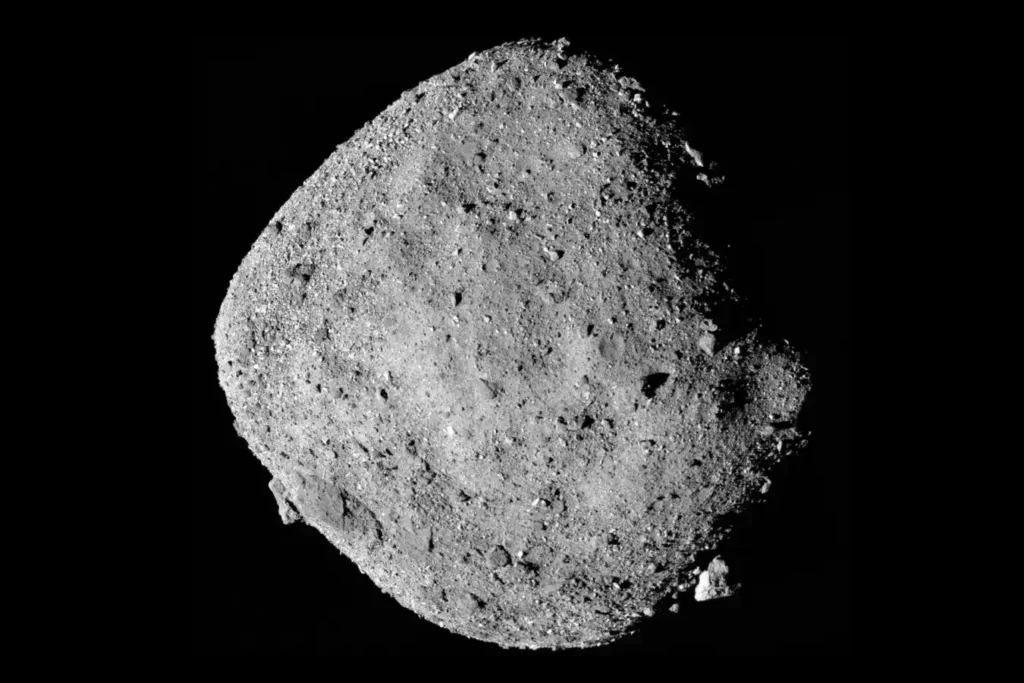
In a development that has captured international scientific attention, researchers have identified tryptophan — one of the 20 amino acids critical to life as we know it — inside the Bennu sample. On Earth, tryptophan is essential in human diets and plays a central role in producing the neurotransmitter serotonin, which influences mood and well-being.
This marks the first time this particular amino acid has been confirmed in material from beyond our planet, providing more evidence that asteroids may carry a complex mix of organic molecules. Tryptophan’s presence suggests that asteroids could have served not just as simple carriers of matter, but as chemical laboratories where life’s ingredients were mixed long before Earth formed.
The Bennu samples analyzed so far also contain a diverse suite of other organics, including molecules crucial to life’s chemistry, such as sugars and compounds that form proteins and genetic materials. These findings are reshaping how scientists think about where and how the essential constituents of life formed.
How Bennu’s Sample Was Collected: A Decade-Long Mission
The story begins with NASA’s OSIRIS-REx spacecraft, launched in 2016 with the goal of visiting a near-Earth asteroid and returning a sample to Earth. After reaching Bennu in 2018, the spacecraft painstakingly mapped and studied the asteroid’s surface before collecting dust and rock in 2020. In a dramatic return, the sample capsule landed safely in the Utah desert in 2023, delivering about 121 grams of pristine asteroid material for study.
Why Bennu? Scientists selected this small, primitive asteroid precisely because it is believed to have undisturbed material from the early solar system, dating back over 4.5 billion years. Its composition — rich in carbon and other elements — makes it a natural archive of the ingredients that later gave rise to planets and life. Early analyses confirmed water-bearing minerals, carbon chains, and a range of organic compounds.
The discovery of tryptophan builds on previous work showing that Bennu contains 14 of the 20 amino acids used by Earth’s lifeforms, alongside all five nucleobases (the molecular letters of DNA and RNA), and bio-essential sugars like ribose and glucose. This suite of molecules paints a picture of an asteroid rich in chemical potential long before Earth had oceans or an atmosphere.
The Science of Prebiotic Chemistry in Space
The presence of amino acids in extraterrestrial material is not entirely new — scientists have found such molecules in meteorites before — but the Bennett discovery stands out for its clean, uncontaminated sample and the diversity of its organic compounds. Because Bennu’s sample was collected and sealed in space before ever reaching Earth, researchers are confident these molecules are truly cosmic in origin.
Tryptophan is particularly intriguing because it is more complex than many other amino acids previously found in space rocks. Its formation typically requires multiple chemical steps that are not easily achieved without catalysts or solvents like water. Bennu’s molecular inventory also includes minerals that suggest it was once part of a larger body that interacted with water long ago, hinting at a once-wet environment capable of sophisticated chemistry.
Taken together with the detection of sugars and phosphate compounds — vital to DNA and RNA — these findings support a scenario in which the early solar system was a cosmic playground for prebiotic chemistry, setting the stage for life even before Earth’s formation.
Implications for the Origins of Life on Earth
These discoveries feed into a long-standing scientific debate: Did Earth’s life begin here, or was it seeded from space? The idea that asteroids and comets may have delivered life’s precursors to the early Earth — known as the panspermia hypothesis — has gained traction partly on the strength of findings like those from Bennu.
Finding tryptophan and other complex organics in Bennu’s sample suggests that Earth was not unique in its chemical richness; similar materials likely fell on other planetary bodies, potentially priming many worlds for life. Beyond Earth, this bolsters the possibility that life’s building blocks are widespread throughout the solar system and possibly the broader universe.
While detecting these molecules does not mean Bennu ever harbored life, it does underscore how rich and common the ingredients of biology might be in space — a key insight as scientists prepare to explore Mars, icy moons like Europa and Enceladus, and exoplanets beyond our solar system.
Next Steps in Asteroid Research and Beyond
The analysis of Bennu’s sample is far from complete. Scientists around the world are using advanced instruments to tease apart the sample’s nuances, searching for ever more subtle clues about early solar system chemistry. Each new discovery adds another piece to the puzzle of how simple molecules assembled into the precursors of life.
Future missions will build on Bennu’s legacy. NASA’s OSIRIS-APEX — the renamed continuation of OSIRIS-REx — is now headed toward the asteroid Apophis for further study, while other sample-return missions, including those targeting Mars and other celestial bodies, promise to deepen our understanding of prebiotic chemistry across the solar system.
As researchers continue to decode the Bennu treasure trove, each finding brings us closer to answering fundamental questions about who we are and where we come from — questions that have captivated humanity for generations.
NASA’s analysis of the Bennu asteroid sample has unveiled more than just space dust: it has revealed complex organic molecules, including the amino acid tryptophan, that connect cosmic chemistry with the genesis of life on Earth. These findings suggest that the raw materials for biology were not unique to our planet but were available throughout the early solar system. As scientists probe deeper into this extraterrestrial archive, our understanding of life’s origins — both on Earth and potentially elsewhere — is poised for remarkable expansion
Kristina is a young writer from India. An arts graduate and an avid content creator, Kristina is passionate about animals and wildlife. She enjoys exploring topics related to pet care, animal behavior, conservation, and nature, combining thorough research with engaging storytelling.