There are stories that stop you in your tracks. Stories so raw, so quietly devastating, that they say more about loyalty, love, and loss than most human dramas ever could. This is one of those stories. Two cats, abandoned in the snow by the people who were supposed to protect them, facing temperatures so brutal that survival was never guaranteed. One didn’t make it. The other refused to leave.
What happened in Fulton County, Illinois in early 2025 is now capturing hearts across the internet. A female cat named Elizabeth, left behind in the freezing cold, stayed by the side of her male companion long after there was nothing left she could do. It’s the kind of devotion that makes you question everything. Let’s dive in.
Abandoned in the Snow: What Happened in Fulton County
A neighbor noticed that two cats had been left behind in the snow after people moved out of their home in January, in Fulton County, Illinois. No arrangements had been made. No shelter, no food, no second thought. Just two cats left alone in one of the cruelest winters in recent memory.
The exact length of time the cats were left outside remains unknown. What is known is that conditions were brutal, with snow on the ground and temperatures hovering around five degrees Fahrenheit. The male cat was eventually found frozen solid to the ground, having passed away before help could arrive.
The survivor, Elizabeth, never left his side. She stayed right next to her companion despite the life-threatening cold. Honestly, it’s hard to read that without feeling something break a little inside. A small animal, in conditions that would challenge a human, choosing presence over survival instinct.
Elizabeth’s Journey to Safety
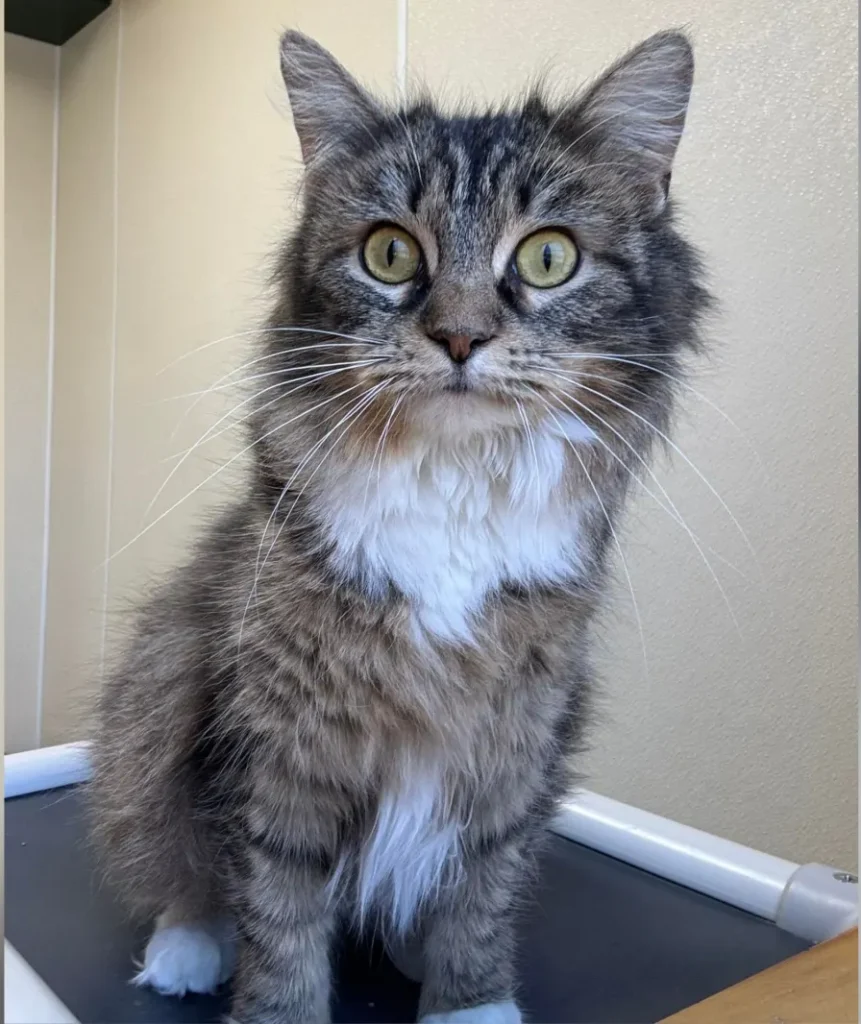
The female cat was brought to animal control in Fulton County, Illinois. From there, after staying with animal control, Elizabeth was transferred to TAPS, the Tazewell Animal Protective Society, on February 8.
TAPS is a no-kill animal shelter that provides a home for dogs, cats, puppies, and kittens until permanent homes can be found, located in Pekin, Illinois, just outside of Peoria in the Central Illinois area. It’s exactly the kind of place Elizabeth needed after everything she had endured. Warmth. Safety. People who would actually stay.
Her story, and her bright green eyes, instantly captured hearts, along with a wave of prospective adopters. The response online was enormous. People from across the country wanted to give Elizabeth the forever home she deserved. That kind of reaction tells you everything about how deeply this story resonated.
The Science Behind Feline Loyalty and Grief
Here’s the thing. People often assume cats are cold, emotionally distant creatures. Aloof. Self-serving. That assumption gets demolished pretty quickly by what Elizabeth did. Science, it turns out, has been catching up with what many cat owners already suspected.
Researchers from Oakland University set out to answer whether cats grieve by surveying hundreds of cat owners about their cat’s behavior after another cat or dog in the household passed away. The data showed that cats exhibited behaviors associated with grief, such as eating and playing less, more often after the death of a fellow pet.
Cats showed similar grief-related changes in behavior compared to dogs in previous studies. Cats with closer relationships to a deceased companion reacted more strongly. That last point is worth pausing on. The stronger the bond, the deeper the reaction. Elizabeth and her companion had only each other in those final hours. Their bond could not have been stronger.
Research confirms this is only the second known exploration of domestic cats’ responses to the death of another companion animal, and it reveals that cats exhibit similar grief-like behavioral changes following such deaths compared to dogs. Specifically, they engaged less in sleeping, eating, and playing but more in seeking attention from humans and other pets, hiding, and appearing to look for their lost companions.
The Cold Reality of Pet Abandonment in Winter
Elizabeth’s story is heartbreaking. It is also far from unique, and that might be the most uncomfortable truth here. Thousands of pets are abandoned every winter in the United States, and the consequences are often fatal.
Animal welfare experts warn that freezing temperatures can quickly become life-threatening for abandoned pets, putting them at risk of hypothermia and frostbite. Cats, despite their reputation for toughness, are not equipped to withstand temperatures near zero for extended periods, especially without food and shelter.
According to a running list compiled by People for the Ethical Treatment of Animals, based on media reports, roughly 86 companion animals died this past winter, with an additional nearly 1,000 needing rescue. Those are not just statistics. Each number represents an animal that had a name, a personality, a bond with someone. It’s a staggering scale of preventable tragedy.
The Humane World for Animals, formerly called the Humane Society of the United States, advises that if you find an animal outside in extreme cold, you should speak up, report the scene, and contact local animal control or a nearby shelter. If you know the owner, consider politely raising your concern, as some may genuinely not understand the dangers cold weather poses to pets.
Public Outrage and an Outpouring of Love
When TAPS shared Elizabeth’s story on social media in February 2025, the response was immediate and overwhelming. People were moved, furious, and deeply empathetic all at once. Let’s be real, when a story like this hits social media, it cuts through all the noise in a way very few things can.
The comments poured in from people who wanted to adopt Elizabeth, donate to the shelter, or simply express their shock at what had happened. TAPS operates as an independent, local, non-profit organization working to serve homeless dogs and cats, providing life-changing services for homeless pets every single day. For a small shelter, the sudden wave of national attention was extraordinary.
The reaction also speaks to something deeper in how people relate to animal loyalty. There is something about the image of a small cat staying beside a frozen friend, in sub-zero temperatures, that strips away every cynical thought and replaces it with pure awe. It is the kind of loyalty that most of us can only aspire to.
What Elizabeth’s Story Reveals About How We Treat Pets
Cats have feelings. Yet some people treat them as disposable objects, keeping them only as long as they find them convenient, and leaving helpless animals behind when circumstances change. Moving house is one of the most common reasons owners abandon their pets, and it is one of the least defensible.
In most cases, people simply need to look harder for pet-friendly housing options. It is becoming more common for rentals to allow pets, and as a pet owner, it is your responsibility to search as thoroughly as possible. The idea that abandoning a pet in freezing temperatures is somehow an acceptable solution to a housing problem is, to put it plainly, indefensible.
Research shows that cats are far more social and emotionally connected to their owners than previously thought, with studies indicating that roughly nearly two thirds of cats demonstrate secure attachment to their caregivers. These are not decorations. They are sentient creatures with emotional lives, social bonds, and the capacity to suffer deeply when those bonds are severed without warning.
A Small Cat, an Enormous Lesson
Elizabeth survived. She is warm now, safe, and surrounded by people who recognize her worth. The shelter that took her in gave her a second chance, and the world responded with open arms and open homes. That part of the story is beautiful.
The part that stays with you, though, is the image of a little cat in the snow, in five-degree weather, refusing to move. Not because she didn’t understand the danger. Perhaps precisely because she did. She chose to stay anyway. When animals are closely bonded, they are more likely to be deeply affected by the loss of their companion. Elizabeth showed the world what that bond really looks like.
We build walls around the idea of animal emotion because it is easier that way. Easier to justify, easier to walk away from. Elizabeth dismantled every one of those walls in a single frozen Illinois morning. The question that lingers isn’t really about cats. It’s about us. What does it say about the humans who left, and what does it say about the cat who stayed?
What do you think about Elizabeth’s story? Share your thoughts in the comments below.
Kristina is a young writer from India. An arts graduate and an avid content creator, Kristina is passionate about animals and wildlife. She enjoys exploring topics related to pet care, animal behavior, conservation, and nature, combining thorough research with engaging storytelling.