Most people think their cat is simply ignoring them. You call out across the room, the cat barely twitches an ear, and you assume nothing registered. Here’s the thing though – your cat almost certainly heard you. In fact, your cat heard you with a level of detail and precision that honestly makes human hearing look like a rough draft.
The world a cat inhabits is sonically richer, sharper, and more layered than the one you experience every day. They’re not just receiving sound. They’re decoding it, filing it, and making constant decisions based on it. What you’re about to discover may change how you look at that furry creature sitting quietly in the corner. So let’s dive in.
An Extraordinary Frequency Range That Leaves Humans Behind
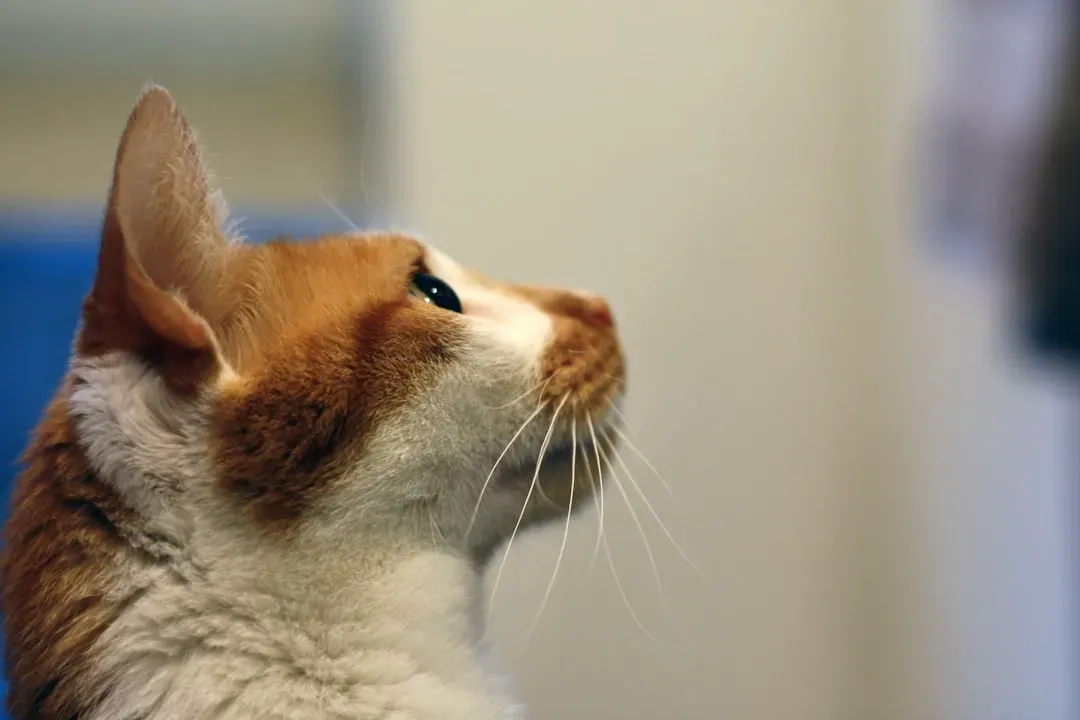
Stop and think about the last time you marveled at your cat staring at an empty wall. There’s a very real chance it was reacting to a sound you couldn’t begin to register. Cats have a frequency range of 48 Hz to as high as 85,000 Hz, which means they can hear both lower and much higher frequencies than you can. Your hearing, by comparison, tops out around 20,000 Hz. That gap is enormous.
While you can hear sounds within a range of about 8.5 octaves, your cat hears across 10.5 octaves, and due to the mobility of their ears, cats can localize the source of sound easily – giving them the broadest range of hearing among all mammals. Think about that for a second. Among all mammals. Not just better than you or the family dog. Among all of them.
The Mechanical Marvel of the Cat Ear
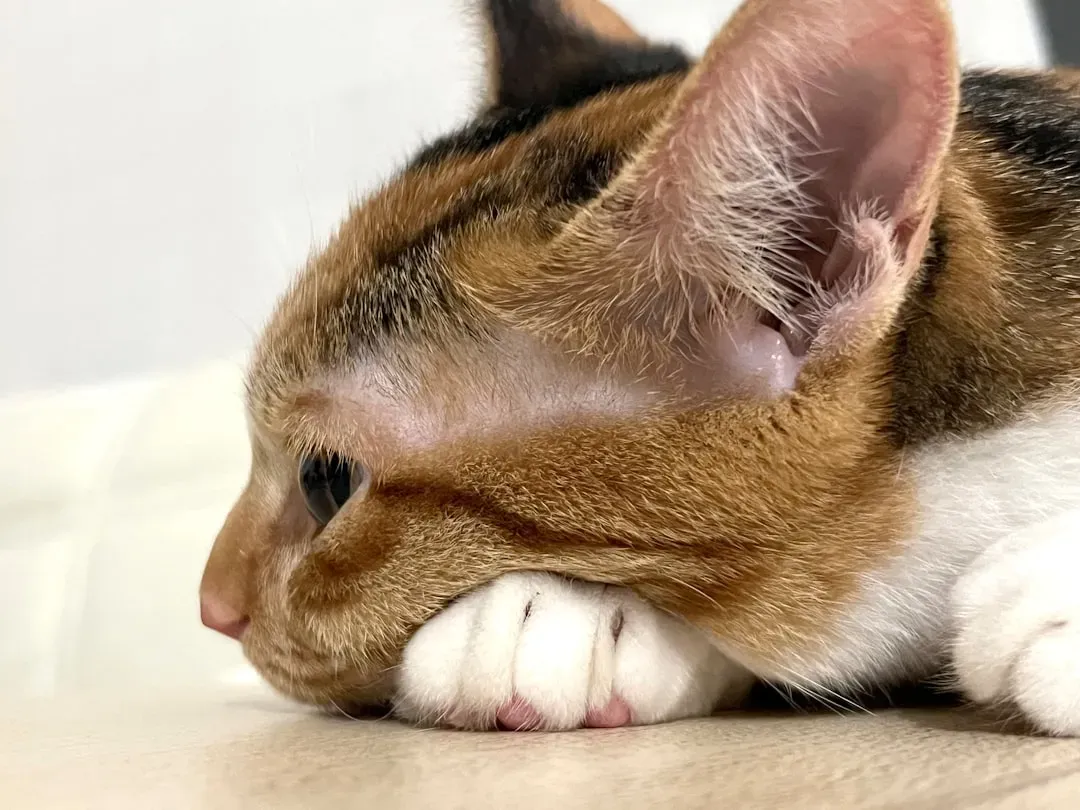
If you’ve ever studied a cat’s ear up close, you might have noticed its striking cone shape. That shape isn’t random at all. The most visible portion of a cat’s ear is the external ear, called the pinna. It is large, upright, and cone-shaped, acting to both catch and amplify sound waves, and a cat’s ear can amplify sound waves two to three times for frequencies between 2 and 6 kHz.
Unlike other mammals whose middle ear has a single chamber, the cat’s middle ear has two. This increases the range of frequencies over which the eardrum can vibrate, giving the cat one of the widest frequency ranges of hearing. It’s a bit like comparing a basic radio antenna to a professional satellite dish. The engineering inside that little ear is genuinely sophisticated.
Swiveling Ears: Your Cat’s Built-In Radar System
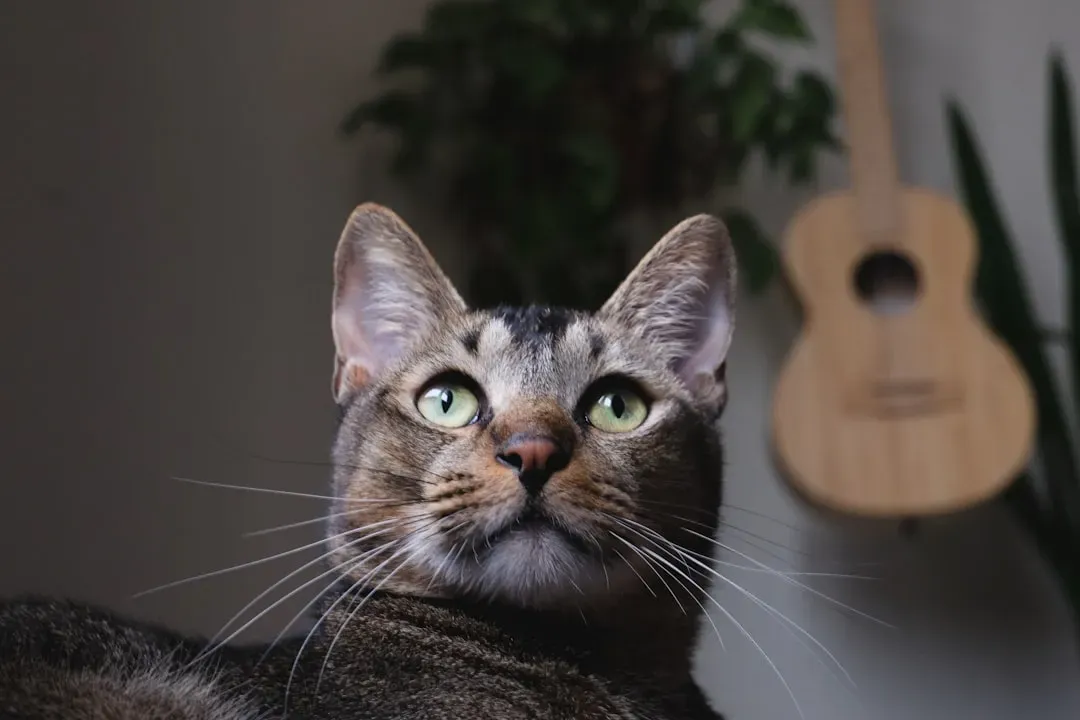
Here’s something that’ll make you look at your cat differently. Those ears don’t just sit there. Cats can move their ears up to 180 degrees, helped by 32 muscles in their outer ears, compared to the six muscles humans have, and this allows cats to pinpoint sounds. Thirty-two muscles. For their ears alone. You have six.
The pinnae actually cause changes to a sound as it passes to the ear canal, and your cat’s brain uses those changes to determine how far away the sound is and whether it’s coming from above or below. So when your cat tilts its head at a curious angle, it isn’t being dramatic. It’s recalibrating its personal tracking system in real time.
Pinpoint Precision: How Your Cat Locates Sound
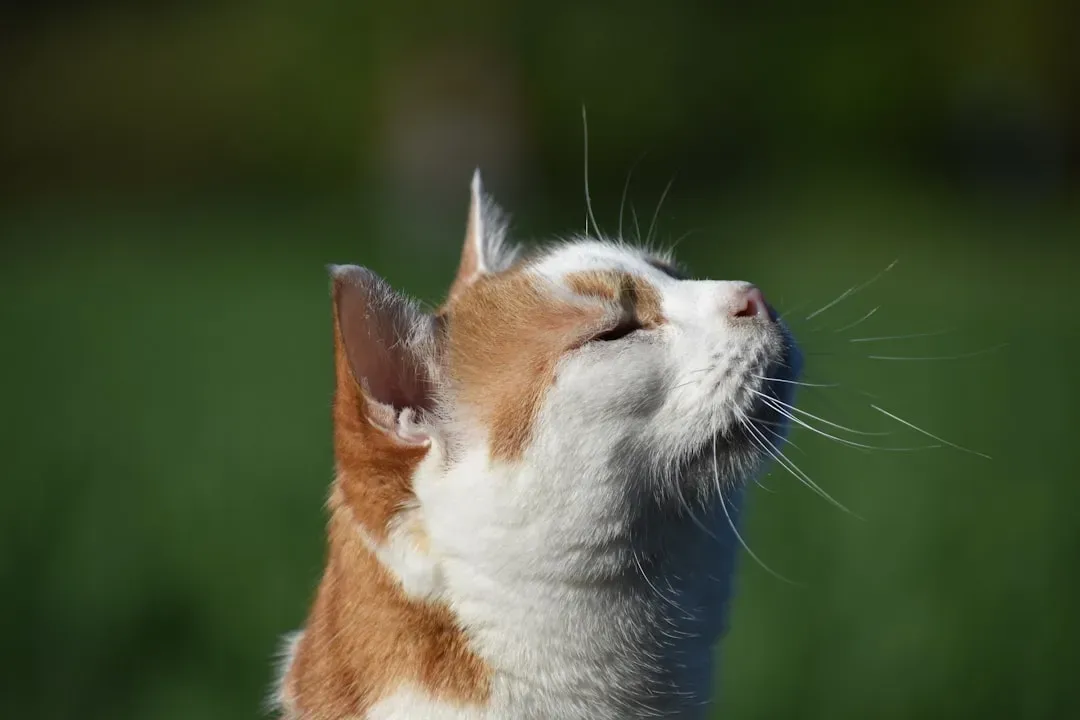
You might be able to tell that a sound is coming from your left or right. Your cat, however, is operating on an entirely different level of spatial awareness. Cats can distinguish between sounds that are just 3 inches apart from a distance of 3 feet, and they can do this in less than 0.06 seconds. This precise directional hearing ability helps them pinpoint the exact location of sounds in their environment.
Your cat can hear sounds from approximately four to five times farther away than you can. Under optimal conditions, they can detect subtle sounds, like the movement of small prey, from up to 100 feet away, which gives them a significant advantage both as predators and in detecting potential threats. Honestly, it’s a bit humbling when you put it that way.
Ultrasonic Hearing and the Hunting Advantage
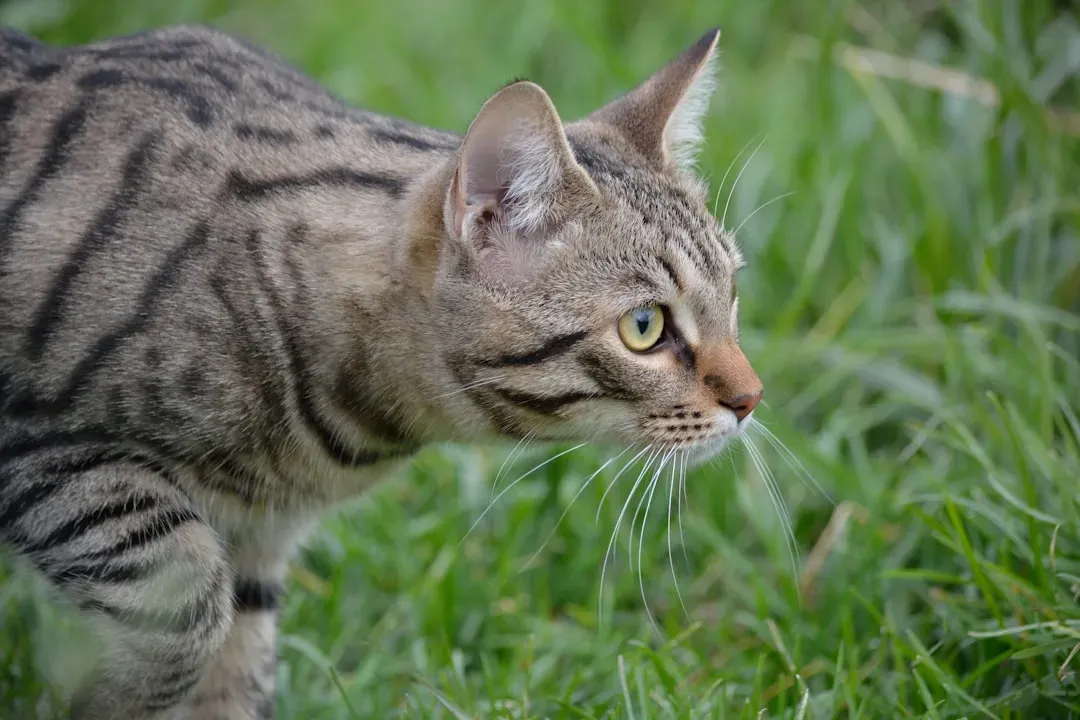
Your domestic cat may look like a sleepy sofa ornament, but underneath that comfortable exterior lives a precision predator. Cats rely on acute hearing as an important part of their hunting. Unlike canines and ancient humans, they don’t tend to chase prey over long distances. Instead, they wait and listen for prey nearby, listening out for sounds like rustling beneath leaves, waiting for the opportune moment to pounce.
Your cat’s hearing range has a particularly important function in nature. Many of the species preyed upon by cats are rodents which rely on ultrasonic sounds to interact with each other. Cats can hear these sounds over a wide distance and can thereby identify where their prey is located. In other words, when your cat is apparently doing nothing, it might be tracking an entire rodent conversation happening inside your walls. I know it sounds a little wild, but it’s completely true.
How Your Cat’s Brain Decodes Sound
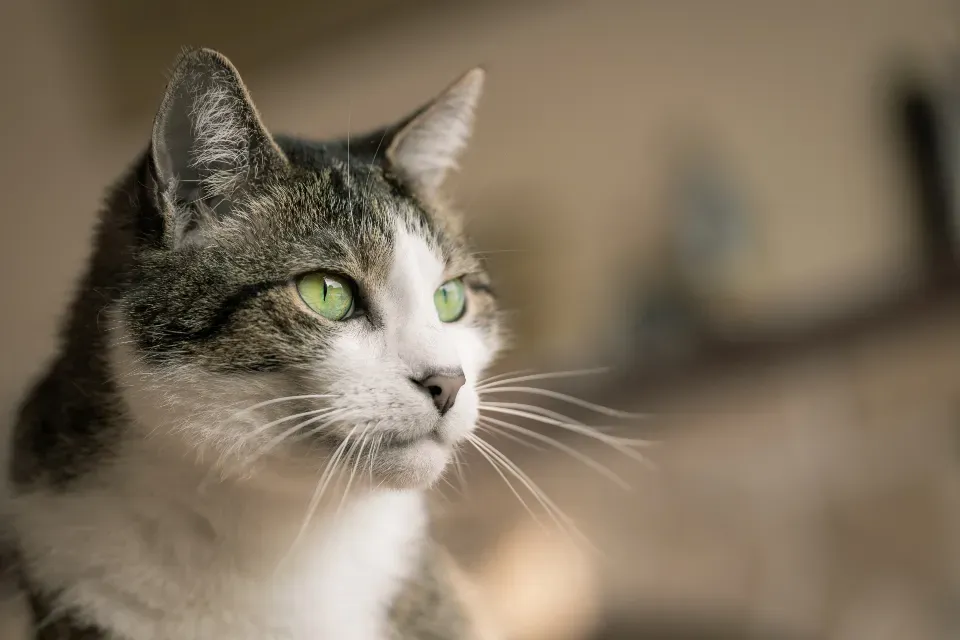
The ears are only one part of the picture. The real magic happens deeper, inside the brain. Sound is recorded in the firing pattern of neurons in the auditory cortex, which is the part of the brain that processes electrical signals generated in the inner ear. Research conducted at the University of Michigan even used cats as models to study how brains process and spatially locate sounds, revealing that cats and humans share remarkably similar auditory cortex processing strategies.
Your cat’s cochlea has 40,000 nerve fibers transmitting sound from the ear to the brain, which is roughly a quarter more than in humans. More nerve fibers means more sound information flowing into the brain at any given moment. Additionally, cats can detect the tiniest variances in sound, distinguishing differences as little as one-tenth of a tone, and this helps them identify the type and size of the prey producing the noise. That level of detail is simply remarkable.
Your Voice Through Your Cat’s Ears

You probably talk to your cat. Don’t be embarrassed – most cat owners do, and there’s actually good reason to believe it matters. A study found that cats may change their behavior when they hear their owner’s voice talking in a tone directed to them, but not when hearing the voice of a stranger or their owner’s voice directed at another person. The study adds to evidence that cats may form strong bonds with their owner.
While cats may respond to certain tones, familiarity is often the most powerful factor. Your cat learns your voice over time and associates it with daily routines like meals, playtime, and comfort. That is why many cats will perk up when their favorite human speaks, even from another room. Your cat doesn’t understand your words the way another human might, but it absolutely registers your tone, your emotional pitch, and your intent. Cats likely don’t understand human language in the way we do, but they are excellent at picking up on intonation, pacing, and emotional tone.
The Language of Meows and Cat Vocalizations
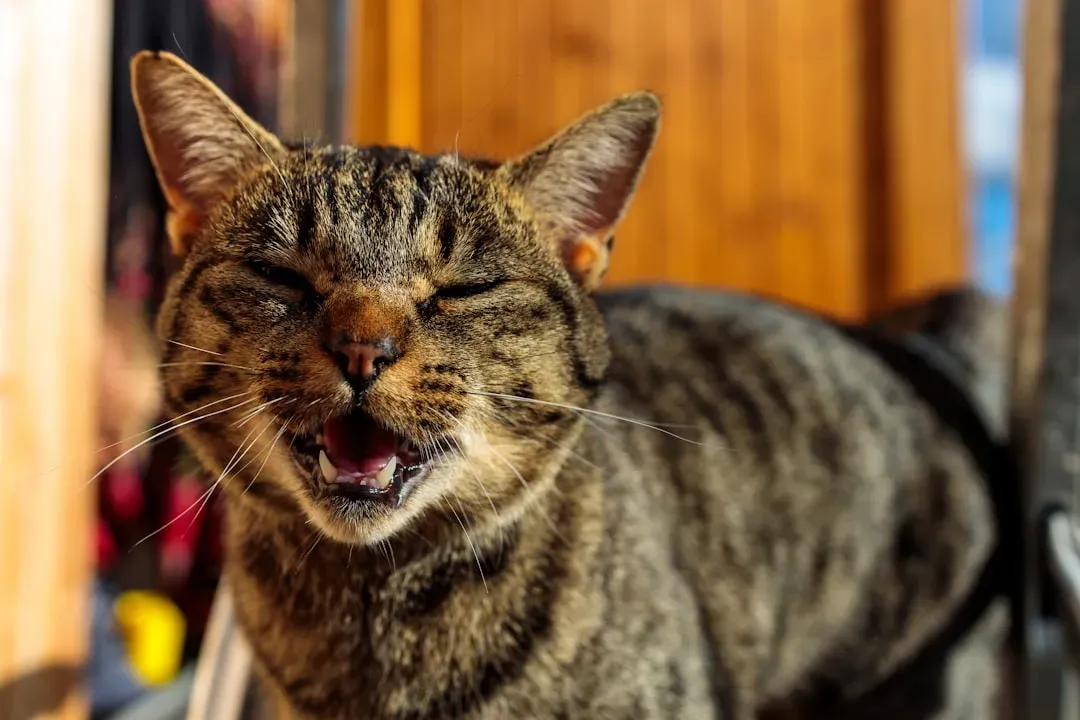
Cats are more conversational than most people realize, and the sounds they make are far more deliberate than random noise. Up to 21 different cat vocalizations have been observed. Each one serves a purpose. Each one communicates something specific, whether to you, to another cat, or to a potential meal they spotted through the window. Vocalizations are a good tool to express internal state and emotions, with a tight integration with brain centers of emotional control, making vocalization a useful emotional scale for veterinarians and cat owners.
Adult cats rarely meow to each other, and so adult meowing to human beings is likely to be a post-domestication extension of mewing by kittens. Let that sink in. Your cat essentially kept its kitten voice just to communicate with you. It developed a language specifically tailored to its relationship with humans, which is, in my opinion, one of the most extraordinary facts about domestic cats. Cats adapt their vocalizing behavior specifically to humans, vocalizing more to them than to other cats, and varying their voice to get humans to do something for them.
Sound, Stress, and Your Cat’s Emotional World

Because your cat hears so much more than you do, the soundscape of your home affects it far more deeply than you might expect. Cats can hear frequencies ranging from about 48 Hz up to 64 to 85 kHz, far beyond the upper range of human hearing, which means many high-pitched or electronic sounds are louder, sharper, and more intense for cats than for people. Your blender, your smoke alarm, your phone ringtone – all of these register very differently for your cat.
Cats listening to music in their homes prefer music that was specially made with cat vocalizations, with preferred tempos and with normal vocal frequencies as the primary considerations. Cats responded to music positively by orienting and approaching speakers playing cat music more often and quicker than to speakers playing classical music. Research published in scientific journals has confirmed that listening to cat-specific music prior to and during physical examination was associated with lower stress scores and lower handling scores in cats, and cat-specific music may benefit cats by decreasing stress levels and increasing quality of care in veterinary clinical settings. So if you’ve ever wondered whether playing music for your cat matters, science says it actually does.
Conclusion
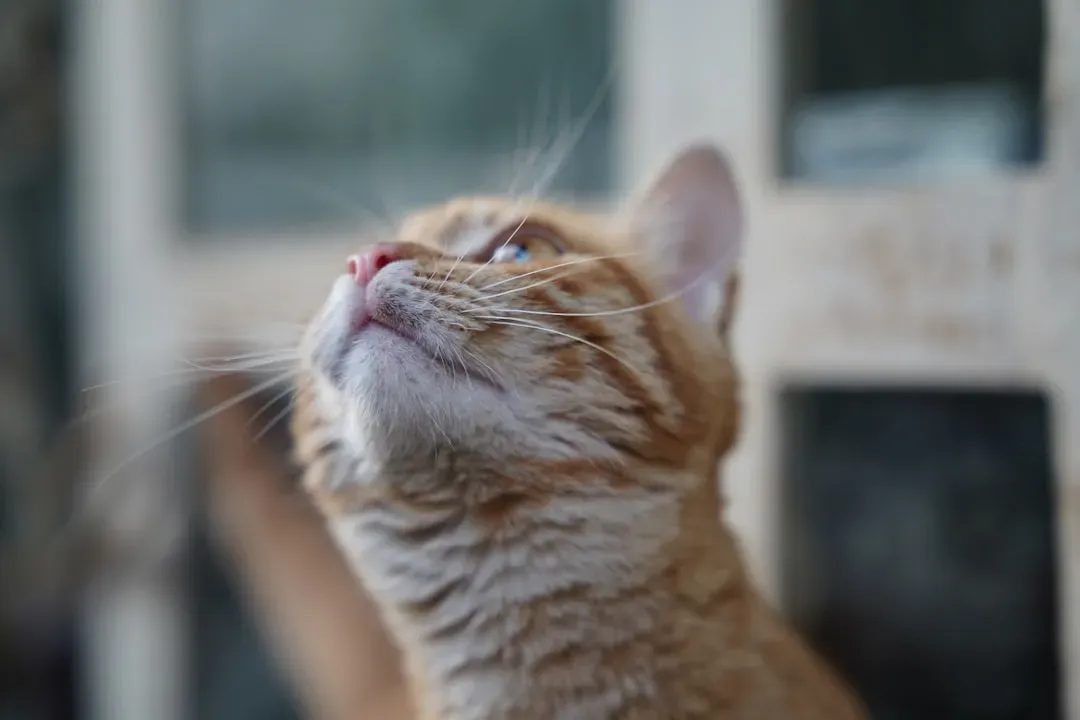
Your cat is not living in the same world you are. Sonically speaking, it occupies a richer, sharper, more textured reality – one where every creak in the walls, every ultrasonic hum from your television, and every subtle shift in your vocal tone carries real meaning. Understanding this changes everything about how you should think about your relationship with your cat.
The next time you watch your cat freeze mid-step, ears rotating like small satellite dishes, remember that it’s not spacing out. It’s listening to things you will never hear, processing information at a speed and precision that no human auditory system can match. The world, for your cat, is alive with sound. And your cat is fluent in all of it.
What would you have guessed was the most surprising thing about how your cat hears the world? Tell us in the comments – we’d genuinely love to know.
Kristina is a young writer from India. An arts graduate and an avid content creator, Kristina is passionate about animals and wildlife. She enjoys exploring topics related to pet care, animal behavior, conservation, and nature, combining thorough research with engaging storytelling.