There is something quietly astonishing about the moment a frightened shelter animal decides, out of nowhere, that you are the one. No paperwork, no interview, no reference check. Just a pair of eyes locking onto yours and a small, trembling body going completely still in your arms. It sounds like something out of a movie, honestly. Yet for one Australian woman, it happened exactly that way, right in the middle of a regular shelter visit, and the internet has not quite recovered since.
This is the story of a shy little kitten, a spontaneous connection, and what science says about why these moments are far more real than they might seem. Let’s dive in.
The Visit That Changed Everything
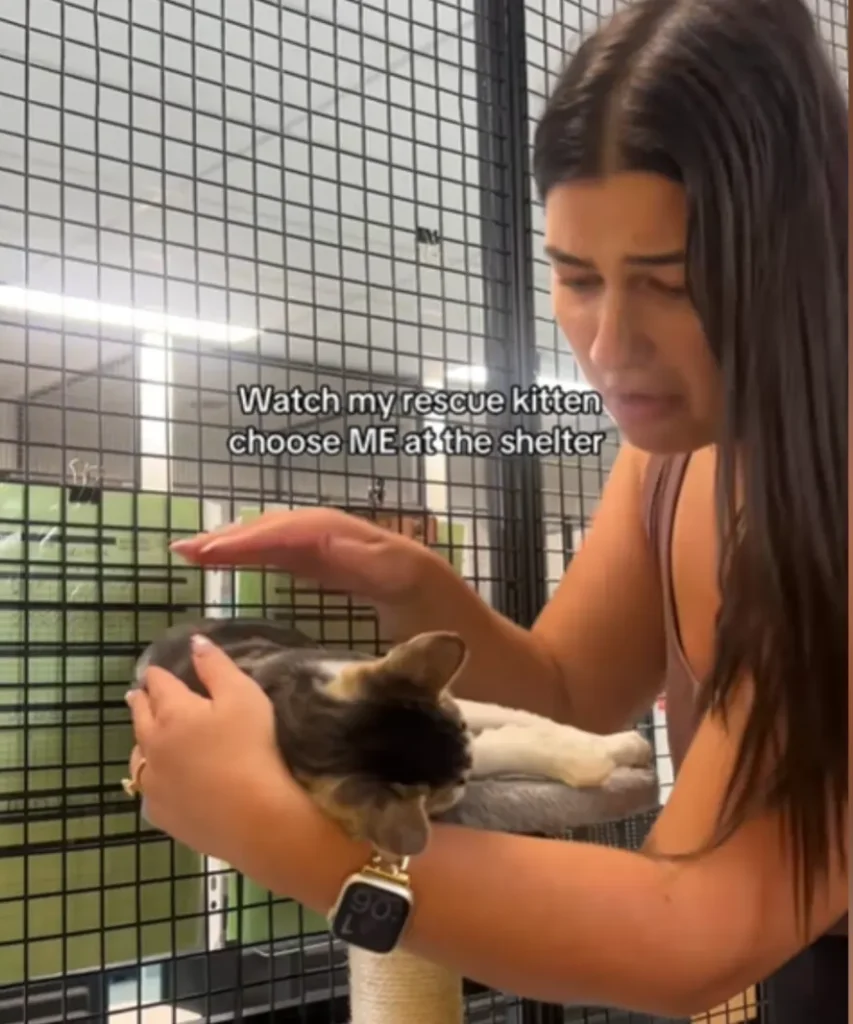
A woman who visited a shelter planning to adopt a certain kitten had her plans thrown into disarray when she met a cat who chose her instead. That is perhaps the most delightful kind of disruption a person can experience. Plans are fine, but sometimes the universe has better ideas.
Rachel Charalambous, who lives in Australia, shared the moment she became the owner of a sweet, shy kitten after meeting her during a shelter visit, posting the video to her TikTok account @rachelchara_ on February 13. The caption was simple and direct: “Watch my rescue kitten choose ME at the shelter.”
The video shows Charalambous petting a small tabby-and-white kitten sitting atop a cat tree, when suddenly the kitten melts under her touch, lying down and stretching out on the stool and letting out a loud, long, rumbly purr. If you have ever witnessed that kind of full-body surrender in a cat, you already know. There is no faking it.
Charalambous wrote that she had been told the kitten was very shy and that it takes patience and time for her to warm up to people. “But within five minutes she trusted me and showed me how much love she has to give.”
A Kitten Who Hadn’t Eaten All Day
What makes this story hit harder than just a cute video is one detail in particular. It is small, but it says everything. Charalambous shows the room the kitten is being kept in, with food bowls barely touched, and says she was told that the first time the kitten ate all day was when she entered the room with her.
Think about that for a moment. A tiny, stressed animal, sitting in an unfamiliar place, too anxious to eat, and then this one stranger walks in and suddenly, appetite returns. It is not magic, but it is close. It speaks to the extraordinary sensitivity these animals carry, even when they appear shut down.
The video ends with the newly adopted kitten being carefully packed into a cat carrier, ready to start her new life in her forever home with Charalambous. That image alone, of a small creature being gently tucked into a carrier, crossing the threshold from shelter life to home life, is almost too much to sit with.
Mushu Settles In, and the Internet Loses It
In videos shared to her account since, the kitten, now named Mushu, seems to be settling in perfectly, sleeping on Charalambous’s bed, playing with toys, and getting plenty of cuddles. From untouched food bowl to pillow naps. That is quite a journey for one small cat.
TikTok users were in pieces, watching the video more than 1.1 million times and awarding it more than 230,000 likes, as one commenter admitted: “Didn’t expect to cry at 7 a.m. but here we are.” And honestly, who could blame them.
The comments paint a vivid picture of collective emotion. One person wrote: “Can you imagine kitty’s thoughts… ‘I get to go home, somebody loves me.'” Another declared: “EVERYTHING about her body language says – I chose you!” Sometimes strangers on the internet absolutely nail it.
The Science Behind “Choosing” a Human
Here is the thing that surprises a lot of people. When a cat appears to choose someone, that is not anthropomorphism or wishful thinking. There is genuine behavioral science behind it. The science is clear: cats are emotionally complex, cognitively advanced, and socially nuanced. Research has shown cats can form secure attachments to their owners, like infants with caregivers, and they recognize human emotions, read tone and gesture, and exhibit behaviors linked to empathy and social awareness.
In a 2017 study, researcher Kristyn Vitale and colleagues found that the majority of both pet and shelter cats preferred interacting with a person over eating food or playing with a toy, although clear individual variability in cat preferences was seen. So when Mushu stopped hiding and started purring the moment Charalambous arrived, she was doing something cats are actually wired to do when they feel safe with a particular person.
Securely attached cats display a reduced stress response and curiously explore the room while checking in periodically with their owners for attention. Mushu’s sudden transformation from a cat who wouldn’t eat to one rolling around and purring loudly fits this pattern almost textbook perfectly. She found her secure base.
For a cat well-socialized to humans as a kitten, it takes many negative experiences with other people to become wary of such contacts, and very few positive experiences with a new owner to become friendly and trusting of that person. Mushu’s rapid response to Charalambous suggests she had it in her all along. She just needed the right person to show up.
What Shelter Life Does to a Cat
To fully appreciate what Mushu’s response meant, it helps to understand what shelters feel like from a cat’s perspective. It is hard to say for sure exactly what a cat processes emotionally, but the behavioral signs are well documented. It can be difficult to determine a cat’s true personality and temperament when it’s in a shelter cage. A cat that is scared and hissing, huddled in the back of a cage, can be an absolute love when given time out of its cage and away from other cats.
The most affectionate cats will often seem depressed in the shelter, because they are. That line, short and blunt as it is, carries real weight. A cat that once had love and warmth sits in a kennel, its whole personality dimmed by stress and confusion.
Shelter cats can be affected by the stress of the shelter, including noise, the smell of multiple animals, and space restrictions from the size of the cage, so you might see a personality extreme that is being amplified. Mushu’s untouched food bowl was almost certainly a sign of this kind of stress. It was not a reflection of who she was. It was a reflection of where she was.
Cat ownership may improve psychological health by providing emotional support and dispelling feelings of depression, anxiety and loneliness. The irony, of course, is that this works both ways. Mushu needed Charalambous just as much as Charalambous needed Mushu.
Shelter Cats and the Bigger Picture
Stories like Mushu’s are beautiful, but they also carry a weight that goes beyond one viral video. In the United States alone, 5.8 million dogs and cats entered shelters and rescues in 2024, according to the American Society for the Prevention of Cruelty to Animals. Of those, 4.2 million animals were adopted into new homes, a figure roughly unchanged from the prior year, indicating that adoption rates are not rising fast enough to ease shelter crowding.
Let’s be real. Behind every heartwarming TikTok is a shelter full of animals waiting for someone to walk through the door and be their person. For every cat someone purchases from a breeder, one remains at a shelter and is possibly euthanized. By adopting a shelter cat, you are saving lives and helping shelters make space for new animals coming in.
Experts encourage potential adopters to base their decision on the individual cat’s personality and behavior rather than a specific breed or look. Mushu was described as shy and difficult to warm up to. In a different world, that description alone might have kept her in the shelter indefinitely. Charalambous ignored the label and trusted the moment.
A cat that is scared and hissing, huddled in the back of a cage, can be an absolute love when you spend time outside its cage. The shelter visitation rooms are the closest you will come to learning what the cat will be like in your home. That is something every potential adopter should hear before walking into any shelter.
Mushu’s story is, at its core, a simple one. A shy kitten. A stranger who sat down and offered patience. Five minutes. One purr. A forever home.
Yet wrapped inside that simplicity is something profound about trust, connection, and what animals are capable of feeling when given even the smallest reason to feel safe. Research shows that interactions with cats may improve health and reduce physical responses to stress, and cat ownership may improve psychological health by providing emotional support and dispelling feelings of depression, anxiety, and loneliness. The bond cuts both ways, always.
Mushu didn’t wait for paperwork or a perfect moment. She simply felt something, stretched out on that cat tree, and decided. There are millions of animals in shelters right now doing the same quiet, desperate math, hoping that someone will walk in and give them five minutes. What would happen if more of us did?
Kristina is a young writer from India. An arts graduate and an avid content creator, Kristina is passionate about animals and wildlife. She enjoys exploring topics related to pet care, animal behavior, conservation, and nature, combining thorough research with engaging storytelling.