Cats have been defying gravity, and our expectations, for as long as humans have been watching them. Drop one from an awkward upside-down position and it somehow twists itself around mid-air, lands cleanly on all four paws, and walks off as though nothing happened. It looks almost magical. For over a century, physicists, veterinarians, and engineers have tried to explain it, and each time they thought they had the full answer, another layer of complexity emerged.
Now, a new study out of Japan has taken the science closer to a definitive explanation than ever before, and the findings are genuinely surprising. Let’s dive in.
A Question That Has Baffled Science for More Than a Century
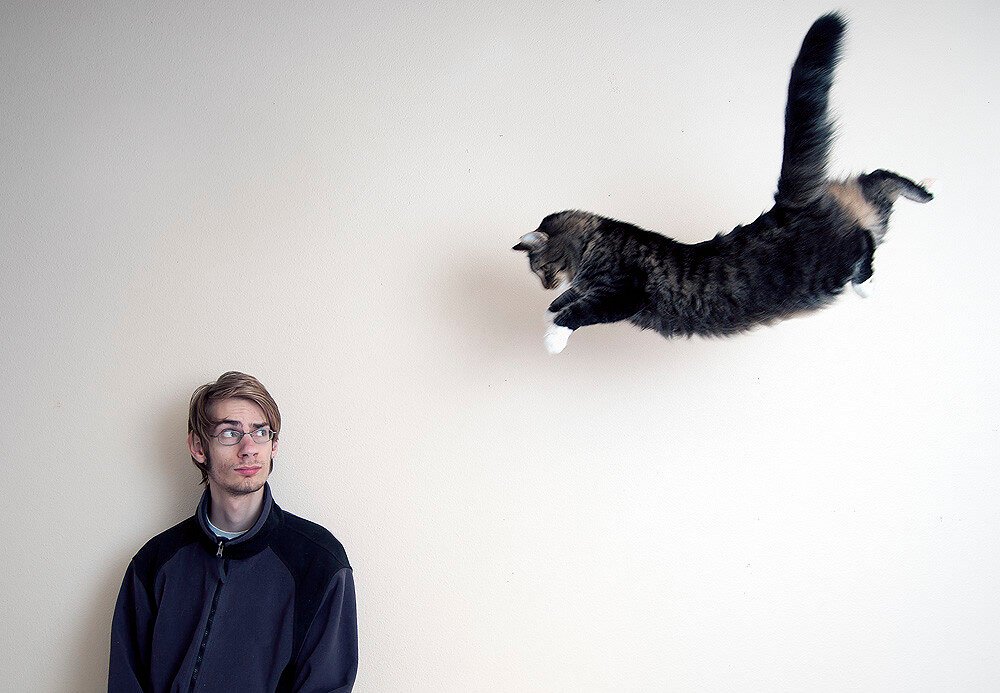
Research into the physics behind a cat’s landing ability is almost as old as physics itself, with the first recorded paper tackling the subject published as far back as 1700 by a French scientist named Antoine Parent. Back then, nobody had slow-motion cameras or computer models. Scientists were working with little more than observation and intuition.
The real turning point came at a fateful meeting of the French Academy of Sciences on October 22, 1894, when physiologist Étienne-Jules Marey presented a series of high-speed photographs showing clearly that a cat begins falling upside-down without any rotation but nevertheless manages to turn over to land on its feet. The room reportedly erupted in scientific chaos. How could this be possible? According to the conservation of angular momentum, it is impossible for an object that is not spinning to suddenly rotate without external influence. Yet the photographic evidence was right there, undeniable.
For a long time, scientists were baffled because early high-speed photos seemed to show falling cats rotating in midair without anything to push against, which looked like a violation of physics. The eventual solution was realizing that cats are not rigid cylinders. They bend in the middle and rotate the front and back halves in opposite directions, so the total spin adds up to zero while the body still turns upright.
The New Breakthrough: It’s All in the Spine
A team from Yamaguchi University in Japan has now provided a far more detailed answer, and it comes down to the thoracic spine being more flexible than the lumbar spine, as they detail in a study published in the journal The Anatomical Record. This is a meaningful step forward. While earlier research explained the physics of the motion, the precise anatomy driving it had remained largely unexplored.
Lead researcher Yasuo Higurashi and his colleagues investigated the puzzle at its source: the cats’ spines themselves. They carefully harvested the spinal columns from five donated cat cadavers, including the ribs and sacrum, while leaving the ligaments and intervertebral discs intact. They measured each section’s torque, rotation angle, stiffness, and neutral zone, which is the range of motion where minimal force is required for movement. The front half, the thoracic spine, has a wider range of motion and twists far more readily than the stiffer lumbar spine in the back half.
They discovered a cat’s thoracic spine, found in the middle of the back, is almost three times more flexible than the lumbar spine, found in the lower back. Think of it like a garden hose that is highly flexible at the top but reinforced and rigid at the bottom. The contrast between those two zones is what makes everything work.
The Sequential Spin: How Cats Pull Off the Move
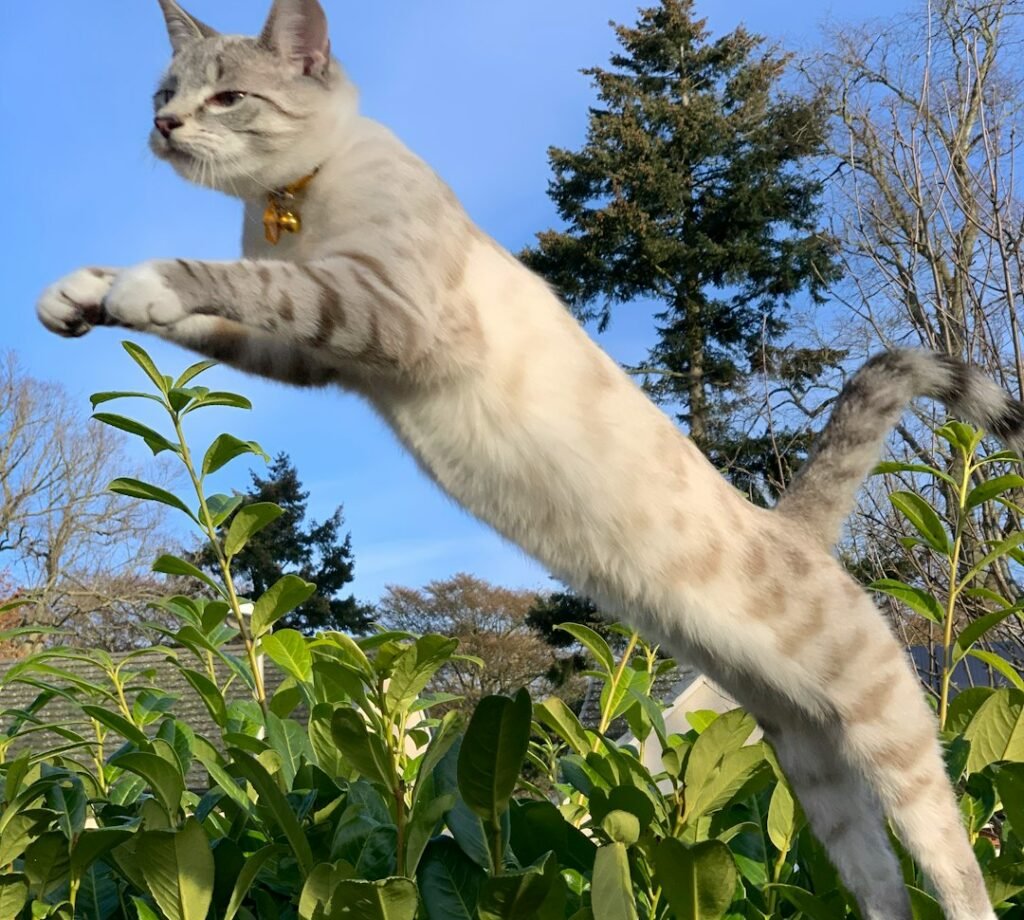
The team discovered that the cat’s spine is not uniformly flexible, and different parts move in different ways to help the animal land safely. The thoracic spine has a neutral zone where it can twist almost freely for nearly 50 degrees with very little effort. Meanwhile, the lumbar spine is much stiffer and acts as a stabilizer.
To confirm this in living animals, the researchers dropped two cats eight times each from a height of about one meter onto a soft cushion, using a high-speed camera to film the process. The results showed that the cats weren’t twisting in a single smooth motion. Rather, the front half rotated first, then the back half followed, with the time difference between the two halves being around 94 milliseconds for one cat and 72 milliseconds for the other.
The researchers propose that falling cats right themselves sequentially, rather than as a single discrete unit. The front of the body goes first because the spine is more flexible, and the front half of a cat’s body has about half the mass of its posterior. Honestly, it’s a bit like watching a carefully choreographed performance that happens in a fraction of a second.
The Righting Reflex: Biology Meets Physics
The righting reflex is powered by a balance system in the inner ear, a spine made of about 30 flexible vertebrae, and shoulders that are not locked in place by a collarbone, which lets the front and back halves twist independently during a fall. This is not a learned behavior, it is hardwired into the animal from a remarkably young age.
A cat’s inborn talent to reorient its body while falling is called an aerial righting reflex. It begins to appear in kittens when they’re about three weeks old and becomes highly developed at around seven weeks of age. Unlike a simple reflex, like a knee jerk, righting in animals is a complex reflex tied to the conscious brain. It relies on the vestibular system, where otoliths in a cat’s inner ear detect changes in acceleration and position relative to the ground, prompting its muscles to move in a way that helps it land on its paws. The whole sequence, from detection to correction, happens in under a second.
Not Foolproof: When the Reflex Fails
Here’s the thing that most people overlook: cats don’t always land safely, and the height of a fall matters enormously. Falls from moderate heights, such as two or three stories, can actually be more dangerous than higher falls, as cats don’t have enough time to position themselves properly. That sounds counterintuitive, but it reflects the time the cat needs to execute the full rotation sequence.
In a 1987 study of 132 cats brought into a New York animal medical center after falling from buildings, it was found that injuries per cat increased with altitude until a height of seven stories, at which point injuries actually decreased. One cat fell 40 stories without serious injury. The study’s authors speculated that after falling five stories, the cats reached terminal velocity, at which point they relaxed and spread their bodies out to increase drag.
Critics of the study have questioned the conclusion that mortality rates decrease at greater heights due to survivorship bias, since falls that resulted in instant death were not included, as a deceased cat would not be brought to a vet. So the data, while fascinating, has a significant blind spot. The physical condition of the cat also plays a role. Cats who are overweight, uncoordinated, or arthritic may not be able to move quickly enough to right themselves, even when falling from four or five feet.
Beyond Cats: What the Science Means for Robots and Medicine
The reason why cats always land on their feet has just been revealed, and it could lead to improved spinal injury treatments in felines as well as the development of more agile robots. That last point is particularly exciting for engineers who have long looked to nature for design inspiration.
Today, research into cat-turning continues in yet another field of study: robotics. Roboticists have long used nature as an inspiration to build better robots, and the falling cat provides a strategy by which a falling robot could land on its feet, minimizing any damage it might otherwise suffer. The researchers also suggest their findings could improve mathematical models of animal movement, help vets treat spinal injuries, and even lead to more agile robots. It’s hard to say for sure just how quickly those applications will materialize, but the foundational knowledge is now considerably more solid.
The researchers acknowledge that cutting through the cats’ rib cages during cadaver testing could affect the mechanical properties of the thoracic spine. However, they also note that their findings are consistent with a 1998 study conducted on living, anesthetized cats, which showed similar flexibility in the thoracic spine. The consistency across methods gives the findings more credibility.
What started as a philosophical puzzle debated in a 17th-century French academy has gradually evolved into a precise, multi-disciplinary scientific field. Cats, it turns out, are living proof that nature solves engineering problems with breathtaking elegance. Cats don’t “magically” land on their paws. They use a biomechanically sophisticated strategy: an extremely flexible thoracic spine combined with a stabilizing lumbar spine and a precisely timed spinning motion.
The new research from Yamaguchi University peels back yet another layer of this remarkable phenomenon, showing that the secret isn’t just that cats are flexible, it’s that their flexibility is strategically unequal. As the researchers themselves note, further studies on the material properties of the spine may help clarify how differences in trunk flexibility affect locomotor performance in mammals. That opens doors not just for feline science, but potentially for understanding movement in a wide range of animals, including humans.
After more than 130 years of investigation, cats are still teaching scientists something new. What do you think about it? Drop your thoughts in the comments below.
Kristina is a young writer from India. An arts graduate and an avid content creator, Kristina is passionate about animals and wildlife. She enjoys exploring topics related to pet care, animal behavior, conservation, and nature, combining thorough research with engaging storytelling.