You’ve probably seen it a hundred times. Your cat tumbles off a shelf, your heart lurches, and then – like nothing happened – it strolls away with the casual indifference of someone who absolutely planned that. It almost feels like cheating. How does something that started upside down manage to flip itself into a graceful, four-pawed landing in the blink of an eye?
The answer sits at the crossroads of biology, neurology, and physics. It involves ancient scientific debates, high-speed cameras, and principles that once stumped the greatest minds in European science. It is honestly one of the most remarkable things happening quietly inside your living room every single day. Let’s dive in.
The Righting Reflex: Nature’s Built-In Gyroscope
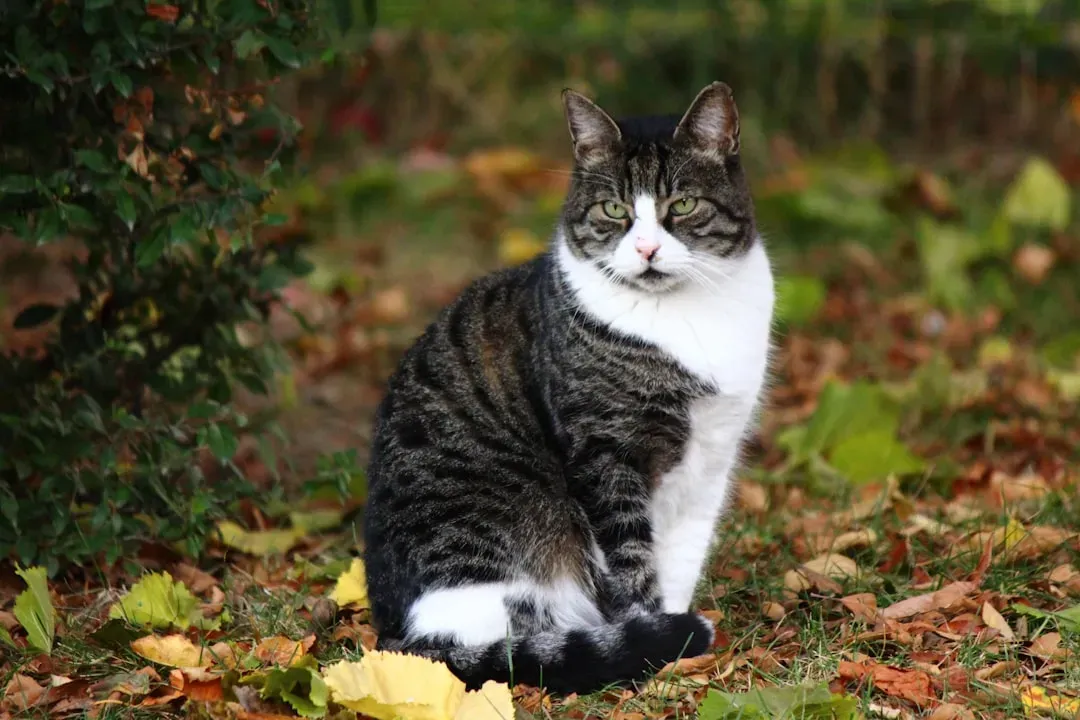
The righting reflex is an automatic response that corrects the body’s orientation when it isn’t in its normal, upright position, allowing cats to land on their feet when they fall or jump to the ground. Think of it like a biological autopilot that kicks in the instant gravity takes over. You don’t teach it, and your cat doesn’t consciously choose it. It just happens.
The cat’s righting reflex is an incredible example of evolutionary skill, blending instinct, anatomy, and physics. The righting reflex likely evolved as a survival mechanism. Cats are natural climbers, often scaling trees or high structures in search of prey or safety. Falling from a height is a common risk, and the ability to land on their feet increases their chances of survival.
A Century of Scientific Confusion
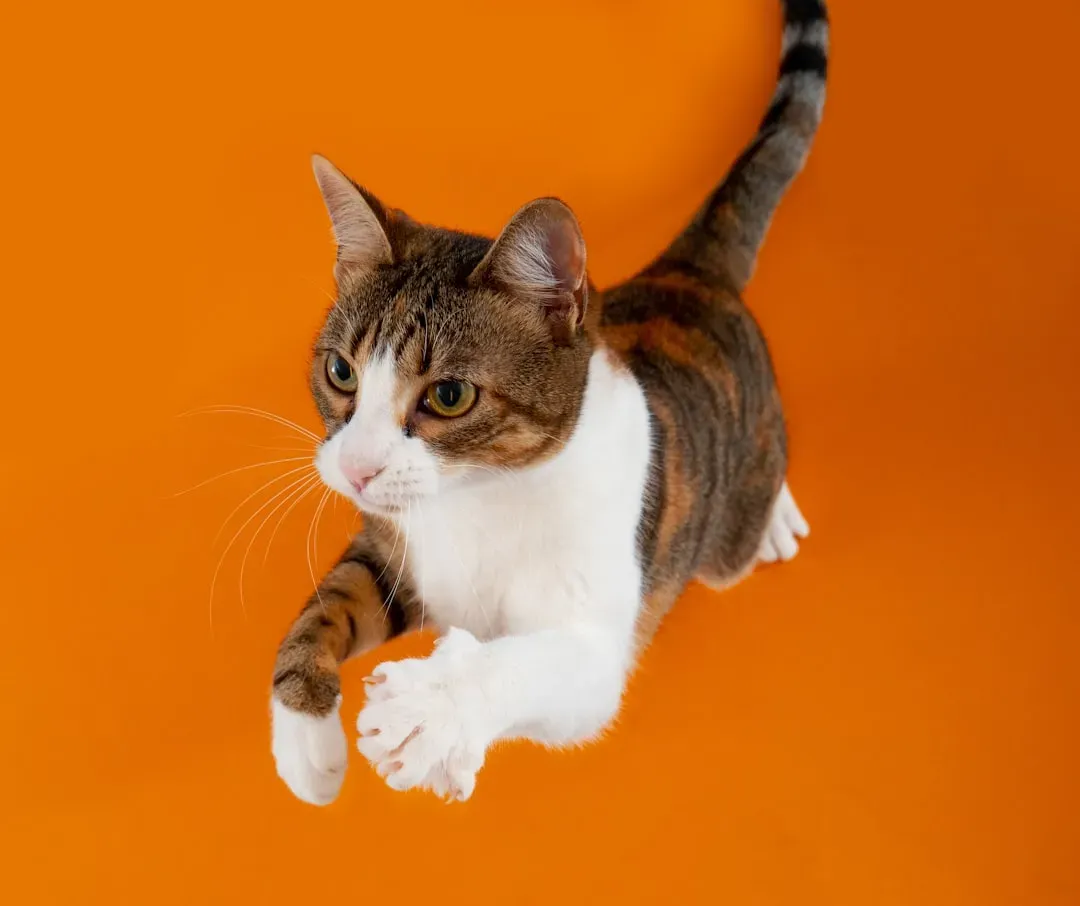
Research into the physics of the cat’s ability is almost as old as physics itself. The first research paper to tackle the subject was published in the year 1700 by a French scientist named Antoine Parent. For context, Isaac Newton was still alive at the time, and his groundbreaking work Philosophiæ Naturalis Principia Mathematica was only 13 years old. So yes, this puzzle is ancient and it is way more serious than people give it credit for.
With the recognition of conservation of energy, physicists soon decided that a cat simply cannot flip over on its own in freefall once it begins falling. The consensus view was that a cat, at the moment it begins to fall, must push off of its perch to give itself some initial rotation that leads to it ending on its feet. This explanation was demolished in a fateful meeting of the French Academy of Sciences on October 22, 1894, by the physiologist Etienne-Jules Marey. Marey presented a sequence of high-speed photographs taken of a falling cat, the first of their kind, showing clearly that the cat begins falling upside-down without any rotation but nevertheless manages to turn over to land.
What Actually Happens Inside a Cat’s Inner Ear
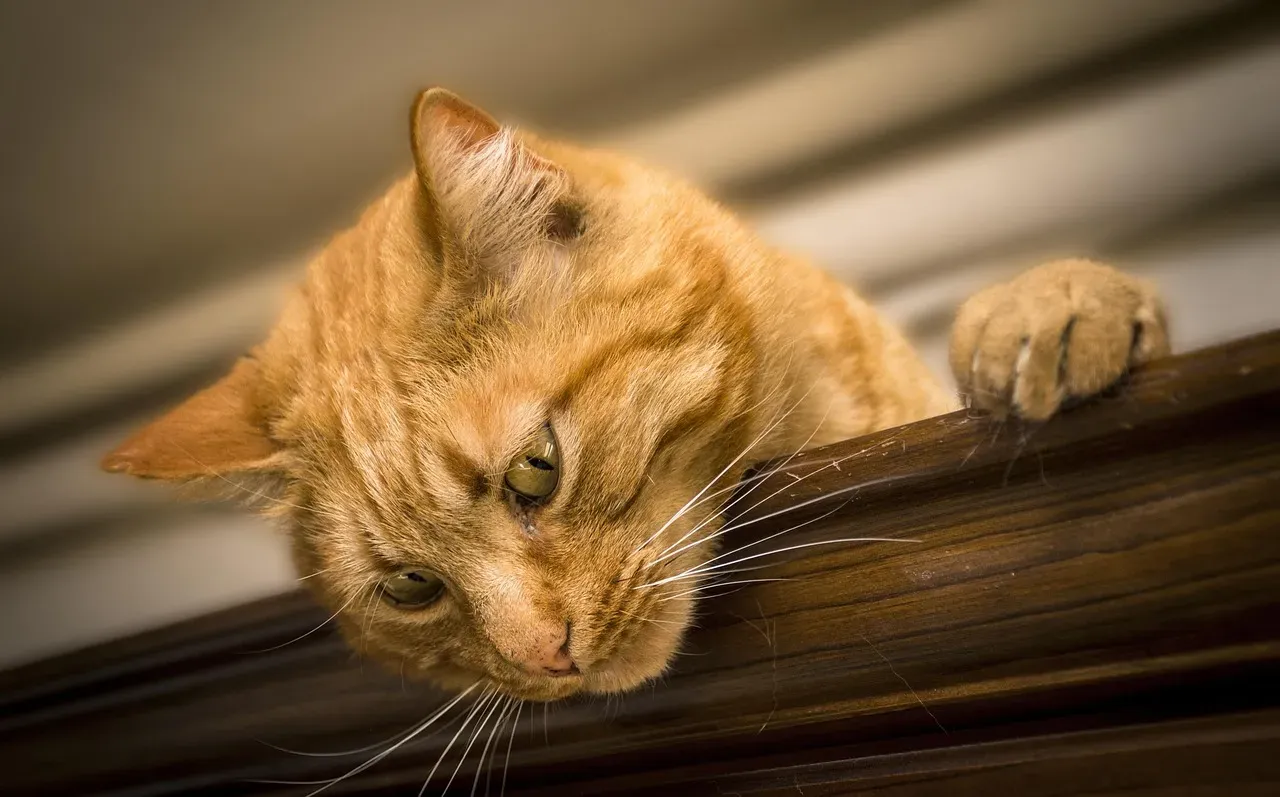
When a cat slips or misjudges a jump, fluid-filled structures in the inner ear detect that the body is no longer upright and send rapid signals to the brain about which way “down” is. It’s essentially a biological compass that activates in milliseconds. Most of us take for granted that we know which way is down, but for a spinning, falling cat, that knowledge has to be acquired in real time.
The righting reflex is primarily triggered by the vestibular system in the inner ear, which serves as the main sensory mechanism for detecting changes in orientation during a fall. This system comprises the semicircular canals, responsible for sensing angular acceleration and rotational movements, and the otolith organs, which detect linear acceleration and the direction of gravity. These components enable the cat to perceive the onset of free fall and maintain spatial awareness relative to the Earth’s gravitational field. It’s genuinely more sophisticated than most people realize.
The Spine: The Secret Weapon Behind the Twist
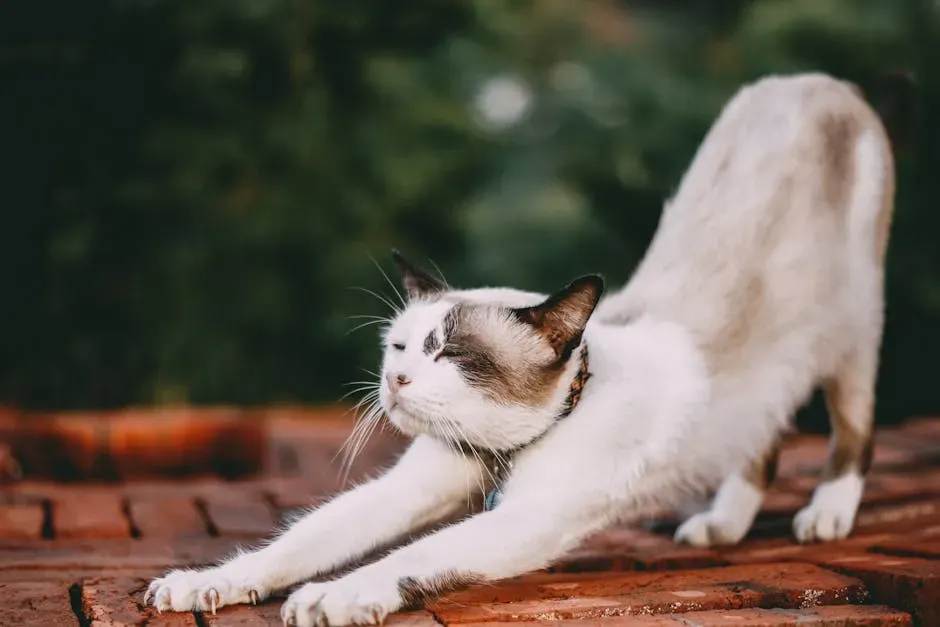
The 30 exceptionally flexible vertebrae in the spine enable felines to stretch out, compress, arch the back, and rotate, bend, and twist the front half of the body independently from the back half. Imagine trying to do that yourself. You can’t. Your collarbone alone would stop you. Cats, on the other hand, are practically built like living Slinkys.
Cats are able to do this because they have an unusually flexible backbone and no functional clavicle, or collarbone. For comparison, cats have 13 thoracic vertebrae while humans have 12, and they have seven lumbar vertebrae while humans have five. This flexibility allows them to quickly twist their bodies with precision and land on their feet. That extra mobility is not cosmetic. It is the entire engine of the maneuver.
Angular Momentum and the “Bend-and-Twist” Sequence
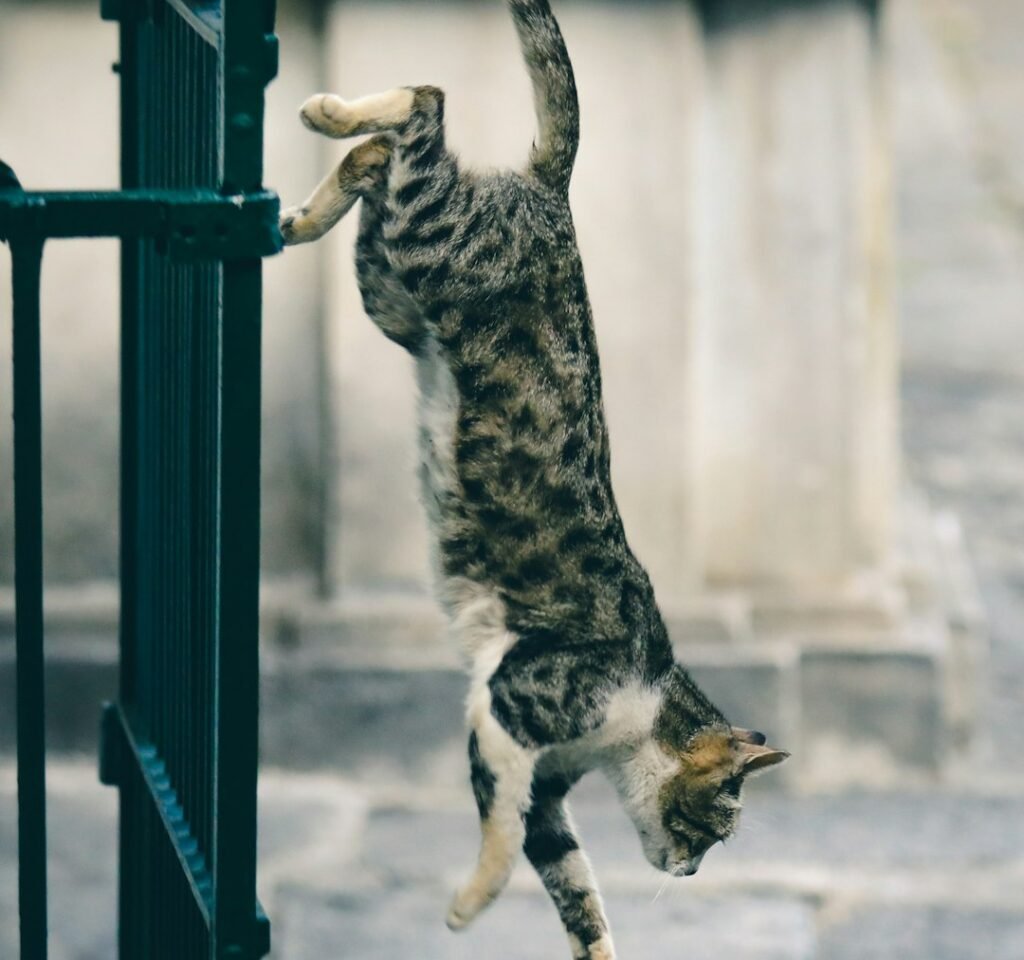
Here’s the thing about physics: it does not make exceptions, not even for cats. The cat righting reflex relies fundamentally on the conservation of angular momentum, a principle from classical mechanics that governs rotational motion in the absence of external torques. When a cat falls from a height, it begins with zero net angular momentum relative to its center of mass. To reorient itself mid-air, the cat exploits its flexible spine and ability to decouple its body into independent segments, allowing differential rotation between the front and rear halves.
A falling cat divides its body into two halves: it twists its head and front torso in one direction while rotating its rear half in the opposite direction. By alternately arching and straightening its spine, it can rotate different parts of its body independently, allowing it to pivot without violating the laws of physics. Think of it like how a figure skater controls a spin by pulling their arms in and pushing them out. The cat does something comparably brilliant, just in free fall and in under a second.
The Step-by-Step Midair Sequence
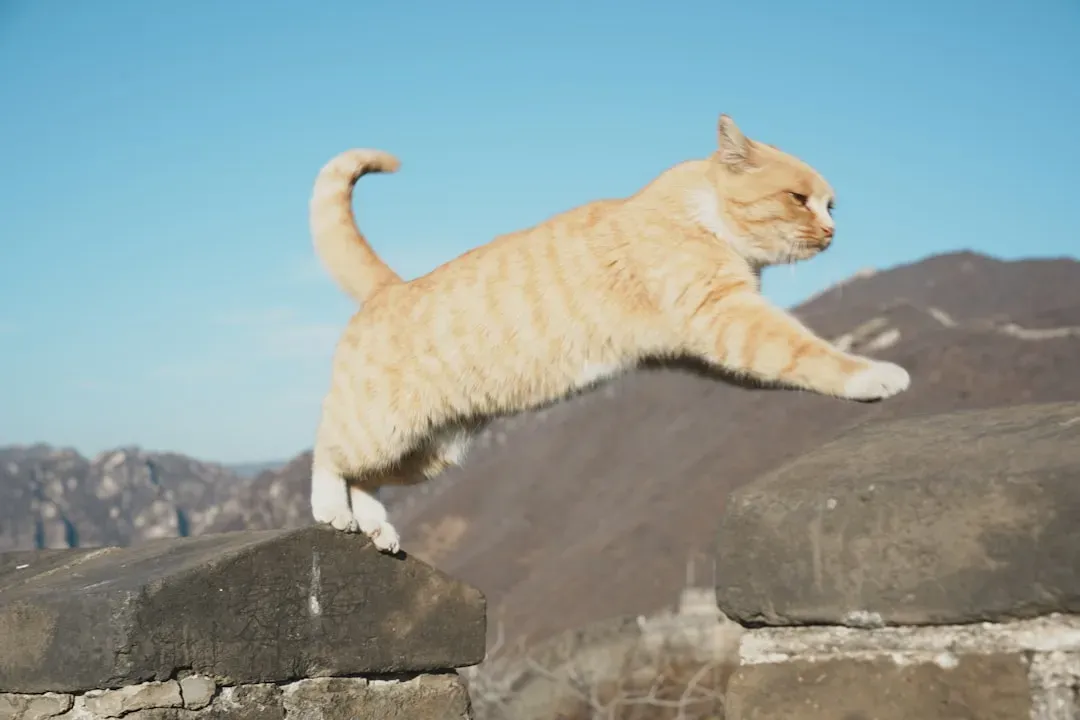
If you watch a slow-motion video of a cat falling, you’ll notice that cats rotate their head first to align with the ground. Then, using their front legs, they twist the upper body, followed by the lower body. This segmented motion allows them to achieve the correct landing position. It happens so fast that the naked eye barely catches it. Only through high-speed photography do you see just how deliberate and structured the whole sequence really is.
Angular momentum is a vector quantity, which means it has both direction and magnitude. When a cat falls and begins to twist its limbs and body, the total angular momentum must still equal zero because the cat does not experience an external torque or rotational force. The cat’s ability to manipulate this principle enables it to reorient itself efficiently during a fall. Cats’ tails have a lot of uses, and while not always necessary, a cat’s tail can act as a counterweight to fine-tune their orientation. For example, when a cat swerves to the right their tail will swing to the left.
Terminal Velocity and the “Cat Parachute” Effect
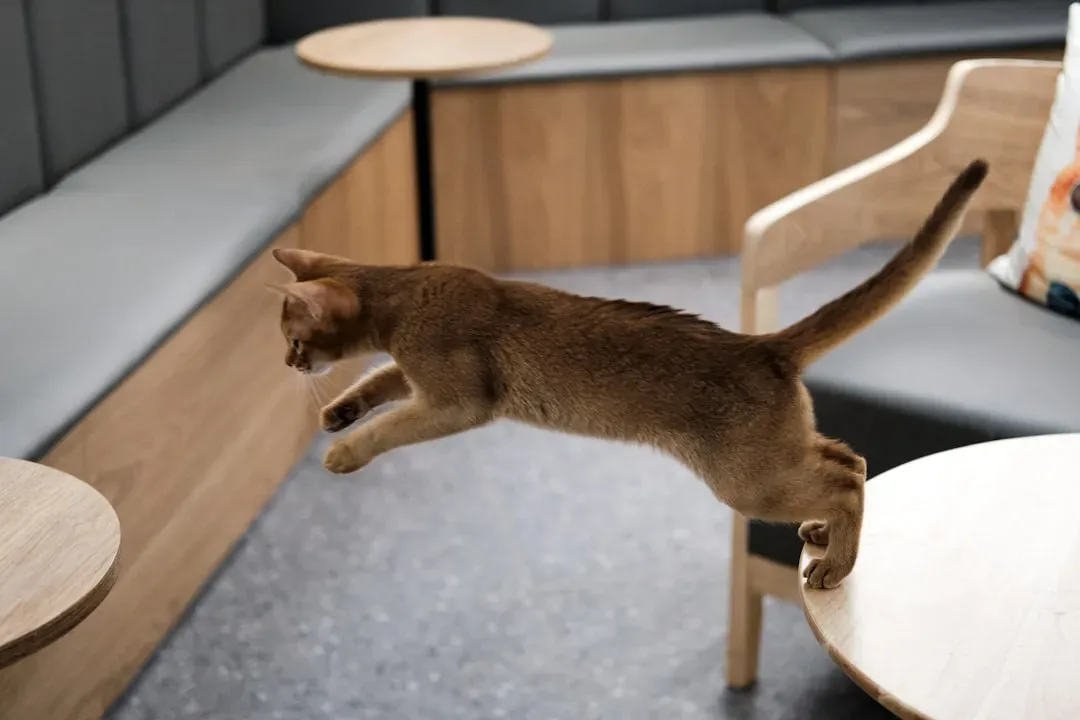
I know it sounds crazy, but once a cat reaches maximum falling speed, something almost magical happens. The study’s authors speculated that, after falling five stories, the cats reached terminal velocity, at which point they relaxed and spread their bodies out to increase drag. An average-sized cat with its limbs extended achieves a terminal velocity of about 60 mph, around half that of an average-sized man, who reaches a terminal velocity of about 120 mph.
Once they reach this stage they begin to relax and stretch their legs out, much like how a flying squirrel does, which expands their body size and creates air resistance. It’s almost like cats can turn themselves into little parachutes, which increases drag resistance. A cat’s relatively small body weight and compact, muscular build help reduce their terminal velocity compared with larger animals. This slower fall can make it easier for them to absorb the impact and land safely. Nature, honestly, is a brilliant engineer.
When the Reflex Fails: Limitations and Real Dangers
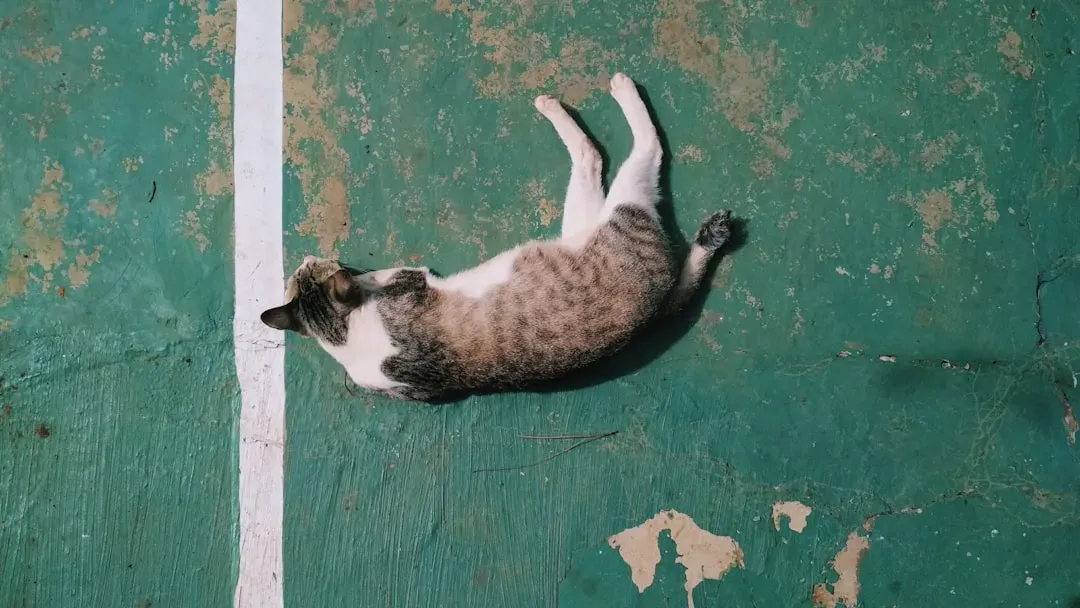
Let’s be real. No reflex, however impressive, is bulletproof. While the righting reflex is impressive, it’s not foolproof. If a cat falls from a very low height, less than one to two feet, there may not be enough time to fully engage the reflex, leading to injury. A minimal height may not provide enough time for a cat to reorient itself fully before impact. The cat requires a sufficient duration to execute the necessary rotations and postural adjustments.
You’re not the only one who gets a little stiffer with age. Cats do too. Even before they hit their senior years around age 10, many start to experience joint stiffness or arthritis that can make midair twists more difficult. Aging cats also tend to lose muscle mass and may struggle with balance. Cats do sustain injuries from falls, and it happens so often the cluster of injuries has a name: “high-rise syndrome.” Researchers discovered that cats who fall from seven stories or higher more often land on their feet than from falls of shorter heights but experience more severe injuries. The most common injuries include chest trauma, broken bones, and facial and dental injuries.
Kittens, Robotics, and Real-World Inspiration
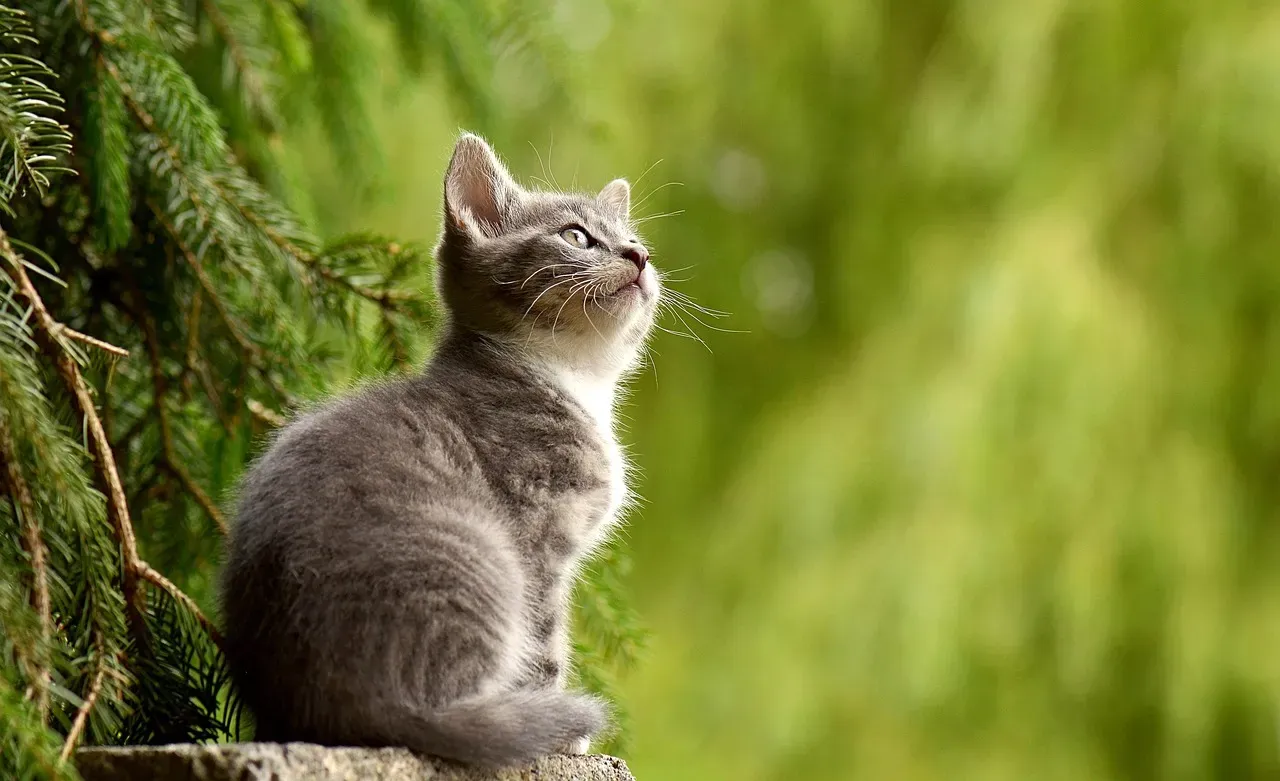
Kittens begin to use the reflex at approximately 3 weeks of age and master it by the time they’re 7 weeks old. That is astonishing when you think about it. By the time a kitten fits in the palm of your hand, it already has a fully operational midair orientation system running in the background. It’s more advanced than most technology we’ve built deliberately.
This adaptation is so effective that engineers and roboticists have studied it for inspiration. The cat’s ability to twist in free fall without external leverage has informed designs for reorienting spacecraft, drones, and even medical robots operating in tight environments. Cats continued to flummox researchers, and this uncanny ability continued to be studied not just by physicists and physiologists but also brain researchers, NASA scientists, and robotics people. Your cat, in other words, is a working prototype for space technology.
Conclusion
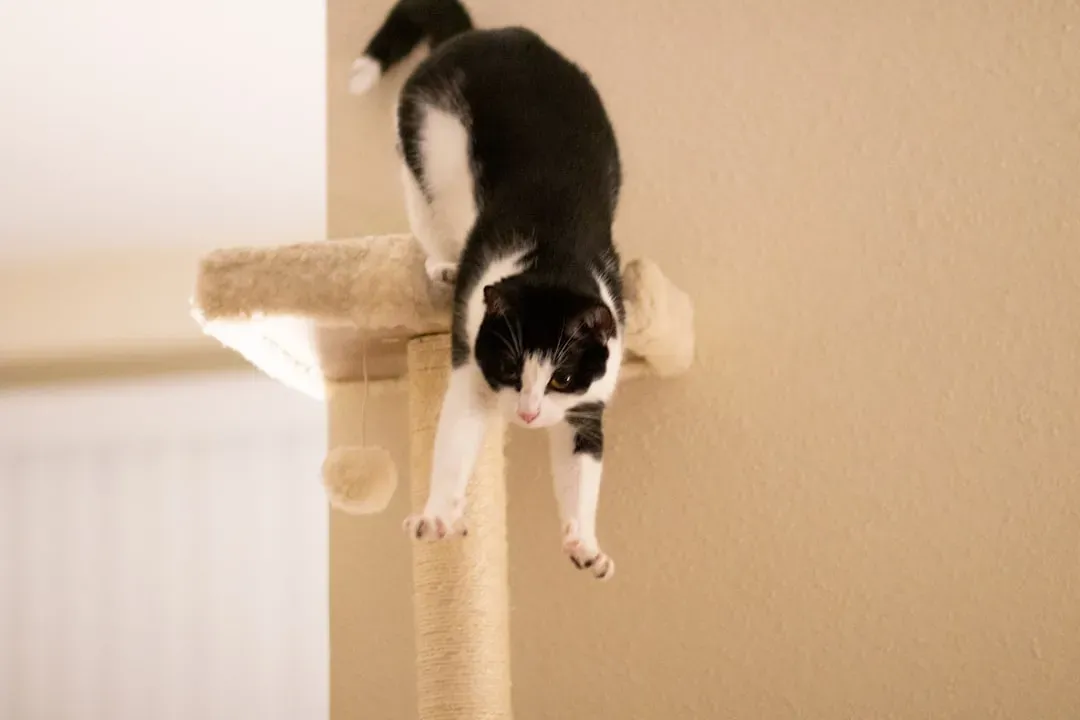
What looks like a casual display of feline arrogance is actually one of the most complex, precisely engineered survival mechanisms in the natural world. From the fluid-filled gyroscopes in their inner ear to the physics-defying bend-and-twist of their flexible spine, cats have essentially solved a problem that stumped physicists for over two centuries.
Honestly, the next time your cat casually survives a fall from the kitchen counter and walks away without even glancing back at you, maybe it deserves a little more respect than the eye-roll you were planning. Watching a cat land on its feet is watching nature’s physics in motion. It’s evolution, instinct, and biomechanics blending seamlessly in a single graceful act. Science has rarely looked as effortless – or as smug.
So, knowing all this now, do you look at your cat a little differently? Tell us your thoughts in the comments below!