Honduras’ Sierra del Merendón – Camera traps captured a young male jaguar navigating dense cloud forest at 2,200 meters elevation on February 6, 2026. The sighting marked the first documented presence of such a high-altitude “cloud jaguar” in the region in a decade.[1][2] Researchers hailed the event as evidence of the species’ resilience and the effectiveness of local conservation measures amid persistent environmental pressures.
A Ghostly Return to the Peaks
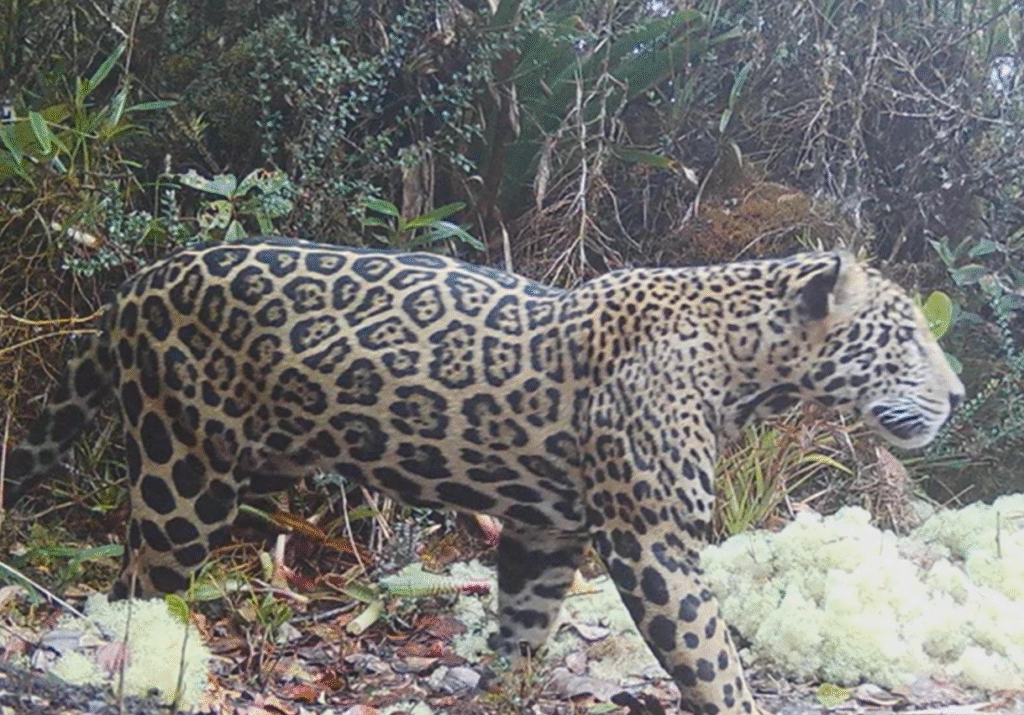
The image emerged from a network of remote cameras placed by conservationists in the rugged Sierra del Merendón mountains, which straddle the Honduras-Guatemala border. This lone male appeared healthy, with no visible signs of distress, just two meters from the exact spot where the previous high-elevation jaguar was recorded on February 4, 2016.[3] That earlier detection had spurred the creation of a vital wildlife corridor linking populations across the two nations.
High-altitude jaguar sightings remain extraordinarily scarce in Honduras, with only three confirmed instances to date. The 2026 capture, therefore, stood as a bold affirmation that these elusive big cats continue to roam the mist-shrouded heights despite years of absence from records.[2] Surveys in the area had yielded no jaguar traces for a full decade, heightening the drama of this breakthrough.
The Enigma of the Cloud Jaguar
Cloud jaguars earn their name from their habitat in montane cloud forests, where low-lying clouds nourish epiphyte-draped trees and create a perpetual veil of moisture. Most jaguars favor lowlands below 1,000 meters, making these high-elevation wanderers outliers in the species’ behavior.[1] Whether driven by prey scarcity, territorial expansion, or seasonal migration remains unclear, though the remoteness of these peaks likely concealed prior presences.
Jaguars, the Americas’ largest wild cats, once roamed vast territories from Mexico to Argentina. Today, they have forfeited nearly half their historical range due to human encroachment, rendering populations outside the Amazon endangered or critically so.[4][3] In Honduras, small groups persist in protected parks, but the Sierra del Merendón hosts no resident pride – only transient visitors like this one.
Conservation Efforts Fuel the Recovery
Panthera, a global wild cat organization, led the monitoring with anti-poaching ranger patrols, acoustic sensors, and prey reintroduction programs targeting species such as peccaries, brocket deer, and iguanas. These initiatives ramped up after the 2016 sighting, transforming the Merendón range into a functional stepping stone within the ambitious Jaguar Corridor Initiative.[1] Honduras deployed 8,000 troops for forest patrols under its Zero Deforestation Plan, aiming to restore 1.3 million hectares by 2029.
Franklin Castañeda, Panthera’s Honduras country director, described the find as “awesome” and credited a decade of work. “Deforestation and poaching are the biggest threats, and we have been working to tackle both,” he stated.[1] Recent detections of pumas – first in 2021 after 17 years – along with ocelots, jaguarundis, and margays confirmed a broader resurgence of the nation’s five wild cat species in the area.
Persistent Shadows Over Progress
Despite gains, challenges loomed large. Honduras lost 1.5 million hectares of tree cover between 2001 and 2024, equivalent to 19% of its forests, primarily to agriculture.[1] Poaching targeted both jaguars and their prey, fragmenting habitats and isolating populations.
- Habitat loss from farming and development.
- Human-wildlife conflicts in expanding rural areas.
- Decline in prey due to overhunting.
- Climate pressures altering cloud forest dynamics.
Experts emphasized that corridors like Merendón demanded ongoing vigilance to sustain genetic flow. Allison Devlin, Panthera’s jaguar program director, noted, “Connectivity is king for the future of the jaguar.”[2]
A Beacon for Broader Wildlife Recovery
This singular frame from a camera trap rippled outward, bolstering international frameworks like the 2026 UN CMS agreement for jaguar protection. It validated cross-border collaborations and technological investments in monitoring. As Honduras pursued its environmental pivot, the cloud jaguar embodied adaptability in a changing landscape.
Conservationists viewed the sighting not as an endpoint but a call to action. Sustained protection across elevations promised healthier ecosystems for jaguars and beyond.
Key Takeaways
- The February 2026 sighting was the first high-elevation jaguar in Sierra del Merendón in 10 years, only the third ever in Honduras.
- Efforts by Panthera and partners, including patrols and reintroductions, drove this positive indicator.
- Jaguars lost 49% of their range; connectivity remains essential for survival.
The return of the cloud jaguar reminded observers that dedicated stewardship could reclaim lost ground for imperiled species. What do you think this means for Honduras’ wild cats? Tell us in the comments.
Kristina is a young writer from India. An arts graduate and an avid content creator, Kristina is passionate about animals and wildlife. She enjoys exploring topics related to pet care, animal behavior, conservation, and nature, combining thorough research with engaging storytelling.