11 Things a Cat Does the Moment It Hears a Voice It Knows
Most people think cats are indifferent - that they barely notice whether you walk in the door or call from the next room. Turns out, science flatly disagrees. The moment a familiar voice hits a cat's ears, its body launches into a cascade of measurable reactions most owners never even catch.
Researchers have tracked these responses one by one, and the list runs eleven items deep - from a twitch of the ear to a full physiological shift in the eyes. Some of these signals vanish in under a second, but they're real, consistent, and proof your cat knows exactly whose voice just spoke. Here's what the data actually show, counted down.
#11 - Their Ears Swivel Like Radar Dishes
The very first thing a cat's body does is give itself away through its ears.
When cats hear their owner's voice, they turn toward the sound fast. They respond with greater intensity, too - a full head turn and both ears swiveling, rather than the single lazy flick they give a random noise.
What's striking is that this ear pivot is involuntary. It's the auditory equivalent of a double-take, the brain flagging a "known signal" before the cat has even decided to react.
Most owners never notice it because it happens in under a second. Strangers get nothing. The moment your voice lands, those ears are already tracking.
Fast Facts
- The landmark test on this behavior studied cats in their adoptive homes, and used a "habituation-dishabituation" method that didn't disrupt their routine.
- Researchers played three different strangers' voices serially, followed by the owner's voice, all while the owner stayed out of sight.
- Cats reacted with sharper head and ear movement to the owner, but no movement of tails or limbs, and no vocalization.
- The findings were published in 2013 in the journal Anim Cogn 16, 685–690 (2013).
But that's nothing compared to what happens next.
#10 - They Freeze Mid-Action
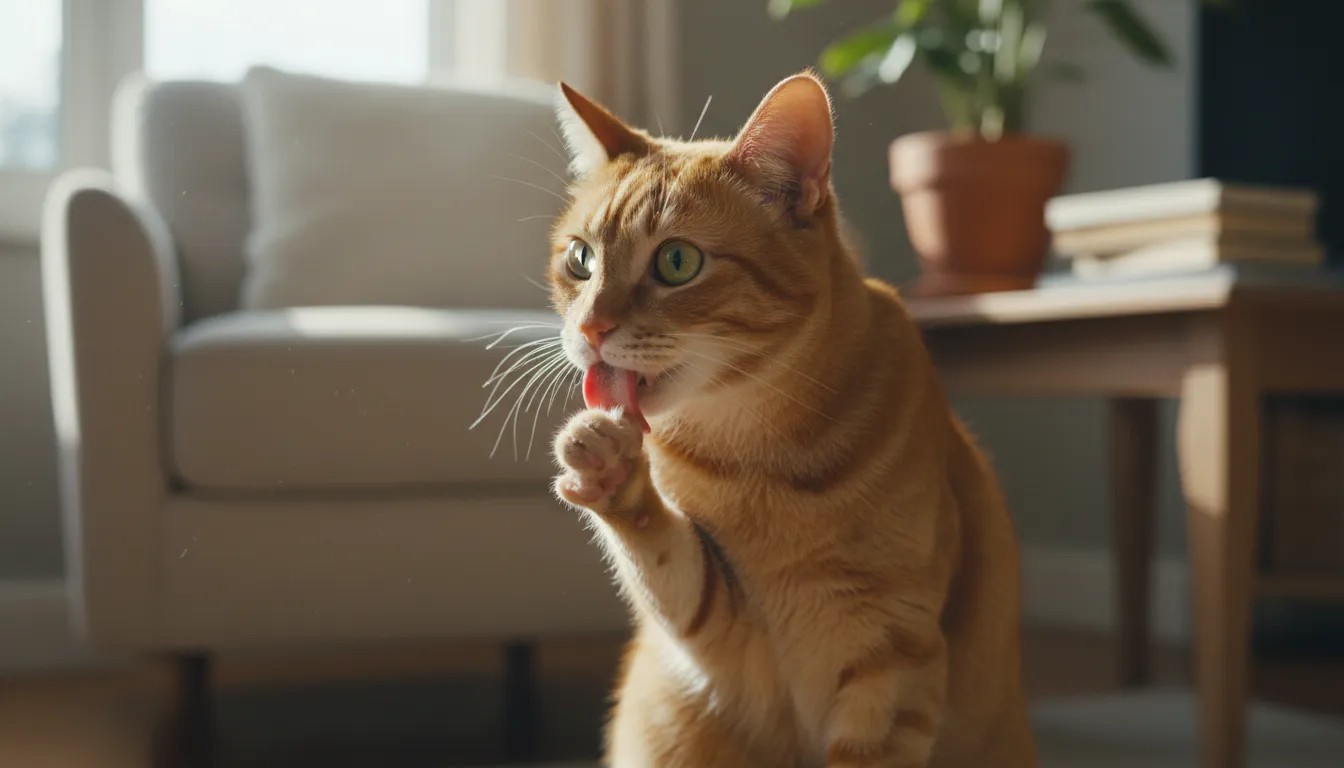
Whatever the cat was doing - washing its face, staring out the window, batting at nothing - it stops.
When cats hear a familiar voice, they respond with a sudden stillness, even freezing mid-groom. This isn't laziness. It's focused attention, the brain flagging an important sound and suspending everything else to process it.
Think of it like a person pausing mid-conversation the moment they hear their own name across a crowded room. The freeze can last just a fraction of a second, but it's consistent enough to show up clearly in lab settings.
Researchers specifically point to it as one of the clearest markers separating owner voices from stranger voices. The freeze is just the opening act.
#9 - Their Pupils Dilate
This one surprises even dedicated cat owners. It's not about light - it's about arousal.
When their owner speaks, cats' pupils dilate noticeably, a physiological spike in alertness that can't be faked or suppressed. The cat isn't performing attention; it's actually experiencing it.
This is one of the few truly involuntary signals in a cat's entire behavioral repertoire. A stranger's voice, even one using a friendly, high-pitched "cat tone," simply doesn't trigger the same response.
That tells us something important: the cat's brain is treating the owner's voice as categorically different. And right after the pupils widen, the tail starts moving.
#8 - The Tail Begins to Swish
A tail in motion is a cat broadcasting information, and a familiar voice is one of its triggers.
This isn't the sharp, irritated lash of an annoyed cat. It's a slower, deliberate sway that signals focused interest, closer to leaning forward in a chair than lashing out in frustration.
The swishing tail is easy to misread as agitation. It's the opposite. The cat is tuned in, processing, and physically expressing that engagement.
Watch for it the next time you call your cat's name from another room. The tail often responds before the head does - and what happens next is even more telling.
#7 - They Move Toward the Sound
Cats have a reputation for ignoring you. The data say otherwise - at least when it's your voice.
When cats hear an owner's voice, they become alert and stop whatever they're doing. Then many walk toward the sound - a move that requires actual intent, not random wandering.
When researchers played a recording of a stranger's voice instead, the same cats showed decreased attention. No approach, no interest, nothing.
Quick Compare
- Familiar voice: full head turn, both ears swivel, quick reaction time.
- Stranger's voice: partial head turn, a single ear twitch, slower response.
- Familiar voice: the cat often walks toward the sound.
- Stranger's voice: interest fades fast, no approach at all.
The movement toward a familiar voice is one of the most consistent findings across independent studies, with cats showing greater intensity (e.g., full versus partial head turn, both ears moved versus one ear twitching) to the most familiar voice. But here's where it gets genuinely interesting - what cats do when they realize you're not talking to them.
#6 - They Tune Out If You're Talking to Someone Else
This is the detail that separates simple sound recognition from actual cat cognition - and it's remarkable.
When an owner speaks directly to their cat, the cat shows real interest and attention. When that same owner turns and talks to another adult instead, the cat tunes right out.
Cats don't make this distinction with strangers at all - whether a stranger talks to the cat or to someone else, the cat's behavior doesn't change.
This means your cat has built a specific social model of you - tracking not just who you are, but who you're talking to. Few people credit their cats with that kind of awareness.
#5 - They Increase Movement Around the Room
Once a cat has clocked your voice and confirmed it's aimed at them, many will start to pace or circle.
This is restless, searching energy - not anxiety, but purposeful scanning. The cat has located you by sound and is now organizing its body to find you physically.
Researchers studying cats after separation call this a rebound in contact-seeking behavior, evidence that the owner matters deeply in the cat's social world.
In other words, the familiar voice essentially "activates" the cat's social drive. What looks like aimless wandering is really a search pattern with your voice as the trigger.
#4 - They May Begin to Purr
Before they've even touched you, some cats will start purring at the sound of a known voice.
This purr isn't a reflex - it's a social signal, deployed as communication before physical contact even begins. Purring during interaction with an owner usually signals safety, the cat treating the human as a source of comfort.
What most people don't realize is that purring triggered by a voice is different from ordinary comfort purring. It's anticipatory - the sound of a cat emotionally preparing for contact.
Researchers tracking behavior after owner returns note purring as one of the key measurable social behaviors that spikes after longer separations. The voice alone can trigger it before you've even walked into the room.
#3 - They Begin to Knead
Kneading - that rhythmic, slow pressing of paws against a surface - can start the moment a familiar voice is heard, even before any touch happens.
It's a behavior rooted in kittenhood, when kittens kneaded against their mother to stimulate milk flow. For adult cats, it resurfaces as a marker of a positive emotional state.
The trigger doesn't have to be touch - the familiar voice alone can kick off this deeply ingrained comfort response. It signals the cat's nervous system has shifted into a relaxed, socially open state.
Cats have scent glands in their paws, and pressing them into a surface - or a person - may be a subtle way of marking that thing as familiar and safe. It's bonding, not dominance. They're claiming you, gently, as their safe place.
#2 - They Show a Strong Rebound After Ignoring Strangers
Here's where cat cognition genuinely surprised researchers - and it's the finding most cat owners have never heard of.
Of 20 cats studied, 15 showed a lower response to a third stranger's voice than to the first, tuning that voice out over repeated exposure. But those same habituated cats showed a sharp rebound the instant their owner's voice arrived.
Overall, 75% of cats showed decreased responses to strangers' voices over time. Yet the moment the familiar voice showed up, that same cat snapped back to full attention.
Worth Knowing
- This rebound pattern isn't limited to house cats.
- A follow-up experiment presented 24 cats of 10 species with unfamiliar and then familiar voice playbacks using a habituation-dishabituation paradigm.
- Those animals showed the same pattern: tuning out strangers, then snapping to attention for a familiar caregiver.
- The results suggest a family-wide ability that is not dependent on domestication or social living.
This "rebound effect" is one of the strongest pieces of evidence that cats don't just passively hear - they actively filter. They're not tuning everything out. They're waiting for the one voice that matters, and that's not indifference - it's sophisticated selective attention.
#1 - They Know When You're Talking To Them - and React Accordingly
This is the finding that changes everything about how we understand the cat-human bond.
One study on 16 companion cats found that cats can tell speech addressed directly to them apart from speech addressed to other adults - but only when the speaker was their own owner.
A stranger can use the exact same tone, the exact same cat-directed baby talk, aimed straight at the cat - and the cat won't bite. It simply goes about its business, unmoved.
The closeness of a cat-human relationship may be based on experience rather than an innate preference for friendly, intimate qualities in a human voice.
Behavioral research on cat-directed speech
Your cat has built a mental model of you that is specific, learned, and irreplaceable by any other human voice. That bond is earned - and your voice is its key.
The Bottom Line
Cats are not indifferent. They are selective - and that distinction matters more than it sounds.
The moment a familiar voice reaches a cat's ears, a measurable cascade begins: ears rotate, pupils dilate, bodies freeze, tails swish, paws start moving toward the source. They even know when you're talking to them versus talking around them.
The science is clear: your cat has a specific, learned response to your voice that no stranger can replicate. Next time your cat seems to ignore you, look closer - the signals are there, subtle and real.
Which of these eleven have you caught your own cat doing? Drop it in the comments.