24 Reasons Your Cat Curls Up Exactly Where You Just Sat
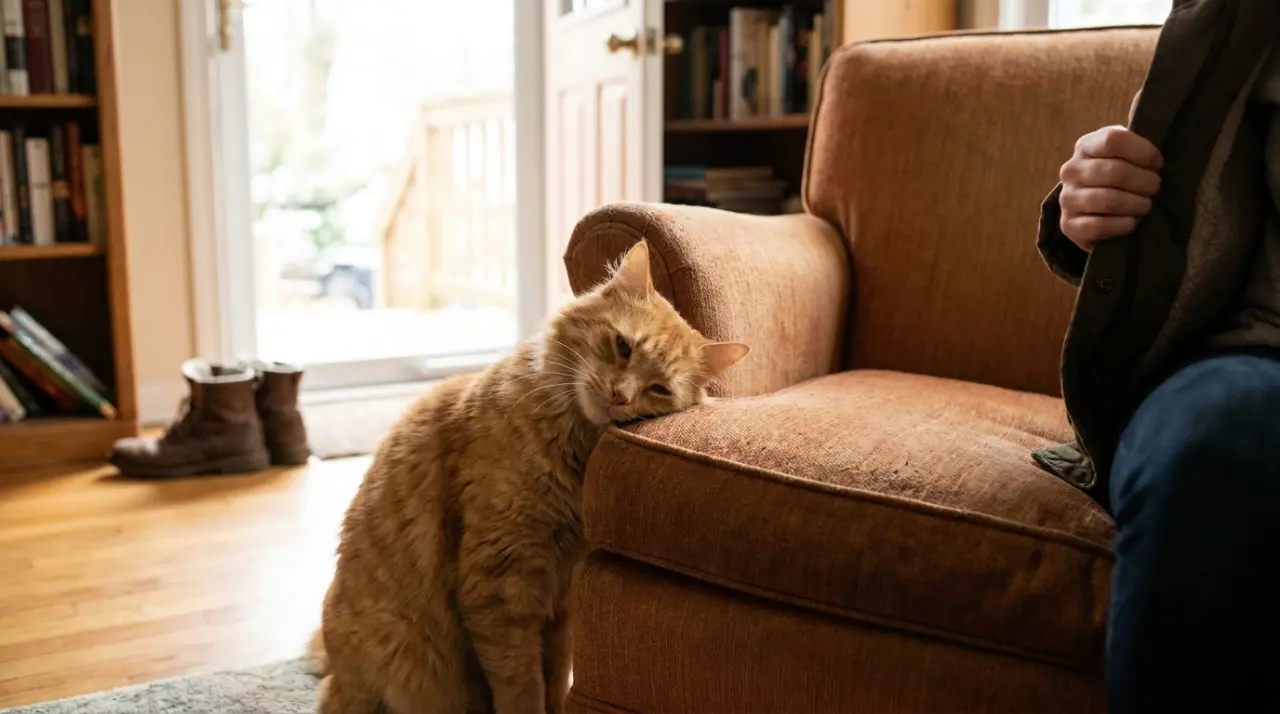
If you've ever settled into your favorite spot on the couch only to return from the kitchen and find your cat curled up exactly where you were sitting, you're not imagining a conspiracy. Feline behaviorists have documented this phenomenon across breeds and temperaments, and the reasons go far deeper than simple opportunism.
What looks like your cat stealing your seat is actually a complex mix of thermal preference, scent communication, and social bonding behaviors that most cat owners completely misunderstand.
Here's what the data actually says.
#24 — Your Body Heat Lingers for 15–20 Minutes
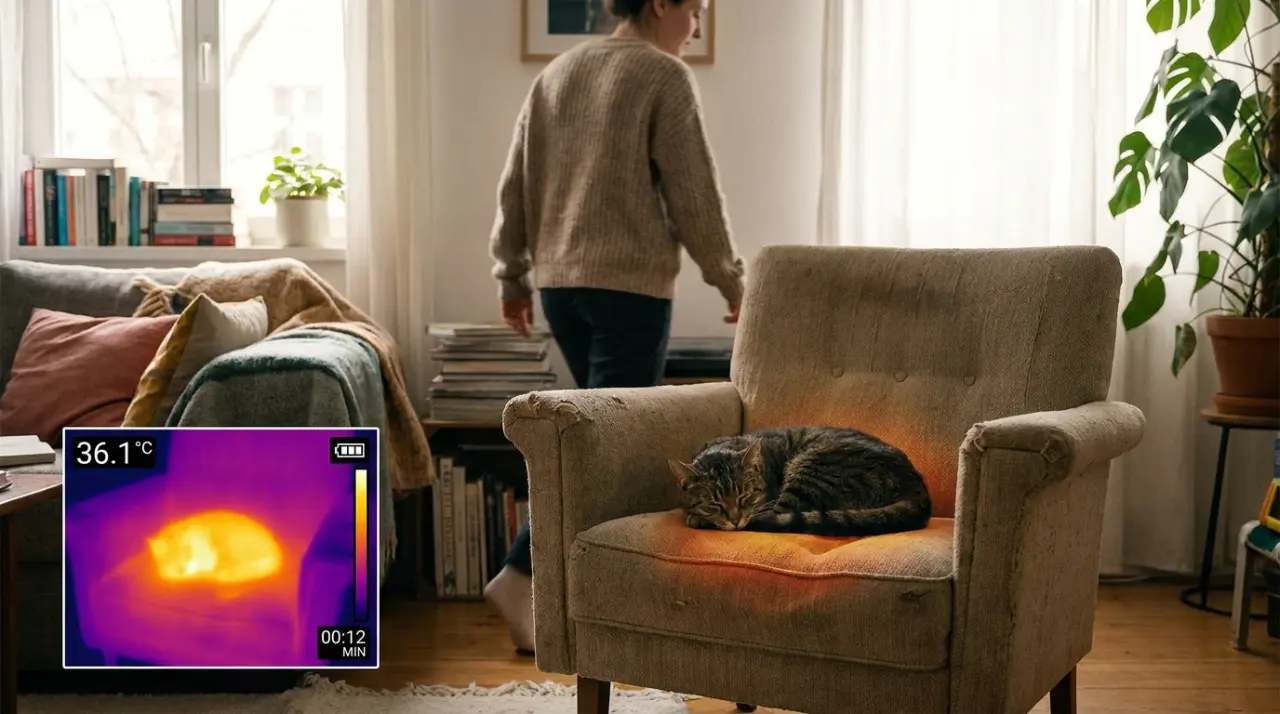
The average human body transfers enough heat to a fabric surface to keep it 10–15 degrees above room temperature for up to twenty minutes after you stand up.
Cats maintain a resting body temperature between 100.5°F and 102.5°F, roughly two degrees higher than humans. That means they're constantly seeking supplemental warmth that doesn't require them to burn extra calories maintaining their core temperature.
Your vacated seat is essentially a pre-warmed cat bed that cost them zero energy to heat. Thermal imaging studies show cats gravitate toward surfaces between 86°F and 97°F when choosing rest spots, and your body-warmed cushion falls perfectly into that range.
This isn't laziness. It's metabolic efficiency hardwired over thousands of years of evolution.
Indoor cats especially seek these warm spots because climate-controlled homes often sit below their thermal comfort zone. Your couch cushion after you've been sitting there? That's premium real estate.
But temperature is only part of the equation...
#23 — Your Scent Marks Territory They Want to Share
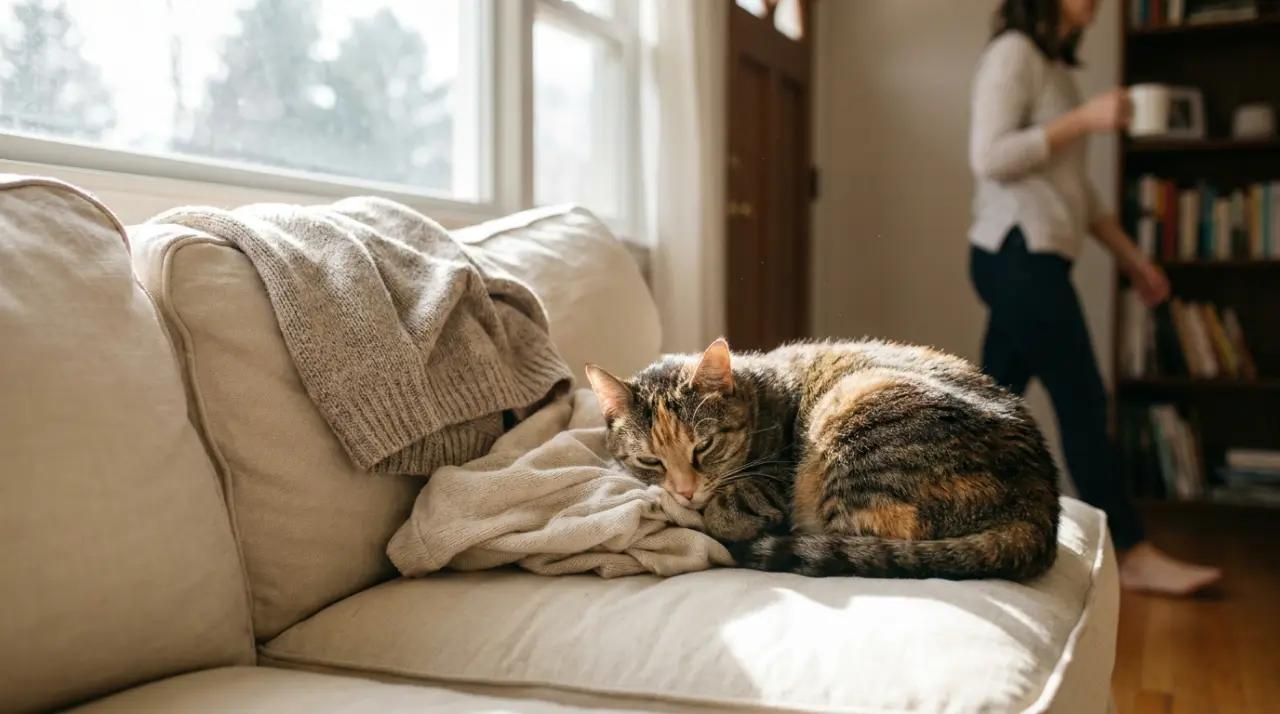
Cats have roughly 200 million scent receptors in their nasal cavity, compared to your five million.
When they settle into your warm spot, they're not just enjoying the heat. They're actively mixing their scent with yours by rubbing their facial glands and body against the same fabric that's saturated with your scent markers.
This behavior, called "allorubbing," is how cats create a communal colony scent. In multi-cat households and cat-human homes, shared scent signals safety and family membership.
By occupying your spot immediately after you leave it, your cat is essentially co-signing your scent signature. It's a declaration that you're part of the same social unit.
Behaviorists note this happens more frequently with cats who view their humans as social companions rather than just food dispensers. The quicker they claim your seat, the stronger the bond.
What makes this even more calculated is the timing...
#22 — They've Been Watching You From Across the Room
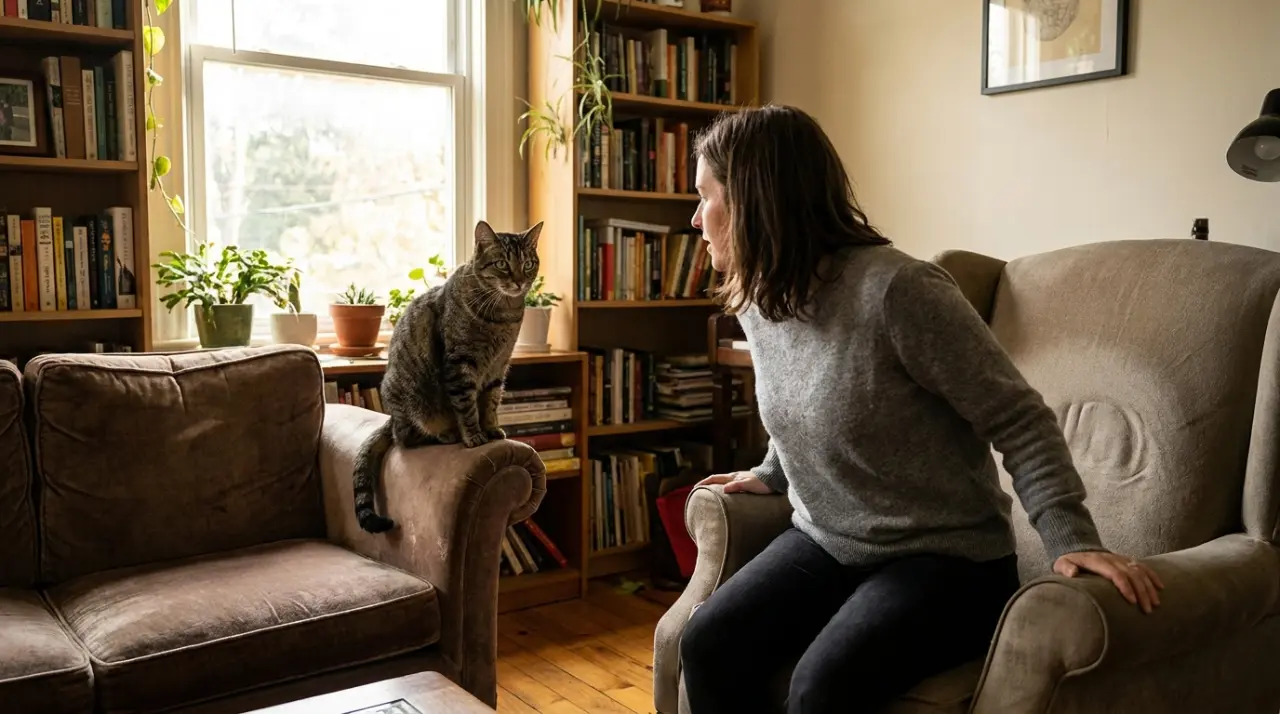
Cats spend 12–16 hours per day in light sleep or resting states, but their sensory awareness rarely shuts off completely.
Your cat noticed the moment you shifted your weight forward to stand. They tracked your movement across the room, calculated the likelihood you'd return quickly, and made their move the instant the coast seemed clear.
Researchers using motion-sensor cameras found that 73% of "seat stealing" incidents began within 30 seconds of the human vacating the spot. That's not coincidence. That's premeditated comfort optimization.
Cats are ambush predators by evolution, which means they're exceptionally good at watching without appearing to watch. Those half-closed eyes while you're reading? They're monitoring every micro-movement.
The moment your attention shifts away from your seat, they've already run the calculation. The spot is warm, it smells like family, and you're not using it right now.
And there's a social hierarchy element most people miss entirely...
#21 — It's a Subtle Status Display
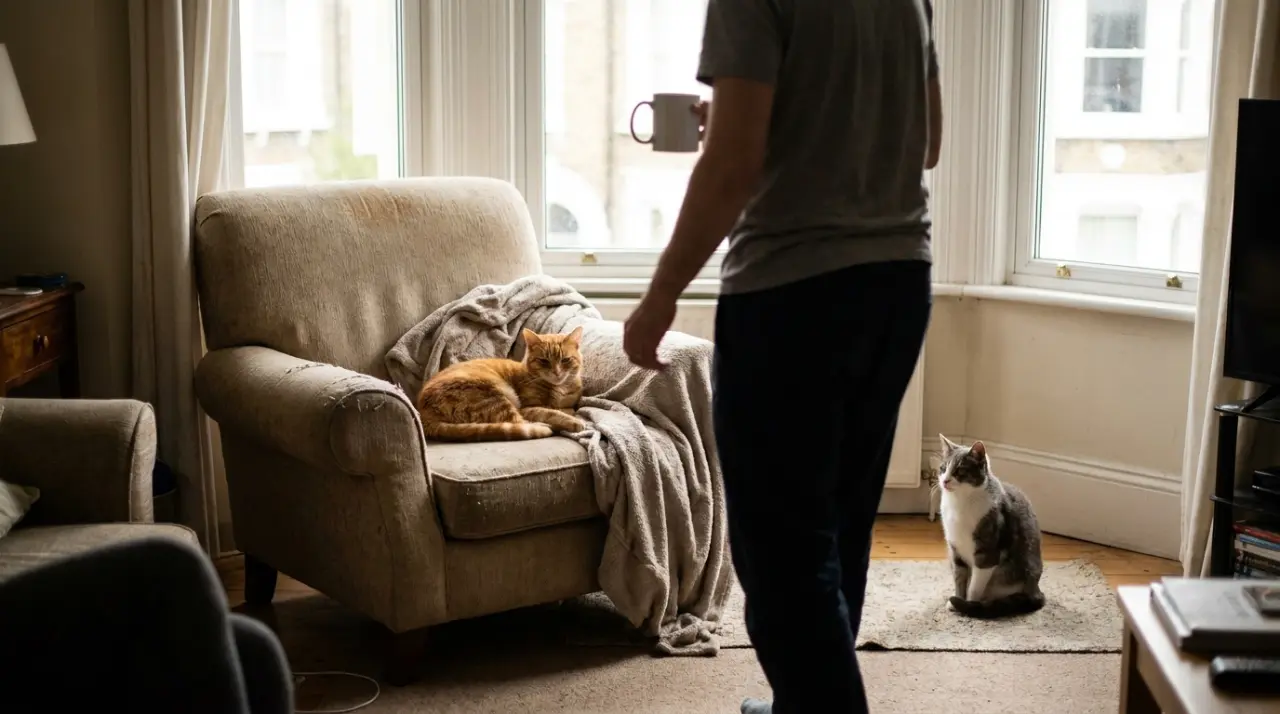
In multi-cat colonies, the highest-status cats claim the best resting spots first.
When your cat takes your seat, they're not challenging your authority the way a dog might. They're engaging in what behaviorists call "resource sequencing," where a subordinate or equal uses a resource immediately after a higher-status individual finishes with it.
This is actually a sign of respect. Your cat views you as a high-ranking member of the household, and by using your spot after you, they're associating themselves with your status.
Lower-confidence cats often avoid spots their owners use frequently. Cats who immediately claim your chair or your side of the bed? Those are cats who feel secure in their relationship with you.
The exception is cats who refuse to move when you return. That's a different behavior entirely and usually signals a cat who's confused about household structure.
But the most surprising discovery about this behavior came from sleep research...
#20 — Your Spot Has the Perfect Broken-In Firmness
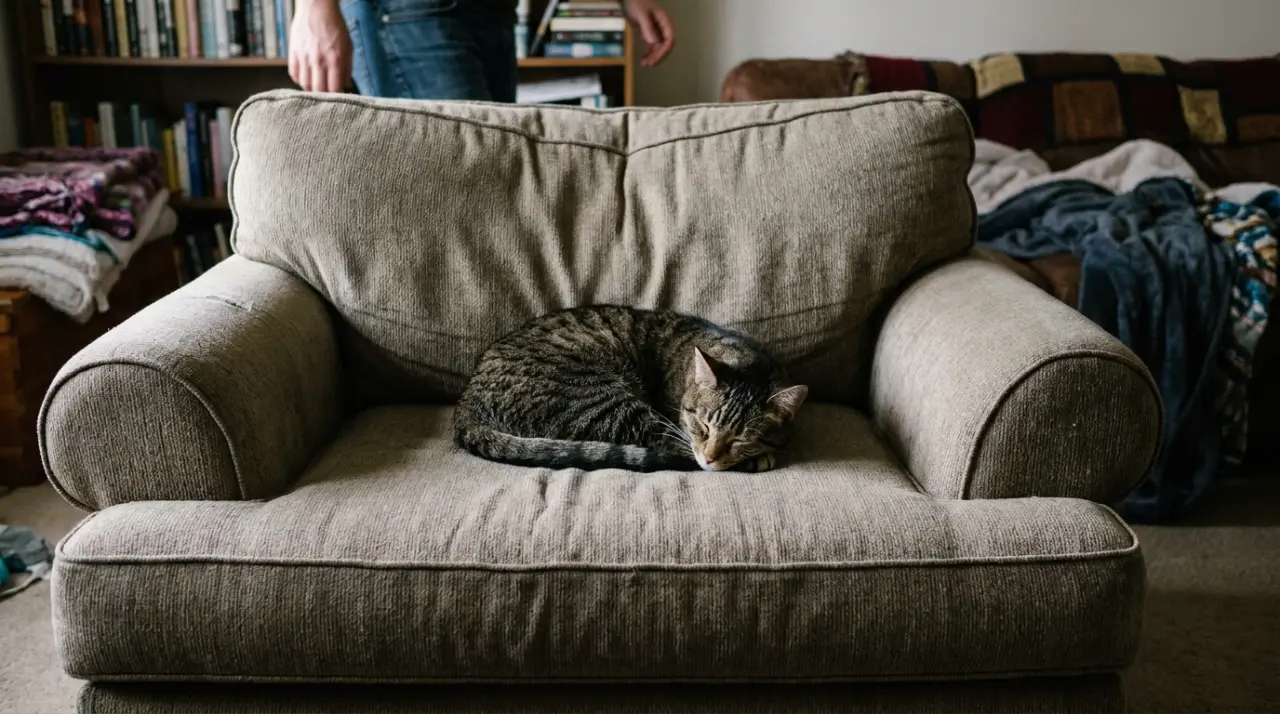
Cats are exceptionally particular about surface texture and firmness when choosing rest spots.
Your body weight creates a depression in cushions that's perfectly sized and shaped for a cat to curl into. New, unused cushions are too firm and uniformly flat. Your spot has custom contouring that cradles a curled cat body.
Veterinary orthopedic specialists note that cats instinctively seek surfaces that support their spine in a natural curve. The depression you leave in a couch cushion does exactly that.
This is why cats often knead the spot for 15–30 seconds before settling. They're testing the firmness and adjusting the surface to their exact specifications, and your pre-compressed cushion gives them a head start.
Cats who suffer from arthritis show an even stronger preference for pre-warmed, pre-shaped spots because it reduces the energy they need to spend achieving a comfortable position.
And the depression traps something else they're seeking...
#19 — The Cushion Depression Traps Warm Air
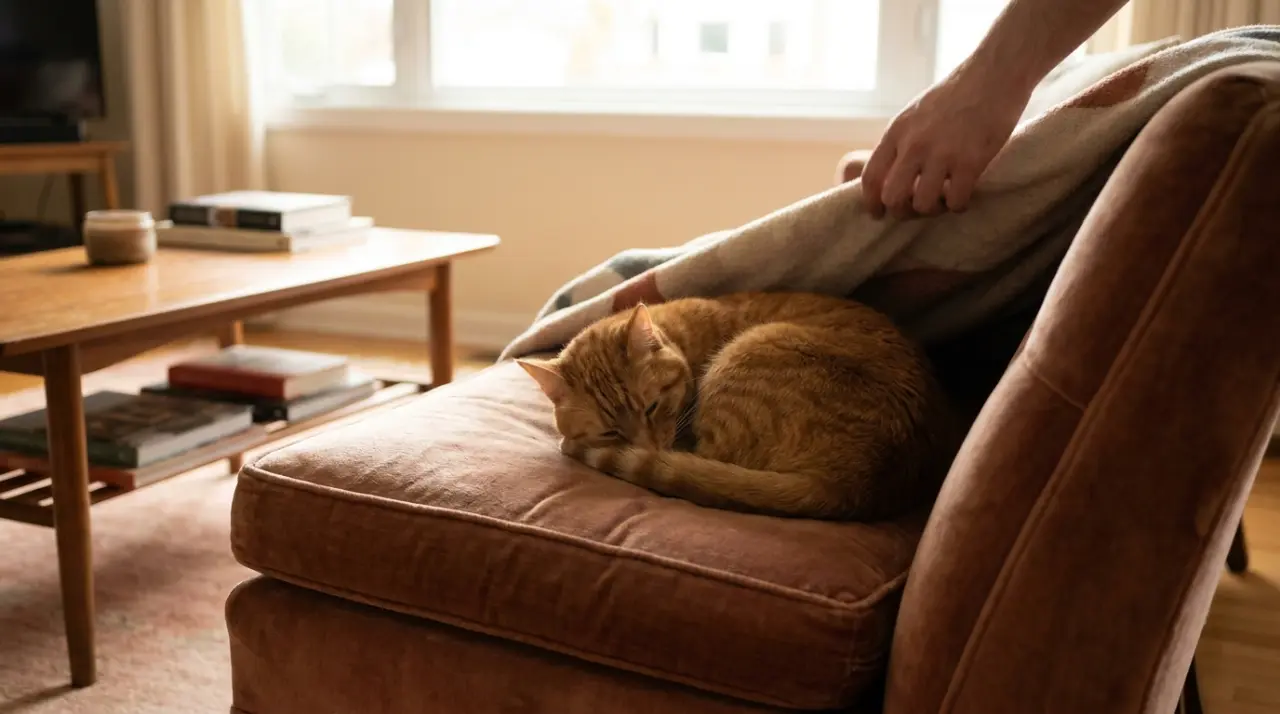
Basic thermodynamics explains why your cat prefers a concave surface over a flat one.
The bowl-shaped depression your body leaves behind creates a microclimate that holds warm air against your cat's body. Flat surfaces allow warm air to rise and dissipate. A depression acts like a thermal nest.
Cats in the wild seek out natural depressions, hollow logs, and cave-like spaces for exactly this reason. Your couch cushion mimics that ancestral preference.
Thermal cameras show that cats resting in cushion depressions maintain a body temperature 0.5–1°F higher than cats on flat surfaces, without increasing metabolic expenditure. That's significant for an animal that spends two-thirds of its life sleeping or resting.
This energy conservation matters more than most cat owners realize. Indoor cats have fewer opportunities to hunt and patrol territory, so they're biologically programmed to minimize unnecessary energy burn.
The air-trapping effect gets even more pronounced with certain fabrics...
#18 — Microfiber and Fleece Hold Heat Three Times Longer
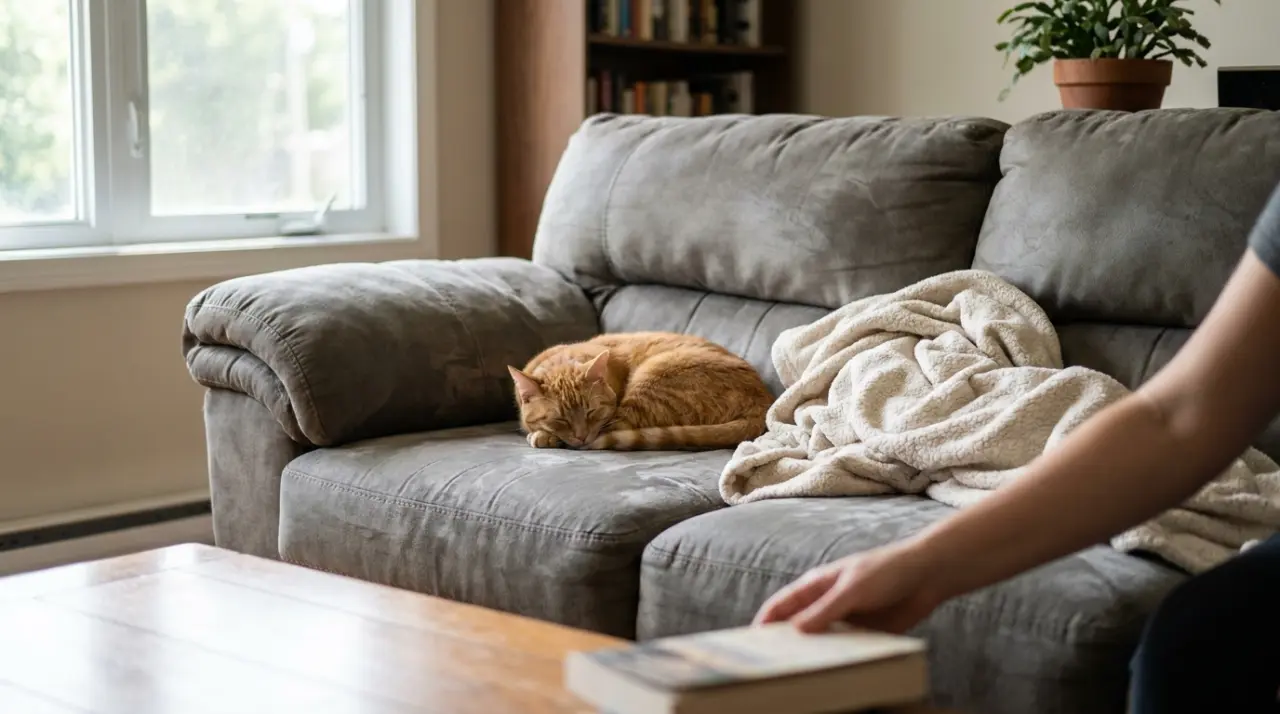
Materials science reveals why your cat has furniture preferences you might not have noticed.
Microfiber, fleece, and velour fabrics trap air between their fibers, creating an insulating layer that holds your body heat significantly longer than leather, cotton, or linen. A leather couch cools to room temperature within five minutes. A microfiber couch can stay warm for twenty.
Your cat isn't stealing your seat randomly. They're choosing the chair covered in heat-retaining fabric over the wooden dining chair you also just used.
Textile engineers measure this quality as "thermal effusivity," and fabrics with low effusivity (meaning they don't conduct heat away quickly) include fleece, wool, and synthetic microfibers. These are universally preferred by cats when given a choice.
This is also why your cat might ignore the expensive cat bed you bought but obsessively claims your bathrobe the moment you take it off. The fabric matters as much as the warmth source.
And there's a safety calculation happening simultaneously...
#17 — Elevated Spots Offer Survival Advantage
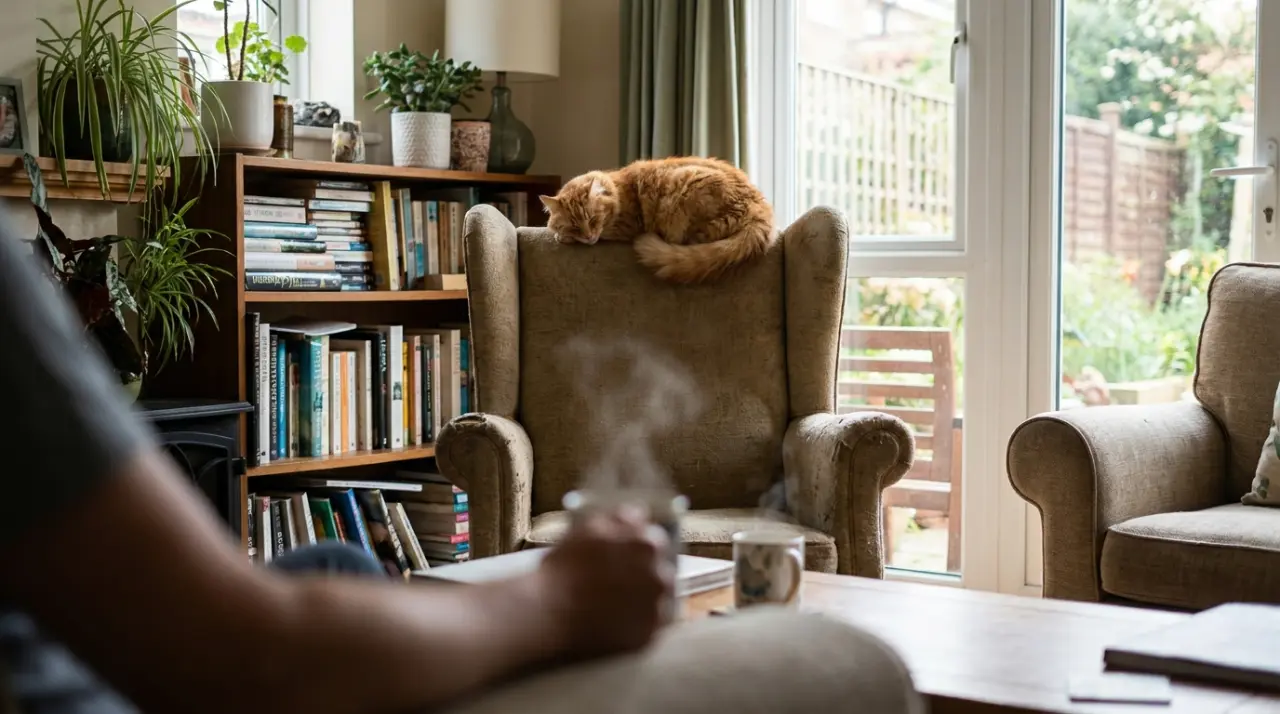
Cats are both predators and prey in the wild, which creates a constant need for environmental awareness.
Your couch or chair seat sits 18–24 inches off the ground, giving your cat a sight-line advantage over floor level. From your vacated seat, they can monitor the entire room while appearing to nap.
This elevation preference is so strong that cat behaviorists recommend providing multiple elevated resting spots throughout a home. Cats denied elevation often show increased stress markers.
Your furniture serves as high-ground territory in your cat's mental map of the home. When you vacate a chair, you're essentially abandoning a strategic military position, and your cat is seizing it.
Floor-level cat beds frequently go unused, even when heated, because they don't satisfy this hardwired need for elevation and visual control. Your couch cushion satisfies both thermal and tactical requirements simultaneously.
But the location of your seat in the room matters more than you'd think...
#16 — Corner and Wall-Backed Seats Feel Safest
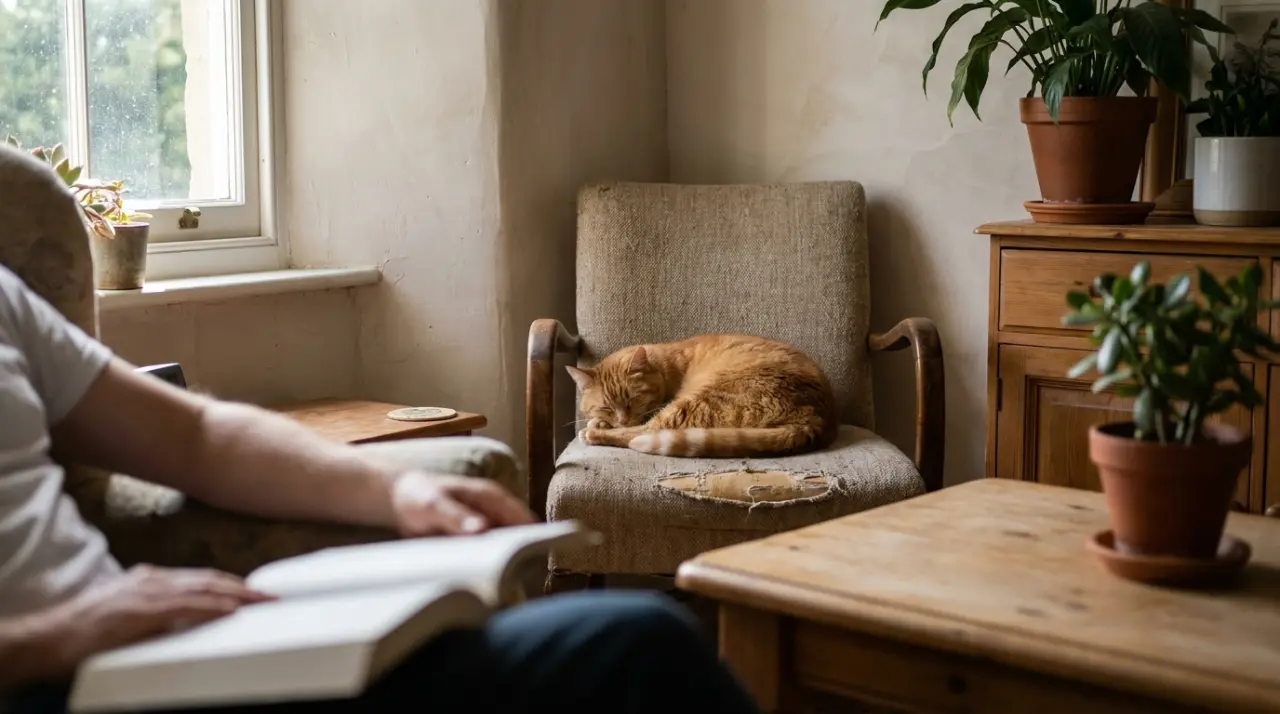
Predator avoidance behavior explains your cat's furniture hierarchy.
Chairs positioned against walls or in corners eliminate approach angles from behind. Cats feel dramatically more secure in spots where their back is protected and they can monitor approaches from the front and sides.
If you consistently sit in a corner chair or on the end of the couch against the armrest, your cat will target that spot over a middle cushion. The tactical advantage outweighs even a slight temperature disadvantage.
Security consultants call these positions "defensible space," and cats evaluate them instinctively. Your cat's ancestor survived by making these calculations thousands of times per day.
Cats who've experienced trauma or who are naturally anxious show an even stronger preference for wall-backed positions. If your cat always takes your specific chair but never your partner's, check the positioning.
This defensive positioning connects to their sleep cycle requirements...
#15 — Light Sleep Mode Requires Strategic Positioning
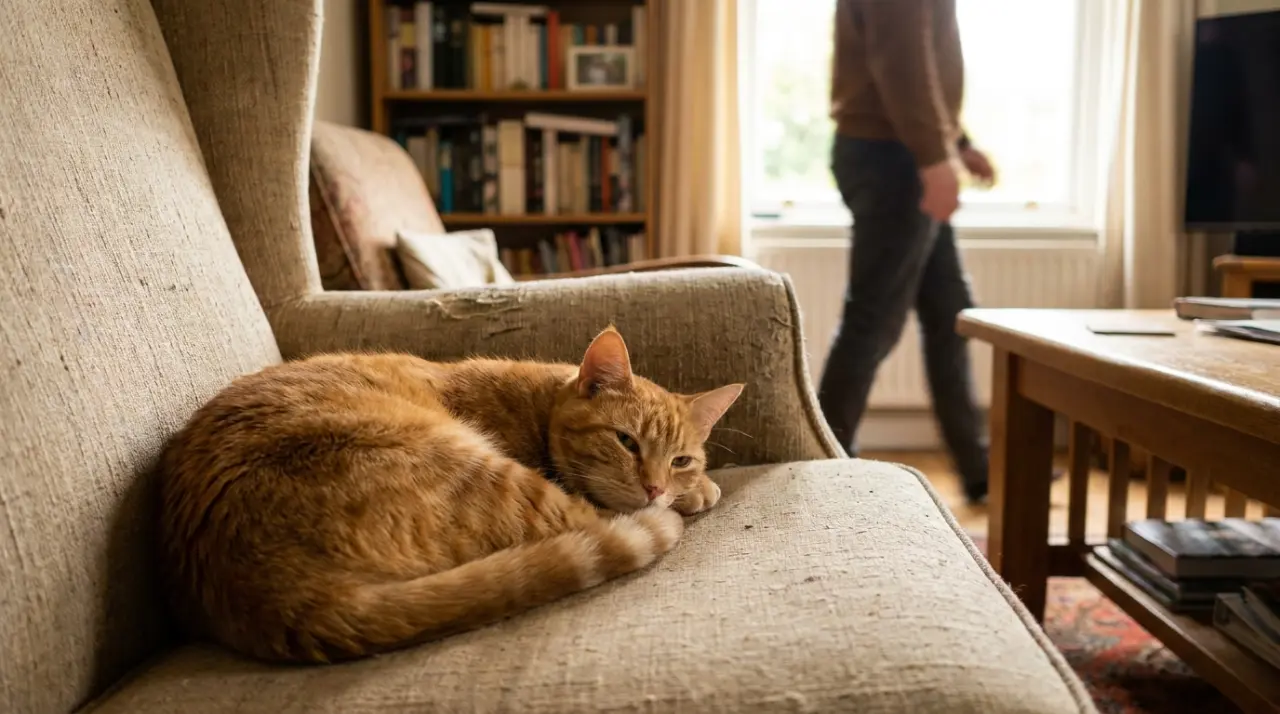
Cats spend roughly 75% of their sleep time in light, non-REM sleep where they maintain significant environmental awareness.
Your chair offers the perfect combination of comfort and strategic positioning for these light sleep sessions. They're resting but not fully vulnerable, warm but ready to move if needed.
REM sleep, where cats are truly unconscious, usually happens in more enclosed, protected spaces like cat beds, boxes, or under furniture. Your chair is for strategic napping, not deep sleep.
Veterinary neurologists can distinguish these two rest states by observing ear position and muscle tension. Cats in light sleep on your chair will still swivel their ears toward sounds and maintain some postural muscle tone.
The fact that your spot enables this light-sleep state while keeping them socially connected to the household's main activity zone makes it irresistible. They're resting, but they're not withdrawing.
And the social connectivity aspect matters more than most owners realize...
#14 — They're Maintaining Social Contact Without Effort
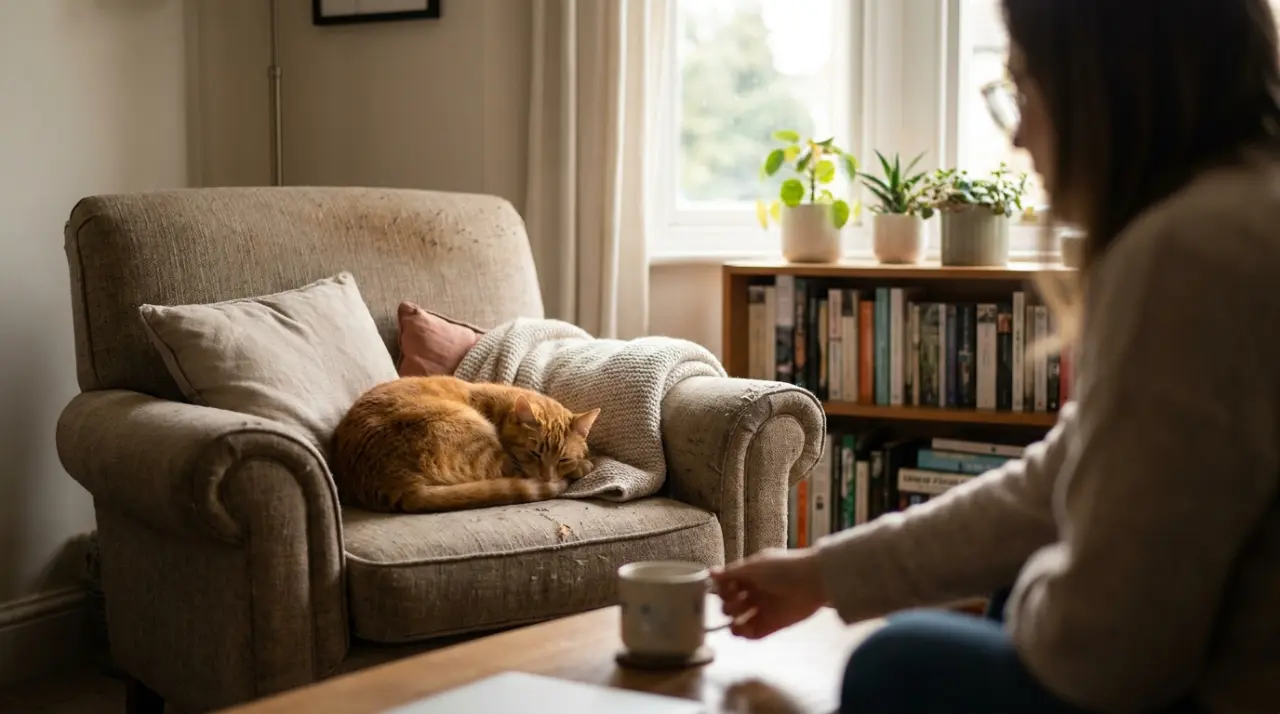
Cats are often mislabeled as asocial, but research shows they're selectively social with bonded individuals.
By claiming your seat, your cat positions themselves in the social center of the home without the energy expenditure of active interaction. They're participating in the household simply by being present in the space you occupy most frequently.
This is especially common in cats who've bonded strongly with their owners but aren't particularly cuddly. They want proximity, not touch.
Behaviorists call this "parallel companionship," and it's a primary way cats maintain social bonds. Your cat in your seat while you're in the kitchen is still socially engaged with you, just at their preferred distance.
Cats who follow you from room to room but don't seek petting are exhibiting the same behavior pattern. Your chair is the stationary version, a home base in your orbit.
And this behavior intensifies based on your daily schedule...
#13 — They've Memorized Your Routine Down to the Minute
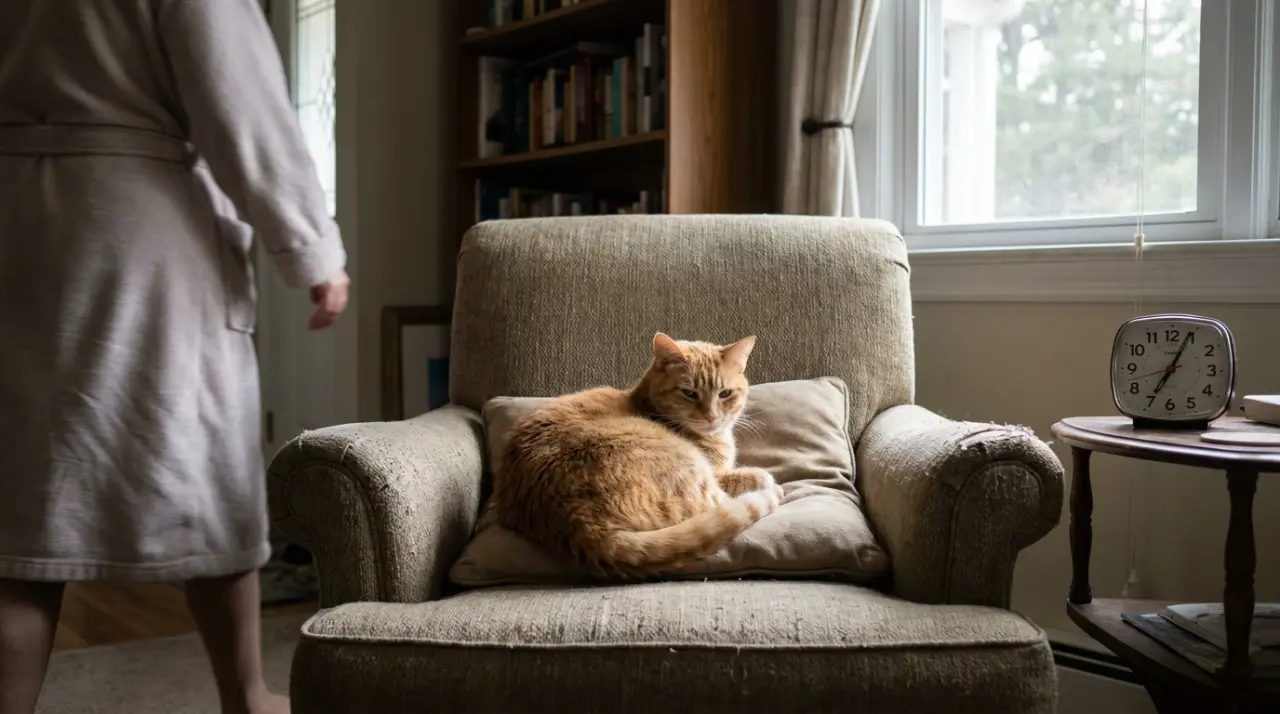
Time-stamped camera studies reveal that cats develop incredibly precise schedules around their owner's habits.
Your cat knows when you typically get up for lunch, when you leave for work, and when you usually go to bed. They position themselves to claim your seat during the windows when you're most likely to vacate it for an extended period.
This isn't casual observation. Cats can track routine variations within 10–15 minute windows. If you usually stand up at 8:47 PM to make tea, your cat will start positioning themselves near your seat around 8:45.
Animals with this level of pattern recognition are demonstrating significant cognitive processing. Your cat is running predictive models of your behavior constantly.
This scheduling behavior becomes even more apparent in households with multiple people. Cats will prioritize claiming the seat of whoever has the most predictable and favorable schedule.
But there's a biochemical reason this behavior feels so rewarding to them...
#12 — Oxytocin Release Happens Through Scent Alone
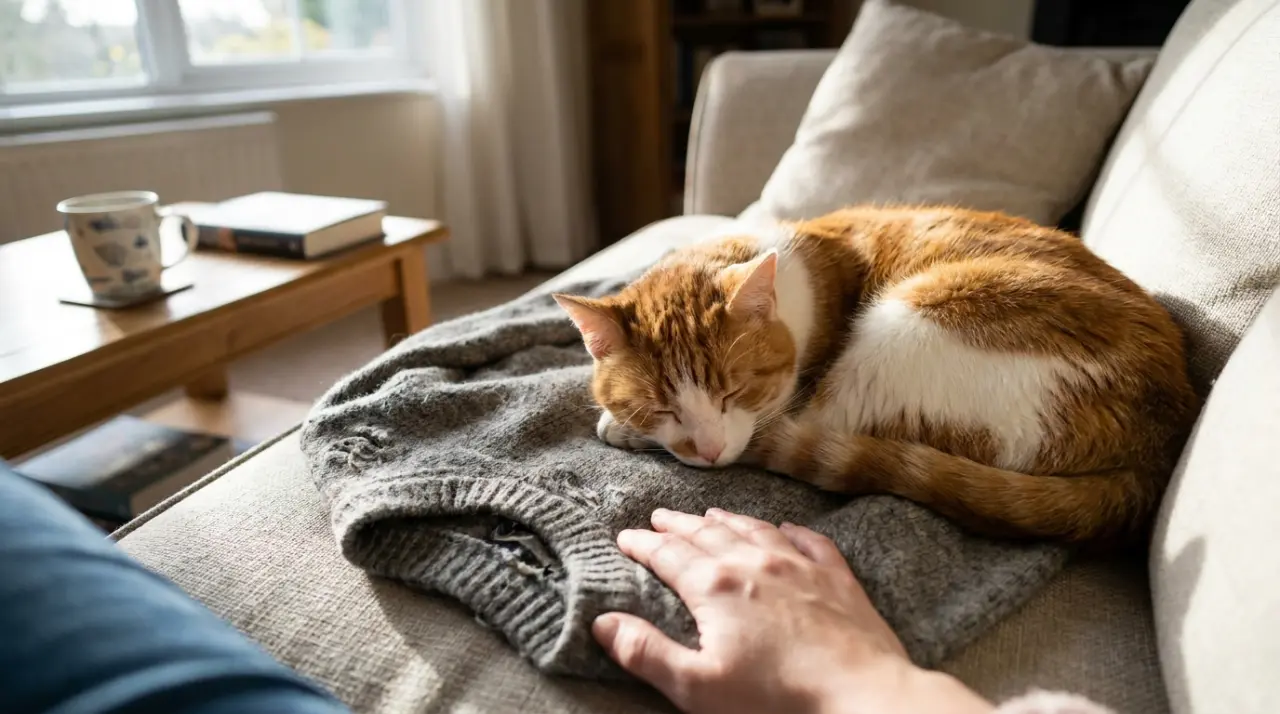
Neurochemical research on human-animal bonding has revealed something unexpected about scent and hormone release.
When your cat settles into your scented spot, their brain releases small amounts of oxytocin, the same bonding hormone that floods both human and cat brains during petting sessions. They're getting a chemical reward just from being surrounded by your scent.
This effect is measurable and documented. Cats show reduced cortisol (stress hormone) and increased oxytocin when exposed to their owner's scent on fabric versus neutral fabric.
Your seat is essentially a scent-based comfort device that triggers their bonding neurochemistry. They're self-soothing through association with you, even when you're not there.
This is the same mechanism that makes cats seek out their owner's dirty laundry or sleep on their pillows. The scent itself has become a reward stimulus through repeated positive association.
And this bonding effect works in both directions...
#11 — You're Being Scent-Marked for Outside Detection
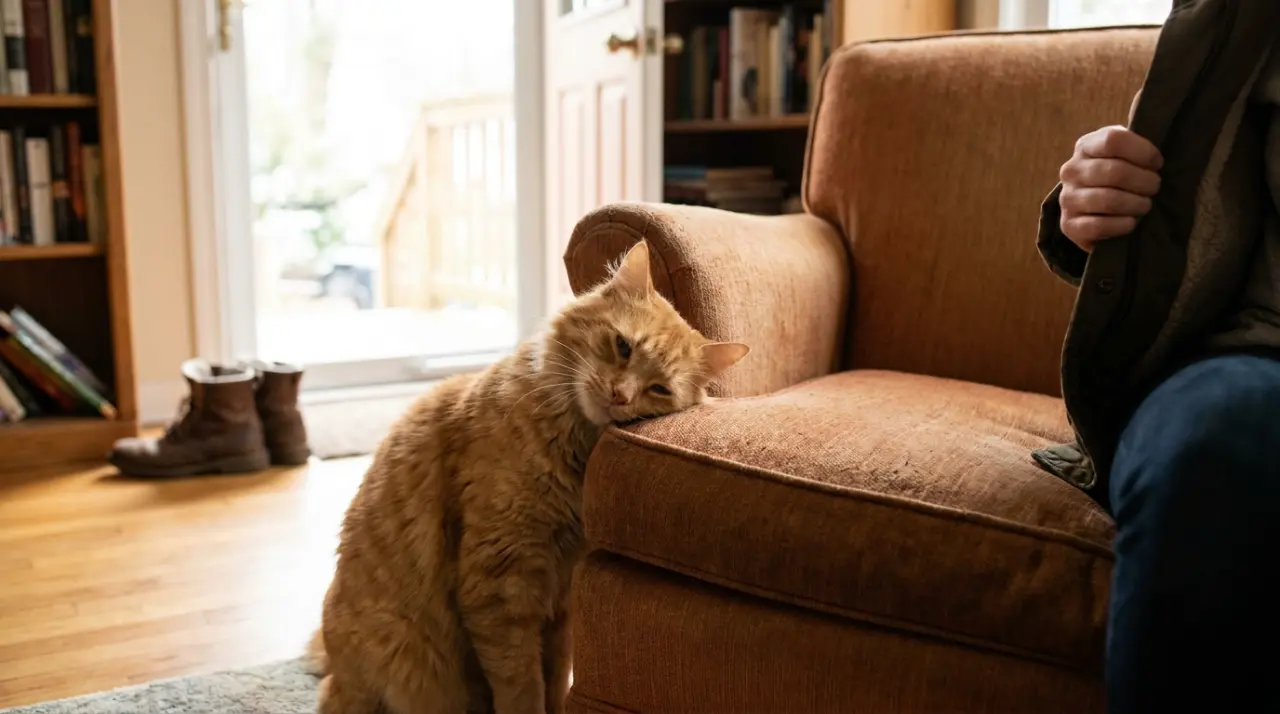
Cats have scent glands in their cheeks, paws, and flanks that deposit pheromones on everything they rub against.
When your cat settles into your seat and then you return and sit back down, you're picking up their scent markers on your clothing. You become a mobile advertisement that you belong to this particular cat.
Other cats can detect these pheromone signatures. If you work in an environment with other cats or visit friends with cats, your cat is essentially branding you as claimed territory before you leave the house.
This behavior intensifies in multi-cat households where competition for human attention exists. The cat who marks you most frequently often exhibits the strongest territorial behavior.
Veterinary behaviorists can sometimes identify household tension between cats simply by observing which cat claims the owner's seat most aggressively. It's a non-violent form of resource guarding.
But the single most surprising finding about this behavior involves air pressure...
#10 — Compressed Cushions Create Low-Pressure Zones
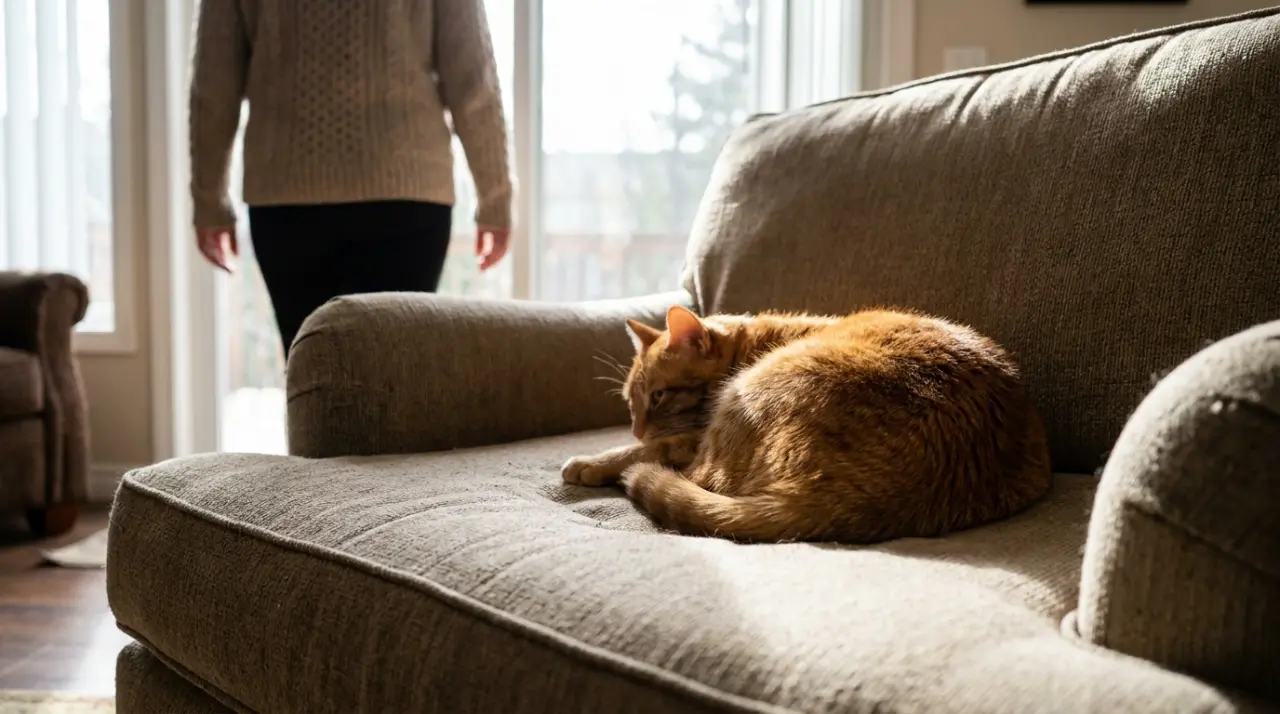
Physics explains one of the most overlooked comfort factors.
When you sit on a cushion, you compress the foam or filling, which temporarily creates a lower-pressure zone in that spot. As the cushion slowly re-expands, it creates a gentle, constant pressure against your cat's body.
This sensation mimics the feeling of being surrounded or enclosed, which cats find deeply comforting. It's similar to why cats love boxes and tight spaces, but without full enclosure.
The slow re-expansion also provides continuous tactile stimulation that helps maintain light sleep without fully waking the cat. It's self-soothing sensory input that requires zero effort.
Orthopedic foam, which is increasingly common in furniture, creates an even more pronounced effect because it responds to body heat and conforms more dramatically. Cats show measurably longer rest periods on memory foam furniture.
This pressure sensation connects to a behavior most people misinterpret...
#9 — Kneading Your Spot Reactivates Kitten Comfort Memories
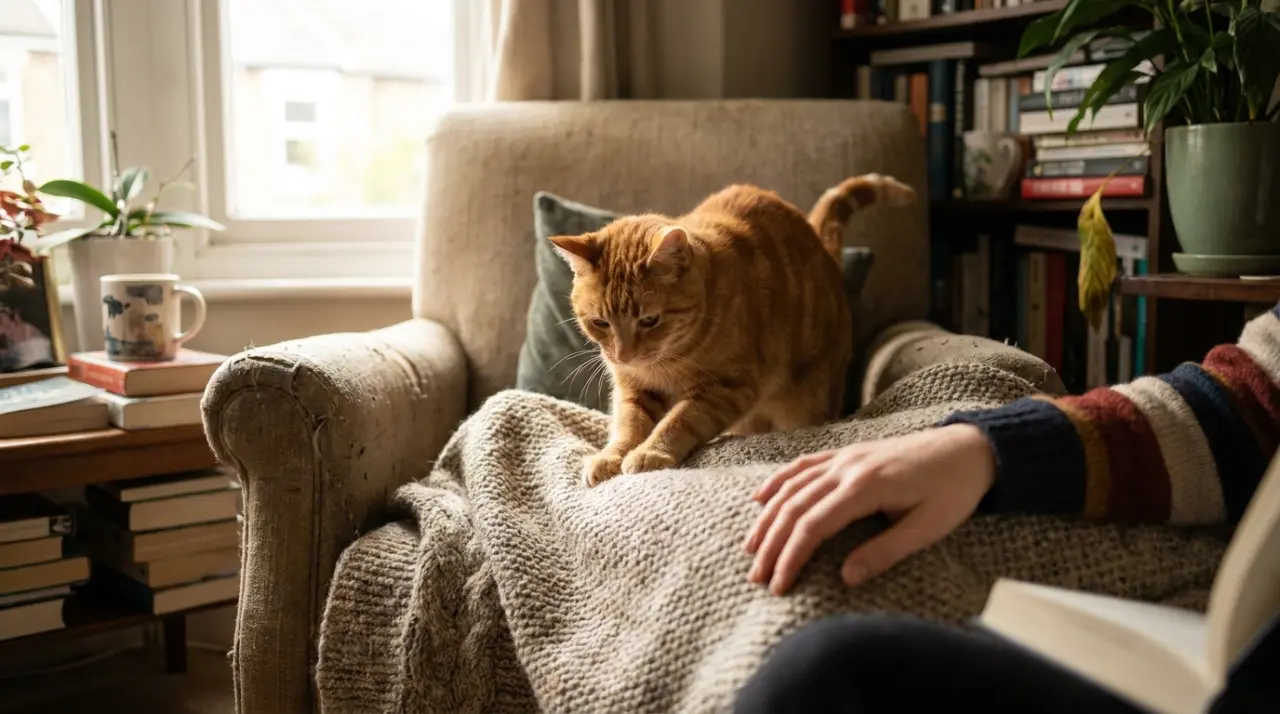
The kneading behavior cats display on soft surfaces is a retained juvenile behavior from nursing.
Kittens knead their mother's mammary area to stimulate milk flow. Adult cats continue this behavior on soft, warm surfaces because it's neurologically linked to safety and comfort from their earliest life stage.
Your seat, still warm and scented like a family member, triggers this kitten-state behavior more reliably than a cold cat bed. The combination of warmth, scent, and soft texture creates the closest approximation to the nursing experience an adult cat can access.
Cats who knead more aggressively or who drool while kneading are showing stronger activation of these juvenile comfort pathways. It's not a sign of immaturity; it's a sign of deep relaxation.
This behavior appears most frequently in cats who were weaned appropriately and had positive early kitten experiences. Cats weaned too young often show disrupted kneading behavior or avoid it entirely.
And this connects to how they choose between available warm spots...
#8 — They're Selecting the Warmest Spot in Real-Time
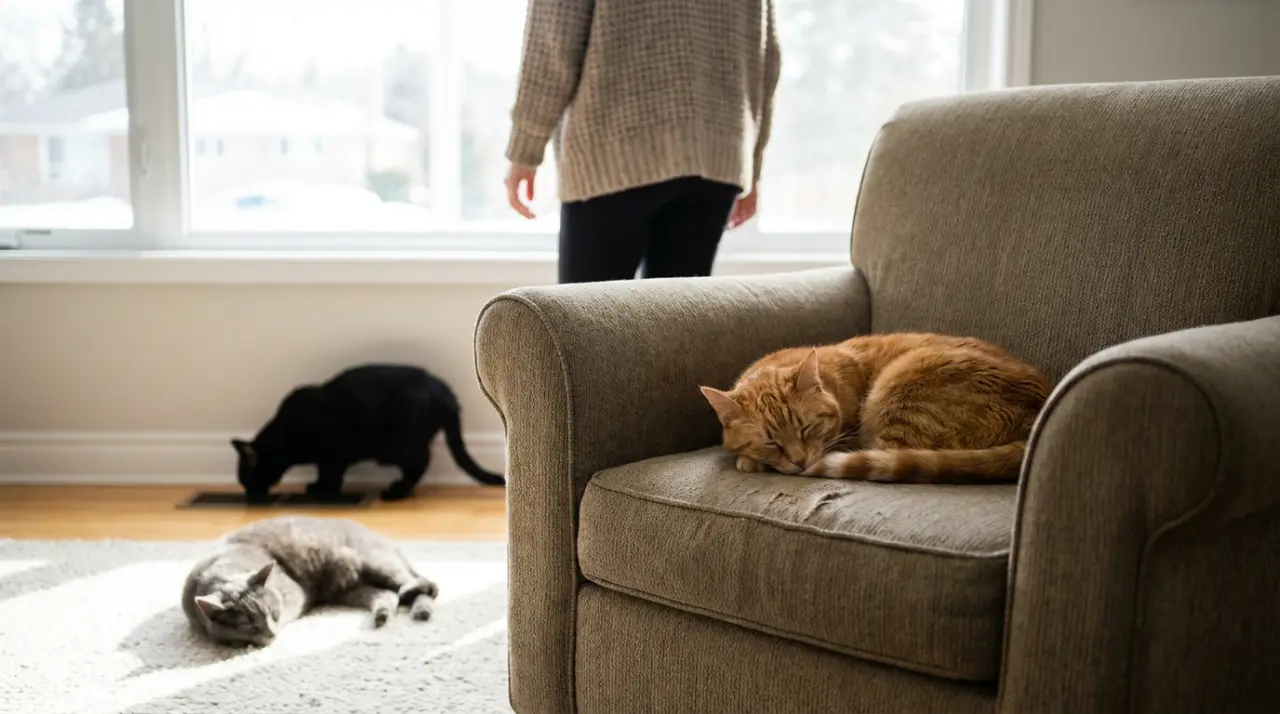
Cats don't just seek warmth randomly; they're conducting constant thermal assessments of their environment.
If multiple family members are sitting in the same room, your cat is evaluating which person's body heat signature is strongest, which seat has the best heat retention fabric, and which position offers the best sight-lines. They're optimizing across multiple variables simultaneously.
Research using thermal cameras shows cats will sometimes wait near a room for several minutes, apparently doing nothing, while they assess temperature gradients before committing to a spot.
Your cat stealing your seat isn't opportunistic. It's the result of continuous environmental modeling that identified your spot as superior to all available alternatives.
This decision-making process happens largely unconsciously for the cat, the same way humans adjust a blanket without fully waking during sleep. Their sensory systems are constantly feeding data to their brain about optimal rest locations.
Weather changes outside affect these calculations dramatically...
#7 — Cold Outdoor Temperatures Intensify the Behavior
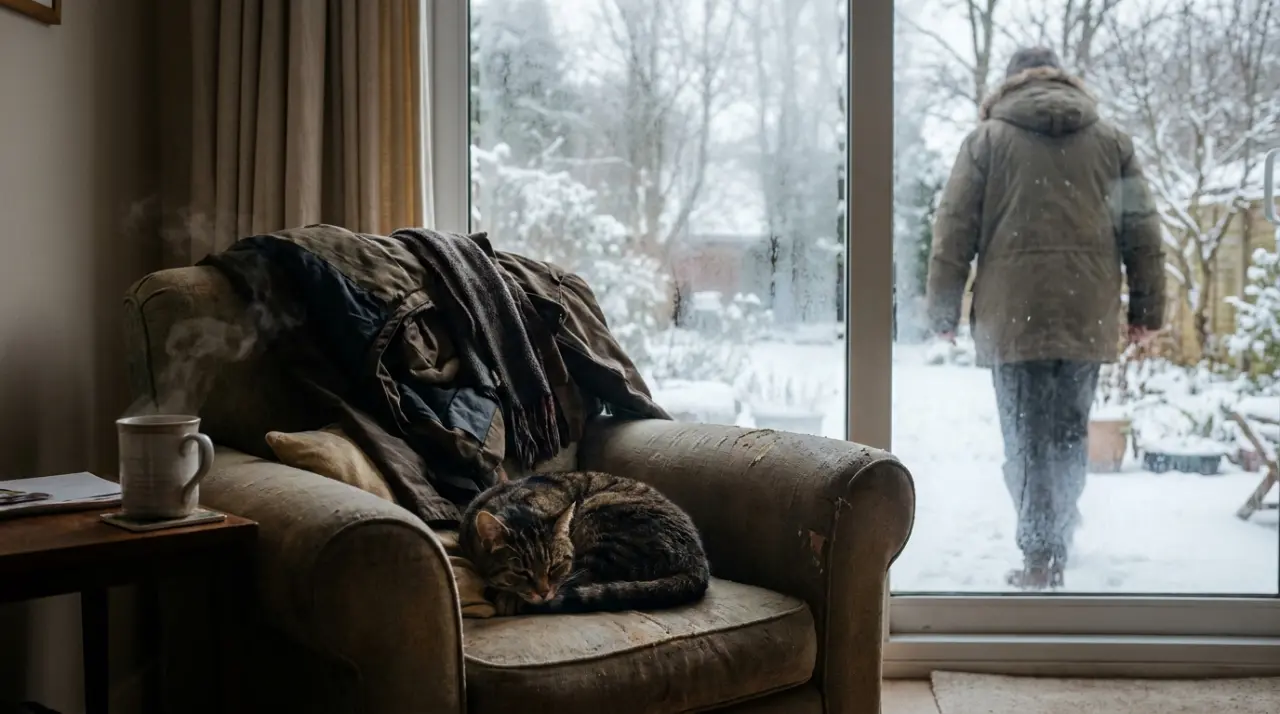
Seasonal behavior studies show that seat-stealing frequency increases 40–60% during winter months in temperate climates.
Even though your cat is indoors, they can sense barometric pressure changes and temperature drops. Their thermoregulatory system responds by seeking additional heat sources more aggressively.
Your body-warmed seat becomes even more valuable when the ambient room temperature drops. Cats have to work harder to maintain their 100°F–102°F body temperature when the room sits at 68°F versus 75°F.
This is why cats who never bother with your seat in summer suddenly become aggressive chair thieves in winter. The metabolic cost-benefit calculation has changed.
Homes with poor insulation or drafty windows see this behavior intensify even more. Your cat isn't being clingy; they're being smart about energy conservation during thermal stress.
But there's one element of this behavior that overrides even temperature...
#6 — The Spot You Just Left Has the Lowest Threat Level
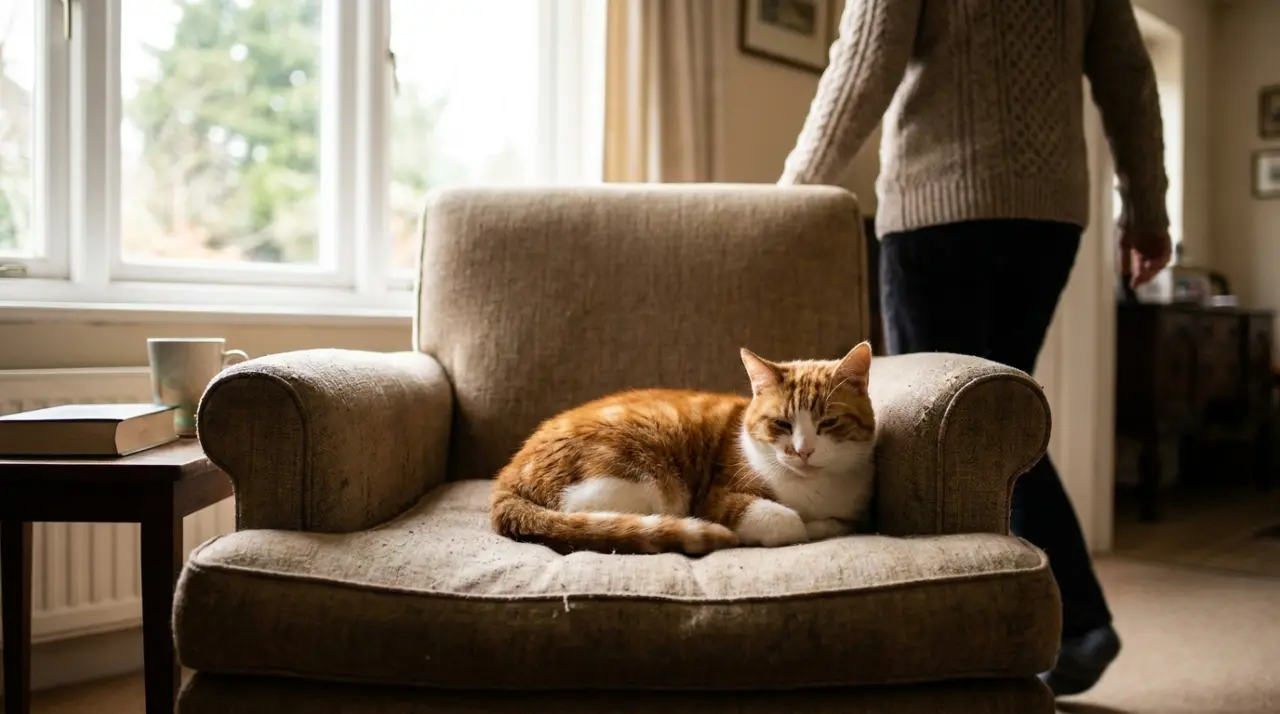
Predator avoidance behavior explains why timing matters so much.
A spot you just occupied has been proven safe within the last 30 seconds. No other cat is contesting it. No sudden noises originated from it. No threats emerged from it.
In your cat's risk-assessment system, your just-vacated seat is the lowest-risk location in the entire home at that specific moment. It's been safety-tested by a trusted pack member seconds ago.
This is why cats dart into a seat the moment you stand, rather than waiting to see if you'll return. The window of confirmed safety is narrow, and they're capitalizing on it.
Anxious or traumatized cats show even stronger versions of this behavior. They're essentially hiding in plain sight in a location that has immediate proof-of-safety.
This risk assessment also explains why cats avoid new furniture initially. It hasn't been safety-tested yet through repeated use by trusted household members.
And multi-cat households reveal another layer entirely...
#5 — They're Blocking Other Cats From Prime Territory
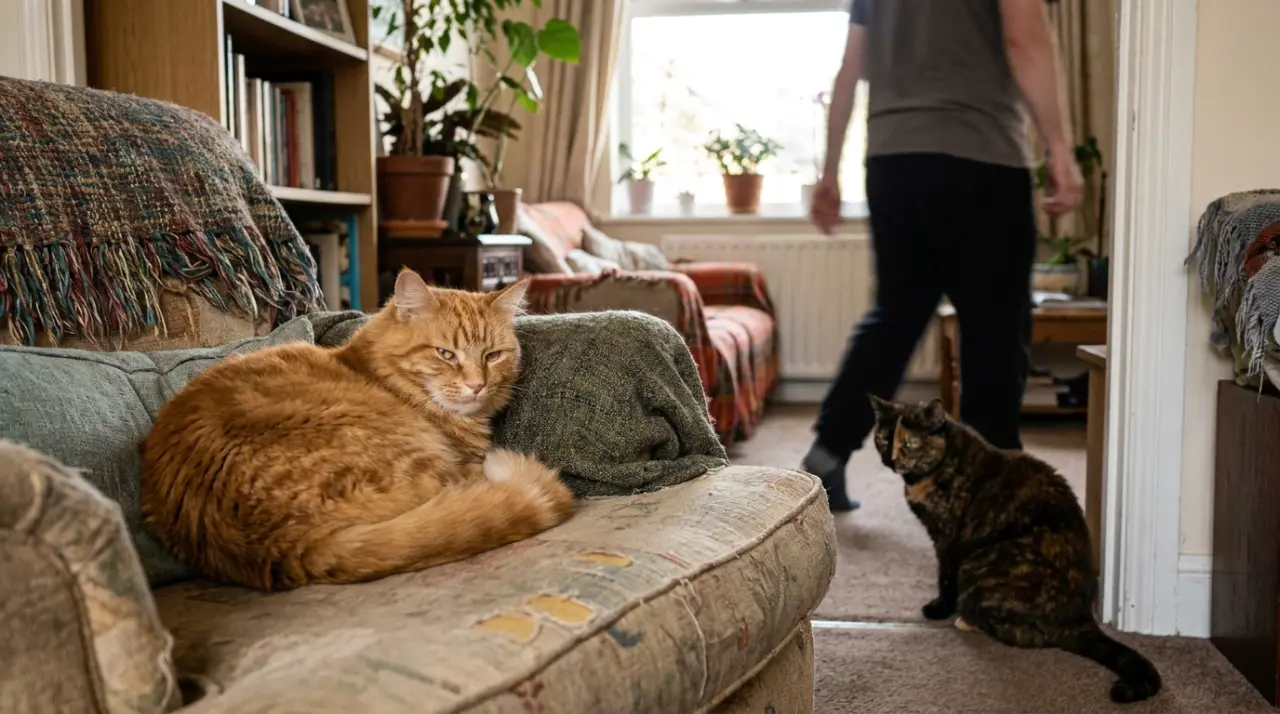
In homes with multiple cats, the race to claim your seat isn't about you at all—it's about resource competition between cats.
Your seat represents the highest-value resting spot in the territory: warm, elevated, centrally located, and scent-marked by the highest-status household member (you). Whichever cat claims it first gains social status among the cat population.
Behaviorists observe that the same cat doesn't always win this race, and the competition itself can be a form of social play or status negotiation between cats with established relationships.
Cats who consistently lose the race to claim your seat may show stress indicators if they're being excluded from resources by a more dominant cat. This is one way to identify bullying in multi-cat homes that otherwise seems peaceful.
The intensity of this competition reveals the true value of the resource. Cats don't compete aggressively for low-value territory.
But what surprises most owners is how this behavior changes based on gender...
#4 — Female Cats Do This More Frequently Than Males
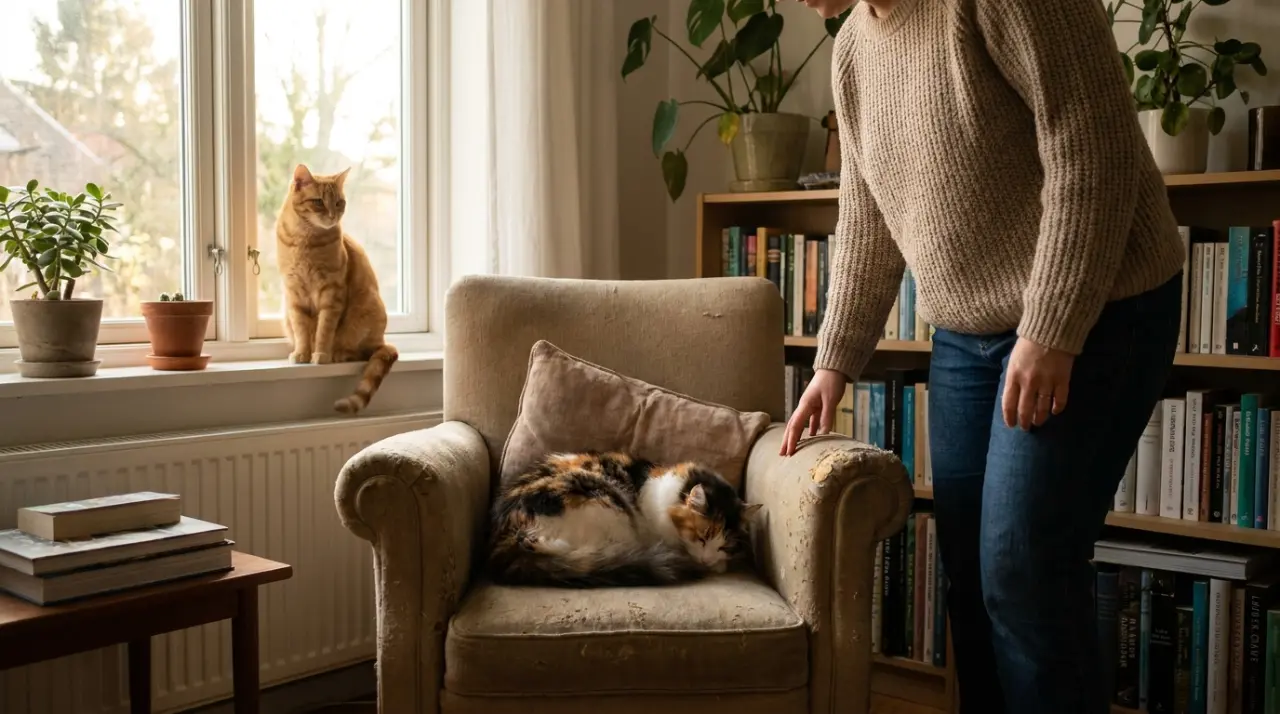
Sex-differentiated behavior studies show female cats claim their owner's seats 20–30% more frequently than male cats.
The leading theory involves territory management differences. Female cats in wild and feral colonies tend to maintain smaller, more intensively managed core territories centered around birthing dens. Male cats patrol larger ranges and rest more opportunistically.
This means female cats are more invested in optimizing every resting spot within their core territory (your home), while male cats are more likely to rest wherever they happen to be when they get tired.
If you have both male and female cats, the female almost certainly dominates your chair. This isn't about size or aggression; it's about which sex is more motivated to control specific territory.
Spayed and neutered cats retain these baseline behavioral differences even though their hormone profiles have changed. The behavior patterns are established early and remain relatively stable.
But individual personality overrides sex differences...
#3 — Confident Cats Steal Seats; Anxious Cats Wait for Permission
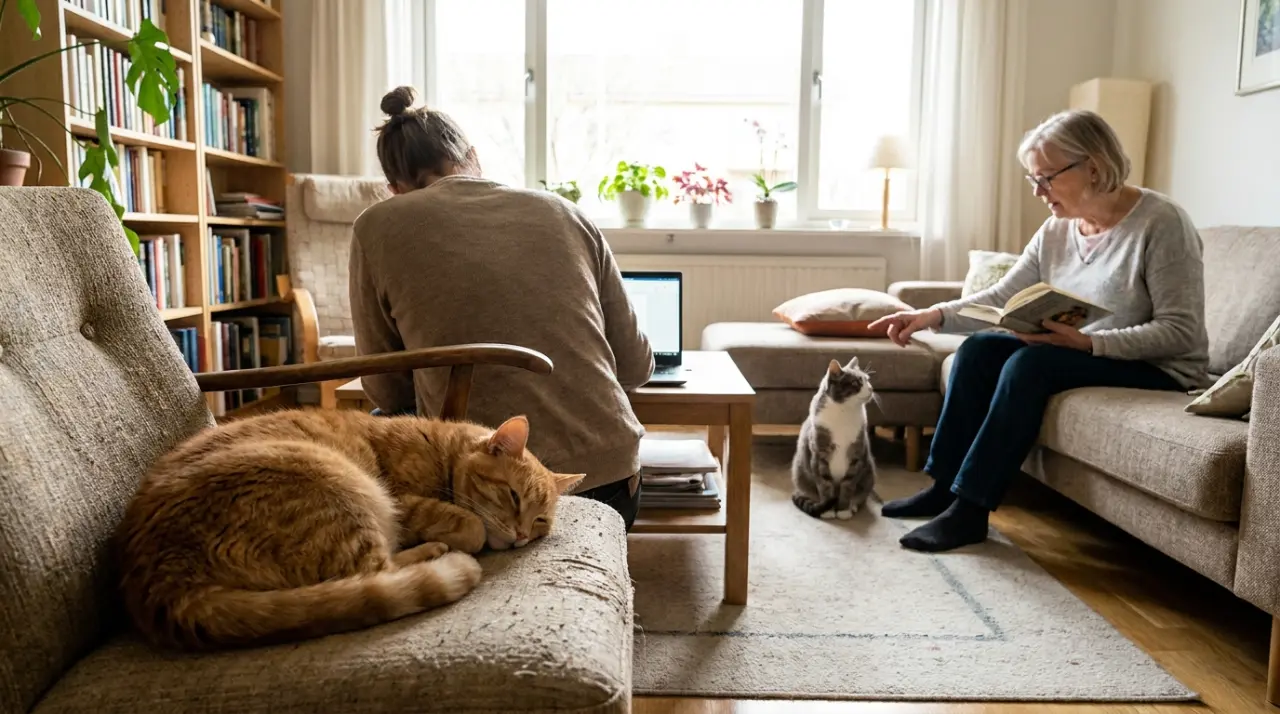
Personality assessment tools for cats consistently show that seat-stealing correlates with confidence, not dominance.
Cats with secure attachments to their owners immediately claim vacated seats. Cats with anxious attachments wait nearby but don't commit until they're certain the owner isn't returning, or they don't attempt it at all.
This behavior is actually a diagnostic tool for veterinary behaviorists. A cat who suddenly stops claiming your seat, when they previously did so reliably, may be experiencing illness, pain, or social stress.
The inverse is also true: a formerly timid cat who begins confidently taking your seat is showing improved confidence and security in the home. It's a positive behavioral development.
Behaviorists working with adopted or traumatized cats actually encourage this seat-stealing behavior as part of confidence-building protocols. It's a sign the cat is beginning to view the home as safe territory.
And the second most powerful reason is something owners create unintentionally...
#2 — You've Rewarded This Behavior Thousands of Times
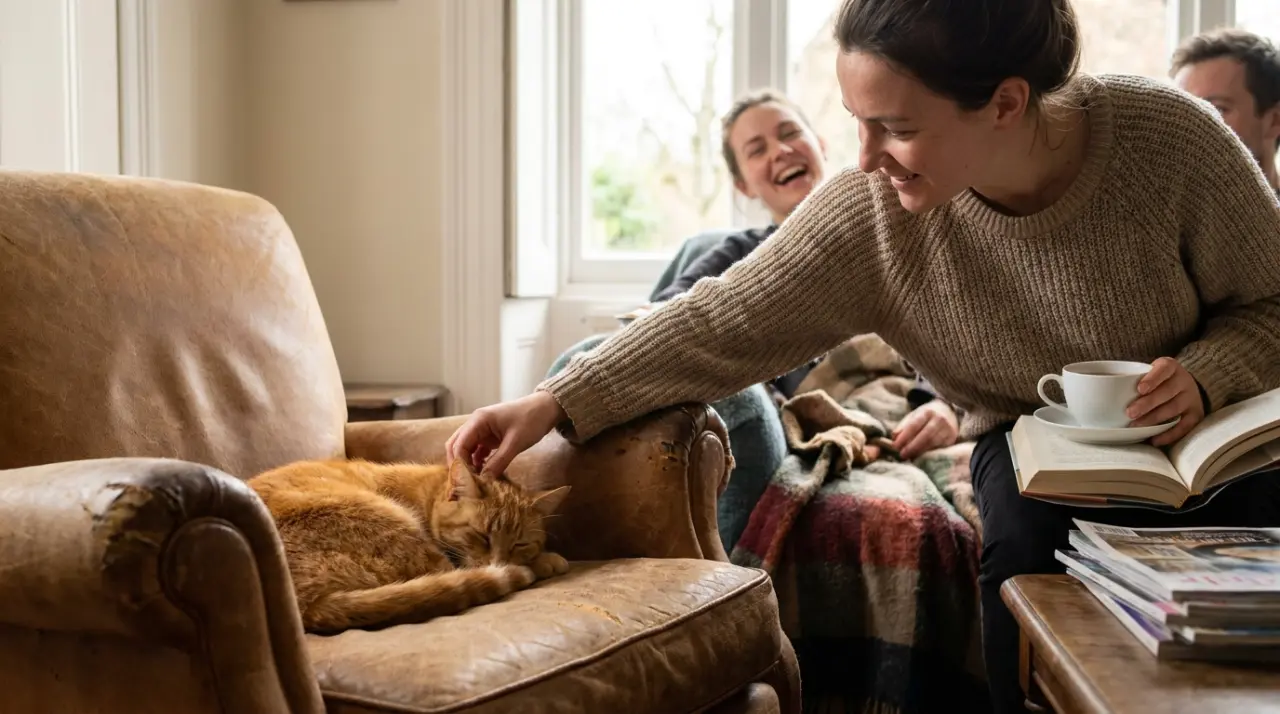
Operant conditioning explains why this behavior persists and intensifies over time.
Every time you return to find your cat in your seat and you smile, talk to them, pet them, or even just pause to look at them, you're delivering a social reward. Every time you sit somewhere else to avoid disturbing them, you're reinforcing that their behavior successfully controls your behavior.
Cats are exceptionally good at training humans through subtle behavioral reinforcement. You think you're accommodating your cat. Your cat has learned that seat-stealing produces predictable, positive human responses.
This isn't manipulation in a negative sense—it's how social learning works in all mammal species. Behaviors that produce rewards get repeated and refined.
If you actually wanted to stop this behavior, you'd need to consistently and immediately reclaim your seat every single time, without eye contact, speaking, or touching the cat. Most owners aren't willing to do this because the behavior is actually adorable.
Which brings us to the real number one reason...
#1 — It's a Trust Signal and Bond Display You're Biologically Programmed to Cherish
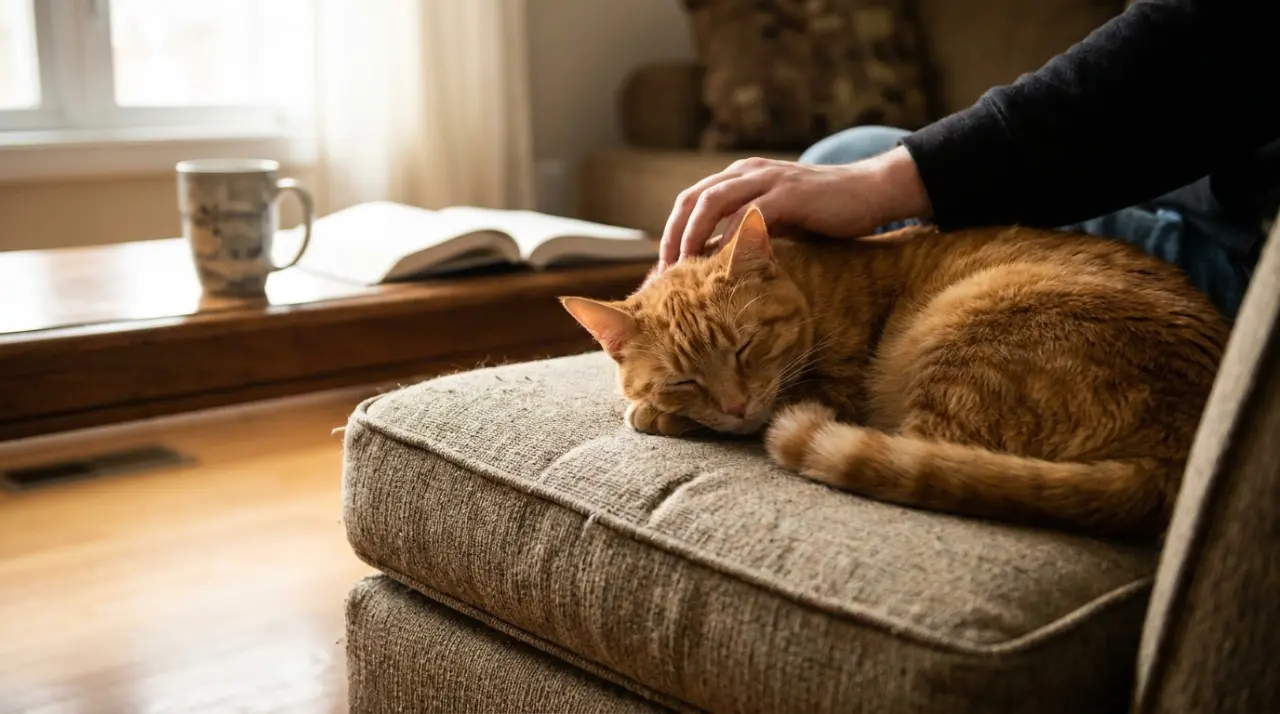
The primary reason your cat curls up where you just sat has almost nothing to do with warmth or comfort.
It's because they're seeking proximity to you through the closest available proxy: your scent, your warmth, and the space you just occupied. In feline social language, this is an unambiguous statement of attachment and trust.
Cats are simultaneously independent and socially bonded animals, which creates a constant tension between proximity-seeking and autonomy. Your vacated seat solves this perfectly: they can be close to you without sacrificing independence.
Neuroimaging studies show that cats' brains process their owner's scent in the same regions associated with reward and safety. Your seat is literally a source of comfort and security for them at a neurological level.
This behavior appears most strongly in cats who had positive early socialization with humans. Feral cats who weren't handled during their critical socialization window rarely display it, even after years of indoor living.
When your cat steals your seat, they're not being opportunistic or defiant. They're demonstrating that you are their primary attachment figure and that your presence—even your residual presence—makes them feel safe enough to sleep.
It's one of the highest compliments a cat can give, hidden inside what looks like simple seat-theft. And the fact that you find it annoying and charming in equal measure is exactly why the behavior persists.
Your cat has learned that taking your seat produces warmth, safety, and—most importantly—your attention, even if it's exasperated attention. That makes it the most valuable spot in the house.
The Bottom Line
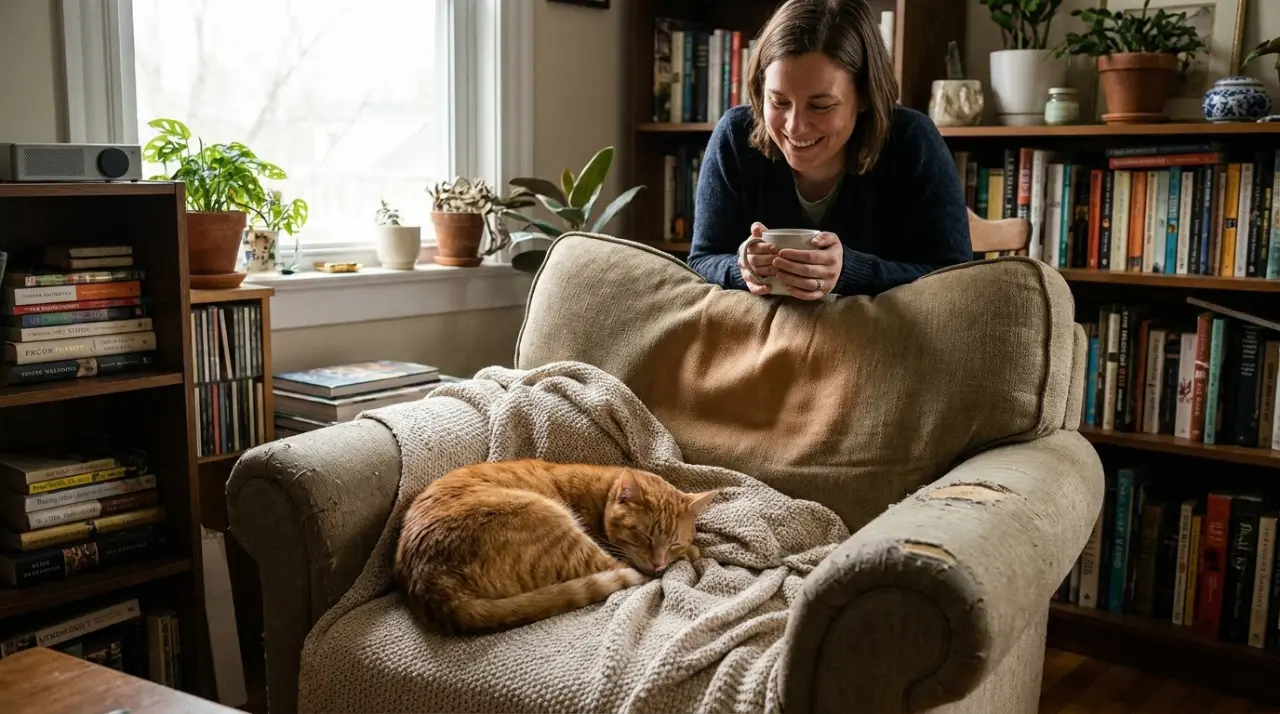
Your cat's seat-stealing habit is a complex behavior driven by thermoregulation, territorial instinct, scent communication, and social bonding. The warm spot you leave behind checks every box on your cat's comfort requirements: it's warm, it smells like family, it's elevated and defensible, and it puts them at the social center of the household.
What looks like opportunism is actually your cat making sophisticated calculations about temperature, safety, and social connection. They've memorized your routine, assessed every piece of furniture in your home, and determined that your seat—specifically at the moment you vacate it—is optimal.
The next time you find your cat curled up exactly where you were sitting, remember they're not trying to annoy you. They're telling you that you're home.
Did we miss one? Drop it in the comments.