16 Reasons Your Cat Stretches Out the Second You Come Home
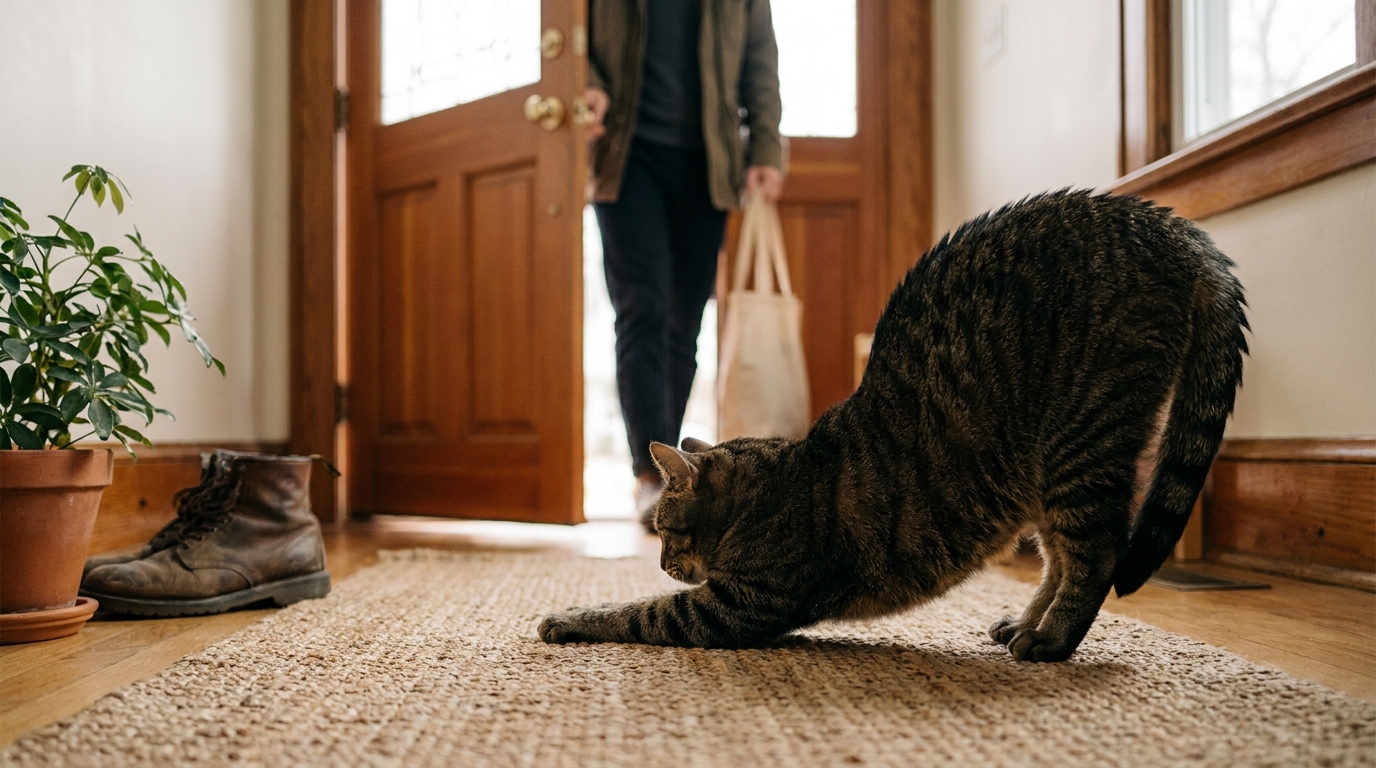
You walk through the door after a long day, and there it is: your cat, mid-stretch, back arched like a furry croissant. Most people assume it's just a yawn-and-stretch combo, the feline equivalent of waking up from a nap.
Turns out, that full-body extension is loaded with meaning—and some of it has nothing to do with being sleepy. Here's what the data actually says.
#16 — They're Recalibrating Their Muscles After Staying Still
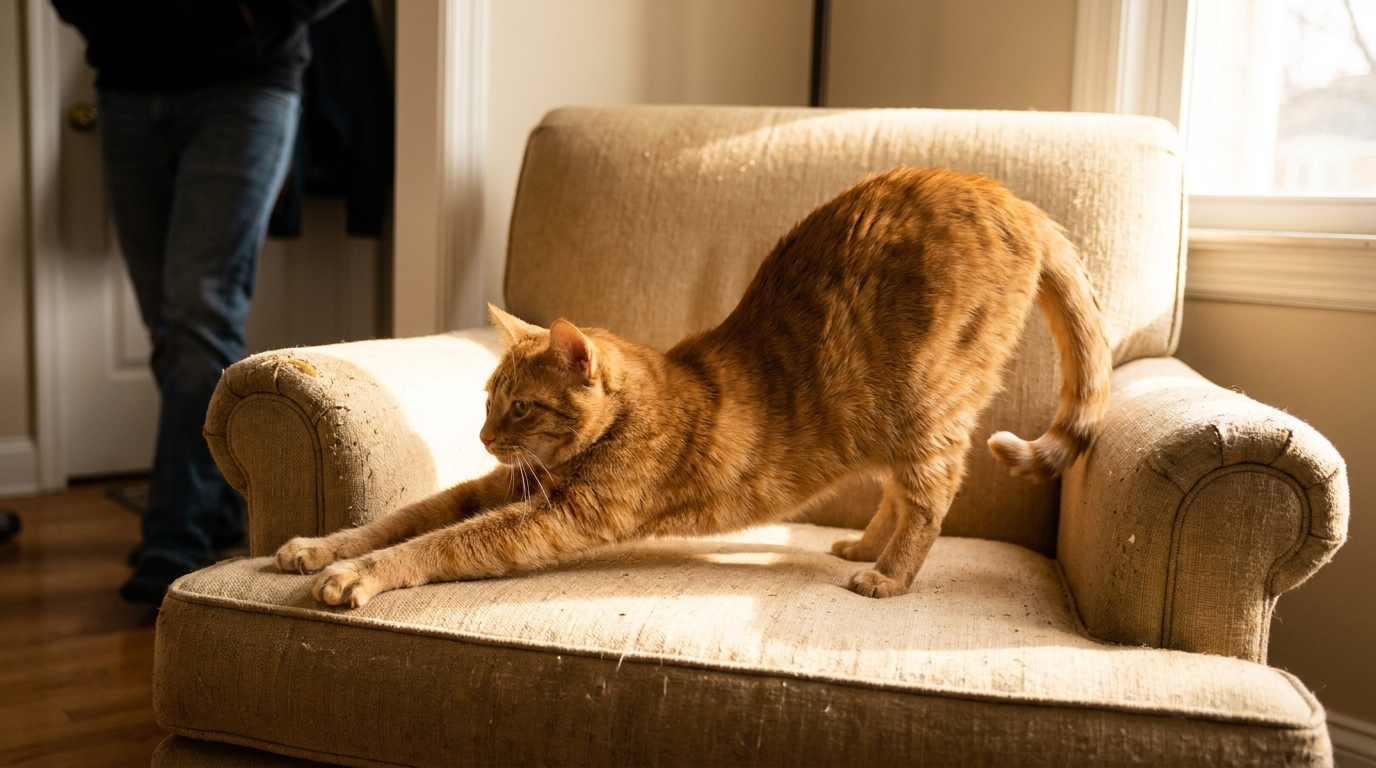
Cats spend up to 16 hours a day resting, and all that stillness comes with a price.
When your cat stretches the moment you arrive, they're literally waking up their muscle fibers. Feline muscles contain a high concentration of fast-twitch fibers designed for explosive movement—pouncing, sprinting, climbing—but those fibers stiffen quickly during long periods of inactivity.
The stretch floods those fibers with blood and oxygen, preparing the body for sudden movement. It's not leisurely. It's mechanical.
Think of it as a system reboot. Your cat doesn't know if your arrival means playtime, dinner, or an unexpected dash across the room, so their body defaults to "ready for anything."
Indoor cats, especially, cycle through rest and alertness dozens of times a day. Each wake-up requires recalibration, and your presence is often the trigger.
But there's more going on than just muscle prep...
#15 — It's a Greeting Ritual You've Been Missing
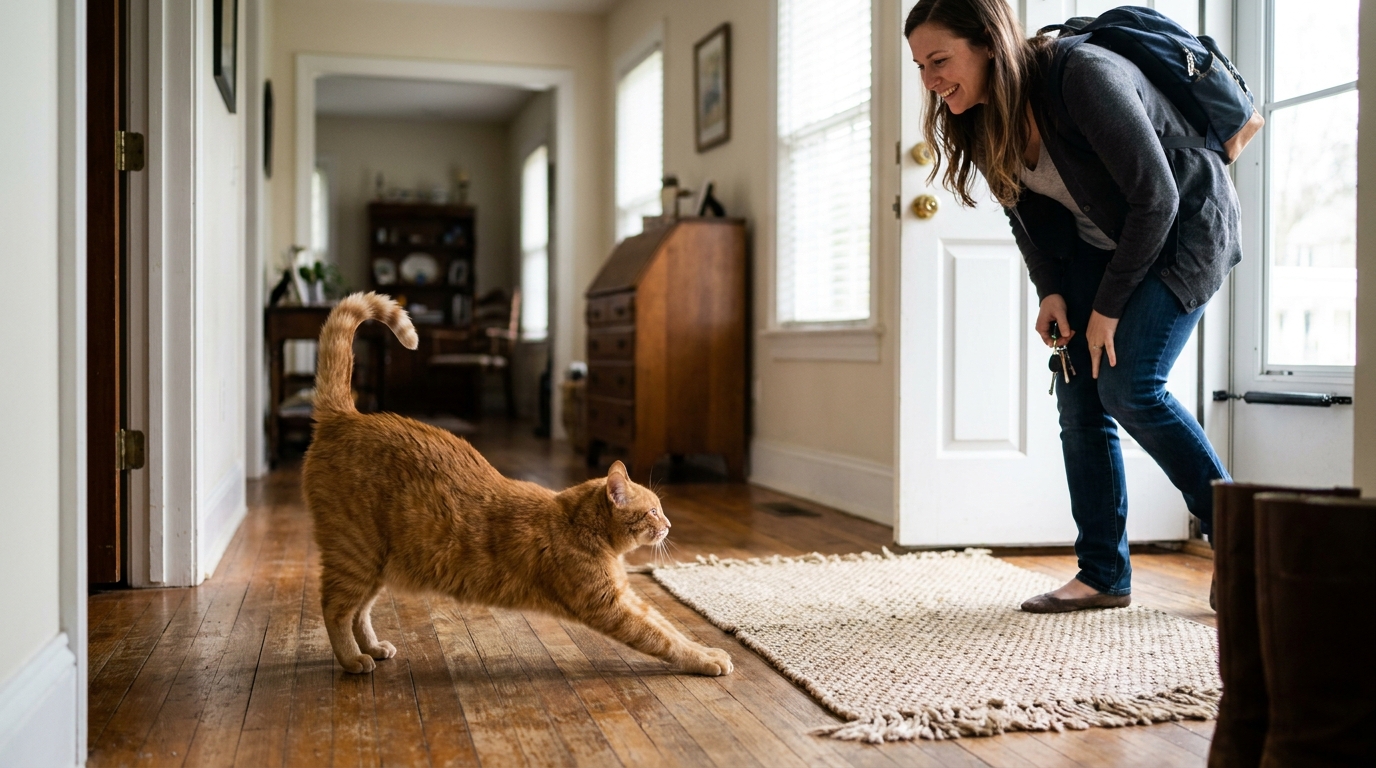
That stretch isn't random—it's part of a social script.
Behaviorists call it a "greeting stretch," and it's one of the clearest signs your cat views you as part of their social group. Cats reserve this behavior for familiar individuals, not strangers or perceived threats.
The stretch often pairs with a slow blink, a raised tail, or a soft chirp. Together, these signals mean "I acknowledge you, and I'm comfortable."
Wild cats and domestic cats both use stretching as a non-verbal greeting within their colonies. It's a way of saying "I see you" without vocalization, which in the wild might attract predators.
You've probably walked past this gesture a thousand times without realizing it was deliberate. Most people interpret it as coincidence—cat happened to stretch, you happened to walk in.
But watch the timing. If it happens within three to five seconds of your arrival, it's not coincidence.
Still, the greeting is only part of the equation...
#14 — They're Marking You with Scent Glands You Can't See
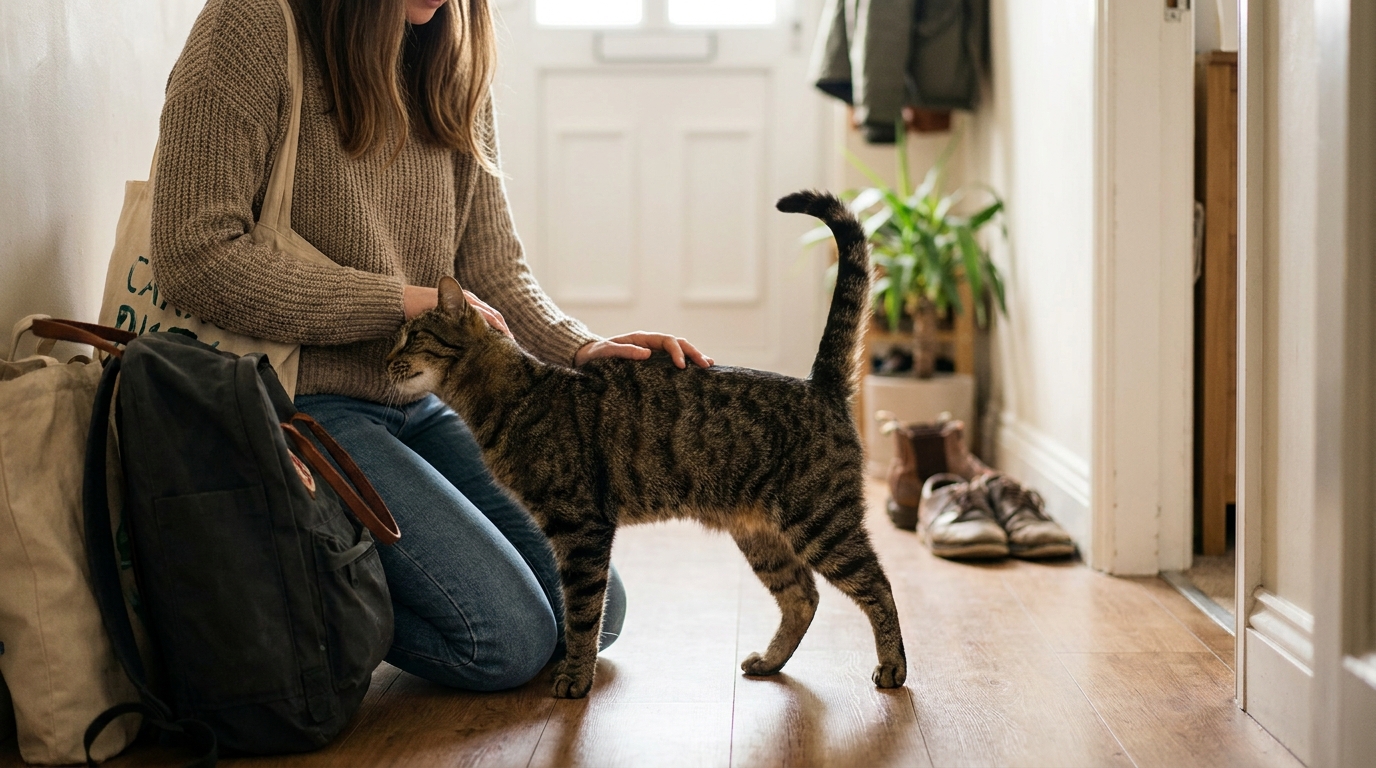
Every time your cat stretches near you, they're leaving invisible messages.
Cats have scent glands between their toes, and the act of stretching—especially when combined with kneading or scratching—activates those glands. When they stretch on the floor near your feet or on furniture you've just touched, they're layering their scent onto yours.
This isn't about territory in the aggressive sense. It's about creating a shared scent profile, a chemical marker that says "this person belongs to my group."
A 2018 study found that cats in multi-cat households stretch more frequently near their preferred human, suggesting the behavior reinforces social bonds. It's a quiet, olfactory version of a hug.
You'll never smell it. Human noses can't detect the pheromones cats deposit through their paw pads.
But to other cats—or even to your own cat hours later—the message is clear: "I was here, with them, and it felt safe."
And that sense of safety triggers something even deeper...
#13 — Stretching Releases Endorphins That Calm Them Down
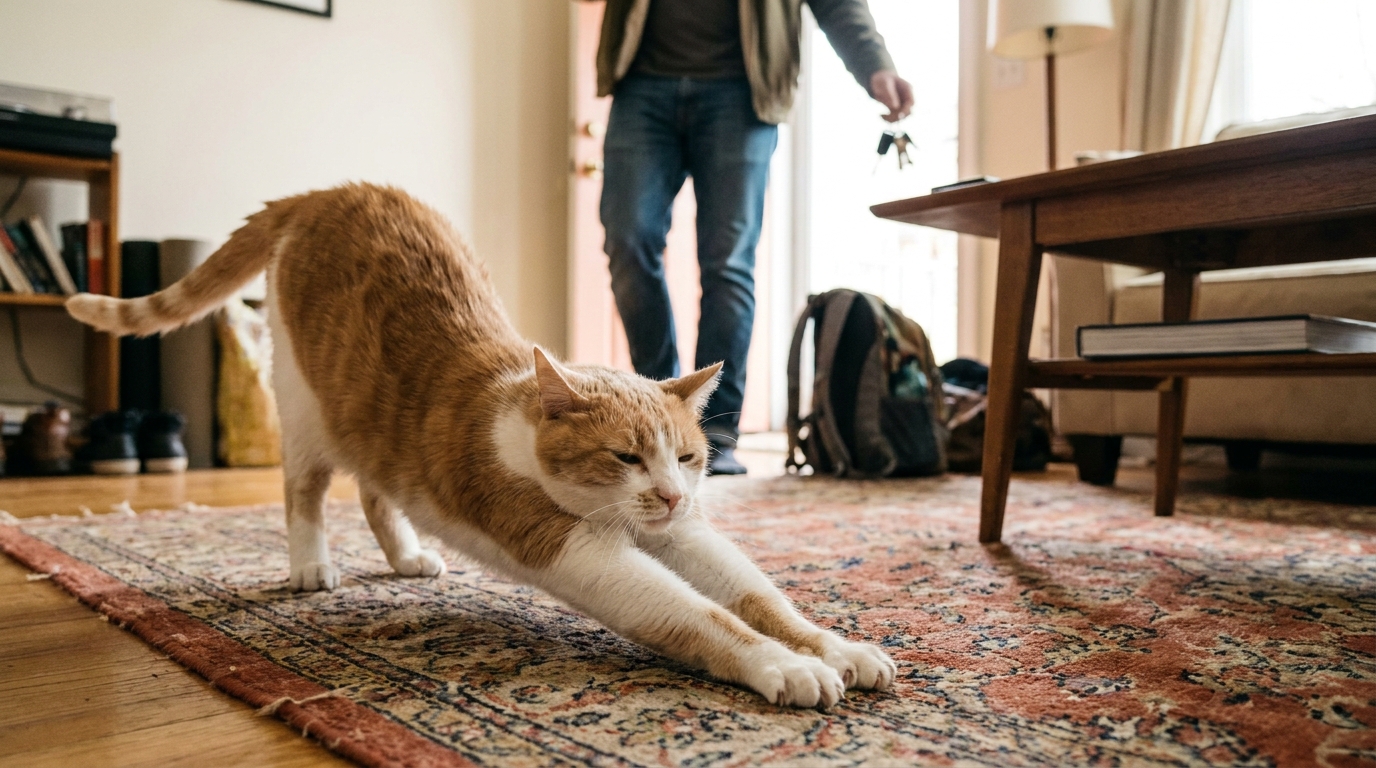
The stretch isn't just physical—it's neurochemical.
When cats perform a full-body stretch, their brains release endorphins, the same feel-good chemicals humans get from exercise. For a cat, stretching after a period of rest creates a mild euphoric effect that reduces stress and lowers cortisol.
Your arrival is often the most stimulating event in their day. That stimulation can register as excitement, but also as low-level stress—especially if your schedule is unpredictable.
The stretch helps them regulate that emotional spike. It's a self-soothing behavior disguised as a physical one.
Veterinary behaviorists note that cats with anxiety disorders often stretch less, or perform truncated, incomplete stretches. The full extension requires a baseline of safety.
If your cat stretches luxuriously the second you walk in, it's a sign they feel secure enough to be vulnerable. Mid-stretch, they're elongated, exposed, and temporarily slower to react.
But the timing of the stretch reveals something else entirely...
#12 — They've Been Listening for You Long Before You Opened the Door
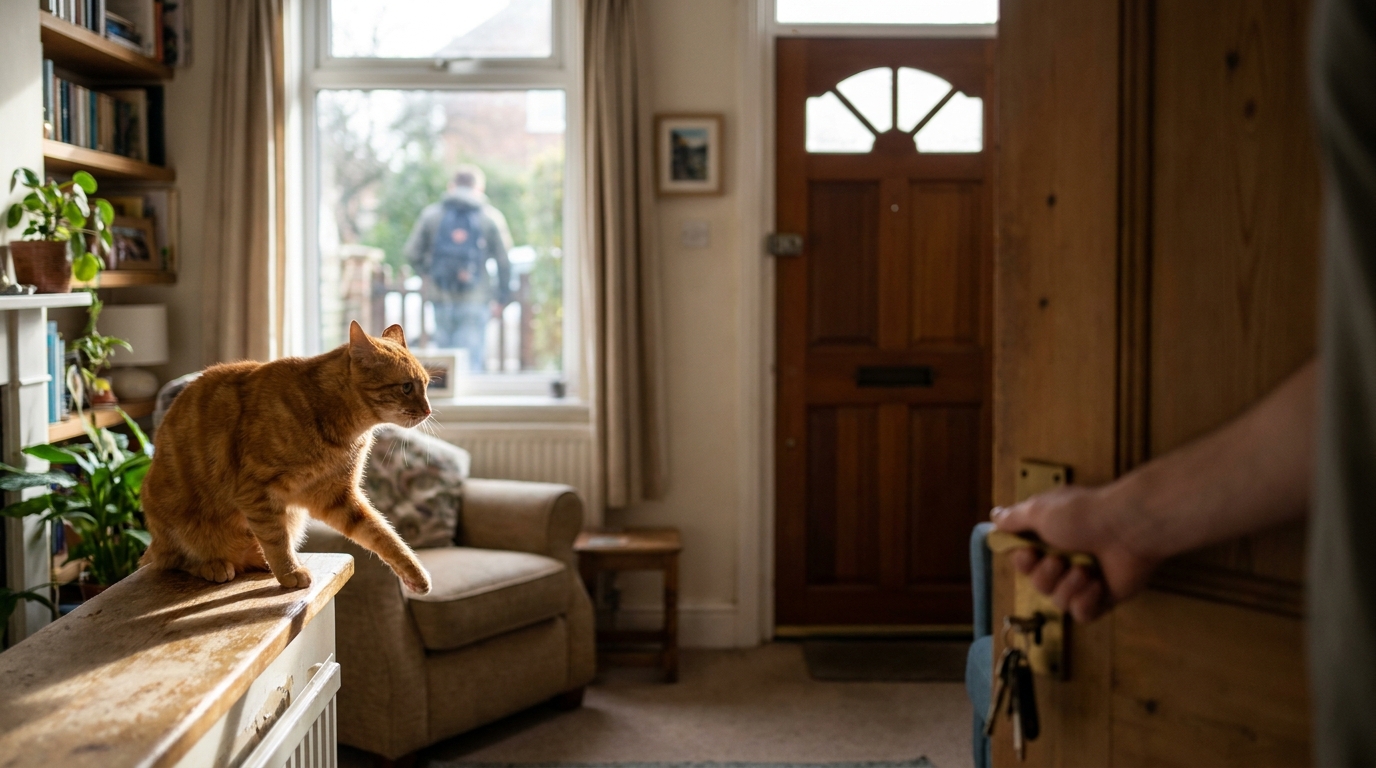
Your cat didn't just wake up when you walked in—they've been tracking you for minutes.
Cats can hear frequencies up to 64,000 Hz, nearly two octaves higher than humans and even higher than dogs. They can detect your car engine from a block away, your footsteps in the hallway, the specific jingle of your keys.
By the time you open the door, they've already identified you, assessed your speed and mood, and decided whether to engage. The stretch is the final beat in a sequence that started long before you arrived.
Indoor cats often position themselves near entry points five to ten minutes before their owner arrives, even when schedules vary. They're not psychic—they're listening.
The stretch, then, is less about waking up and more about transitioning from "alert and waiting" to "time to interact." It's a physical punctuation mark.
Some cats will stretch in place. Others will walk toward you mid-stretch, combining movement with extension.
That combination reveals something most owners never notice...
#11 — The Stretch Helps Them Transition from Prey Mode to Social Mode
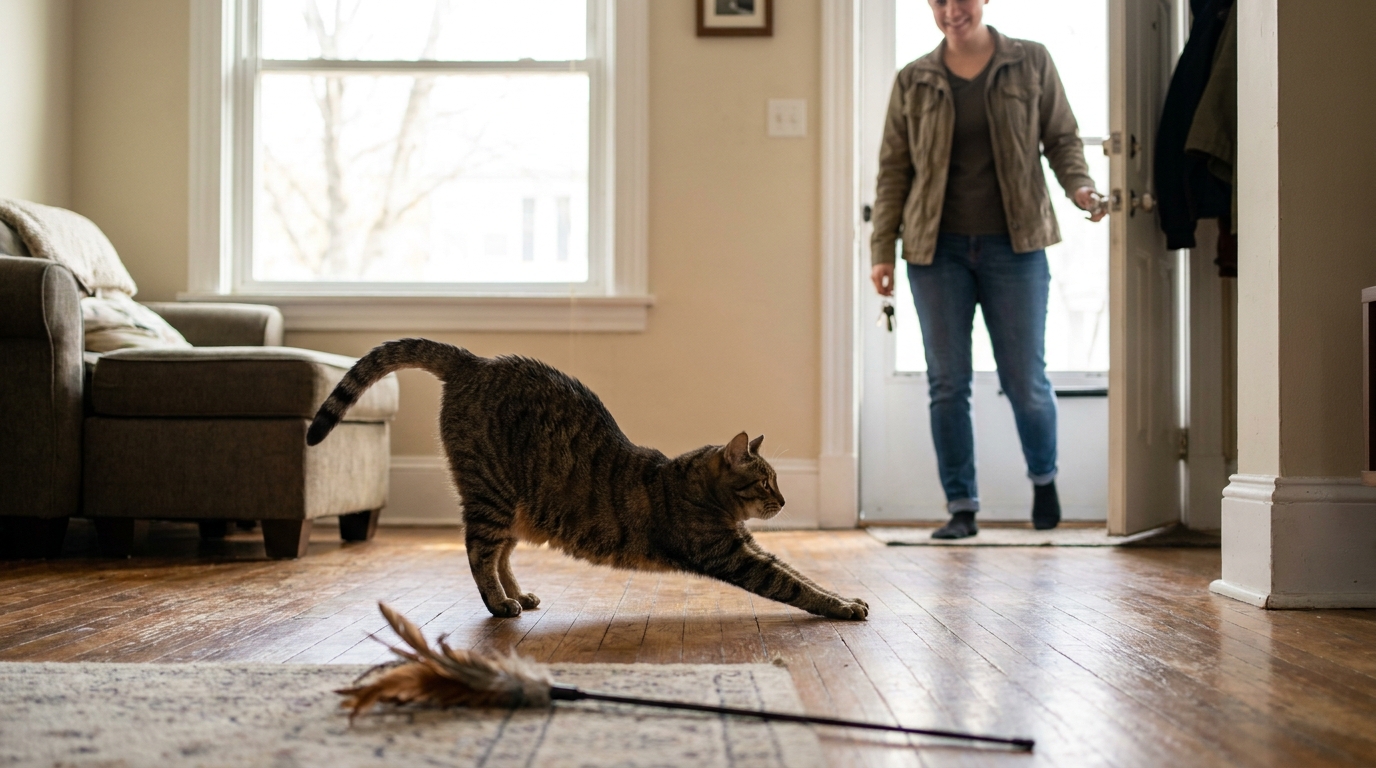
Cats toggle between behavioral states faster than most animals, and the stretch is part of that toggle.
Before you arrived, your cat was likely in a low-level hunting mode—eyes tracking shadows, ears swiveling toward sounds, body primed for movement. That's the default state for a solitary predator, even one who lives indoors and eats from a bowl.
Your entrance flips the script. Suddenly, they need to shift from "monitor the environment for threats and prey" to "engage with a social companion."
The stretch acts as a neurological bridge between those two modes. It discharges residual tension from the hunting state and resets their body language for affiliation.
You'll see this most clearly if you've been gone for several hours. The stretch is longer, more deliberate, often accompanied by a head shake or ear flick. They're not just waking up—they're switching gears.
Cats who skip this transition often stay in a semi-alert state, which can look like aloofness or disinterest. The stretch is proof they're meeting you halfway.
But not all stretches are created equal...
#10 — The Direction of the Stretch Tells You What They Want
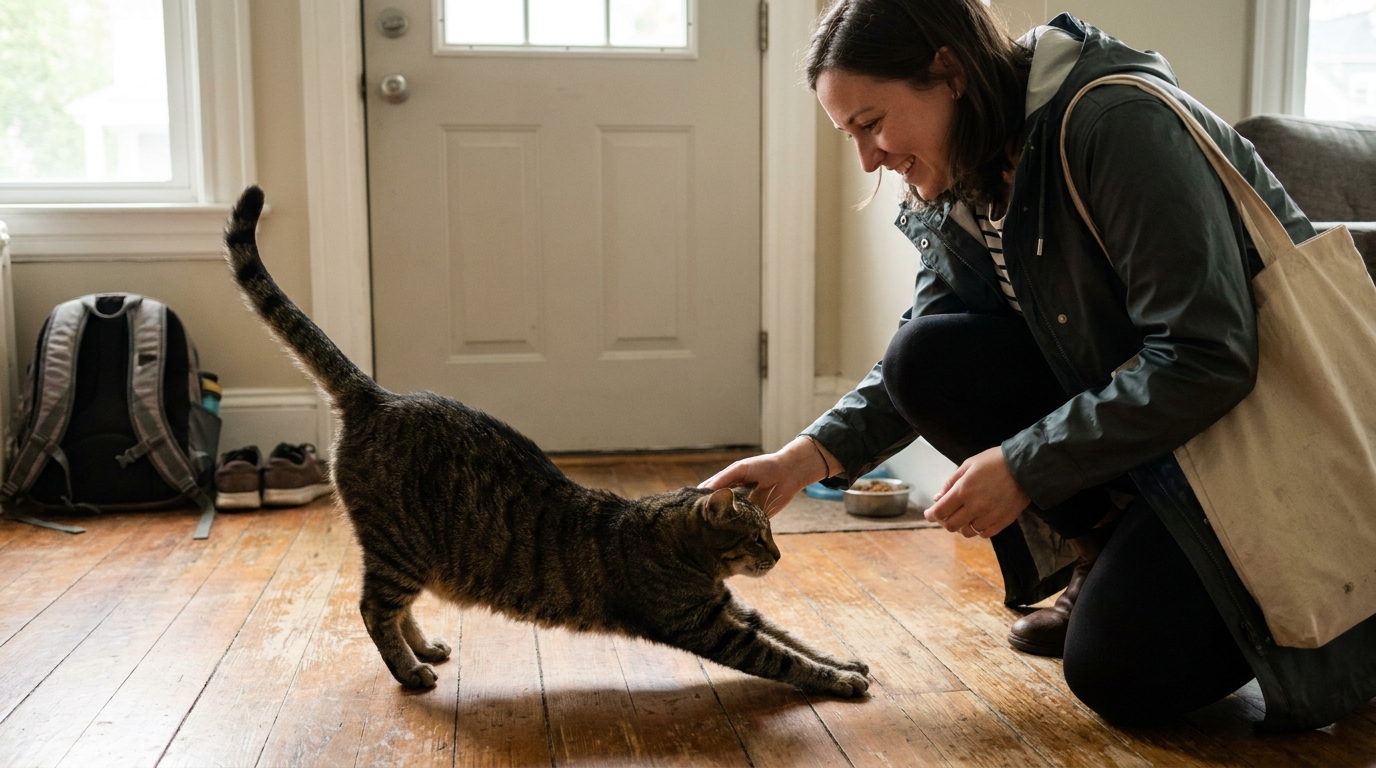
Watch where the stretch goes, and you'll decode the ask.
A stretch that moves toward you—front legs extending in your direction, body leaning forward—is an invitation. It usually precedes a request: food, play, or physical contact.
A stretch that moves away from you, or one where the cat remains in place and only extends vertically, is more about self-maintenance. They're happy you're home, but they're not asking for anything yet.
Veterinary behaviorists use stretch direction as a diagnostic tool for assessing cat-owner bonds. Cats who consistently stretch toward their owners show higher rates of secure attachment.
The most telling version is the "elevator butt" stretch—rear end up, front legs down, tail vertical. That's an affiliative signal borrowed from kitten behavior, and it almost always means they want interaction.
If your cat stretches and then immediately walks away, don't take it personally. They've acknowledged you. That's the point.
But the stretch also serves a function that has nothing to do with you...
#9 — They're Testing Their Spine After Hours of Compression
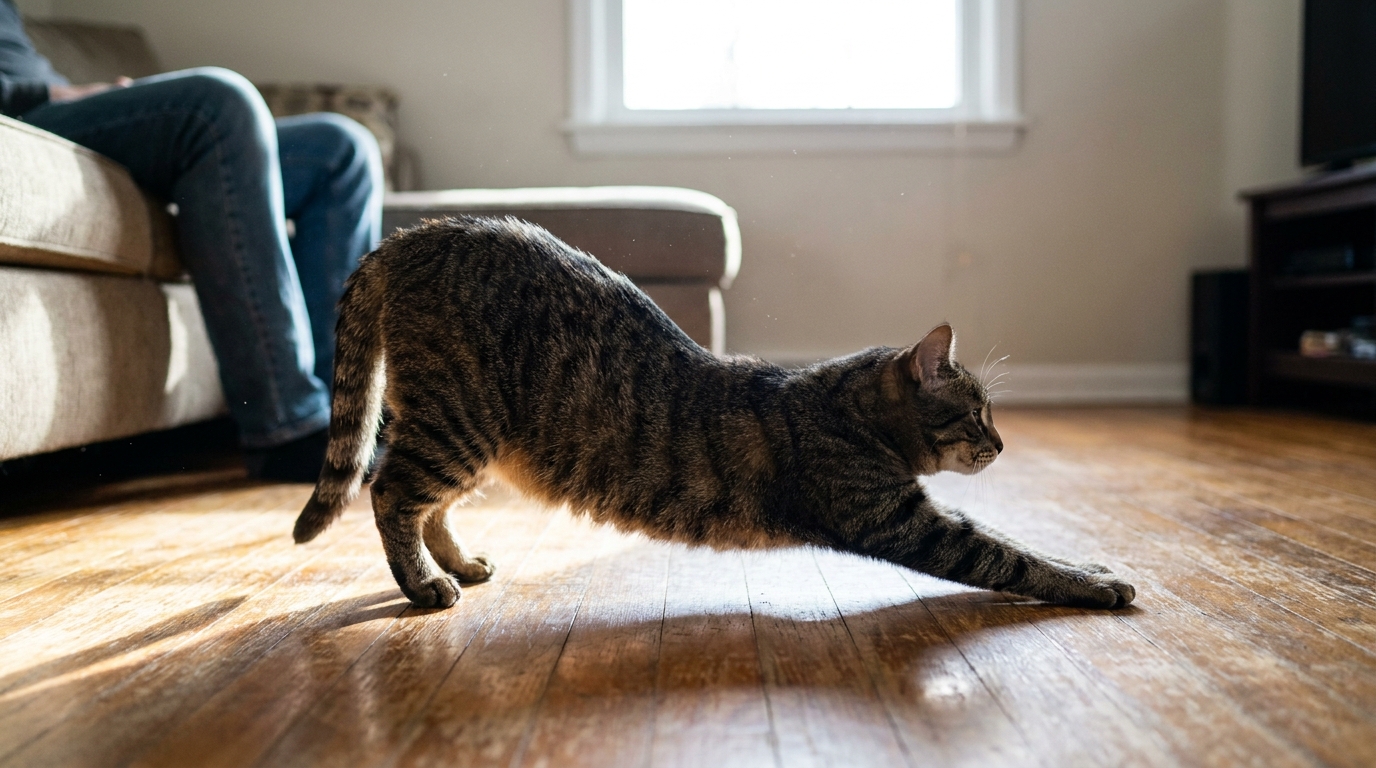
A cat's spine contains nearly 53 vertebrae—compared to 33 in humans—and all that flexibility comes with maintenance requirements.
When cats curl up to sleep, they compress those vertebrae into tight curves. The stretch afterward isn't optional—it's orthopedic necessity. Each extension decompresses the spinal column, realigns the vertebrae, and prevents the stiffness that would otherwise limit their mobility.
Cats who don't stretch regularly develop gait problems and reduced jumping ability by middle age. The stretch is preventive medicine.
Your arrival just happens to coincide with their internal timer. Most cats stretch every 20 to 30 minutes during waking hours, and if you've been gone for four or five hours, you're witnessing the first stretch of their active cycle.
Older cats stretch more slowly and less completely. If your senior cat's stretches are getting shorter, it's worth mentioning to your vet—it can be an early sign of arthritis or spinal pain.
Meanwhile, that stretch is doing something to their digestion...
#8 — Stretching Stimulates Their Digestive System Before Dinner
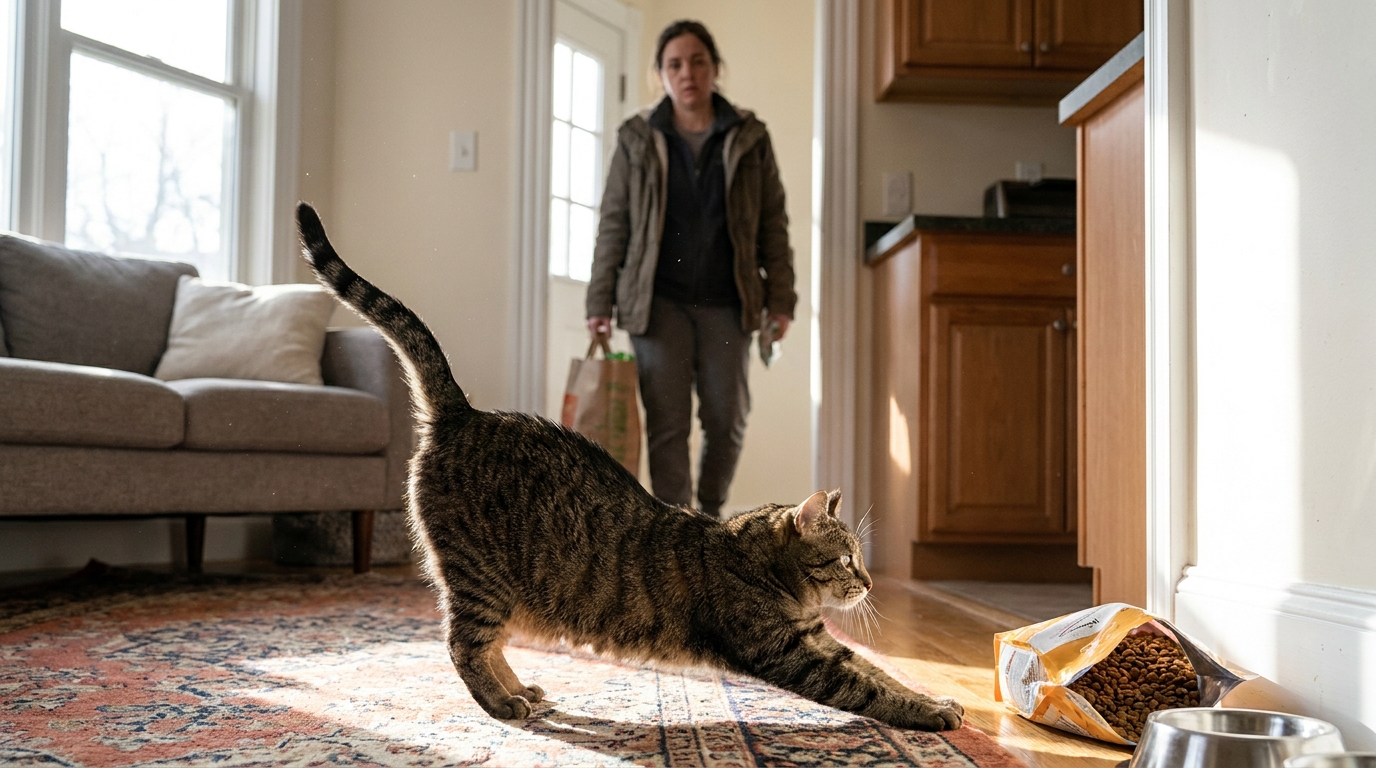
The stretch isn't just about muscles—it massages internal organs.
When a cat extends fully, the movement compresses and releases abdominal organs, including the stomach and intestines. This gentle pressure stimulates digestion and helps move food through the GI tract.
If you typically arrive home around feeding time, your cat's stretch is partly physiological prep. Their body is anticipating food and getting the digestive system ready to process it.
Cats have relatively short digestive tracts—about three feet on average—and they rely on regular movement to keep things moving. A sedentary cat is a constipated cat.
The post-stretch behavior often includes a trip to the litter box, then a visit to the food bowl. The sequence isn't random—it's mechanical.
Some cats will stretch, groom briefly, and then stare at you expectantly. They're not being demanding—they're following a biological script that's thousands of years old.
But the stretch also reveals something about their emotional state...
#7 — It's a Vulnerability Display That Proves They Trust You
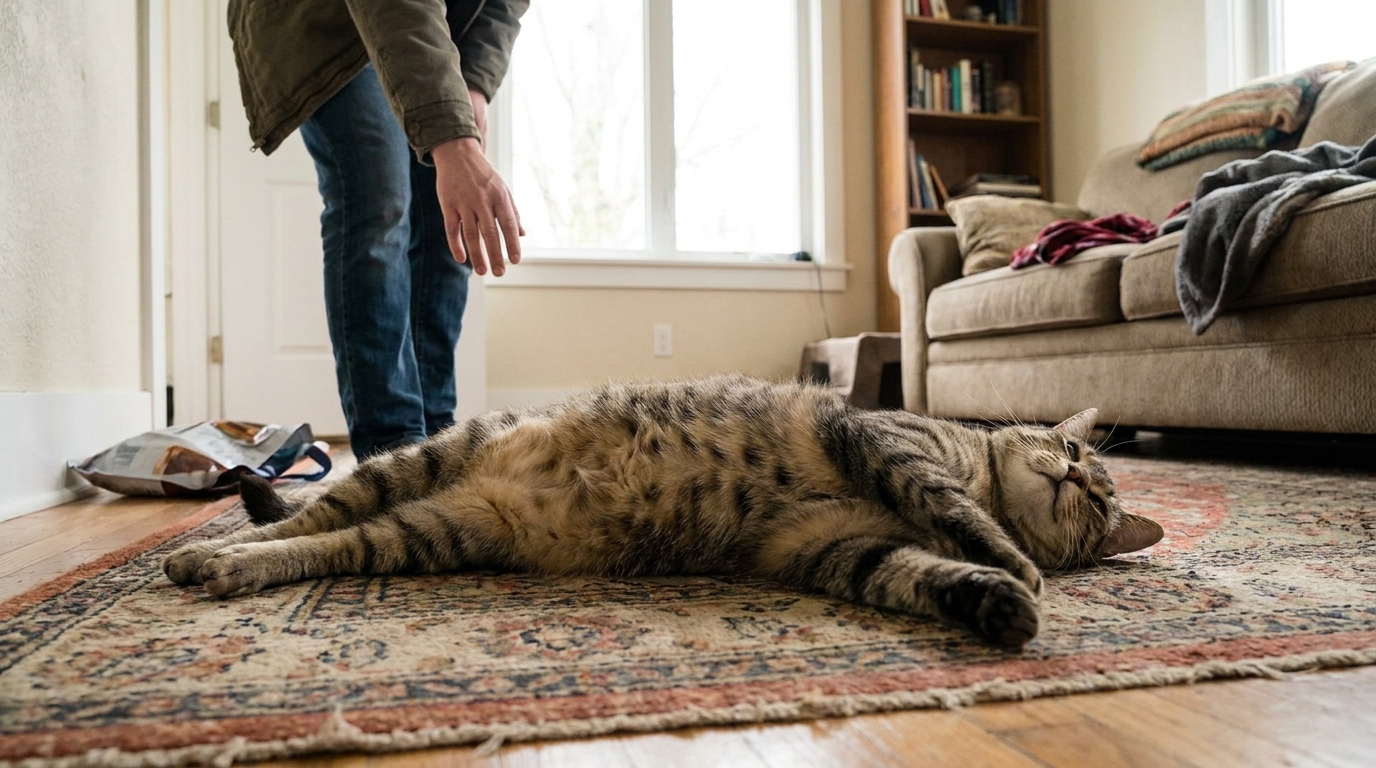
Mid-stretch, your cat is defenseless.
A fully extended cat can't run, can't pivot quickly, and can't retract their claws for traction. In the wild, that level of exposure is dangerous. Prey animals freeze when predators approach; predators don't stretch in the open unless they're certain of safety.
When your cat stretches the moment you arrive, they're telling you they feel safe. It's one of the most overlooked trust signals in feline behavior.
Cats in shelters or new adoptees rarely stretch in front of humans during the first few weeks. The behavior emerges only after they've assessed the environment and decided you're not a threat.
If your cat not only stretches but does so while making eye contact, the trust level is even higher. They're monitoring your reaction while being vulnerable, which requires confidence in the relationship.
Contrast this with a cat who tenses or flattens when you arrive. That cat is still in threat-assessment mode, and the absence of a stretch is the giveaway.
Yet even trusted humans can trigger a different kind of stretch...
#6 — The "Elevator Butt" Stretch Is Borrowed from Kittenhood
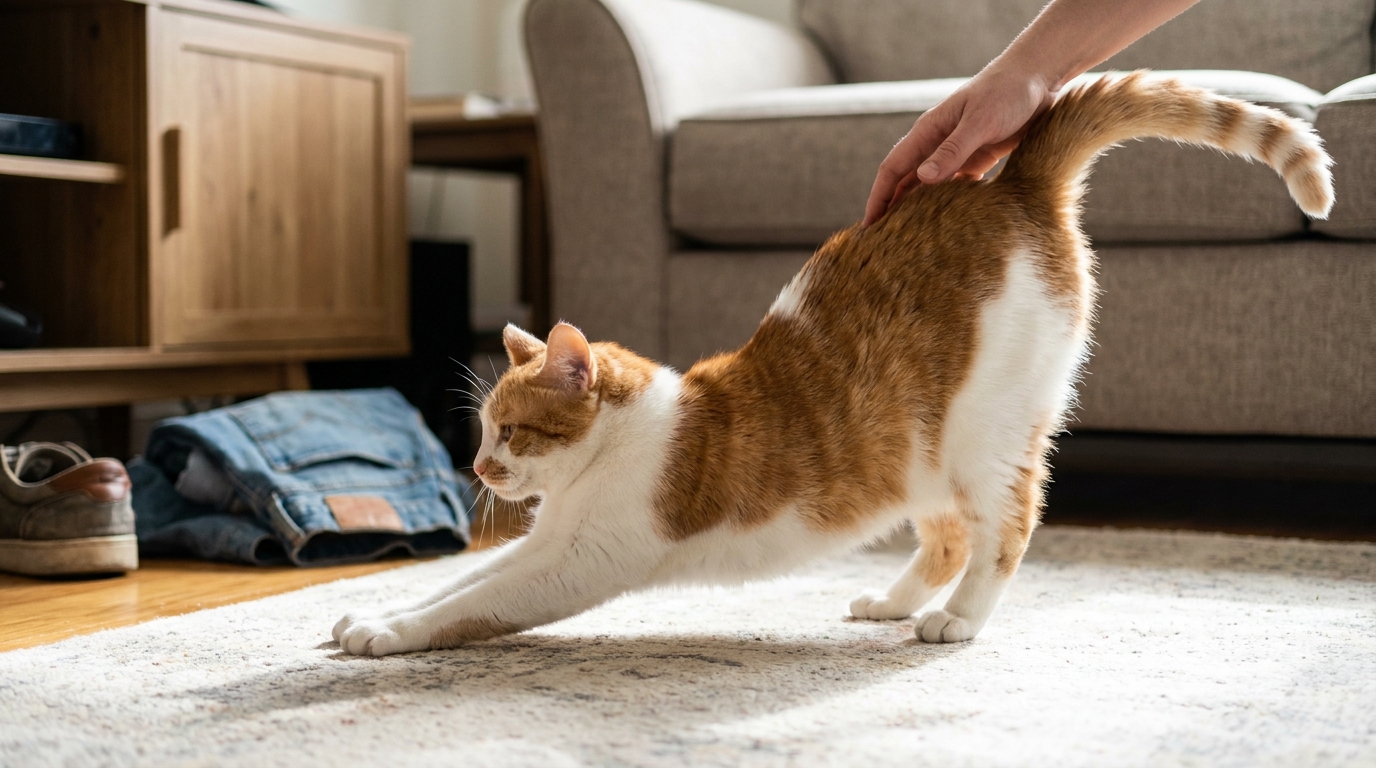
You've seen it: rear end high, front legs stretched low, tail quivering.
This isn't a standard stretch—it's a social holdover from infancy. Kittens use this posture to solicit grooming and attention from their mothers, and adult cats retain it as a way to signal "treat me like family."
When your cat greets you with an elevator butt stretch, they're not just saying hello. They're regressing, in the neurological sense, to a kitten state where you're cast in the role of caregiver.
It's one of the few juvenile behaviors that domestic cats carry into adulthood, and it only appears with trusted individuals. Feral cats don't do this with humans. Outdoor cats rarely do it with anyone.
The tail quiver that often accompanies it is a scent-marking behavior—another kitten throwback. Kittens quiver their tails while nursing, releasing pheromones that help the mother identify them.
Your cat is, in effect, marking you as "theirs" while simultaneously asking for nurturance. It's manipulative in the most endearing way.
But not every stretch is affectionate...
#5 — Some Stretches Are Displacement Behaviors When They're Conflicted
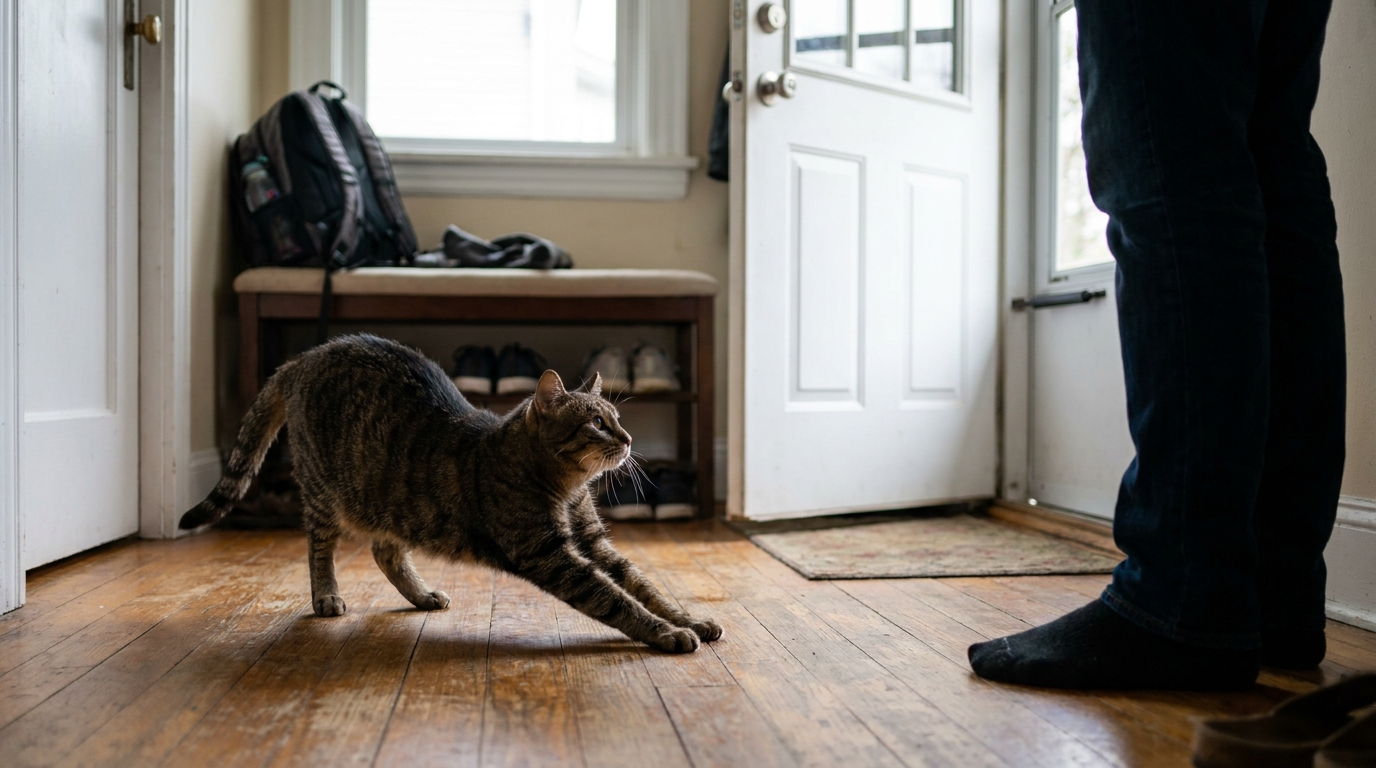
Not all stretches mean "I'm happy you're home."
When cats feel conflicted—wanting something but uncertain how to get it, or feeling two opposing emotions at once—they often perform displacement behaviors. Stretching is a common one.
If you arrive home and immediately do something unpredictable (rearrange furniture, bring in a strange bag, talk loudly on the phone), your cat might stretch as a way to self-soothe through confusion. It's the feline equivalent of a nervous laugh.
These stretches look different. They're quicker, less complete, and often paired with other displacement signals: excessive grooming, yawning, or sudden intense focus on an object.
Behaviorists see this in vet clinics constantly. A cat on the exam table will stretch mid-checkup—not because they're comfortable, but because they're trying to regulate stress.
If your cat stretches when you come home but then hides, or stretches and immediately grooms, they're not greeting you. They're coping.
The good news: true greeting stretches are easy to distinguish. They're slow, full-bodied, and followed by approach behavior.
And then there's the stretch that's actually a test...
#4 — They're Checking If You'll Respond to Their Body Language
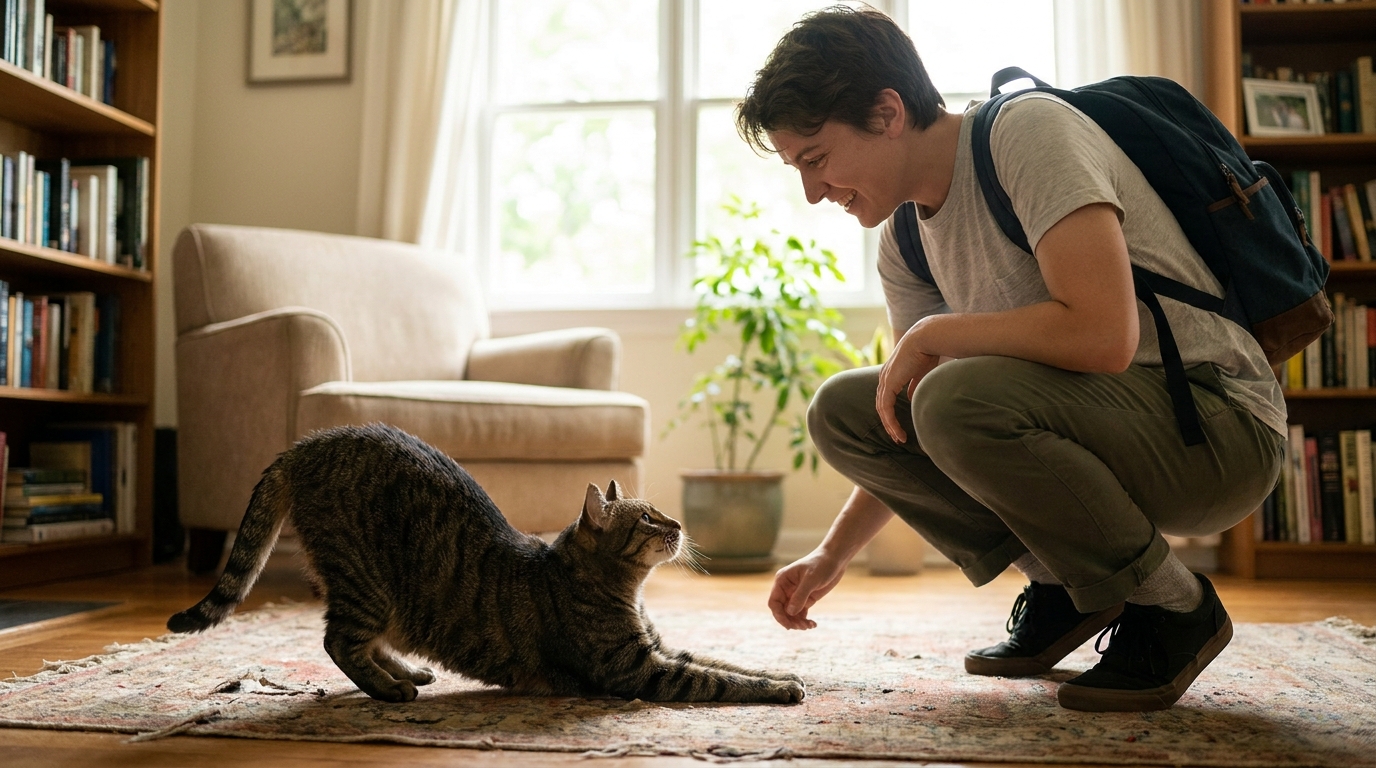
Your cat is running an experiment every time they stretch in front of you.
Cats are brilliant at operant conditioning—they test behaviors to see what gets a reaction. If stretching near you results in petting, food, or play, they'll repeat it. If it results in nothing, they'll try a different signal.
Studies of cat-owner interaction show that cats modify their greeting behaviors based on human response rates. A cat whose stretch is consistently ignored will eventually stop stretching as a greeting and switch to vocalization or rubbing.
This is why some cats have elaborate greeting rituals and others barely acknowledge you. It's not personality—it's learned communication.
If you want to reinforce the stretch as a greeting, respond to it consistently. A few seconds of eye contact, a soft word, or a head scratch is enough. The cat logs the pattern.
Ignore it for weeks, and the behavior fades. Cats don't waste energy on signals that don't work.
But the stretch also serves a function that's purely practical...
#3 — It's a Joint Mobility Check They Perform Multiple Times Daily
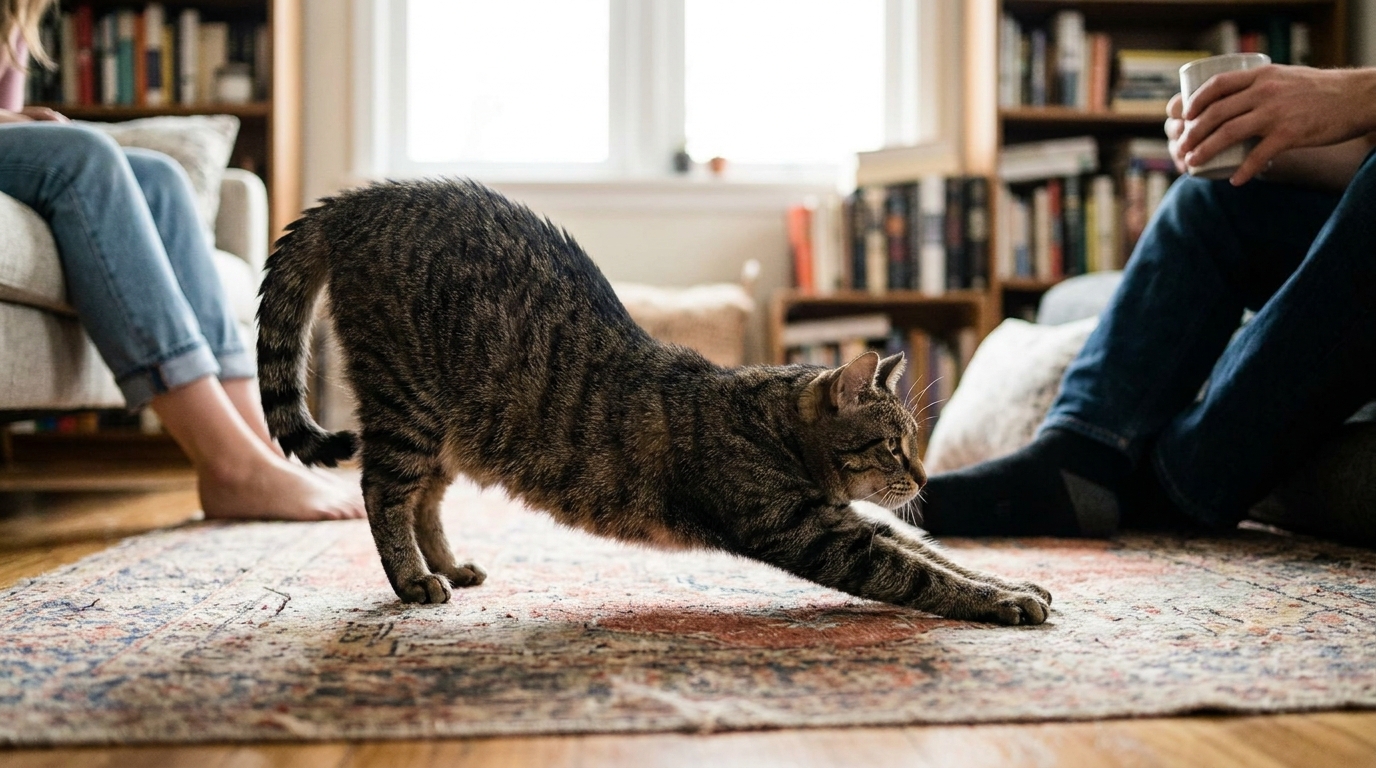
Cats are obsessive about joint health, and stretching is their self-diagnostic tool.
Each stretch tests range of motion in the shoulders, hips, spine, and ankles. If something hurts or feels stiff, the cat adjusts the stretch or skips that joint entirely.
Veterinarians use stretch observation as a non-invasive way to assess pain and mobility in cats. A cat who stops fully extending one leg may have an injury or arthritis that hasn't yet caused a limp.
Your arrival triggers a stretch because your presence often signals a transition to activity—and before a cat moves, they check their body. It's instinctive quality control.
Indoor cats, especially those on upper floors or in small spaces, stretch more frequently than outdoor cats. They have fewer opportunities for natural, varied movement, so they compensate with deliberate extensions.
If your cat's stretches are becoming shorter or less symmetrical, it's worth a vet visit. Changes in stretch behavior often precede visible lameness by months.
And then there's the stretch that's really a power move...
#2 — They're Claiming Space and Reasserting Presence After You've Been Gone
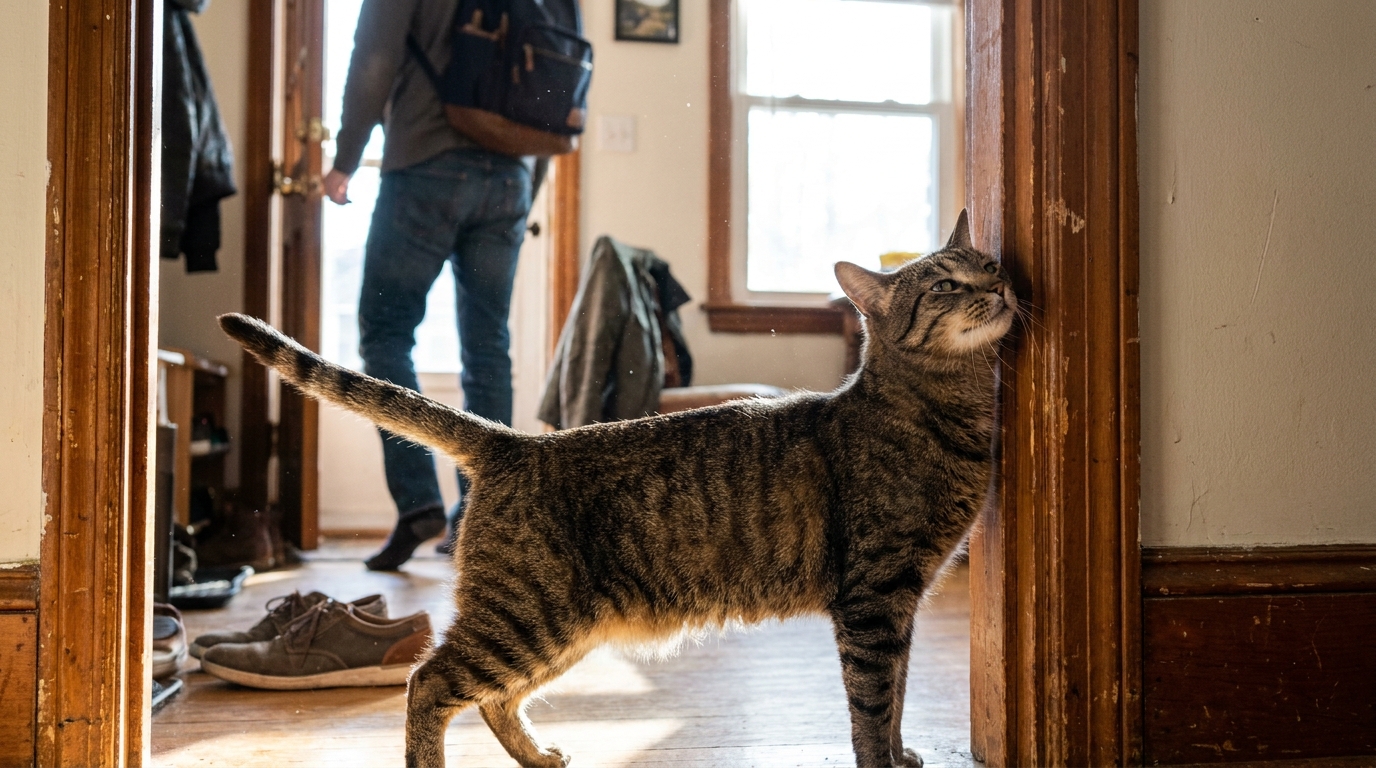
That stretch isn't just a greeting—it's a territorial refresh.
When you leave, your scent fades from the home's "active scent map." Other smells—cooking, weather from open windows, even the mail—start to dominate. Your cat's scent, too, weakens in shared spaces.
The moment you return, your cat stretches in high-traffic areas to re-establish their presence. The stretch activates scent glands in their paws and flanks, re-marking the space as theirs while you're standing in it.
This is most obvious in multi-cat or multi-pet homes. The cat who stretches first is often the most confident one, and they're making a statement to the other animals as much as to you.
Watch where they stretch. If it's directly in a doorway, on your usual chair, or in the center of a room, they're choosing high-value real estate. The stretch says "I'm here, this is mine, and you're part of my territory."
It's dominance wrapped in a gesture that looks like laziness. Cats are strategic like that.
But the number-one reason might surprise you...
#1 — It's an Invitation to Play That Most Owners Completely Miss
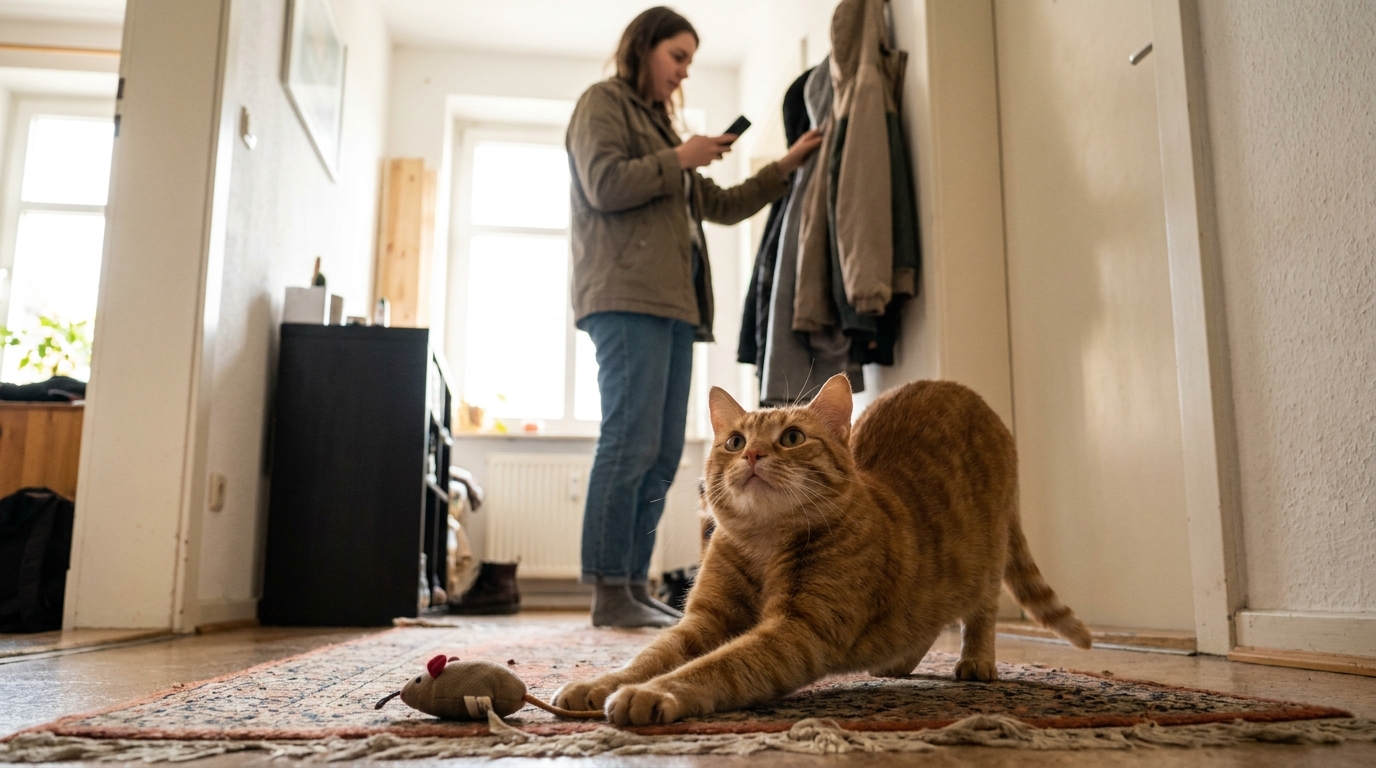
The stretch isn't passive—it's an opening move.
When cats stretch in front of you with their rear end elevated and their gaze locked on yours, they're issuing a challenge. In feline body language, this is the start of a play sequence.
The "play stretch" differs from a waking stretch in one key way: the cat holds your gaze and waits for a response. If you move toward them, they'll dart away and expect you to chase. If you toss a toy, they'll pounce.
Most owners misread this as sleepiness or indifference. They walk past the cat, and the cat settles back down, opportunity missed.
Kittens learn this invitation gesture from their mothers and siblings. It survives into adulthood because play, for cats, isn't just recreation—it's social bonding and predatory practice rolled into one.
If you've ever wondered why your cat seems bored despite having toys everywhere, this is often why. They're inviting interaction, and the invitation is being ignored.
Try this: next time your cat stretches when you come home, crouch down and wiggle your fingers or tap the floor. Watch what happens.
You've been declining play dates without realizing it.
The Bottom Line
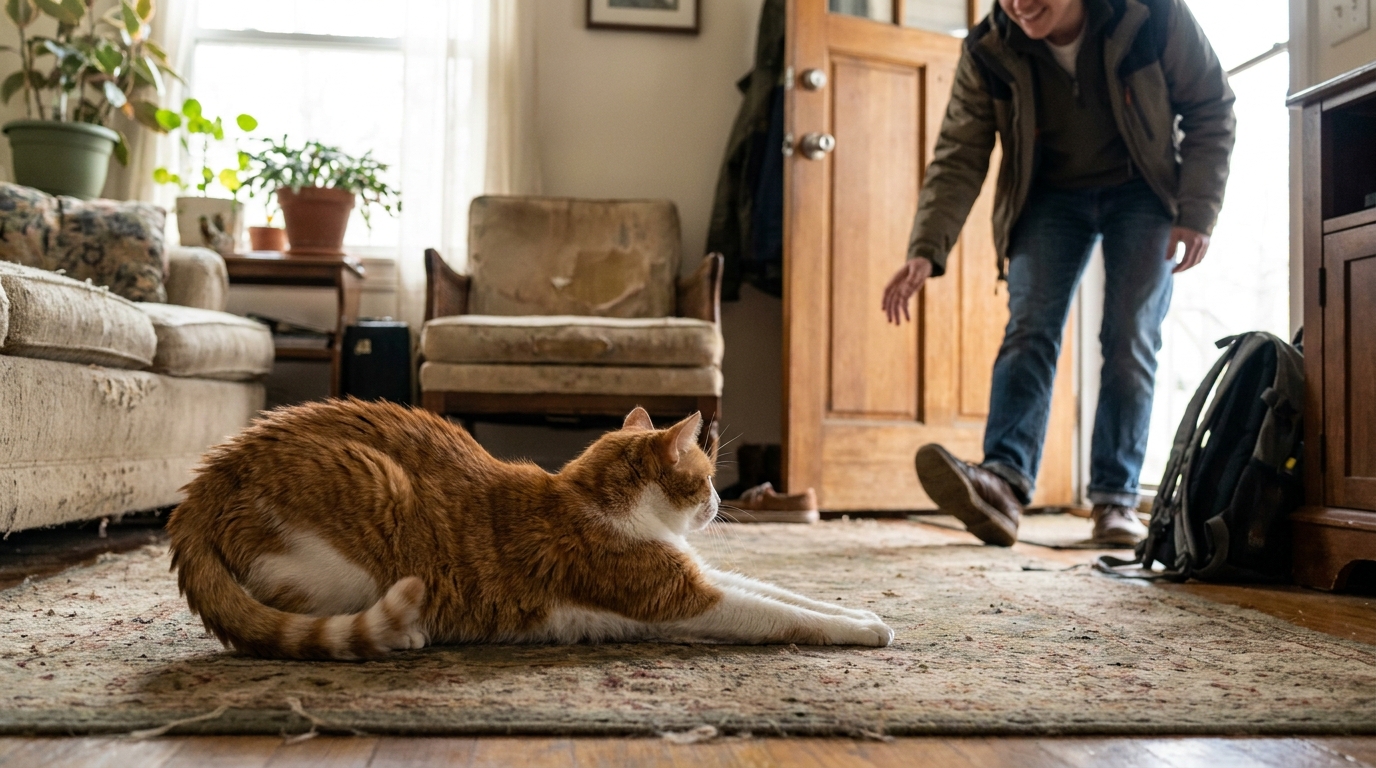
Your cat's stretch isn't filler—it's a multilayered message about trust, biology, and social expectation.
Some of it is mechanical: joint checks, muscle prep, digestion. Some of it is chemical: endorphin release, scent marking, stress regulation.
But the core of it is relational. That stretch is your cat's way of saying "I've been waiting, I'm ready, and I trust you enough to be vulnerable in your presence."
Did we miss one? Drop it in the comments.