8 Things Your Cat Has Learned About Your Mornings Before You Wake Up

Stick with us to the end: one subtle shift in your routine can turn your cat from wary observer into eager morning companion.
Your cat sleeps through the night while you do, right?
Not quite. While you're deep in REM sleep, your feline is running a detailed surveillance operation on your bedroom, your schedule, and your habits. Cats are crepuscular hunters by nature, meaning they're wired to be most active at dawn and dusk—exactly when you're transitioning between sleep and waking.
Most people assume their cat's morning behavior is random or purely food-driven. What the research actually reveals is far more interesting: your cat has been studying your pre-alarm patterns, cataloging your movements, and building a detailed map of what happens before you're even conscious. They know which floorboards creak, which doors open first, and which version of you they're getting today.
Here's what the data actually says.
#8 — They've Memorized Your Pre-Alarm Movements

Your cat knows you're about to wake up before your alarm goes off.
Cats can detect micro-movements during lighter sleep stages, the small shifts in breathing, position changes, and muscle tension that signal you're surfacing from deep sleep. They're not psychic—they're observant. Your body broadcasts wake-up signals 10 to 20 minutes before you're consciously aware of them.
This detection ability comes from their predator wiring. In the wild, cats need to read the breathing patterns and body language of both prey and threats from a distance, often in near-darkness.
Research on feline sensory processing shows cats can detect vibrations through their whiskers and paw pads that humans can't consciously register. They're also watching your eyelids—the rapid movement beneath closed lids during REM sleep versus the stillness of deeper stages gives them a reliable countdown to your waking moment.
But #7 shows they're tracking something even more specific than your sleep cycles...
#7 — They Know Which Day You Sleep In

Your weekend routine doesn't fool them for a second.
Cats can distinguish weekday mornings from weekend mornings based on subtle changes in your evening behavior the night before. They're reading patterns you don't consciously set: the time you turn off lights, whether you set multiple alarms, even the tone of your last evening activity.
This pattern recognition is rooted in their territorial nature. Cats are highly attuned to routine disruptions in their environment because changes in pattern historically signaled either opportunity or danger.
Your cat isn't demanding breakfast at 6 AM on Saturday—they're recalibrating based on last night's data.
Studies of cat cognition reveal they can track routine patterns across seven-day cycles and adjust their behavior accordingly. On Friday nights when you stay up later or move through the house differently, your cat logs that deviation. By Saturday morning, many cats will wait 30 to 90 minutes longer before initiating contact, having learned that weekend wake-up times follow a different schedule.
But #6 reveals they're also tracking your emotional state before you're awake...
#6 — They're Reading Your Stress Levels While You Sleep

Your cat can smell when you've had a rough week.
Cortisol and other stress hormones are secreted through human skin and breath throughout the night, creating a chemical signature that cats detect easily. Their olfactory system is roughly 14 times more powerful than yours, and they're using it to assess your baseline state every morning.
This chemical detection serves a practical purpose for cats. In a multi-cat household or wild setting, knowing which animals are stressed, sick, or injured helps cats avoid conflict and identify vulnerable targets or companions who need space.
Veterinary behaviorists note that cats often modify their morning approach based on these stress signals. After high-stress periods—work deadlines, family disruptions, illness—many cats will either keep more distance or, conversely, increase physical contact depending on their individual attachment style and prior learning about how you respond to comfort.
Quick Compare
- Calm morning: cat approaches within 5 minutes of first movement
- Stressed period: approach delayed by 10–15 minutes, or becomes more insistent
- Post-illness: closer monitoring, often sitting within direct line of sight
- Stable routine: predictable interaction pattern, same location daily
But #5 shows they're also monitoring something happening outside your room...
#5 — They've Mapped Your Household's Morning Hierarchy
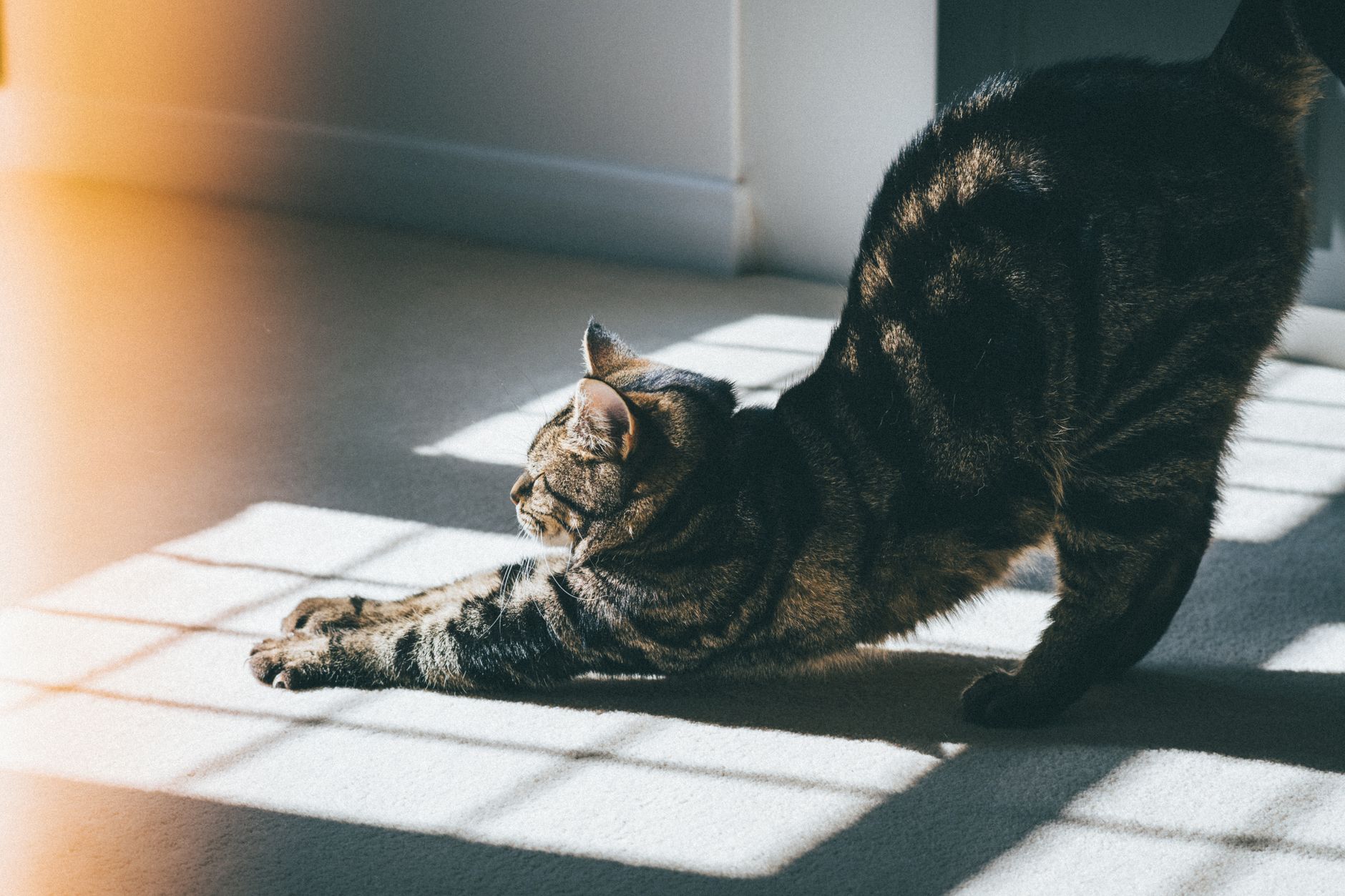
Your cat knows exactly who wakes up first and why that matters.
Cats in multi-person households track the wake-up sequence of every member and position themselves accordingly. They've learned who feeds them, who's most likely to trip over them, and who provides the best morning interaction. This isn't luck—it's strategic positioning based on weeks of data collection.
This hierarchical tracking is an extension of how cats navigate social structures. Even in domestic settings, cats maintain mental maps of relationships, resources, and routine sequences that help them maximize benefit and minimize conflict.
A 2019 study on cat behavior in family environments found that cats reliably adjusted their morning position based on the first person likely to descend stairs or enter the kitchen. In homes where children wake before adults, cats typically position themselves farther from bedroom doors until adults emerge, having learned that children's movements are less predictable and less likely to result in feeding.
But #4 reveals they're studying something about your actual alarm...
#4 — They've Learned to Distinguish Your Alarm Types
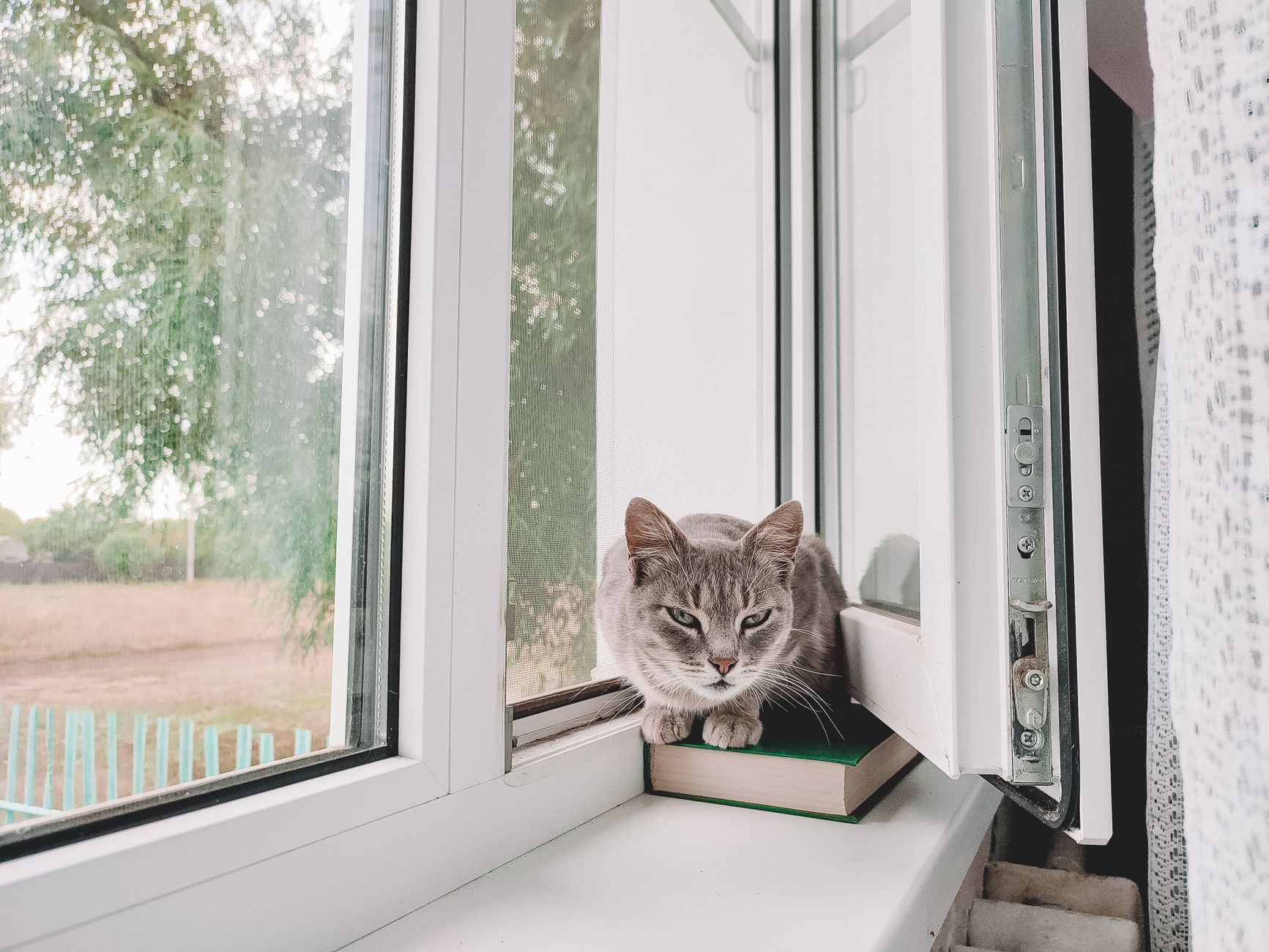
Your phone alarm sounds different from your backup alarm, and your cat knows it.
Cats can differentiate between alarm tones and associate each with different outcomes, particularly the difference between first alarms that you snooze and final alarms that produce actual movement. They've learned that some sounds mean "wait ten more minutes" while others mean "the human is actually getting up now."
This acoustic learning demonstrates cats' ability to form conditional associations. They're not just hearing sounds—they're predicting outcomes based on which specific sound occurs and what has historically followed it.
Feline hearing spans a frequency range up to 64 kHz (humans max out around 20 kHz), allowing cats to detect subtle variations in alarm tones that sound identical to human ears. Researchers studying cat cognition have documented cats responding differently to alarms based on pitch, duration, and even the time of morning they occur, suggesting they build complex conditional models of household sounds.
But #3 shows they're tracking an even more subtle morning signal...
Biscuit
Biscuit is looking at you hopefully.
#3 — They Notice When You Check Your Phone Before Rising
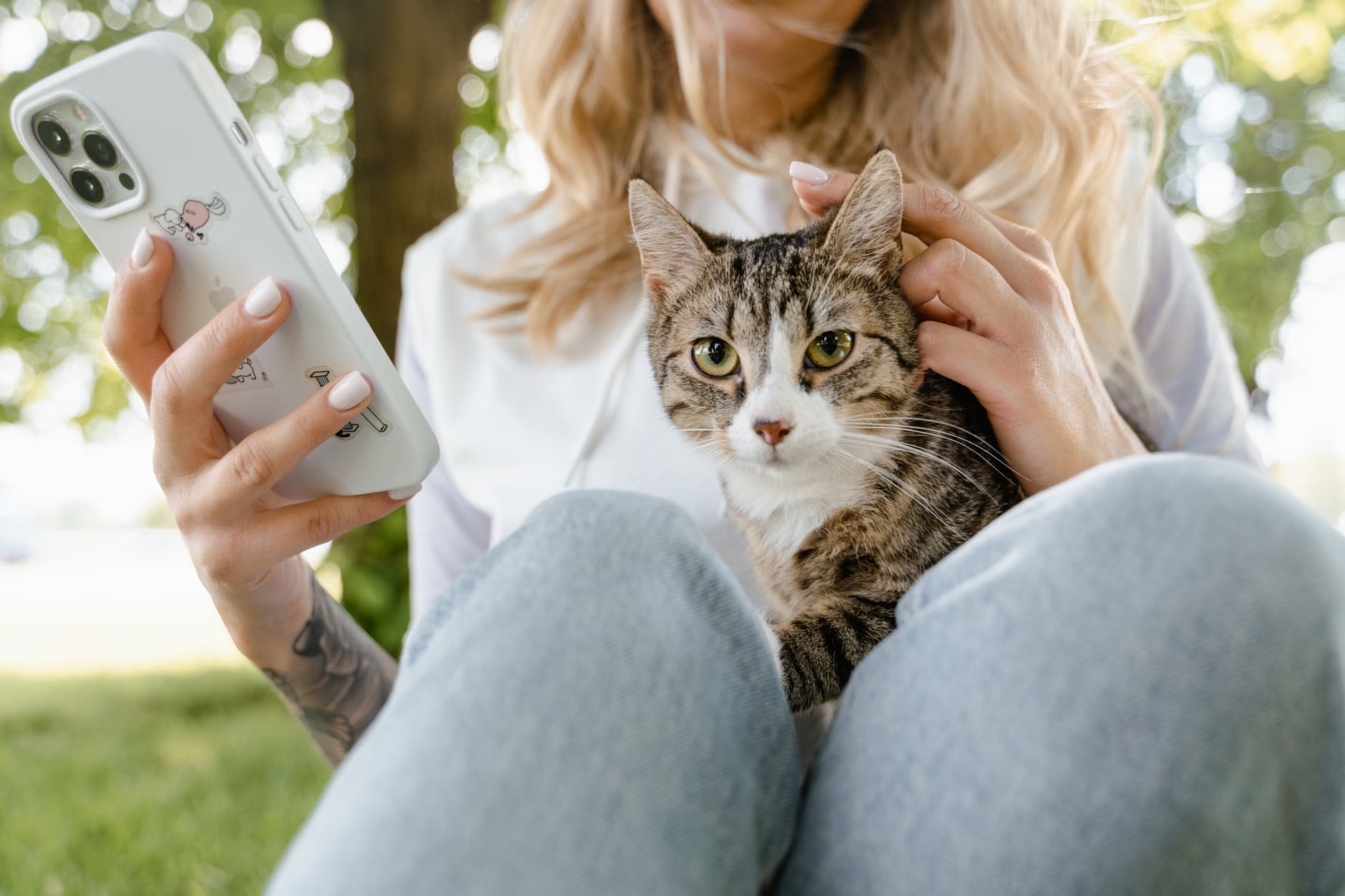
That blue glow tells your cat everything they need to know.
The light from your phone screen creates a distinct illumination pattern that cats associate with imminent waking, and they've learned it's a more reliable signal than your alarm. When you reach for your phone—to check the time, silence an alarm, or scroll before rising—your cat registers both the light change and the arm movement.
Cats have specialized vision adapted for low-light hunting, including a higher density of rod cells that make them extremely sensitive to changes in ambient light. A phone screen in a dark room is, to a cat, a spotlight announcing your transition from asleep to aware.
Behavioral observations suggest cats positioned near sleeping humans will often shift position or increase alertness within seconds of phone screen activation, even before the human makes any significant movement. The phone check has become, for many indoor cats, the single most reliable predictor that food, attention, or door-opening is roughly five to ten minutes away.
Fast Facts
- Cats can see in light levels six times lower than human threshold
- Rod cells (for motion/low-light) outnumber cone cells 25:1 in cat eyes
- Phone screen brightness in dark rooms exceeds cat's preferred hunting light
- Most cats adjust position within 30 seconds of screen activation
But #2 reveals they're also tracking what you do after you wake up...
#2 — They've Timed Your Bathroom-to-Kitchen Route

Your cat is already in position before you leave the bedroom.
Cats calculate the optimal intercept point between your bedroom and your first destination, which in most households is the bathroom and then the kitchen. They're not following you—they're predicting where you'll be and arriving first. This requires them to have memorized both your route and your walking speed.
This predictive positioning is hunting behavior adapted to domestic life. Ambush predators don't chase—they calculate trajectories and wait at choke points where prey must eventually appear.
Watch your cat's morning position closely for a week. Most cats won't sit at the bedroom door—they'll position themselves three to ten feet down the hallway, at the exact point where you typically make the turn toward the kitchen or bathroom. In multi-level homes, cats often wait at the top or bottom of stairs rather than outside the bedroom itself, having learned that intercept points along your path are more effective than starting points.
But #1 reveals the most sophisticated morning skill they've mastered...
#1 — They Know Exactly How Persistent to Be Based on Your Responses

Your cat has calibrated their morning demands to your breaking point.
Cats adjust meowing frequency, volume, and duration based on learned response thresholds, creating what behaviorists call an "escalation ladder" customized to each owner. They know how many meows it takes before you get up, whether physical contact accelerates your response, and whether ignoring them for five minutes means they need to increase intensity or try a different approach.
This calibration happens through operant conditioning, but the cat is training you, not the other way around. Every time you respond to a particular intensity of demand, you're teaching your cat the minimum effective dose needed to produce that outcome.
Why It Stands Out
- Cats can run 30+ different morning "experiments" before finding optimal strategy
- Successful patterns are reinforced within 3–5 repetitions
- Most cats have 2–4 distinct escalation strategies they cycle between
- Response time varies by day, so cats constantly adjust their approach
Veterinary studies on cat vocalization patterns show that cats living with the same human for multiple years develop individualized vocal signatures—specific meow patterns that work on their particular owner but might not transfer to a different household. The pitch, rhythm, and repetition rate are all calibrated through trial and error. Some cats learn that a single loud meow near your face works immediately. Others discover that persistence—soft meowing repeated every 20 seconds—is more effective. A few learn that knocking objects off surfaces produces faster responses than any vocalization.
This isn't manipulation in a negative sense—it's adaptive communication. Your cat has learned to speak your language, and the morning routine is where that language is most precisely refined.
The Bottom Line

Your cat's morning behavior isn't random, instinctive, or purely food-motivated—it's the result of careful observation and pattern recognition that happens while you sleep.
From tracking your pre-alarm movements to calibrating exactly how persistent they need to be, cats are running sophisticated behavioral experiments every single morning. They're reading chemical signals, timing your routines, and positioning themselves based on predictions about where you'll go and what you'll do.
The cat sitting at your bedroom door at 6 AM isn't impatient—they're demonstrating skills honed by thousands of hours of observation.
The most surprising finding isn't any single behavior but the cumulative picture: your cat has built a detailed working model of your morning sequence, complete with contingency plans for variations, and they update that model constantly based on new data. They know your household better than you realize, because they're awake and watching while you're not.
What has your cat learned about your mornings that genuinely surprised you when you finally noticed it?
Bonus — The One Change That Makes Mornings Calmer for Both of You
Here's what most cat owners miss: consistency in your own behavior is the single most powerful tool for managing your cat's morning intensity.
Cats escalate their morning behavior when your responses are unpredictable. If you sometimes get up at the first meow and sometimes ignore them for twenty minutes, you've created what behaviorists call an intermittent reinforcement schedule—the same mechanism that makes slot machines addictive. Your cat learns that persistence might pay off, so they keep trying.
The fix is a consistent, non-negotiable morning sequence:
- Set your alarm for the same time every day, including weekends, even if you go back to sleep after feeding
- Respond to your cat only after your alarm, never before, regardless of how long they've been requesting attention
- Feed or interact at the exact same point in your routine daily—after bathroom, before coffee, or whatever works for you
- Ignore all pre-alarm vocalizations completely; any response, even "quiet down," teaches them that meowing works
Within seven to fourteen days, most cats will adjust their wake-up requests to match your actual routine rather than trying to accelerate it. You're not ignoring your cat's needs—you're teaching them exactly when those needs will be met, which reduces their anxiety and your frustration. The cat who knows breakfast arrives at 6:30 AM without exception stops campaigning for 5:45 AM.
READER QUIZ
What Your Cat Has Learned About Your Mornings
How far in advance can cats typically detect that you're about to wake up, based on micro-movements and breathing changes?
- 1–3 minutes before waking
- 10–20 minutes before waking
- 45–60 minutes before waking
- Only when your alarm sounds
What chemical signal do cats detect through smell that indicates your stress levels while you sleep?
- Melatonin
- Dopamine
- Cortisol
- Serotonin
Where do cats typically position themselves in relation to your bedroom door for optimal morning interception?
- Directly outside the bedroom door
- Three to ten feet down the hallway
- In the kitchen waiting
- On your bed
How many times more powerful is a cat's sense of smell compared to a human's?
- 4 times
- 8 times
- 14 times
- 20 times
What type of reinforcement schedule do inconsistent responses to morning meowing create, making cats more persistent?
- Fixed ratio schedule
- Negative reinforcement schedule
- Intermittent reinforcement schedule
- Continuous reinforcement schedule
How does your cat typically wake you in the morning?
- Meowing or vocalizing near my face
- Pawing at me or walking on me
- Knocking things off surfaces or making noise