Most of us set traps expecting to catch what we were hunting. A mouse in a mouse trap. A fly in a flypaper. A coyote in a coyote cage. The Hernandez family of Fallbrook, California, had all the same reasonable expectations when they rigged up a humane cage in their backyard. What they got instead was one of nature’s most powerful predators staring back at them through metal bars at night, just a few feet from their back door.
It’s the kind of story that sounds like it belongs in a nature documentary, not a quiet San Diego County neighborhood. The events that unfolded in mid-February 2026 have left the community buzzing with both awe and anxiety. Let’s dive in.
Missing Animals Spark the Family’s Concern
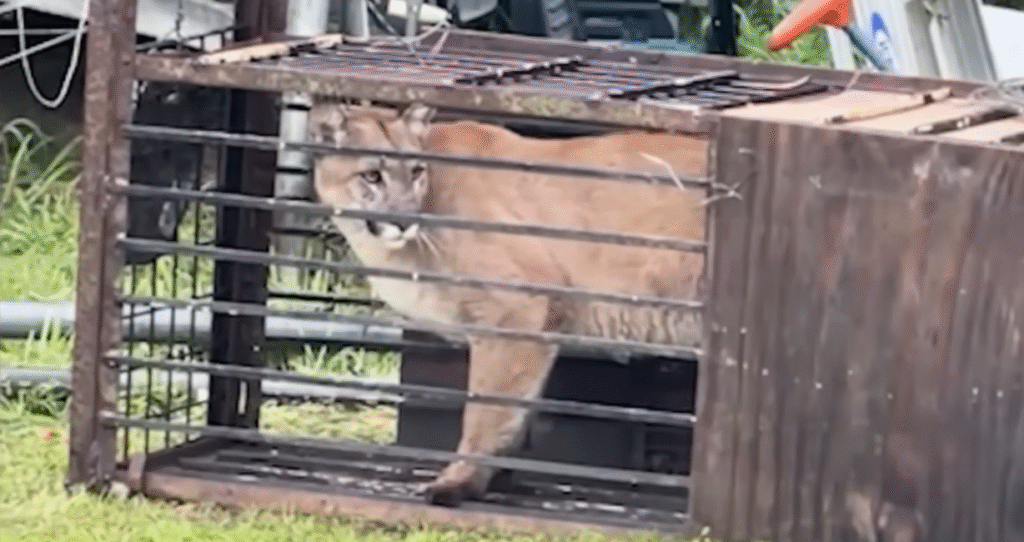
The unsettling chain of events began when chickens started disappearing from the family’s henhouse. On its own, one missing chicken might not raise alarm. But the evidence left behind was unmistakable. Several animals went missing from the Hernandez family property, including chickens kept in a henhouse and four cats, one of which was pregnant, and there was a big hole on the rooftop with feathers scattered all over the place.
Hernandez said her mother-in-law was especially upset about the missing cats. Honestly, that’s deeply understandable. These weren’t just livestock. They were pets, beloved members of the household. Four cats owned by the Hernandez family vanished, including one that was pregnant. The family was grieving real losses, and naturally, they wanted answers.
A Homemade Trap Becomes the Unlikely Solution
Believing a coyote was responsible, Hernandez had her father-in-law construct a humane cage trap and placed it on the rural property. It was a practical, sensible move. Coyotes are notorious for preying on backyard chickens and small pets throughout Southern California, and the signs certainly pointed in their direction. The trap was designed specifically to catch coyotes without causing harm, with the goal of safely containing the animal so that wildlife officials could remove it.
Think of it like setting out a bucket to catch a dripping faucet, only to discover the whole pipe has burst. The family did everything right for the problem they thought they had. Nobody could have predicted what would show up. Mountain lions are known for their stealth, and they can travel miles in a single night, often without being detected. It is entirely possible for one to move through a neighborhood under cover of darkness, unseen and unheard.
The Shocking Discovery That Woke Up the Whole House
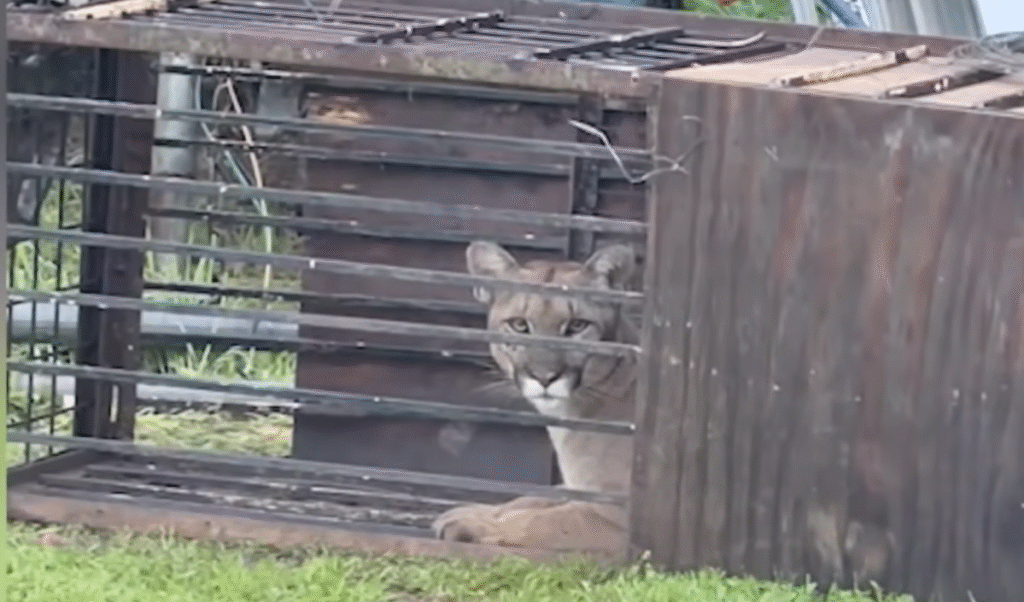
On the night of February 19, Hernandez’s husband went to check the trap and found a mountain lion lying calmly inside. Calmly. That word alone is enough to send a chill down the spine. Not pacing, not growling. Just lying there, composed and enormous, as if it had simply chosen to rest in a cage. He woke everybody up, and the family was shocked by how big it was and how it looked. Hernandez said her immediate concern was for her three children, ages 5 to 9.
Hernandez said she and her family breathed a sigh of relief, then wondered what to do next after having a mountain lion in their possession. That mix of emotions, relief that it was contained, terror at what was actually inside, must have been overwhelming. Adult mountain lions weigh between 85 and 170 pounds, and they can reach speeds of 50 mph, jumping vertically up to 18 feet. When you consider those numbers, the idea of one sitting just outside your children’s bedrooms is genuinely chilling.
Wildlife Officials Respond, Then Make a Controversial Call
Hernandez called 911, and on Friday morning, state wildlife officials, including a warden, arrived at the home. The cougar was released from the trap and ran off. For the family, that was far from the ending they had hoped for. They had imagined the animal being moved somewhere far away, somewhere its presence wouldn’t pose a continuing threat to their children and pets. The decision to release the animal surprised and frustrated the family, who had expected it would be relocated far from their rural neighborhood, and some neighbors shared those concerns.
According to wildlife officials, state law requires that any mountain lion that is privately trapped must be released in the same general area where it was captured. This is the part that is honestly hard to swallow when you’re the parent of young kids. The law makes ecological sense, since mountain lions have established territories and moving them can disrupt ecosystems or cause the animal to perish in unfamiliar terrain. Hernandez said she understands that wildlife officials must follow protocol, even if she disagrees with the outcome, adding that she has a real fear the lion could come back.
Neighbors on Edge as Fears Linger in the Community
Jeanette Villegas, who owns horses on her property, said she worries the mountain lion could return, stating that releasing an animal that already has an established food source in the area makes it likely it may come back. That’s a fear rooted in pure common sense. An animal that has discovered a reliable hunting ground doesn’t simply forget. It’s like moving a stray dog one block away from the garbage cans it loves. Villegas expressed concern that when she walks the property in the evening to check on her animals, the lion could be lurking nearby, hidden behind a building or bush.
The community’s anxiety is understandable, and it touches on a much larger conversation happening across California. Mountain lion attacks are rare in California, but incidents have been increasing and the cats’ behavior has been changing in the past few decades. Roughly forty percent of the state is considered suitable mountain lion habitat, making it likely that these elusive animals are around areas residents already frequent. Rural communities like Fallbrook sit squarely in that overlap zone between human life and wild territory.
What Residents in Mountain Lion Country Should Know
Keeping pets such as cats and dogs indoors at night if possible, and using fully enclosed pens for animals that must stay outside, is strongly recommended, since mountain lions are active during low-light hours. That advice feels especially relevant here, given that the Hernandez family lost four cats and multiple chickens before realizing what they were actually dealing with. Installing motion-sensing lights and sprinklers can also scare off mountain lions and keep them moving, while also helping improve a home’s overall security.
Experts also warn that leaving food out for stray cats can attract deer, and mountain lions may follow as they hunt their prey. Essentially, every food source on a rural property is a potential link in a chain that ends with a large predator in your yard. In the past 65 years, the California Department of Fish and Wildlife has recorded only 20 verified lion attacks in the state, and only three fatalities in 130 years, which puts the risk in perspective, though it offers little comfort when the animal is literally in your cage overnight.
The Hernandez family set out to solve a simple problem and stumbled into one of the most jaw-dropping wildlife encounters a suburban household can imagine. Their story is a vivid reminder that in many parts of California, the line between neighborhood and wilderness is surprisingly thin. One night it’s a coyote suspicion. The next, a mountain lion is waiting quietly in your backyard cage.
It also raises questions that don’t have easy answers: Are California’s wildlife release laws the right balance between ecological protection and community safety? Should rural residents have more recourse when a known predator is discovered near young children? The Hernandez family’s experience doesn’t resolve those debates, but it brings them into sharp, real focus. What would you have done if you found a mountain lion in your trap? Tell us in the comments.