It started as a quiet, ordinary evening. A cat owner stepped outside to check on her tuxedo cat after dark, half expecting to find him lounging on the porch. What she found instead was something so unexpectedly captivating that millions of strangers on the internet had exactly the same reaction: pure, wide-eyed wonder.
The clip she posted has since set social media ablaze, sending people tumbling down a rabbit hole of questions about what cats actually see when they stare into the night sky. Is it instinct? Incredible vision? Something we can’t fully explain? There is a lot more to this story than meets the eye. Let’s dive in.
The Viral Moment That Stopped the Internet in Its Tracks
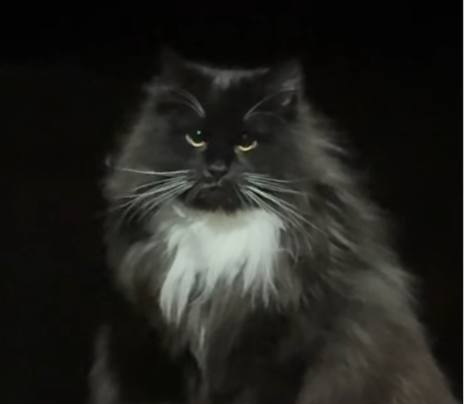
An Instagram clip, shared in February under the username @ranchousecats, shows a fluffy tuxedo kitty sitting on a fence out on the porch, looking up at the sky and enjoying the wind blowing through his fur as he stargazes. The scene is almost cinematic. There is something about the combination of a still, contemplative cat and the vast open sky that just hits differently, and clearly, the internet agreed.
The video quickly went viral on social media and has so far received over 4.2 million views and more than 640,000 likes on the platform. That is not just a successful post, that is a cultural moment. People were not simply watching a cat. They were projecting something onto him, a sense of mystery and cosmic awareness that felt strangely personal.
The comments section became a kind of philosophical forum in record time. Users flooded in with takes that ranged from sweet to genuinely thought-provoking. One commenter wrote “He knows ALL the secrets of the universe,” while another said “He looks like he could be a spirit guide out there with that song.” Honestly, it’s hard to disagree with either assessment.
Why Are Cats So Active After Dark?
Here’s the thing a lot of people get wrong. Cats are not actually nocturnal, even though your sleep schedule might strongly suggest otherwise. Cats are crepuscular, which means they’re most active around dawn and dusk. If your cat zooms around the house at sunrise or right before bed, that’s completely normal. The tuxedo cat in the video was simply doing what his biology has been quietly instructing him to do for thousands of years.
Cats are naturally crepuscular creatures, meaning they enjoy dim or dark spaces for resting, hiding, or stalking, which harks back to their hunting instincts. Think of it this way: cats are essentially miniature, domesticated lions who still carry the same operating system as their wild ancestors. The couch and the living room are just a savannah with better lighting.
Cats’ ancestors adapted to hunting during twilight hours to take advantage of cooler temperatures and the increased activity of their prey, which often includes small mammals and birds that are also active during these times. This adaptation reduces the risk of overheating during the chase and leverages low light conditions to stalk prey more effectively. Even when a modern house cat has zero intention of hunting anything more dangerous than a toy mouse, those ancient instincts never fully switch off.
The Science Behind Feline Night Vision
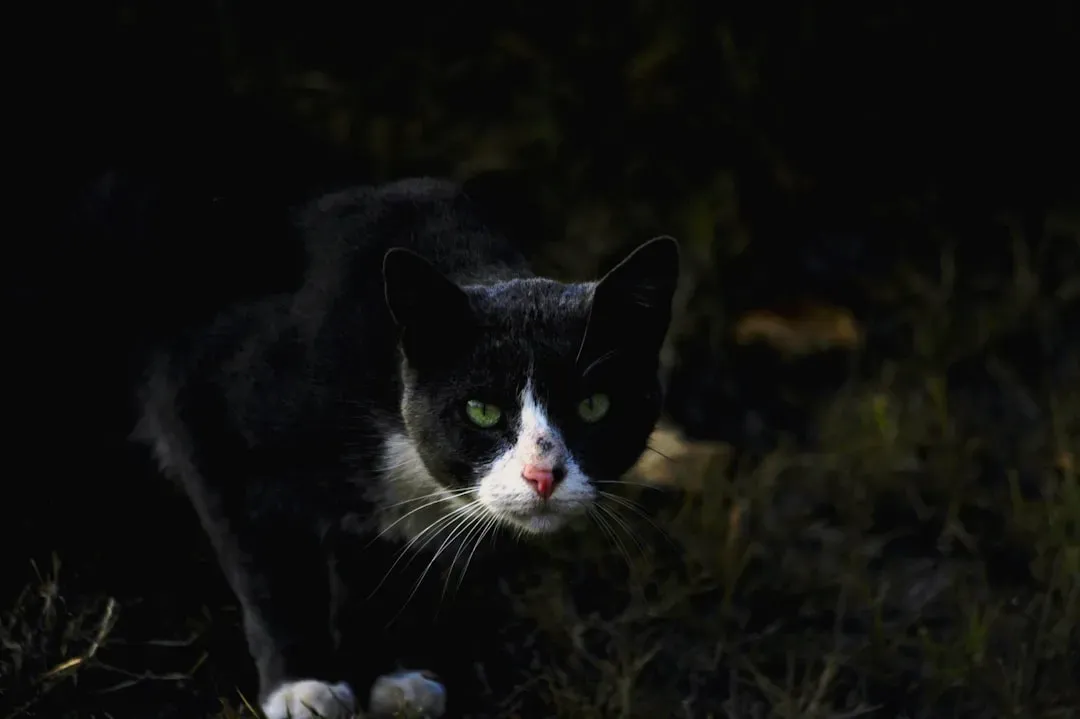
If you have ever shone a flashlight at a cat in the dark and been mildly terrified by the glowing eyes staring back at you, there is a fascinating explanation for that. Cats have a reflective layer behind their retinas called the tapetum lucidum, which amplifies available light and gives their eyes that famous nighttime glow. This structure allows them to see in light levels six times lower than what humans need. It is basically a built-in light amplifier tucked right inside the eye. Remarkable.
Cats’ eyes have a higher concentration of rod cells, the type of photoreceptor that works well in dim light. In fact, they have six to eight times more rod cells than humans, which allows them to detect movement and shapes even when lighting is poor. Meanwhile, cats have more rods in their eyes compared to humans and are therefore able to perceive motion better than us. This is why cats are drawn to and stare at moving or flowing objects almost methodically.
Humans typically have a visual field of 180 degrees, while cats have a visual field of 200 degrees, giving them notably better peripheral vision. So when a cat is gazing up at the night sky, it is perceiving a far wider, more motion-sensitive panorama than we can even imagine. What looks like peaceful stargazing to us might actually be an intensely active visual experience for them.
What Is the Cat Actually Watching Up There?
This is the question that keeps everyone guessing. To be fair, it is hard to say for sure. Not every staring session is mysterious. In most cases, a cat is simply responding to stimuli invisible to the human eye or ear. That could mean anything from a moth fluttering dozens of feet above, a bat darting across the sky, or even subtle shifts in ambient light that our comparatively limited visual system simply cannot register.
Cats have highly sensitive ears attuned to various noises and frequencies. They can pick up on high pitches that are barely audible to humans, providing another explanation for why cats seem to stare into empty space. For instance, a subtle buzzing noise emanating from a refrigerator might be barely noticeable to you but intensely bothersome to a cat. As the sound continues, so does the unwavering gaze. Now scale that up to the open night sky, full of insects, rustling trees, and distant animals, and suddenly that cat on the fence is not being mysterious at all. He is simply paying attention.
Research has shown that free-ranging cats are most active in low light conditions and tend to be more active around the new moon. So the night sky itself, including its cycles and its light levels, can directly influence how alert and engaged a cat becomes. That tuxedo cat was, quite literally, in his element.
The Internet’s Obsession With Cats and Their Mysterious Behavior
Let’s be real: the internet and cats have always had a very specific and unbreakable bond. Something about feline behavior manages to simultaneously feel deeply relatable and completely alien, and that contrast is endlessly entertaining. A cat staring into the night sky is not just cute, it is an inkblot test. Everyone sees something different in it.
The wave of comments on the viral video reveals a genuine emotional response from viewers. People were not just amused. They were moved. They projected wisdom, mystery, and even spiritual significance onto one small cat perched on a fence in the dark. A cat’s hunting instincts are intrinsically connected with her crepuscular nature, resulting in a fascinating form of behavior that aligns with her ancestors, much like having your very own miniature lion. That ancestral grandeur is apparently something humans are hardwired to recognize and admire.
Curiosity is a major reason cats stare so much. The world is fresh, new, exciting, and intriguing to their feline eyes, and they want to take it in as much as possible. They love to stare at moving objects, strange items, and things they can’t quite understand. In a way, the cat and the millions of viewers watching him share something in common: both are captivated by something vast and slightly beyond full comprehension.
What Cat Owners Can Learn From This Moment
Beyond the viral fame and the philosophical comments, this video is actually a gentle reminder to pay closer attention to our feline companions. A cat’s activity pattern can be influenced by the habits of their human companions, the availability of food, and their environment. Indoor cats fed at regular intervals may show less pronounced crepuscular behavior compared to cats that are allowed to roam outdoors and exhibit natural hunting behaviors. Giving cats some outdoor access or enriched environments can make a genuine difference in their wellbeing.
For domestic cats, the crepuscular hours can also be a time for social interaction, play, and exploration. Cats may be more inclined to engage with their human family members during these times, seeking attention, play, or food. So instead of being frustrated the next time your cat is suddenly full of energy at dusk, consider joining them. You might be surprised what you both notice out there in the fading light.
A cat’s circadian rhythm naturally guides them to be awake during twilight hours, but feeding schedules and playtime can make a big difference. Trying a good play session and a meal before bed can help align your routines more harmoniously. Understanding your cat is not just good for them, it is genuinely good for you too.
What began as a simple evening check-in turned into one of those rare internet moments that actually means something. A tuxedo cat sitting on a fence, face tilted toward the stars, wind in his fur, gave millions of people a reason to pause and feel something genuine. That is no small thing in a world moving at relentless speed.
The science behind feline behavior is fascinating on its own. But what this video tapped into is something older and more human: our deep, enduring fascination with animals that seem to perceive a world just slightly beyond our reach. Cats have been sitting in this liminal space between the domestic and the wild for thousands of years, and they show absolutely no signs of giving it up.
Maybe that little tuxedo cat really does know all the secrets of the universe. Or maybe he just spotted a moth forty feet up and thought it looked delicious. Either way, we will keep watching. What do you think he was looking at? Tell us in the comments.