Queensland, Australia – A 2-year-old deaf white cat named Huckleberry, affectionately called Huck, captured the attention of millions online with his savvy use of speech buttons. The fluffy rescue, who also has heterochromia, trotted to his communication board and selected “school” to signal his desire for a training session, even when dinner awaited.[1] His owner, Mads, shared the moment on TikTok, where it quickly amassed over 315,000 views and 50,000 likes.[1]
The Surprising Button Press That Went Viral
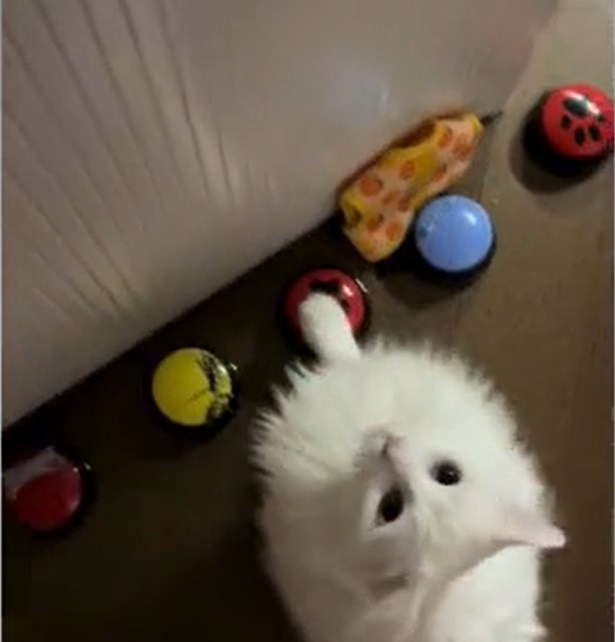
Huck perched on a box as Mads approached with sign language cues. Instead of pawing the food button as expected, the cat confidently pressed “school,” his designated word for training time. He followed up with a high-five, a gentle boop on Mads’ hand, and a swift turn – all responses guided by familiar signs.
Mads recounted her astonishment in the video caption: “I was 100 percent expecting to walk over and watch him paw then lie on his food button and I get dinner out. Nope, this guy constantly amazes me!”[1] Huck typically preferred treats before lessons, yet his behavior aligned perfectly with the request. Viewers flooded the comments with awe, noting the deep bond evident in their nonverbal exchanges.
From Shelter to Speech Board: Huck’s Adoption Story
Mads adopted Huck five months earlier, bringing the young rescue into her Queensland home. At first, he avoided eye contact during signing sessions, looking away whenever hands moved near him. Patience proved essential; it took weeks of daily consistency for Huck to recognize those gestures as meaningful communication.
The turning point came through trick training with hand signals. Huck began associating specific movements with actions like high-fives and spins. Mads explained, “I adopted him five months ago and he has learnt all the signs, tricks and buttons in that time.”[1] This foundation paved the way for broader understanding, transforming random motions into a shared language.
Unlocking Communication: Buttons Meet Sign Language
Huck’s speech buttons represent a modern tool in pet interaction, allowing him to express needs clearly. The “school” button, in particular, signals readiness for mental stimulation through tricks and games. Mads reinforced presses with positive responses, ensuring Huck linked actions to outcomes.
Sign language complemented the buttons seamlessly. Simple cues directed Huck’s responses, building trust and responsiveness. If uninterested, he simply walked away, underscoring his agency in the process. Mads noted that dinner ran late that day due to Huck’s deep sleep – a trait common in deaf cats who miss auditory wake-ups.[1]
Progress accelerated once Huck grasped the system. He now navigated his board with purpose, occasionally combining presses for clarity.
Lessons from Huck’s Rapid Learning Curve
The duo’s routine highlighted key training principles. Consistency built Huck’s confidence, while starting small prevented overwhelm. Mads integrated buttons into daily life, from mealtime requests to play sessions.
- Begin with visual cues like hand signals for tricks.
- Introduce buttons one at a time, associating each with rewards.
- Observe body language to confirm intent and reinforce successes.
- Allow choice; respect when the pet disengages.
- Celebrate small victories to maintain motivation.
These steps turned skepticism into success. Mads initially wondered if a deaf cat could master buttons, but Huck proved otherwise through steady advancement.
Key Takeaways
- Huck learned signs, tricks, and buttons in just five months.
- Visual consistency overcame initial avoidance.
- His viral choice of “school” over food showed true comprehension.
Huck’s story illustrates the profound potential of adaptive communication between humans and pets. It reminds us that barriers like deafness fade against dedication and innovation. What do you think about Huck’s button skills? Tell us in the comments.