You’re sitting quietly in the living room when your cat suddenly freezes. Their gaze locks onto a bare corner of the wall. Pupils wide, ears rotating like tiny satellite dishes, body tense. You look over. Nothing. Absolutely nothing is there. Yet your cat watches with an intensity that could only mean one thing – right?
Well, maybe. Or maybe not. The truth behind this remarkably common, genuinely spine-tingling moment sits somewhere between hard biology and age-old wonder. Cat owners have been asking this question for centuries, and in 2026, we still don’t have a tidy scientific verdict. What we do have, though, is a fascinating collection of facts, folklore, and sensory science that will completely change how you think about your feline companion. Let’s dive in.
The Question That Has Haunted Cat Owners for Centuries
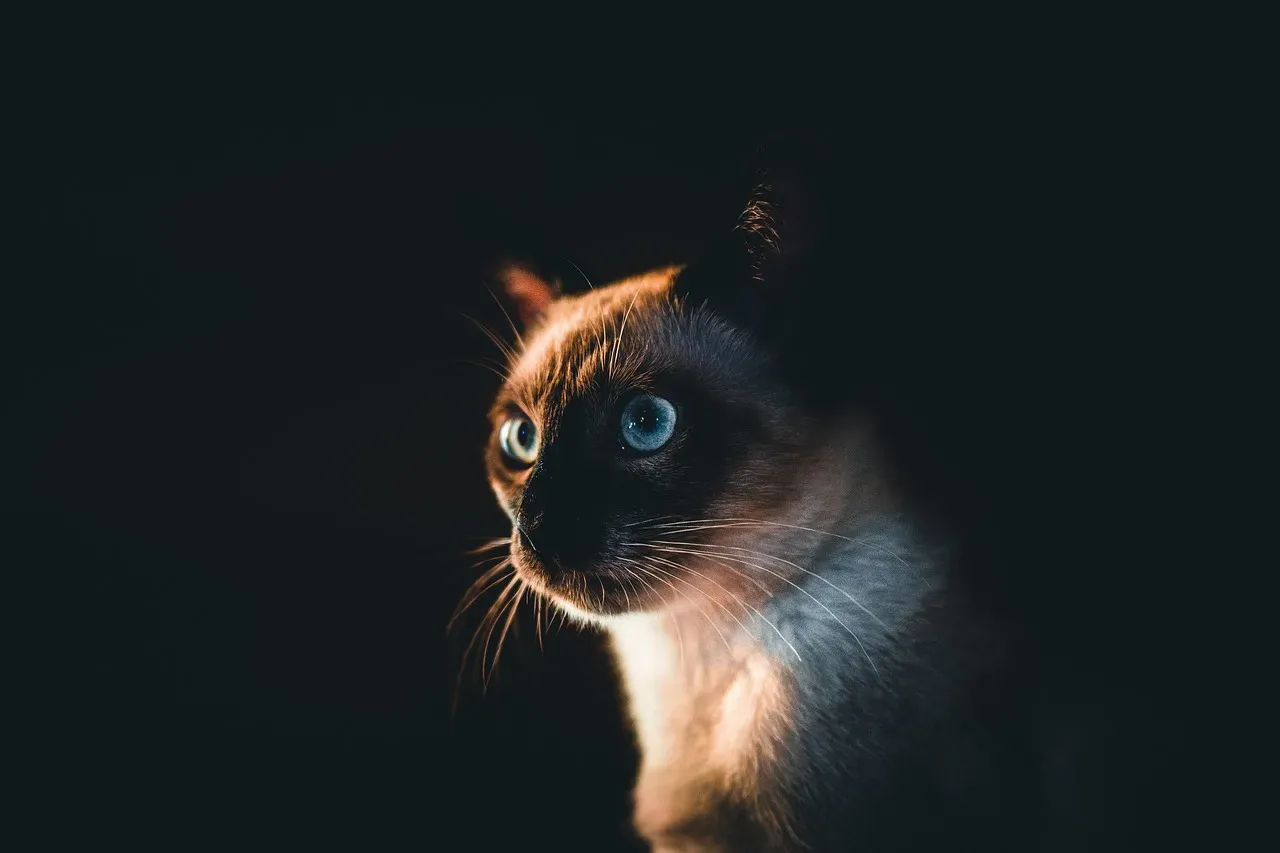
Honestly, nearly every cat owner has experienced it. Your cat stares at something invisible with unnerving focus, tracks a “something” across the ceiling, or hisses at an empty doorway. Cats being associated with the supernatural is not a new concept by any means. For centuries, witches and cats went hand in hand, and many superstitions surrounded these mysterious animals. The connection between felines and the spirit world is deeply woven into human culture across the globe.
Currently, science has not settled the question of whether ghosts even exist, much less whether cats can perceive them. However, cats do have more heightened senses than humans, so they are more likely to pick up on subtle stimuli that people simply cannot see. That distinction is an important one. Just because your cat reacts to something you can’t detect doesn’t automatically mean it’s supernatural. It might just mean your cat is operating on a completely different sensory level than you are.
Your Cat’s Extraordinary Eyes: Seeing the Invisible
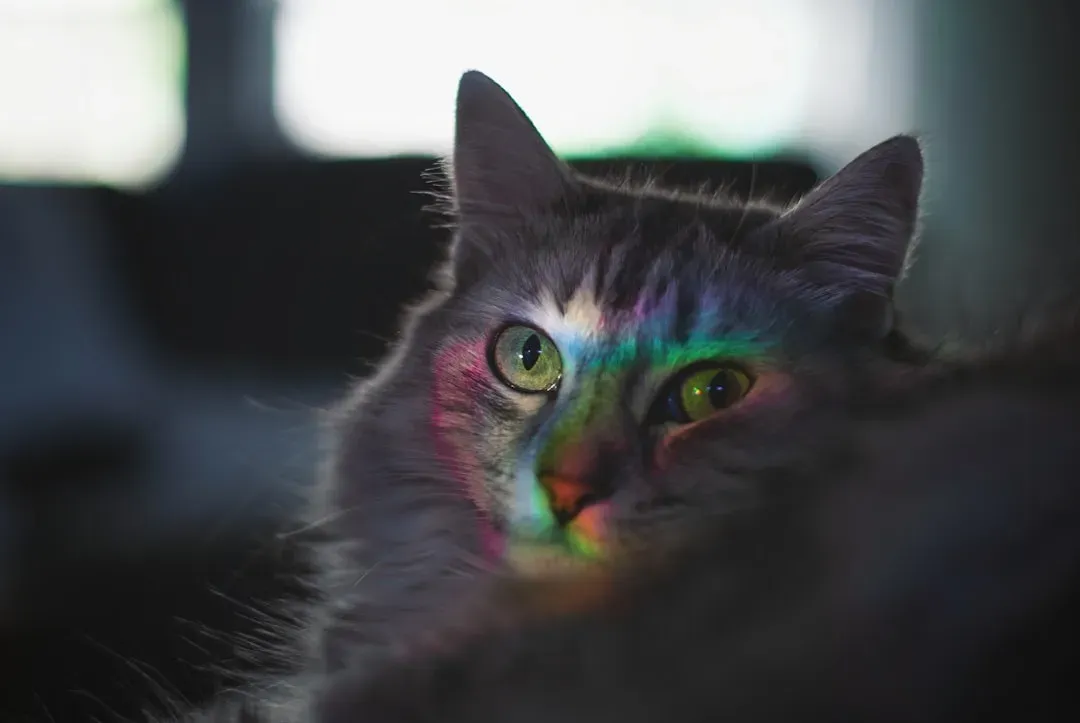
Cats can see about six to seven times better than humans in dim light, according to veterinary research. They have more rod cells in their retinas, plus the tapetum lucidum, a reflective layer that bounces light back through the retina. Think of the tapetum lucidum as a biological mirror installed inside the eye. It’s the reason your cat’s eyes glow an eerie green in photos, and it’s why they navigate a pitch-dark hallway like it’s lit up with floodlights.
Research has found that cats have lenses that allow some ultraviolet light through, suggesting these animals may see in the ultraviolet spectrum. This is genuinely remarkable. To your cat, a plain white wall might be covered in UV-reflective patterns, urine trails from a mouse that scurried by three days ago, or optical brighteners from your laundry detergent on a floating dust mote. So when your cat is staring at “nothing,” she might actually be watching a psychedelic light show of UV reflections that your eyes are simply too limited to process.
Ears That Pick Up What No Human Could Ever Hear
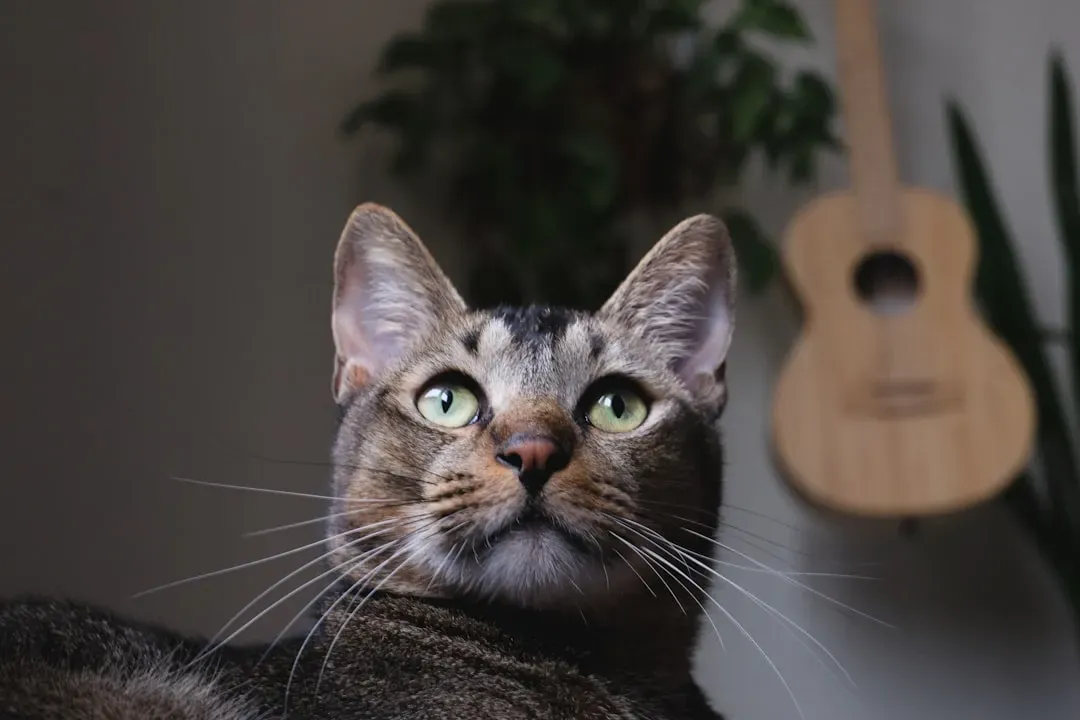
Cats have some of the best hearing of all the land mammals. They can detect sounds in a range of 50 Hz to around 80 kHz. In contrast, humans detect sounds of only 20 Hz to 20 kHz. To put that into plain language: your cat is hearing an entire dimension of sound that exists completely beyond your reach. Every creak in the wall, every high-pitched hum from an electronic device, every tiny squeak from inside the pipes – your cat hears all of it, perfectly.
A cat can separately rotate the outer ear flaps 180 degrees, each functioning like a mini-satellite dish that retrieves data to be analyzed by the cat’s brain. Cats can hear ultrasound to enhance their ability to detect high-frequency sounds produced by rodents, which communicate in the 20 to 50 kHz range. Small cats are therefore well-equipped to detect the sounds of their prey. So when your cat snaps their head toward the corner and stares with burning intensity, there’s a very good chance they just heard a mouse squeak inside your wall at a frequency you will never, ever perceive.
The Whisker Effect: Feeling Things That Aren’t Visible
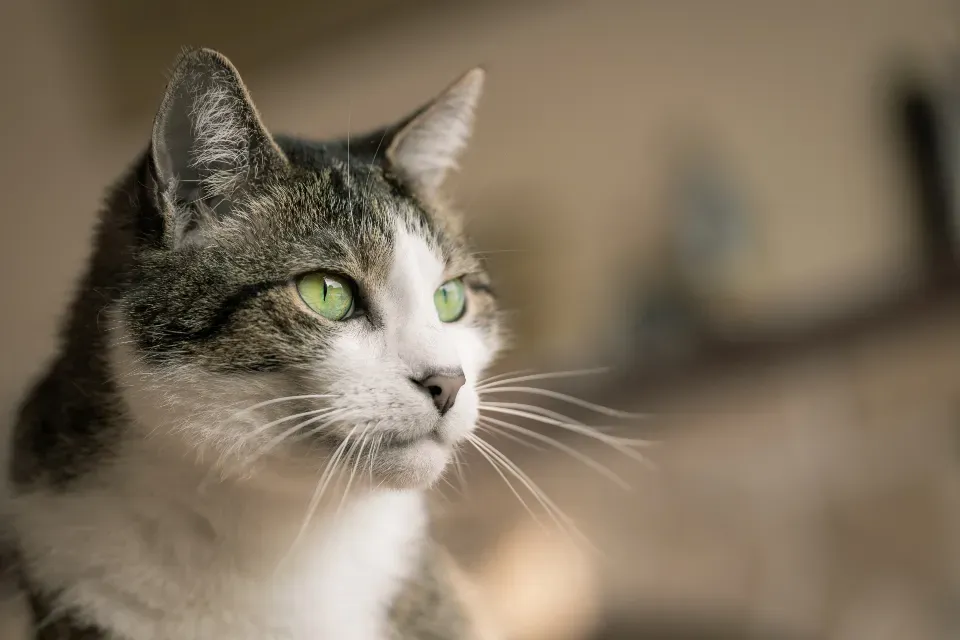
Cats have twenty-four vibrissae or whiskers which send information to their barrel cortex, similar to the visual cortex of the brain. Because of this, felines can essentially create a 3D map of their environment. They can also use their vibrissae to sense air movement. This is essentially a second sensory system running parallel to their vision. It’s like having a radar system built directly into your face.
A cat’s senses are far more heightened than ours, and their whiskers can even detect air currents and temperature changes. What does this mean practically? Even the slightest shift in airflow – from an open vent, a draft through a barely-cracked window, or a change in air pressure before a storm – registers immediately in your cat’s awareness. Cats can certainly sense changes in their environment, like airflow, tiny vibrations, or emotional tension. That mysterious “nothing” your cat is reacting to might very well be a tiny air current you’ve never even noticed.
Cats in Mythology: A Supernatural Legacy Across Civilizations
In ancient Egypt, cats were represented in social and religious scenes dating as early as 1980 BC. Several ancient Egyptian deities were depicted and sculptured with cat-like heads, such as Mafdet, Bastet, and Sekhmet, representing justice, fertility, and power, respectively. The ancient Egyptians clearly saw something extraordinary in their feline companions. This wasn’t casual admiration. This was reverence on a civilizational scale.
Cats were believed to possess magical powers, capable of warding off evil spirits and safeguarding households. Meanwhile, across the world in Japan, folklore introduces the Bakeneko and Nekomata – supernatural cats capable of shapeshifting, speaking human language, and even raising the dead. These mythical creatures emerge from ordinary cats that have lived long enough to develop magical powers. In Celtic mythology, the Cat Sith was a spectral black cat with a white spot on its chest. It was believed to steal the souls of the dead before they could move on. To prevent this, people would play games and use catnip to distract cats during wakes. Every culture, it seems, arrived at the same conclusion independently: cats are special.
Barometric Pressure and Environmental Sensitivity: Nature’s Early Warning System
Research has found that cats can detect changes in barometric pressure. This sensitivity to changes in the weather can help them “predict” storms and other natural occurrences. Cats pay close attention to the world around them and notice even the subtlest changes that humans may not pick up on. This is a well-documented phenomenon. If your cat suddenly becomes restless and agitated before a thunderstorm, they’re not losing their mind – they felt the shift in atmospheric pressure before the clouds even darkened the sky.
Here’s the thing: this kind of sensitivity gets misread as paranormal behavior all the time. A sudden change in barometric pressure, a vibration in the ground, an uptick in electromagnetic activity – your cat’s nervous system is wired to register all of these as meaningful signals. Animals, unlike people, don’t have an ulterior motive for what they’re reacting to – it’s simply a combination of instinct and abilities. Your cat isn’t performing for you. When they react, something is genuinely triggering their senses, even if you’ll never know what.
When “Ghost Behavior” Is Actually a Medical Concern
Let’s be real for a second. Not every wall-staring, air-hissing episode is either supernatural or benign sensory processing. Sometimes, it’s a sign that something is physically wrong with your cat. Feline Hyperesthesia Syndrome is a condition causing extreme sensitivity and hallucinations. Cognitive Dysfunction Syndrome is essentially feline dementia – older cats may get confused and “get stuck” staring. These are real, diagnosable conditions that can look eerily like ghost-seeing behavior from the outside.
Seizures can also cause what are called “fly biting” episodes, where cats snap at invisible flies. If strange behavior comes with appetite changes, hiding, or aggression, it’s worth consulting your veterinarian. I know it’s more fun to imagine your cat is communing with the spirit of your great-grandmother, but if the behavior is sudden, constant, or escalating, please call your vet. A ghost probably won’t show up on an MRI, but a brain lesion will.
The Science Versus the Supernatural: What We Actually Know
As a general answer, there is no scientific evidence at all that cats can see ghosts and spirits. The science on this is inconclusive in part because there is also insufficient evidence to confirm the existence of ghosts and spirits in the first place. It’s a bit of a circular puzzle, honestly. You can’t definitively prove cats see ghosts when we haven’t definitively proven ghosts exist at all. The entire debate rests on a foundation of unknowns stacked on top of more unknowns.
Yet dismissing the whole conversation seems too quick. Some cat owners may not notice any supernatural phenomena with their cats since they don’t believe in anything beyond the physical world. Meanwhile, a cat’s strange behavior could simply be explained as supernatural if its owner also believes in it. Without enough research into cats and the spiritual realm, this may continue to be unresolved. Anything could be possible. The honest answer, perhaps the only honest answer available right now, is that we don’t know. The science of cat perception has revealed genuinely extraordinary abilities. Whether those abilities extend into any metaphysical dimension remains firmly in the territory of personal belief.
Reading Your Cat’s “Ghost Behavior”: What It Really Looks Like
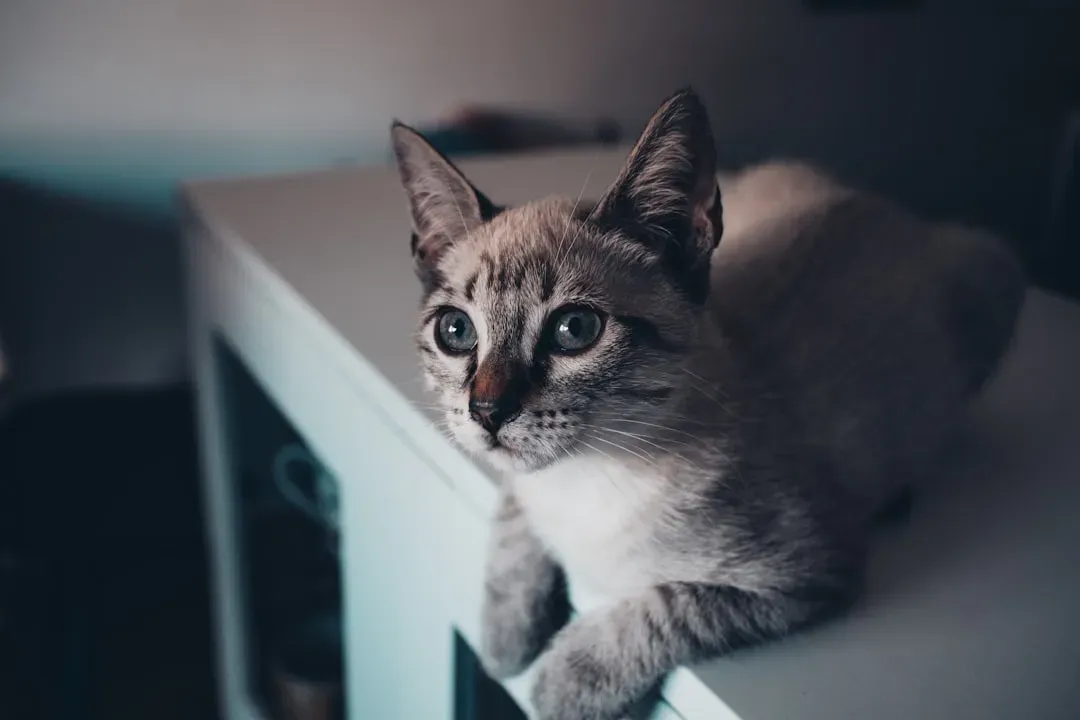
Some cats stare continuously at a particular spot – a spot that was later discovered to have a story behind it. Others watch the stairway as if someone is walking up and down, or a wall in the house, as if someone is hiding behind it. Sometimes, after staring for a while, the cat’s face looks as if they are trying to fight something off. These are the moments that genuinely make even the most skeptical cat owner pause and wonder.
When a cat feels threatened and needs to protect herself, she flattens her ears, puffs up her tail, and poses in a crouched position. They may even hiss or growl in defense. Some cat parents agree that sometimes their cat will exhibit this behavior without any noticeable danger. In such instances, some animal experts believe cats do this when they sense something invisible. Your best move? Often, when your cat stops and stands completely still, it’s because they’re trying to determine if they’re in any danger. You should generally try to reassure your cat when they turn rigid for no reason. This is especially true if they start vocalizing, as that can be a sign that they want you to come to the rescue.
Conclusion: The Mystery That Lives Between Science and Belief
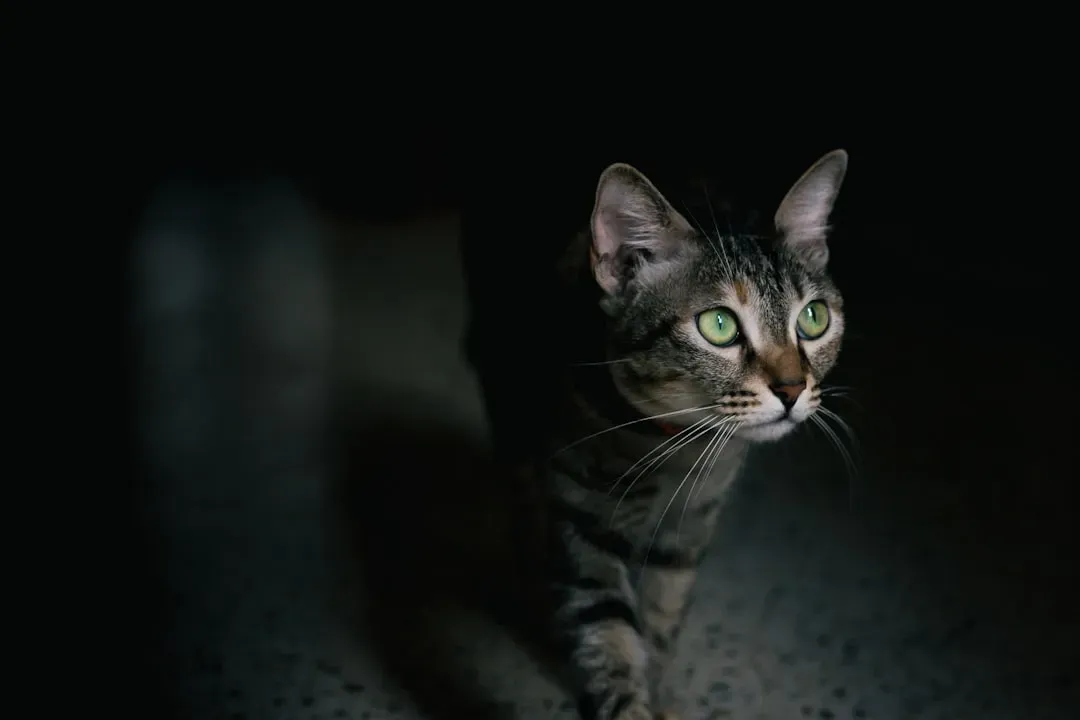
Your cat is, without question, operating in a sensory world that makes yours look like a rough sketch. Their vision pierces the ultraviolet spectrum, their ears penetrate the ultrasonic, their whiskers map the invisible architecture of airflow, and their nervous system functions as a living barometric instrument. Cats excel at reading body language, detecting pheromones through their vomeronasal organ, and sensing emotional states through subtle cues. What seems like a sixth sense is actually complex environmental information processing through superior senses that far exceed human capabilities.
Still, there is a quiet space at the edge of all that science where certainty simply runs out. Whether cats possess supernatural powers or not is entirely up to what you believe. What we all know to be true and can agree on is that cats are amazing, curious communicators, and observing their behavior can lead to some very interesting questions. So the next time your cat locks eyes with an empty corner at 3 AM, maybe don’t reach for the holy water just yet. But maybe don’t dismiss it entirely, either.
What do you think – is your cat tuned into something science hasn’t named yet, or are they just watching the world’s most invisible mouse? Tell us in the comments.