If you’ve ever tried to teach a cat to do anything on command, you already know the look. That slow, dismissive blink that says, “Nice try, human.” So when one pet owner decided to take on the ambitious task of leash training her tabby cat, nobody expected the lesson to be taken over by a four-legged colleague. What happened next racked up hundreds of thousands of views and left the internet in stitches. Let’s dive in.
The Video That Stopped Everyone Mid-Scroll
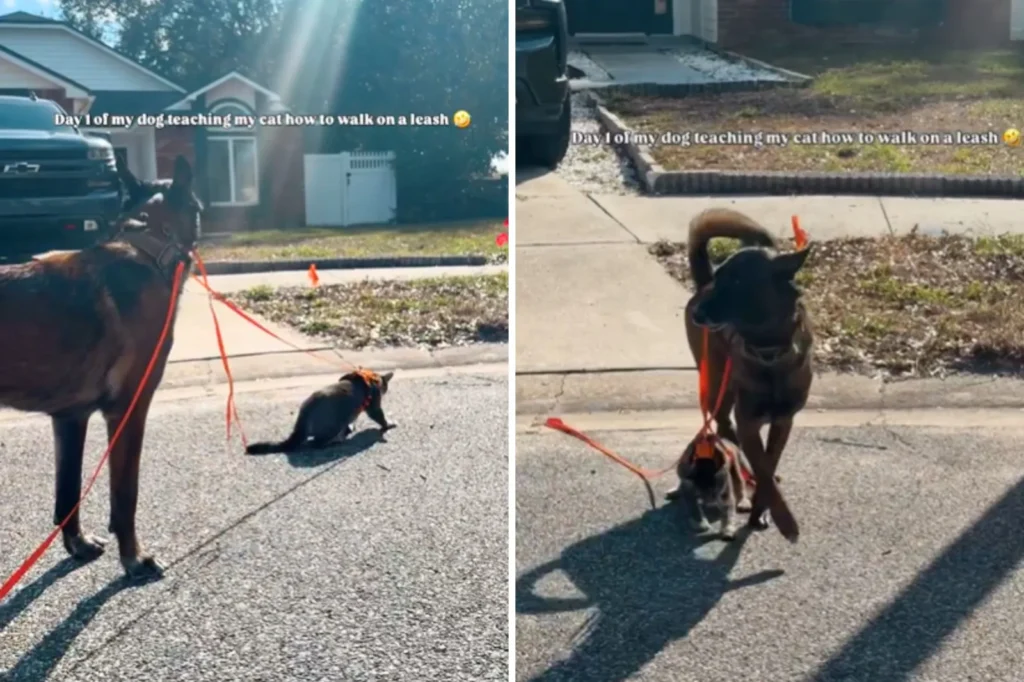
Owner Kylee had been leash-training her tabby cat, Camo, for several days before sharing a February 17 video under the account @tightlines.and.canines, documenting the progress. It was a genuine, day-to-day effort – nothing staged, nothing scripted. Just a cat owner putting in the work.
Kylee’s goal was to eventually walk both Camo and her Belgian Malinois, Mako, together, as the cat had always shown an interest in going outside, but first needed to become comfortable with the leash. That’s a sweet vision, honestly. Peaceful family walks where the cat and dog explore the world side by side. Reality, as it turns out, had other plans.
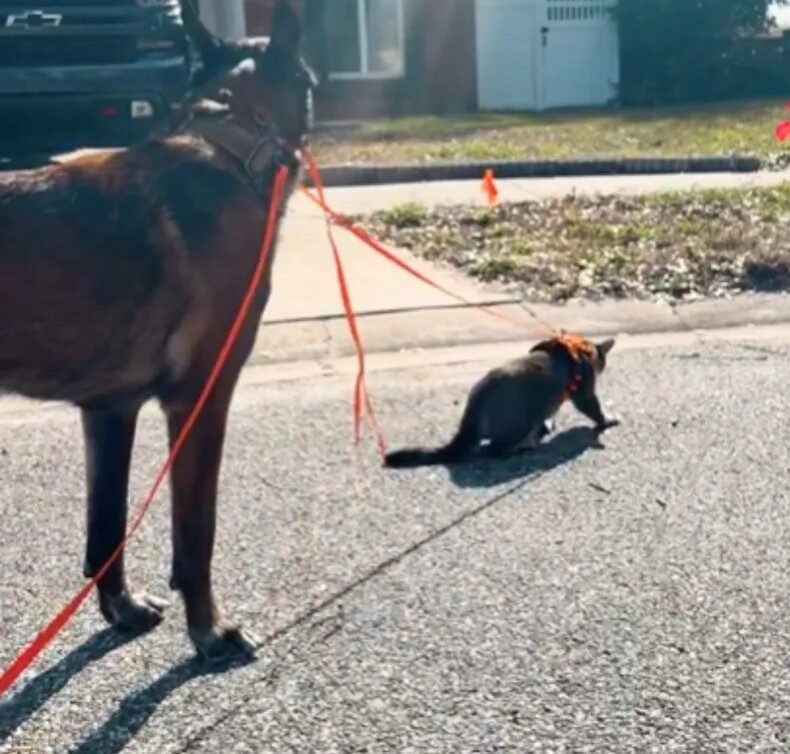
Before long, Mako appeared to take matters into his own paws. In the clip, the dog gently holds the leash in his mouth as Camo slowly walks ahead of him outside the home. As Kylee films the interaction, Mako initially matches the cat’s cautious pace before trotting forward with Camo in tow, seemingly trying to speed the training process.
Camo Scrambles, Mako Marches On
Think of it like this: Camo was on a peaceful Sunday stroll, and Mako decided it was suddenly a Monday morning commute. By the end of the clip, Camo could barely keep up, his tiny paws scrambling across the ground as Mako continued forward with the leash in his mouth. While it seemed like the kitty was not a fan, Kylee reassured viewers in the caption that he was “fine.”
Kylee’s tone throughout the whole thing was refreshingly light and loving. She noted that her dog absolutely loves Camo and that she thought it was hilarious, adding that Camo follows Mako everywhere he goes, too. So really, this was less a hostile takeover and more a very enthusiastic friend trying to show you how it’s done. The clip had reached over 328,000 views on Instagram as of Sunday.
Why Leash Training a Cat Is Nothing Like Walking a Dog
Here’s the thing that makes this video so perfectly ironic: Mako, a dog, was essentially trying to walk the cat the way a dog gets walked. Purposeful. Forward-moving. Goal-oriented. That’s basically the opposite of how it’s supposed to go. Leash training a cat can be a great way to provide a kitty with physical activity and mental stimulation, but the approach is a whole different story from walking a dog.
Walking a cat is nothing like walking a dog. The first misconception is that you are ever going to be walking the cat. The cat is going to be walking you. The owner follows, observes, and stays out of the way. Leash training a cat can sometimes require a bit more time and patience than getting a puppy used to walking on a leash, since cats are naturally quite independent creatures. Mako, bless his heart, did not get that memo.
The Right Way to Actually Leash Train a Cat
If Kylee’s video inspired you to try this yourself, pump the brakes – and definitely don’t let your dog run the session. The process starts way before any outdoor adventure. The first step is familiarizing the cat with a harness and leash, which should be done slowly and in a fun, positive manner. Simply shoving it on your cat is going to create an aversion, so the key is to go at their pace.
Leaving the harness and leash in the cat’s favored areas of the house so the cat can investigate them is a great first move. Rewarding any interest with treats and praise helps build a positive association. When the cat is relaxed with it around the home, the harness can be placed near or on the cat, and if they remain calm, another reward is offered. Once the cat is comfortable with the harness touching them, it can be put on and adjusted for fit. Once a cat appears comfortable moving freely in the harness, the leash can be clipped on and allowed to trail behind under supervision so the animal can adjust to the sensation. Short, low-stress outings in quiet outdoor spaces are typically suggested as the next step.
The Right Gear Makes All the Difference
Gear matters more than most people expect. You can’t just slap a dog leash on a cat and call it a day. Attaching a leash directly to the cat’s collar is not recommended, because pulling against the leash via the collar could potentially injure the cat’s neck. A cat’s head is about the same circumference as the neck, and the feline neck is quite fragile.
Cats need a harness that can be fitted snugly around both the neck and shoulder area and the torso under their front legs, with the D ring – the metal ring where the leash attaches – between the shoulders. Most dog harnesses have their D ring farther down the back, and the straps for a dog’s sturdier anatomy are often wider and stiffer than a cat harness. A proper fit is easy to check: the cat’s harness should feel snug but not too tight – you should be able to place two fingers between the harness and the cat’s body. Also, a fixed-length leash, preferably only four to six feet long, is the right call. Retractable leashes are a risk you really don’t want to take with a cat.
Meet Mako: The Belgian Malinois Who Decided He Was in Charge
The real character of this story, apart from the scrambling Camo, is Mako. The smart, confident, and versatile Belgian Malinois is a world-class worker who forges an unbreakable bond with his human partner. Honestly, seeing Mako pick up that leash and stride forward is not remotely surprising once you know the breed. The Belgian Malinois is intelligent, relishes mental and physical challenges, is playful and energetic without being hyperactive, and does not give up easily.
Malinois instinctively display herding behavior such as chasing and circling, moving effortlessly for hours. So Mako seeing a leash, a smaller animal, and an open outdoor space? His instincts basically wrote the script. Belgian Malinois form deep bonds with their families and are naturally protective of their loved ones. They are highly attentive to their owners’ cues and emotions, making them not only loyal companions but also dependable working partners who are always ready to spring into action. In Mako’s mind, he was almost certainly helping.
What the Viral Moment Says About Multi-Pet Households
There’s something genuinely heartwarming underneath all the comedy here. This wasn’t a dog bullying a cat. It was, in a strange and chaotic way, a dog who cares deeply about the cat in his life, trying to do what he knows best: work. For cats who take to leash walking, the activity can provide valuable mental stimulation and safe outdoor enrichment while strengthening the bond between pet and owner.
Using a harness and leash allows indoor cats to safely explore the outdoors, while gaining mental stimulation and exercise, which can help combat the risks associated with a sedentary lifestyle, including obesity. The method also provides enrichment without the risks of free-roaming, making it an increasingly popular option for curious felines eager to experience the outside world. The fact that Camo already follows Mako everywhere suggests these two have already built a real friendship – and maybe, just maybe, Mako’s unorthodox lesson planted a seed.
Kylee set out to teach her cat how to walk on a leash. Instead, she captured something that resonated with hundreds of thousands of people: the beautiful, chaotic reality of loving animals who all have their own ideas about how things should go. Camo may have been dragged along faster than he planned, but he and Mako share something most pets never get – a genuine, cross-species bond that plays out in the most wonderfully unpredictable ways.
If you’ve ever watched your pets interact and thought, “I have absolutely no idea what’s happening here,” you’re in good company. Sometimes the funniest moments are the ones nobody planned. What would you have done if your dog decided to take over the training session? Tell us in the comments.