When Theo was adopted during the height of quarantine, it quickly became clear he wasn’t just a playful kitten—he was deeply attached. With limited stimulation and constant time with his owner, Theo grew intensely bonded, a common trait in “pandemic pets.” What no one expected was that his strongest emotional connection would form with a black-and-white stuffed cat that soon became his constant companion.
That plush toy, nearly Theo’s exact size, filled an emotional gap. While it started as a novelty, it soon became a stand-in for something more meaningful: companionship.
A STUFFED TOY THAT BECAME FAMILY
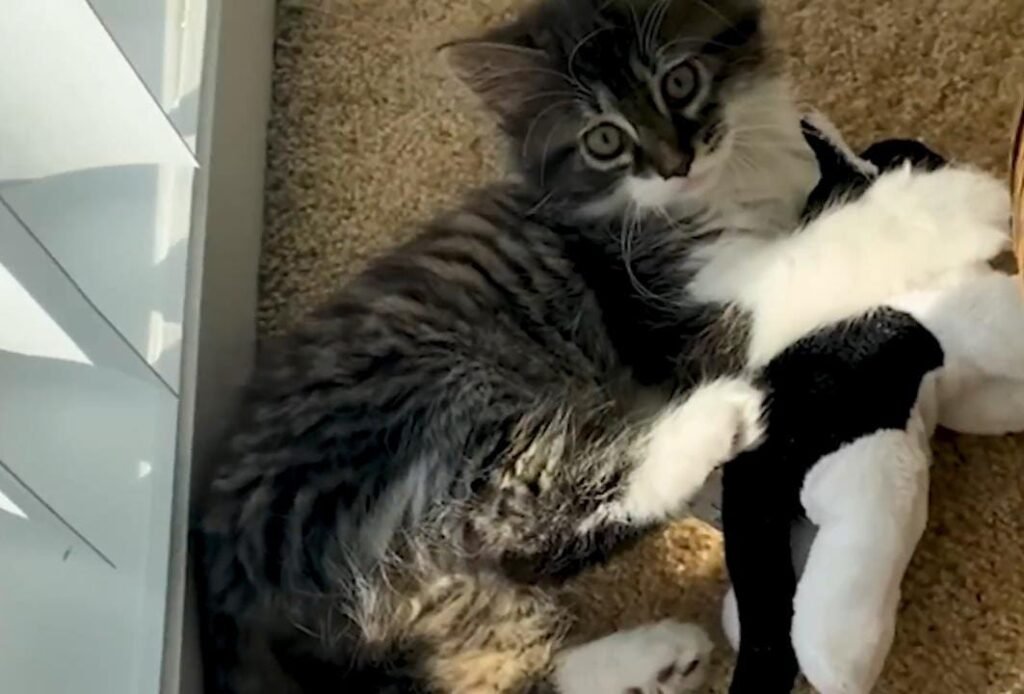
The stuffed cat was originally introduced as a joke, meant to simulate a littermate. But Theo treated it seriously from the start. He wrestled with it, carried it around the house, and later began cuddling with it as he matured.
Animal behaviorists note that young cats often imprint on objects when social needs aren’t fully met. Theo’s attachment wasn’t just cute—it was a sign he craved feline interaction beyond what a human could provide.
RECOGNIZING THE NEED FOR A REAL COMPANION
Over time, Theo’s joy with the toy became bittersweet. His owner noticed how content he seemed while cuddling it, but also felt guilt knowing it couldn’t replace a real cat.
This realization led to a visit to the Austin Animal Center, where Theo’s future sibling, Zelda, entered the picture—a high-energy kitten with curiosity to spare.
A FAST AND SURPRISING INTRODUCTION
Initial meetings can be tense, but Theo was instantly captivated. Zelda’s speed, confidence, and playfulness intrigued him rather than intimidated him.
Within days, the two were comfortable sharing space. Proper introductions, calm environments, and close supervision helped ease the transition, proving how preparation can make multi-cat households successful.
FROM STUFFIE TO SIBLING BOND
The most telling moment came one morning when Theo was found cuddled up with Zelda, gently grooming her. The stuffed cat had been replaced without hesitation.
Theo began treating Zelda as his own—sharing beds, cat trees, and routines. Even new furniture didn’t disrupt their bond; they chose togetherness over territory.
A HAPPIER, HEALTHIER DYNAMIC
Zelda gave Theo what the toy never could: real interaction, play feedback, and mutual comfort. The two quickly became inseparable.
Their story highlights the importance of social enrichment for cats, especially those raised in isolation. Sometimes, the best way to help a pet thrive is to expand their family—just like Theo finally did.