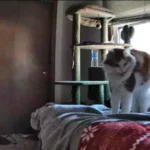
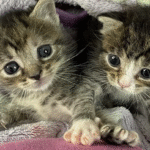
Most cat owners have asked the same quiet question at some point, usually while sitting in a hotel room or at a relative’s dining table, miles from home: “Does my cat even notice I’m gone?” Cats have a reputation for being mysterious and emotionally detached. They don’t greet you at the door with tail-wagging chaos. They don’t call. They don’t text. So honestly, it’s a fair question to ask.
One woman decided she wasn’t going to just wonder. She set up a camera and let the footage do the talking. What she found was simple, quiet, and – honestly – a little heartbreaking in the best possible way. Let’s dive in.
A Three-Week Trip and a Clever Camera Setup
Peanut the cat has been a part of Phuong’s life for two years. His previous owner had to give him up when they relocated and couldn’t bring him along, with Phuong finding him through a Facebook group. Peanut settled into his new home warmly, and the bond between owner and cat grew deep.
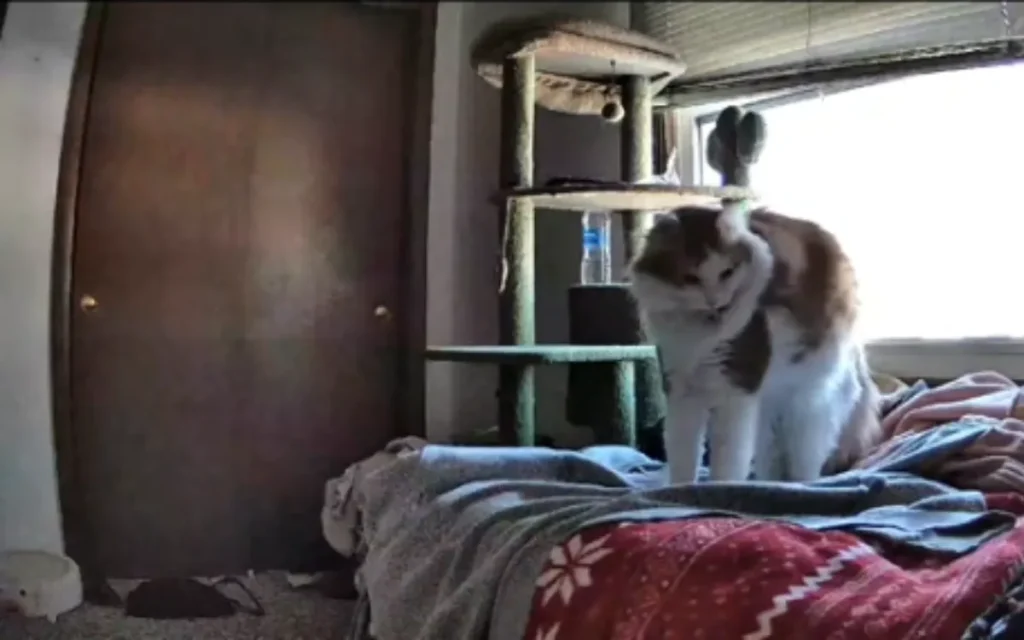
Peanut is notably attached to Phuong, typically following her everywhere and needing to be in the same room at all times. When Phuong recently went away for a family visit, leaving her roommate in charge of the cats, she still wondered whether Peanut would truly miss her – so she set up a camera in her room to check in occasionally during her three-week absence.
Phuong’s Other Cat and the Feline Friendship Factor
Peanut isn’t alone in the household. Phuong also has another cat named Hunnie, and the two are described as best friends. You might think that having a feline companion would fill the gap left by an absent owner. A buddy to chase around, a warm body to curl up with – problem solved, right?
Well, not exactly. When Phuong finally checked the petcam, she found Peanut napping. That seems ordinary enough, until she noticed he was “always sleeping in one spot” – and then realized that spot was exactly where she had left her sweater. The detail is almost unbearably sweet. Even with a feline friend in the house, Peanut still gravitated toward the one thing that carried his owner’s presence.
What the Petcam Footage Actually Showed
The realization hit Phuong with a wave of mixed emotions – she felt both sad and deeply touched by what she saw. There’s something about that image – a cat curled up on a sweater, again and again, waiting for someone to come home – that hits harder than any elaborate display of affection ever could.
Phuong later shared the footage on TikTok under the handle @peanutnhunnie, and she has since noticed that Peanut returns to that same spot every single time she checks in on the camera. No exceptions. The sweater has become Peanut’s anchor, his little patch of home in a temporarily rearranged world. It’s the kind of story that makes you want to go home and hug your cat immediately – or at least leave a sweater behind next time you travel.
The Science Behind Cats and Their Owners’ Scent
So why does a cat sleep on a sweater? Is it just warmth, or is something more emotionally complex going on? Here’s the thing – a cat is drawn to its owner’s scent because it provides comfort and a sense of security, with the behavior rooted in feline instinct around scent marking and familiar smells.
By choosing clothing as a resting spot, a cat isn’t just seeking warmth – it’s reinforcing social bonds. Cats have an extraordinary sense of smell, up to 14 times more powerful than a human’s, thanks to a specialized organ in the roof of their mouth. While cats primarily recognize their owners by voice, scent is nearly as important – to a cat, your body odor is as unique as a fingerprint. Peanut wasn’t just napping. He was, in his own quiet feline way, keeping Phuong close.
Do Cats Actually Miss Their Owners? What Research Says
The science here is more compelling than most people expect. A 2019 study published in Current Biology found that cats display attachment behaviors similar to those seen in dogs and human infants, using an adapted version of the Ainsworth Strange Situation Test. Researchers found that approximately 65% of cats demonstrated secure attachment to their caregivers, showing reduced stress when reunited and using their owners as a secure base for exploration.
To put this into perspective, studies on attachment styles in human children found that roughly 65% displayed secure attachment, while about 58% of dogs did the same – meaning cats actually edged out dogs by around 6% in terms of secure attachment rates. Cats also have strong long-term memories, especially when emotional connection is involved, and can remember someone for months or even years – suggesting they not only remember absent owners but miss their presence, their smell, and their routines. It’s hard to say for sure how deeply Peanut experiences all of this, but the sweater napping doesn’t exactly scream “completely indifferent.”
How Cats Show They Miss You – The Subtle Signs
Unlike dogs, cats tend to express their emotions subtly. You won’t get the dramatic airport-reunion energy. What you’ll get instead are small, quiet gestures that are easy to miss if you’re not paying attention. These can include excessive vocalization, changes in eating habits, increased sleep, decreased playfulness, or unusually intense affection upon reunion.
A 2015 study in the Journal of Veterinary Behavior found that cats left alone for extended periods exhibited signs of stress and disrupted behavior. Cats also produce oxytocin – often called the “love hormone” – when interacting positively with their owners, though their emotional expression tends to be more subtle because they evolved as both predators and prey. So that slow blink your cat gives you when you walk in the door after a long day? That’s basically a standing ovation in cat language. Peanut curled on a sweater for three weeks straight is the feline equivalent of leaving the porch light on.
The Quiet Love of a Cat
Phuong’s story is small in scale but enormous in what it reveals. A petcam, a sweater, and a rescue cat named Peanut managed to answer one of the most common questions any cat owner has ever asked. Though cats might appear aloof and decidedly independent compared to dogs, there is ample evidence to suggest that cats are not only attached to their owners but actually miss them when they are gone.
A cat’s independence is better understood as self-sufficiency rather than emotional detachment. Modern research continues to reveal cats’ capacity for forming strong, specific bonds with their human caregivers – their more subtle communication style compared to dogs has simply contributed to misinterpretations of their emotional depth. Peanut doesn’t need to cry at the door or pace the hallway. He just finds the sweater, curls up, and waits. Sometimes the quietest gestures are the most meaningful ones of all.
What do you think – does your cat have a spot or an item they always return to when you’re away? Tell us in the comments.