There are goodbyes that feel especially heavy. Not because they’re unexpected, but because they carry the weight of something much larger than one life, or even two. That’s the kind of farewell Belfast Zoo was forced to make recently when it said a final goodbye to two extraordinary lionesses named Thheiba and Fidda, sisters who had shared every single day of their 22 years together. Their story is one of survival, conservation, and an irreplaceable bond that made the decision to let them go all the more difficult.
These weren’t ordinary lions. They belonged to the Barbary lion, a subspecies that no longer exists anywhere in the wild. So when they passed, the world lost something it can never fully recover. What exactly happened, and why does it matter so much? Let’s dive in.
A Double Loss at Belfast Zoo
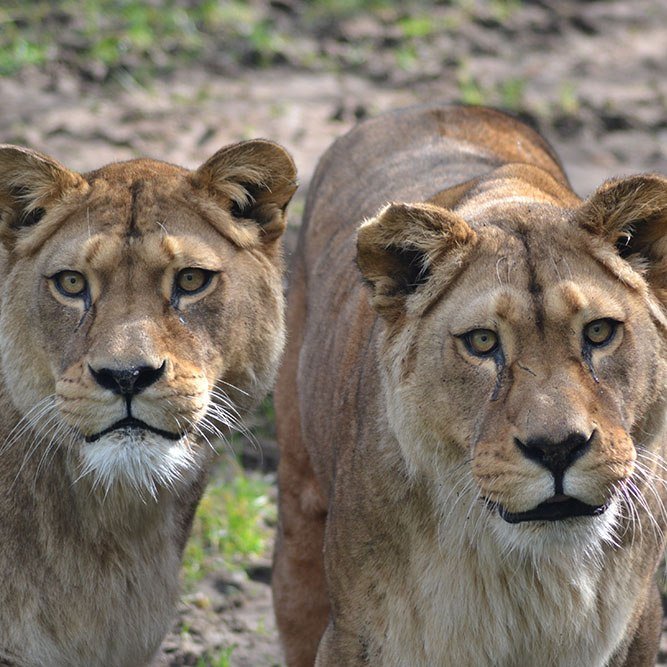
Belfast Zoo has put its last two remaining Barbary lionesses to sleep. Thheiba and Fidda, who were sisters, were both euthanized at the age of 22. The zoo said the decision was made after Thheiba had begun showing signs of deterioration in recent weeks.
Thheiba experienced mobility issues and significant weight loss in her final weeks. After a veterinary assessment, zoo staff took the decision to euthanize her and end her suffering. Honestly, it’s the kind of call that no zookeeper ever wants to make, but that sometimes love and care demand.
Because the lionesses had never been apart and relied on companionship, leaving the surviving sister alone would have caused her serious stress. As the zoo noted, lions are highly social pride animals that depend on companionship within a group. So Fidda, too, was peacefully euthanized, sparing her the trauma of solitude she had never once known.
The Barbary Lion: A Subspecies Lost to History
It’s hard to overstate just how significant the Barbary lion is, or was. The Barbary lion was a population of the lion subspecies Panthera leo leo. It was also called the North African lion, the Atlas lion, and the Egyptian lion. It lived in the mountains and deserts of the Maghreb of North Africa, stretching from Morocco to Egypt.
It was eradicated following the spread of firearms and bounties for shooting lions. A comprehensive review of hunting and sighting records revealed that small groups of lions may have survived in Algeria until the early 1960s, and in Morocco until the mid-1960s.
Once native to North Africa, the animals are now extinct in the wild, with the last recorded Barbary lion shot in Morocco in 1942. Think about that for a moment. A creature that once roamed an entire continent, vanished within a human lifetime, largely because of hunting. It’s a sobering reminder of what we’re capable of destroying.
A Rich and Royal History
The Barbary lion wasn’t just a wild animal. It was woven into human civilization for thousands of years, and not always gently. Barbary lions are recorded throughout history, with the Romans using them in the Colosseum to battle with gladiators. They were also kept in the menagerie at the Tower of London and were offered as gifts to royal families of Morocco and Ethiopia.
It is believed that Barbary lions in captivity today are directly descended from these so-called royal lions. There’s something both poetic and troubling about that lineage. Animals once paraded before emperors and kings are now fighting for survival in zoo enclosures, their existence entirely dependent on human cooperation.
Male Barbary lions are generally larger than other lion species and are distinguished by their thick black mane and belly hair. In the past, they were considered a royal beast and Roman emperors often had them imported from North Africa. Their sheer grandeur made them desirable to the powerful. Tragically, that same desirability contributed to their downfall.
The Bond Between Two Sisters and the Ethics of Euthanasia
One of the most moving aspects of this story is the relationship between Thheiba and Fidda themselves. Thheiba and Fidda had lived together their entire lives and shared a very strong bond. On veterinary advice, and to avoid significant stress and welfare challenges if left alone, Fidda was also euthanized.
Both were 22 years old, which the zoo noted was much older than the average life expectancy for lions, either in the wild or in captivity. That alone is remarkable. Most lions in the wild live somewhere around 10 to 14 years, and even in captivity, reaching 22 is genuinely exceptional. These two managed to do it together, side by side.
There will always be debate around the ethics of euthanizing a healthy animal to spare it grief. I think most people, if they’re honest, can understand the reasoning here. Separating bonded animals who have never known a day apart from each other isn’t mercy. It’s the opposite. The zoo made a compassionate, if heartbreaking, call.
Key Contributors to Conservation
Thheiba and Fidda weren’t passive residents at Belfast Zoo. They were active participants in one of the most important conservation programs in Europe. During their lives, the animals had been at the centre of international conservation efforts as part of the EAZA Ex-Situ Programme (EEP), a coordinated breeding initiative designed to protect species under threat.
During their lives, the sisters received exceptional care and became key contributors to conservation as part of the EAZA Ex-Situ Programme, producing multiple offspring and helping secure the future of Barbary lions, a lion subspecies now extinct in the wild.
The only Barbary lions left in the world are found in zoos and are part of a global and collaborative breeding programme to ensure their future survival. Every cub born in captivity represents a small but meaningful thread in the effort to keep this subspecies from vanishing entirely from the planet. Thheiba and Fidda helped weave several of those threads.
Belfast Zoo’s Decades-Long Commitment to the Barbary Lion
Belfast Zoo’s relationship with the Barbary lion isn’t a recent one. Barbary lions first arrived at Belfast Zoo in the 1960s, beginning an association with the subspecies spanning more than half a century. That is a remarkable and sustained commitment. Think of it like a family that has fostered endangered relatives for generations.
The zoo carries out important conservation work and takes part in over 90 European and international breeding programmes to help ensure the survival of many species under threat. It is a member of the British and Irish Association of Zoos and Aquariums, the European Association of Zoos and Aquaria, and the World Association of Zoos and Aquariums.
Barbary lions once roamed across North Africa but were declared extinct in the wild by the 1960s. Fewer than 200 are thought to remain in captivity worldwide. That number is staggering when you consider the scale of what has been lost. The work that Belfast Zoo and institutions like it do is not just admirable. It may be the last line of defense for a subspecies that history nearly swallowed whole.
What Comes Next for the Barbary Lion
Despite the sadness surrounding the loss of Thheiba and Fidda, there are reasons not to give up hope entirely. In mid-2025, remarkable news emerged from Central Europe. Four Barbary lion cubs recently made their public debut at a Czech zoo working to eventually reintroduce the breed to its native habitat. The three females and one male were seen playing in their outdoor enclosure at Dvůr Králové Safari Park, with the cubs born in early January and first spotted outside in April.
After initial talks with Moroccan authorities, who have not rejected the idea of their reintroduction, a conference of experts has been planned to take place in Morocco to decide whether it would make sense to go ahead with such a plan in one of the national parks in the Atlas Mountains.
Any reintroduction would face numerous bureaucratic and other obstacles. Since the lion has not been present in the environment for such a long time, plans would have to ensure their protection, a sufficient prey population, and cooperation and approval from local communities. It’s a long road, and there are no guarantees. Still, the fact that the conversation is happening at all is itself meaningful.
The passing of Thheiba and Fidda is a moment of genuine grief, not just for the staff at Belfast Zoo and the thousands of visitors who loved them, but for anyone who understands what their lives represented. Two sisters, inseparable in life and in death, who lived to a remarkable age and contributed meaningfully to the survival of a subspecies that has no home left in the wild.
Their story asks us to sit with a complicated truth: that conservation is often reactive, that we try to save what we’ve already lost, and that the efforts of zoos, scientists, and keepers around the world are both inspiring and, at times, painfully insufficient. The Barbary lion deserves better than extinction. So do the countless other species teetering on the same edge.
What does it say about us that two lionesses in Belfast were among the last hope for an entire subspecies? It’s worth thinking about.
Kristina is a young writer from India. An arts graduate and an avid content creator, Kristina is passionate about animals and wildlife. She enjoys exploring topics related to pet care, animal behavior, conservation, and nature, combining thorough research with engaging storytelling.