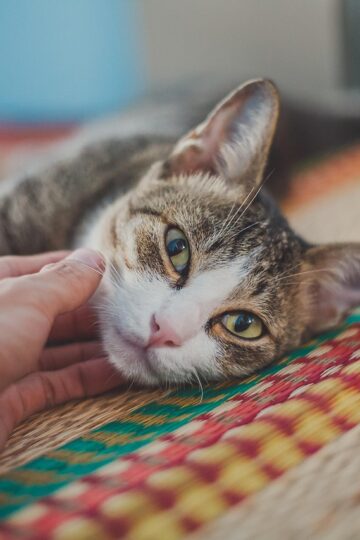
Why Your Cat Wakes You at the Same Time Every Morning
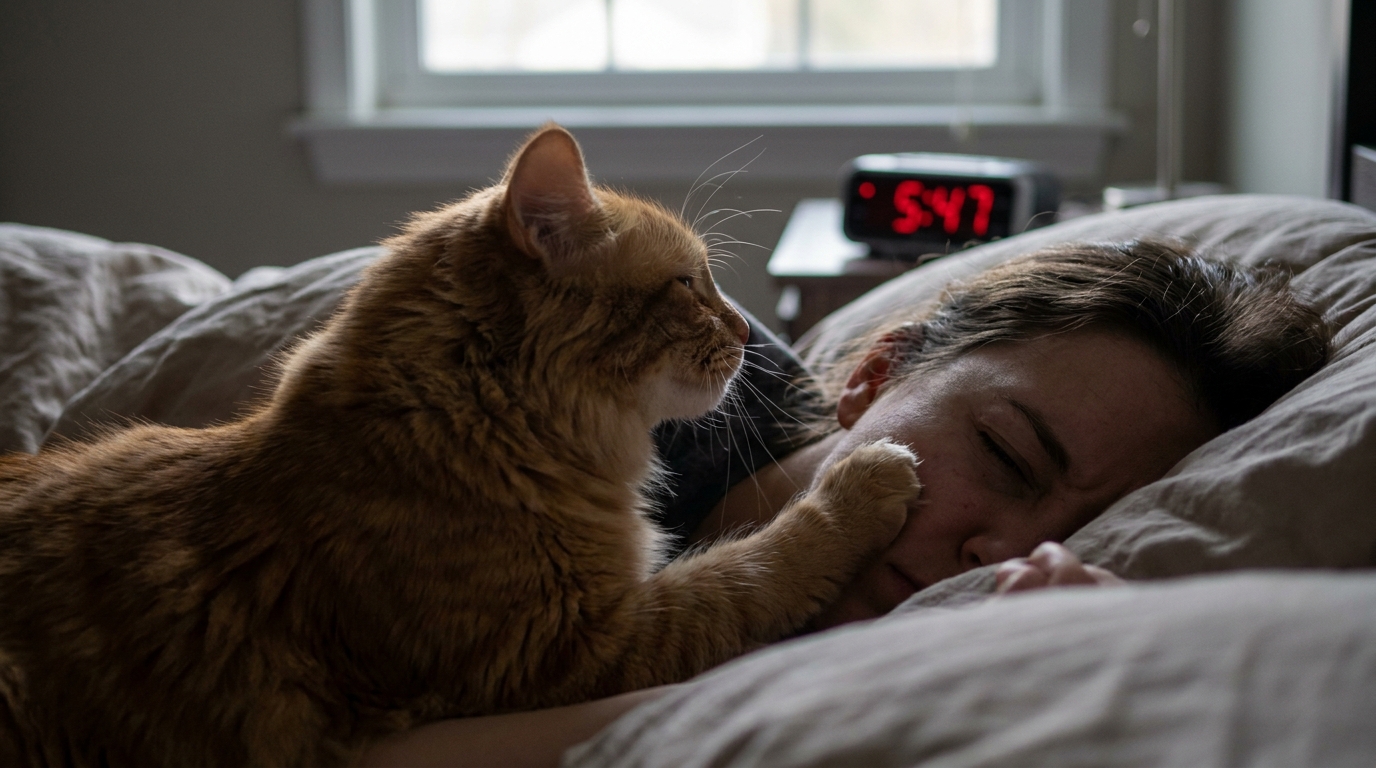
It's 5:47 a.m., and your cat is standing on your chest, meowing directly into your face. If this sounds familiar, you're not alone—a 2019 survey of 1,200 cat owners found that 64% reported being woken by their cat at least three times per week, and nearly half said it happened at roughly the same time each day.
What most people don't realize is that this isn't spite, boredom, or randomness. Your cat's internal clock is actually more precise than yours, and the reasons behind those wake-up calls reveal surprising truths about feline biology and the routines you've accidentally trained into your pet.
Here's what the research actually says.
#8 — Your Cat's Circadian Rhythm Is Hardwired for Dawn
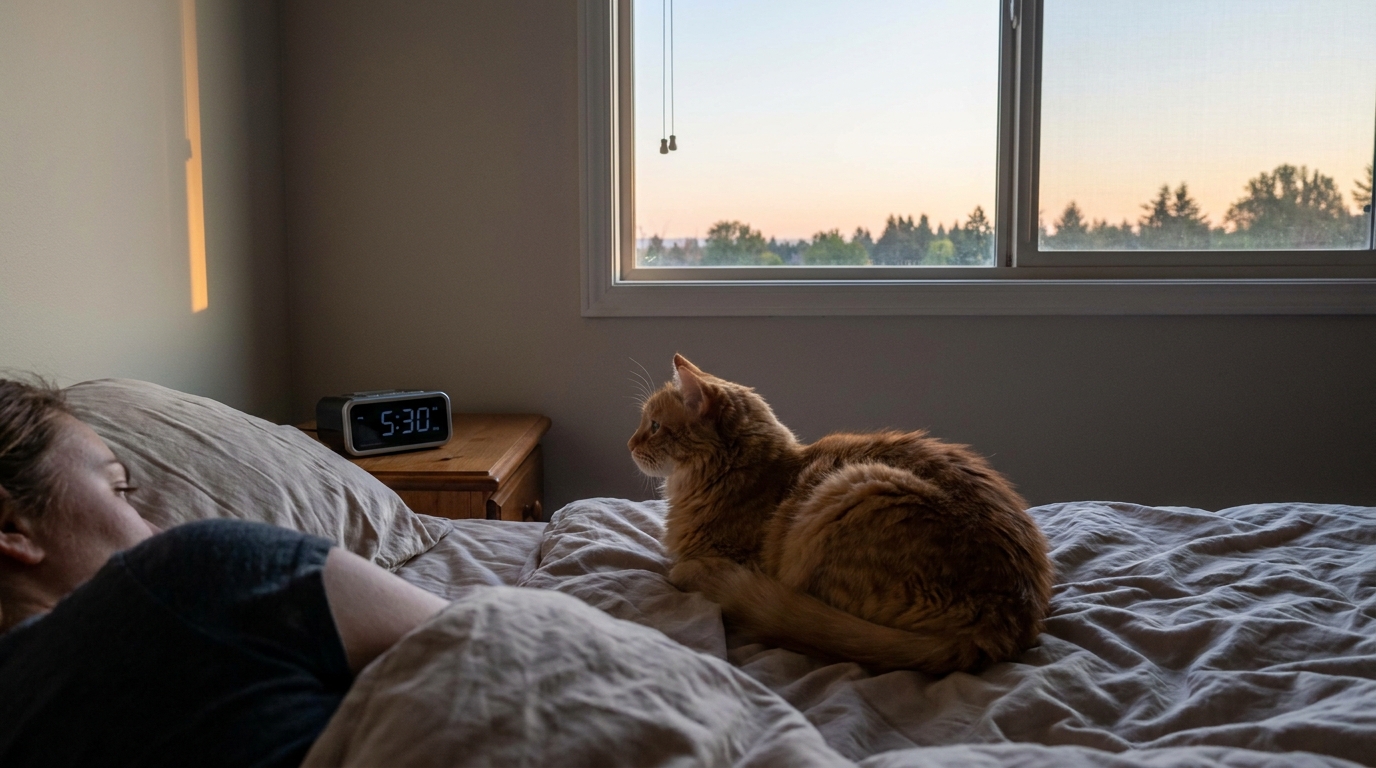
Cats are crepuscular, meaning they're biologically programmed to be most active at dawn and dusk.
This isn't a preference. It's an evolutionary adaptation that allowed their wild ancestors to hunt when prey was most active and larger predators were less of a threat.
Domestic cats retain this circadian pattern even when they've never stepped outside. Studies using activity monitors show that indoor cats experience pronounced energy peaks around sunrise and sunset, regardless of feeding schedules.
Your cat doesn't wake you at 6 a.m. because it's learned your alarm goes off then. It wakes you because its internal biology is firing on all cylinders, and you're the only available outlet for that energy.
But that's just the framework—the real reason it happens at the exact same time is far more calculated...
#7 — You Rewarded the Behavior Once, and Cats Never Forget
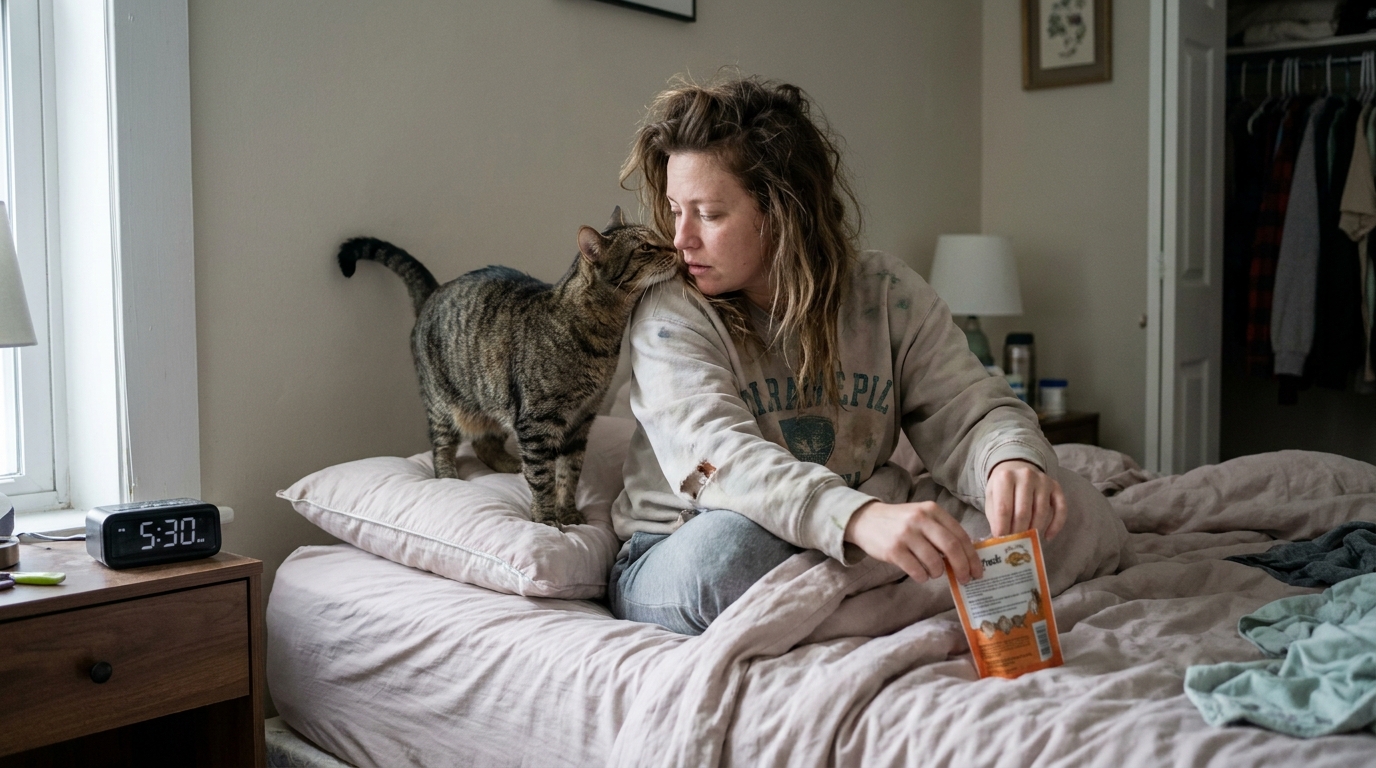
The first time your cat woke you and you fed it to buy yourself silence, you created a permanent association.
Cats are operant learners. A 2017 study in the journal Animal Cognition found that cats can form food-related associations after as few as two reinforcements, and those associations can persist for months without additional reward.
You probably don't even remember the specific morning you gave in. But your cat does.
Now, every successful wake-up call strengthens the loop. The behavior becomes self-reinforcing because even inconsistent rewards—feeding them four out of seven mornings—create what behaviorists call a "variable ratio schedule," one of the most powerful reinforcement patterns known.
This is the same mechanism that makes slot machines addictive.
And once the pattern is set, your cat's sense of time takes over...
#6 — Cats Have an Internal Clock Accurate to Within Minutes
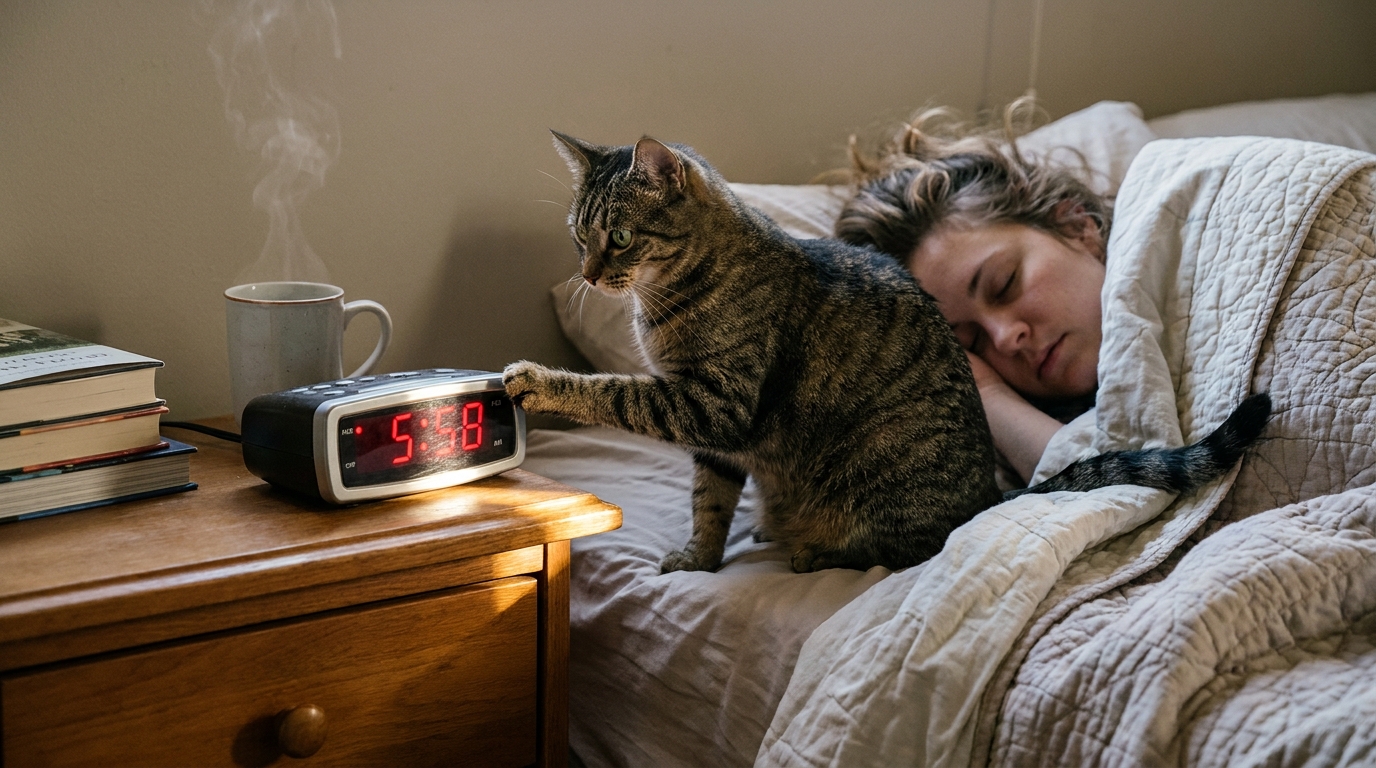
Feline time perception is shockingly precise.
Research from the University of Lincoln found that cats can track elapsed time intervals and anticipate regular events with accuracy comparable to dogs—and in some contexts, better.
Your cat doesn't need to see a clock. It's monitoring light levels, your movement patterns, household sounds, even subtle shifts in temperature as morning approaches.
One study had cats anticipate feeding times that were hours apart, and they began pre-feeding behaviors (vocalizing, pacing, positioning near the food area) an average of 12 minutes before the scheduled time.
That's not luck. That's neurological timekeeping refined over thousands of generations.
And if you think closing the bedroom door will solve the problem, you're underestimating how much your cat has mapped your entire routine...
#5 — They've Memorized Every Pre-Wake Cue You Emit
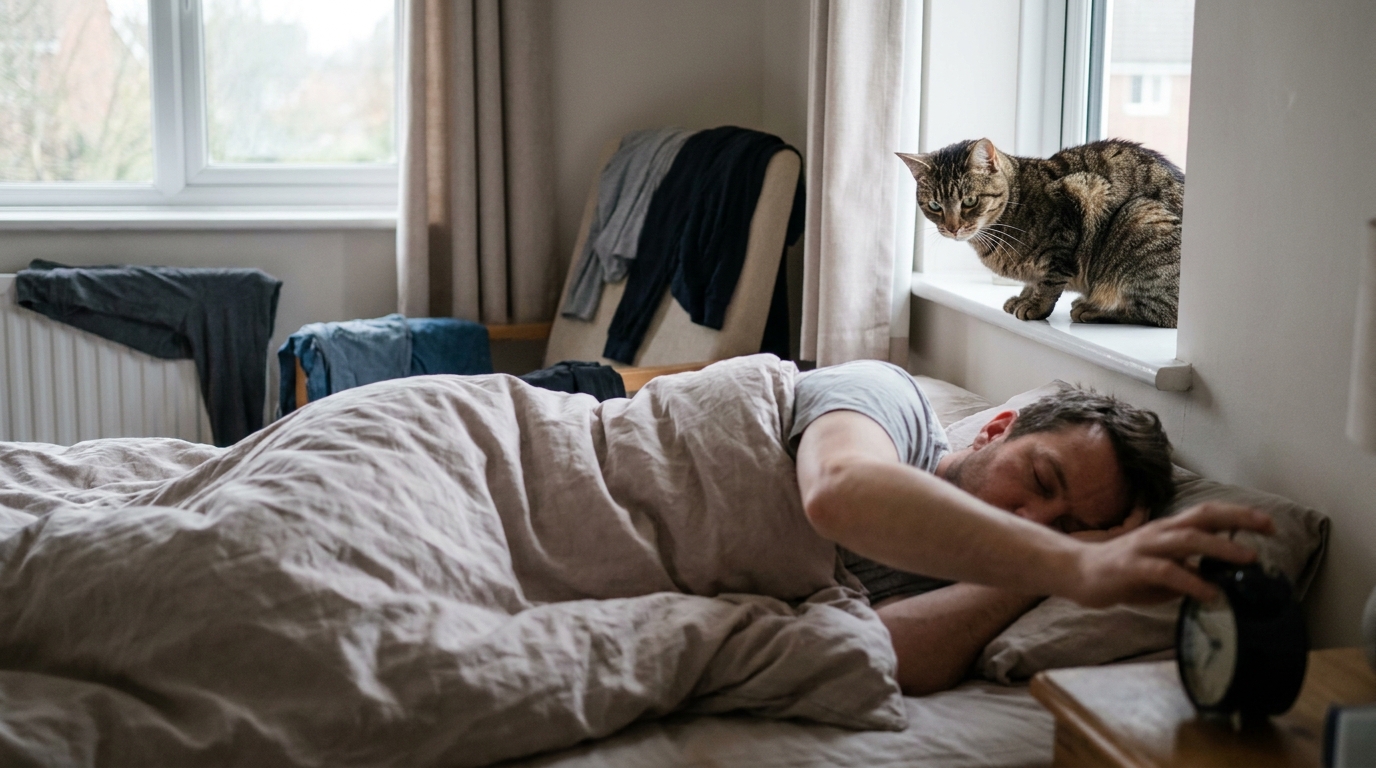
Your cat knows you're about to wake up before you do.
Humans don't transition from sleep to wakefulness instantly. In the 20 to 40 minutes before you wake, your sleep shifts from deep (slow-wave) sleep to lighter REM and stage-2 sleep.
During this time, you move more. Your breathing changes. You might shift position, sigh, or make small sounds.
Cats are ambush predators with hearing that detects frequencies up to 64,000 Hz—nearly two octaves higher than humans. They can hear the rustle of sheets, the change in your breath rate, even the subtle creak of your mattress as you shift.
A 2014 study in Applied Animal Behaviour Science showed that cats respond to owner behavior changes even when those changes are unconscious and minimal.
Your cat isn't waking you. It's responding to the fact that you're already beginning to wake, and it's learned this is the optimal moment to vocalize and get results.
But the internal clock is only part of it—there's a hunger-driven mechanism that's even more primal...
#4 — Their Stomachs Are Smaller Than You Think
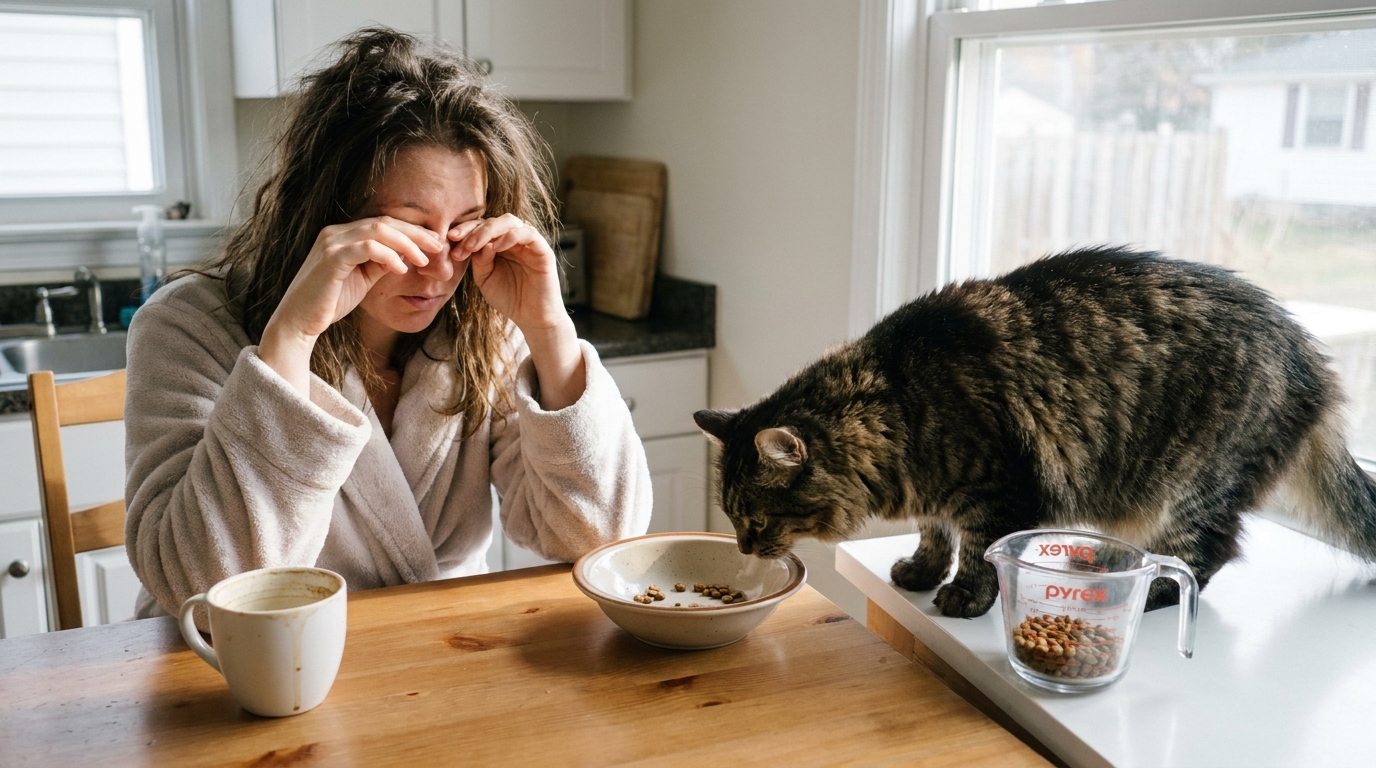
A cat's stomach holds roughly four ounces of food—about half a cup.
That means they're designed to eat multiple small meals throughout a 24-hour cycle, not one or two large ones. In the wild, cats hunt and consume 10 to 20 small prey items per day.
When you feed your cat once in the evening, its stomach is empty again within eight to twelve hours. By early morning, genuine hunger is driving the behavior.
**A 2020 study in the Journal of Feline Medicine and Surgery found that cats fed once daily showed significantly higher morning vocalization and wake-up behavior than those fed three or more times per day.**
This isn't manipulation. It's biology. Your cat is legitimately hungry, and it's learned that waking you is the fastest way to resolve that discomfort.
And if you've been free-feeding, the problem might actually be worse...
#3 — Free-Feeding Creates Anxiety, Not Independence

Many owners leave dry food out all day, assuming it reduces morning demands.
It often does the opposite.
Free-feeding removes the predictable structure that cats crave. Without a defined mealtime, many cats develop low-grade anxiety about food availability and begin "checking in" with owners more frequently, not less.
Cats are also naturally motivated by the hunt-catch-eat cycle. When food is always present, that cycle is broken, and many cats become restless, especially during their crepuscular activity peaks.
Veterinary behaviorist Dr. Mikel Delgado notes that scheduled feeding actually reduces food-related anxiety in most cats because it provides certainty and routine.
Counterintuitively, feeding your cat at fixed times—including a small morning meal—can reduce wake-up behavior because the cat knows the resource is coming and doesn't need to "remind" you.
But even if you fix the feeding schedule, there's one sensory trigger you might be overlooking...
#2 — Light Leaks Reset Their Clock Every Single Day
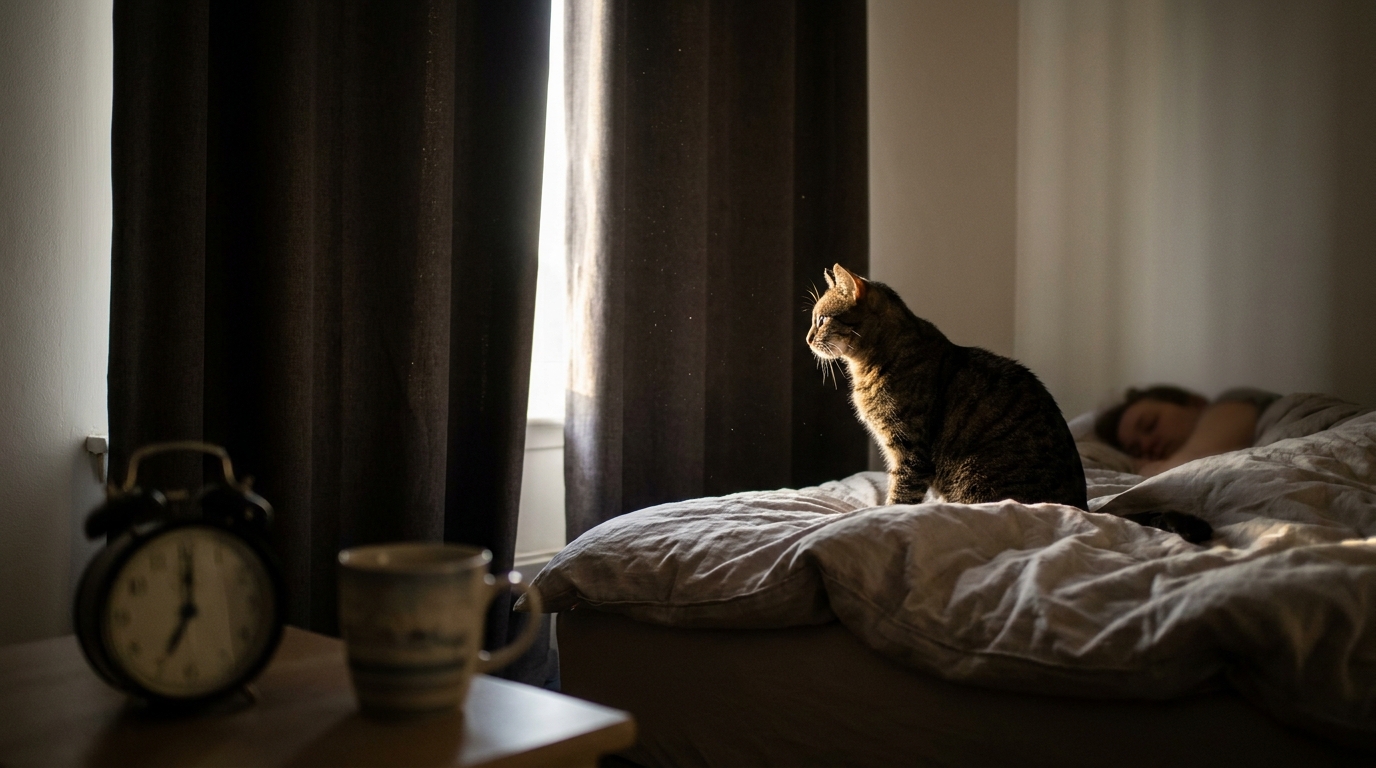
Even a small gap in your curtains can anchor your cat's wake-up time.
Cats use light as the primary zeitgeber—the external cue that synchronizes their internal clock. Morning twilight begins roughly 30 to 60 minutes before sunrise, and even low levels of increasing light trigger wakefulness in crepuscular animals.
If your bedroom gets any natural light, your cat is responding to that, not to your alarm or schedule.
A 2016 study on domestic cat activity patterns found that indoor cats with access to windowed rooms showed wake times that tracked sunrise throughout the year, shifting earlier in summer and later in winter.
Blackout curtains can shift your cat's wake time by 30 to 90 minutes simply by removing the environmental cue.
This is especially true if your cat has a favorite spot near a window. That morning light is doing exactly what millions of years of evolution designed it to do—activate your cat.
And now, the most overlooked factor that makes the behavior almost impossible to stop...
#1 — You're Probably Getting Up Anyway
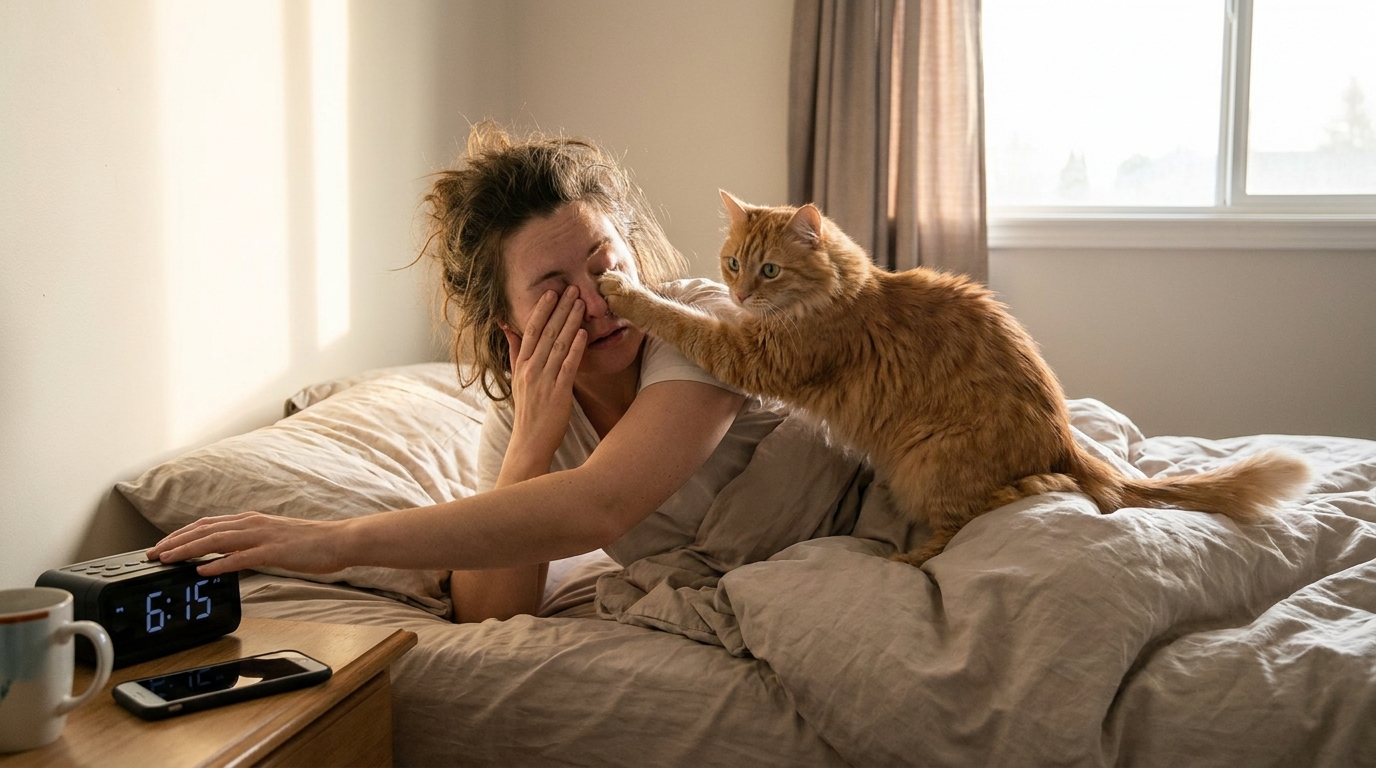
Here's the uncomfortable truth: your cat wakes you at the same time every morning because you wake at the same time every morning.
Even on weekends, most people don't sleep more than 60 to 90 minutes past their weekday alarm. Your body has its own circadian rhythm, and it's remarkably consistent.
Your cat has simply learned to anticipate it.
A 2021 study tracking human sleep patterns found that adults over 50 wake within a 20-minute window on 78% of days, even without an alarm set. Your cat isn't creating the schedule—it's adapting to one you've already established.
If you wake for work at 6 a.m. Monday through Friday, your cat learns that 6 a.m. is "active time" in the household. It doesn't understand weekends. It understands patterns.
The most effective intervention isn't training your cat—it's deciding whether you actually want to sleep later or if you'd rather work with your natural rhythm and your cat's.
Many owners who shift to a consistent seven-day wake time and add a small early feeding report that the behavior doesn't stop, but it stops feeling like an intrusion.
Your cat isn't the problem. The mismatch between your weekend goals and your weekday habits is.
The Bottom Line
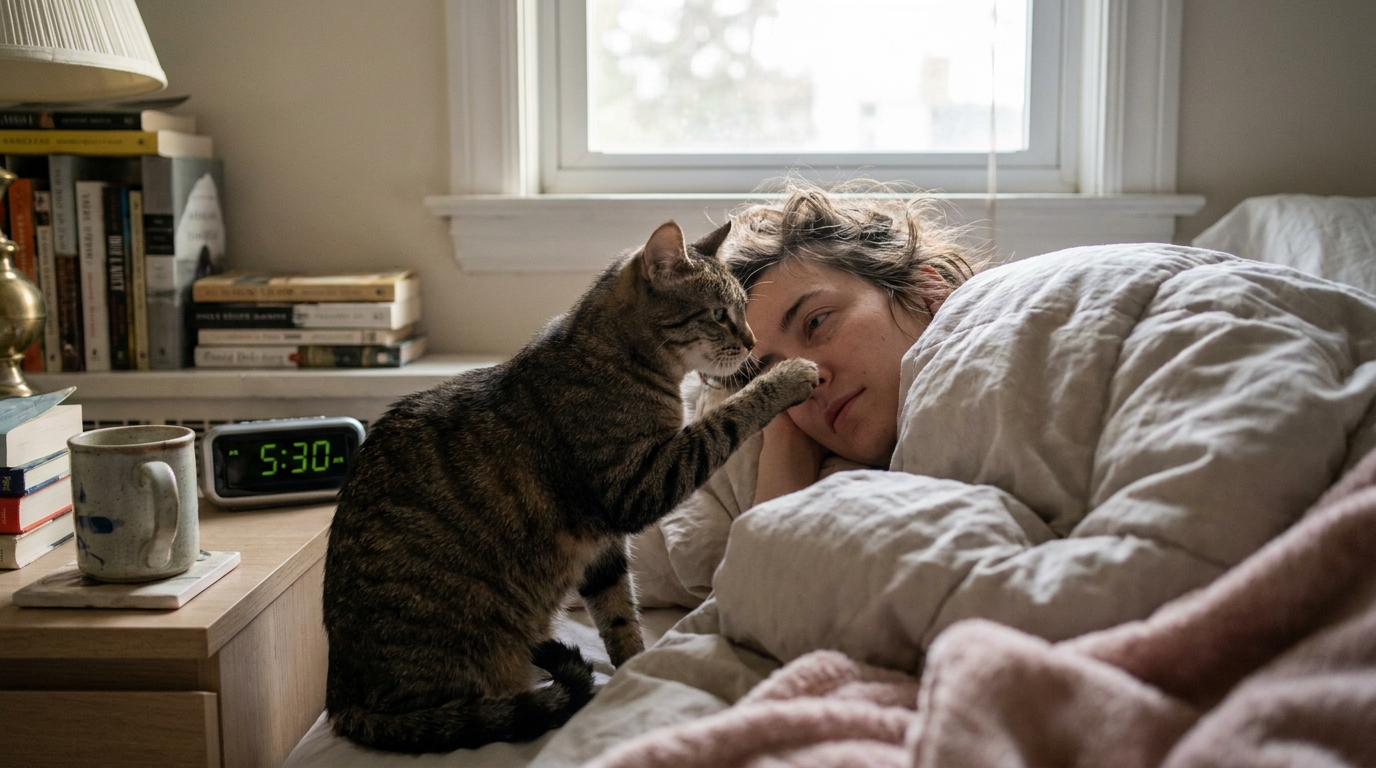
Your cat's morning wake-up calls aren't random, and they're not just annoying—they're a window into precise biological clocks, learned behavior, and the routines you've built together. The 6 a.m. meowing is driven by crepuscular instincts, operant conditioning, genuine hunger, light cues, and your own sleep patterns.
The good news: you can modify the behavior with scheduled feeding, blackout curtains, and pre-bedtime play sessions that tire your cat out. The bad news: if you're inconsistent, you're training your cat to be more persistent, not less.
Does your cat have a different morning ritual, or have you found a solution that actually worked? Drop it in the comments.
- 10 Tiny Ways Cats Show They Trust You That Are Easy to Miss in Everyday Life
- Feline Psychology Says Cats Who Relax More Quickly Around One Person May Be Revealing Who Makes Them Feel Safest
- 12 Signs Your Cat Has Made You Part of Their Daily Routine and Notices When You’re Missing
- 10 Quiet Ways Cats Ask Their Favorite Human for Reassurance Without Making a Sound