13 Reasons a Purebred Cat Bonds Harder with One Person Than Any Other
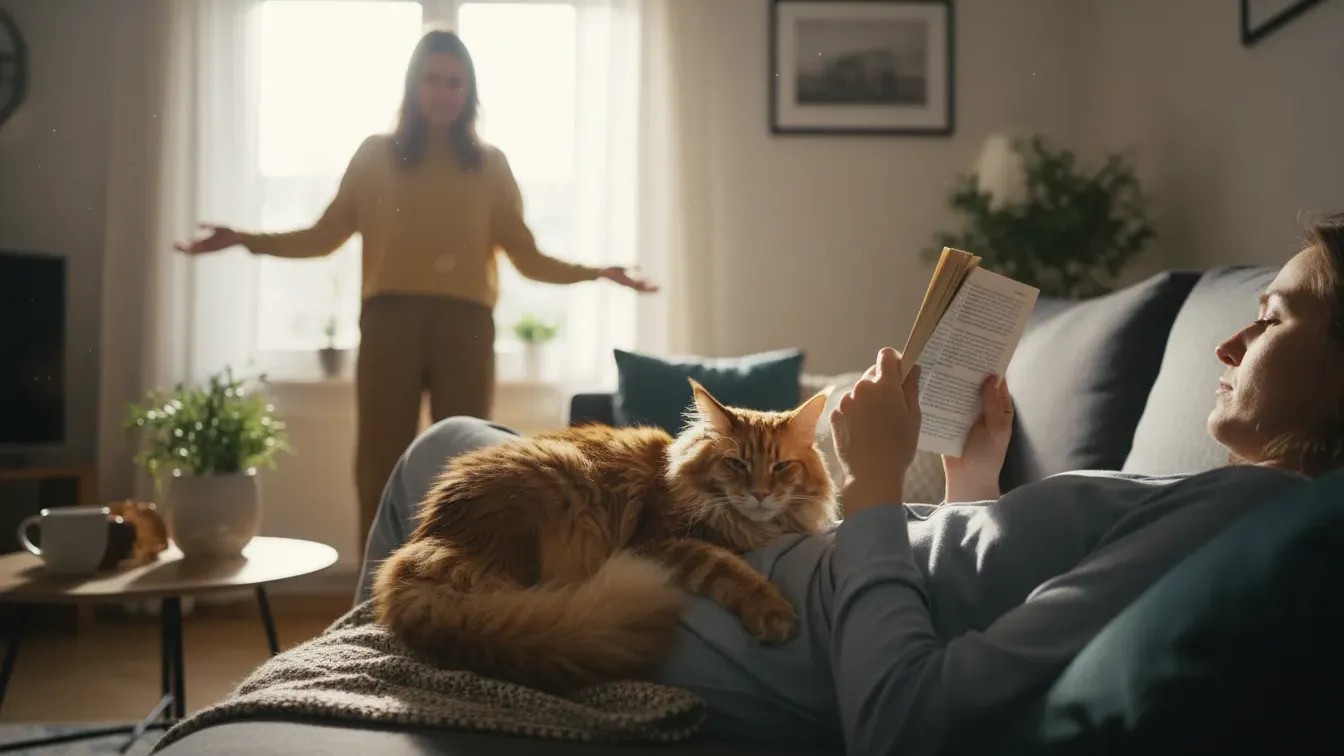
Most people assume cats are independent loners who barely tolerate their owners. Turns out, scientists have found something that completely flips that story - especially for purebred cats.
Research out of Oregon State University confirmed cats form attachment bonds comparable to human infants. But purebreds take it further: genetics, selective breeding, and hard-wired temperament push them past casual affection into locking onto one person with an intensity that stuns even lifelong cat owners - and the 13 reasons why go deeper than anyone expects.
#13 - Their Genetics Were Literally Shaped for It
Purebred cats aren't wild cards. Decades of selective breeding wired specific behavioral tendencies directly into their DNA.
Research confirms that cat breeds have diverged behaviorally - and those behavioral differences are inherited. This isn't opinion; it's measurable heritability.
Many personality traits in purebred cats show moderate heritability around 40-53%, meaning genetics plays a meaningful role alongside environment.
That means a purebred cat's tendency to fixate on one person isn't a quirk - it's partially written into its genetic code.
A mixed-breed cat's personality is a roll of the dice. A purebred's is a stacked deck.
What breeders selected for over generations - calmness, sociability, or intense human focus - shows up reliably in adult behavior. That's why owners of Siamese, Ragdolls, or Burmese often report an almost eerie devotion to a single household member.
Fast Facts
- Personality traits in purebred cats show roughly 40-53% heritability
- Sociability and vocal tendencies are measurably inherited, not just anecdotal
- Siamese, Ragdoll, and Burmese cats are frequently cited for intense one-person devotion
- Mixed-breed cats show far more unpredictable personality variation by comparison
But genetics is only the foundation. What happens in the first weeks of life can either amplify or disrupt everything that DNA set up - and that's where things get really interesting.
#12 - The Socialization Window Changes Everything
There is a narrow developmental window that permanently shapes who a cat bonds with. Miss it, and no amount of love fixes it.
Kitten socialization means intentional, positive exposure to people, gentle handling, and new environments - especially during the critical 2 to 14 week window.
Kittens bond with whoever cares for them most after leaving their mother, and that person becomes their figure of safety. The quality of those early interactions literally shapes the cat's brain.
Purebred breeders who handle kittens intensively during this window essentially pre-select who those cats will trust most. If the primary human caretaker after adoption continues that pattern, the bond crystallizes around them.
Kittens who meet at least four different people during this time grow up to be "multi-person cats," offering affection to family and strangers alike. Purebreds from single-breeder households often miss that breadth - arriving home already tuned to one type of person.
Genetics set the stage. That socialization window cast the lead role. But there's another force quietly running beneath both - and most owners never notice it.
#11 - Breed Temperament Creates a One-Person Bias
Not all breeds bond the same way. Some were specifically bred toward intense, focused human attachment - and that shows up as a preference for one person over everyone else in the house.
The Ragdoll is often described as relaxed, loving, and friendly, while the Russian Blue is intelligent, playful, and reserved. That reservation isn't coldness - it's selectivity.
Selective breeding for strong human bonding in breeds like the Siamese increased vocal communication and emotional dependence on one chosen person.
A Siamese that ignores your partner while shadowing you all day isn't being rude - it's being exactly what it was bred to be. The breed's entire behavioral profile points toward one deep connection rather than spread-thin sociability.
Quick Compare
- Ragdoll: relaxed and affectionate, but still loyal to one favorite person
- Russian Blue: intelligent and playful, reserved and selective with strangers
- Siamese: vocal and emotionally dependent, fixated on a single bond
This is where most multi-pet households get surprised. They expect the cat to eventually warm up to everyone equally.
With certain purebreds, that never happens - and it's not a training failure. It's the breed doing exactly its job.
And yet, even within a breed, something far more personal is at work. It has to do with something you probably never think about.
#10 - They Use Scent to Identify Their Person
Cats experience the world primarily through smell, and your scent is your signature. A purebred that has imprinted on you recognizes you before you even enter the room.
Cats have roughly 200 million scent receptors compared to a human's 5 million. Your unique scent profile - skin, breath, detergent, even stress hormones - becomes their definitive marker of safety.
Gentle handling builds that bond, but sudden movements or rough handling make cats wary. Partly because it disrupts the scent-safety association they've built around you.
A purebred that sleeps on your clothes, rubs its face on your hands, or headbutts you repeatedly is performing scent-marking - actively claiming you as its person. This is social behavior, not territorial behavior. There's a crucial difference.
Other household members often have different scent profiles - different products, different stress levels, different touch patterns. To a scent-driven animal with a strong one-person bias, those differences aren't subtle. They're decisive.
Which brings us to something even more fundamental - one of the most overlooked reasons why the bond forms where it does.
#9 - Whoever Feeds Them Consistently Wins the Bond
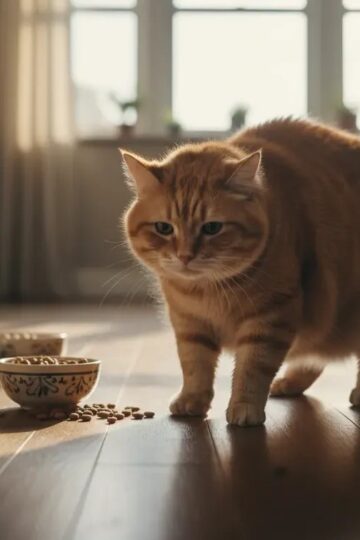
Turns out, the hand that feeds the cat really does control the heart. Consistently providing food is one of the most powerful bonding mechanisms in feline psychology.
Research found that most cats genuinely enjoy human interaction - many even prefer spending time with a familiar person over eating food or playing with a toy.
But the person who delivers that food calmly and predictably? That's the one who becomes the anchor.
In multi-person households, whichever person feeds the purebred cat 80% of the time statistically becomes the cat's primary attachment figure. The other people in the home aren't irrelevant - they're just background noise compared to that one consistent provider.
This is why cats who seem cold toward one partner often flip completely once feeding duties shift.
The bond isn't personal preference the way humans experience it. It's a deep, repeated association between one person and survival-level reward.
But feeding alone doesn't seal the deal. The cat is also doing something more complex - something researchers only recently started measuring.
#8 - Purebreds Form Measurably Secure Attachments
This isn't soft talk about cat feelings. Actual attachment theory - the same framework used to study human infant bonding - has now been tested on cats, and the results are striking.
In 2019, researchers ran an experiment with 79 people and their kittens. Each pair spent two minutes together in an unfamiliar room, then the person stepped out for two minutes and returned.
The young cats responded much like dogs - or human infants - would.
About 65% of the cats and kittens tested were securely bonded to their owners.
Securely bonded cats - disproportionately found among well-socialized purebreds - use their chosen person as a literal "secure base" to explore the world. Remove that person, and the cat's confidence collapses.
This is the same mechanism that drives a toddler to keep checking that mom is still in the room. The cat isn't being needy. It's running a deeply evolved attachment script - specifically for you.
Like dogs, cats display social flexibility in regard to their attachments with humans. The majority of cats are securely attached to their owner and use them as a source of security in a novel environment.
Kristyn Vitale, Oregon State University
What happens when that security is consistently confirmed? The bond tightens in a way that starts to look almost dog-like - and that's exactly what reason #7 is about.
#7 - They Mirror Their Person's Emotional State
Purebred cats don't just bond with their chosen person - they start to synchronize with them. This is one of the most underreported phenomena in feline behavior.
A cat's mere presence - and certainly its behavior - can affect human moods. The reverse is true too: human mood swings shape cat behavior.
A stressed owner creates a more anxious cat. A calm owner produces a more relaxed, confident one.
Over time, a deeply bonded purebred can read micro-signals - posture, breathing rate, even scent changes linked to cortisol - and adjust its own behavior accordingly. This is why some owners describe their cat as "knowing" when they're having a bad day without a single word being spoken.
This synchronization strengthens the bond by making the cat feel emotionally competent around its chosen person. The cat essentially learns your emotional language.
Other people in the home haven't had enough consistent interaction for that translation to ever happen.
And that emotional fluency? It accumulates over time in a very specific way - one that makes the bond increasingly hard to break the longer it goes on.
#6 - Routine Repetition Deepens the Lock
Cats are creatures of routine - and in purebreds, that instinct is often amplified. Every repeated interaction with the same person is another brick in a wall that eventually becomes nearly unshakable.
A consistent routine helps foster trust. Regular feeding times, play sessions, and sleep schedules give the cat predictability it can count on.
Purebred cats who share a bed, a morning routine, or a consistent evening ritual with one person are essentially practicing attachment reinforcement every single day. Over months, this creates a neural association so strong that the cat's stress response is calibrated to that one person's presence.
Worth Knowing
- Shared sleep spots reinforce trust every single night
- Consistent morning and evening rituals calibrate a cat's stress response
- Bonded purebreds often grow visibly unsettled when that routine breaks, like during travel
- Predictability - not affection alone - is what cements this kind of bond
This is why purebreds that bond hard with their owners often become visibly unsettled when that person travels. It isn't separation anxiety in the clinical sense - it's a disruption of the routine that has become synonymous with safety.
Other household members, no matter how kind, represent unpredictability by comparison. And to a cat bred for loyalty to one figure? Unpredictability is the enemy of trust.
That said, there's one physical behavior that signals a deepened bond most clearly - and most people completely misread it.
#5 - Slow Blinking Is a Trust Declaration
Most people think their cat slow-blinks because it's sleepy. It isn't.
That slow blink is one of the most deliberate social signals a cat produces - and purebreds use it almost exclusively with their chosen person.
Research shows slow blinking during human-cat interactions increases positive engagement. Cats interpret it as a non-threatening, affiliative signal.
In practical terms: when a cat holds your gaze and slowly closes its eyes, it's telling you it trusts you enough to drop its guard entirely.
Purebreds that have bonded deeply with one person will slow-blink at them repeatedly while ignoring other household members entirely - a clear signal of who sits at the top of the cat's social hierarchy.
Cats don't naturally prefer one gender or age group of people - but people interact with cats differently, and cats react to that difference.
The person who receives the slow blinks is simply the one whose interaction style the cat found most compatible. Everything else falls into place from there.
The next reason is one that most owners actively get wrong - and it ends up pushing the cat closer to just one person anyway.
#4 - Unwanted Interaction Pushes Cats Toward One Person
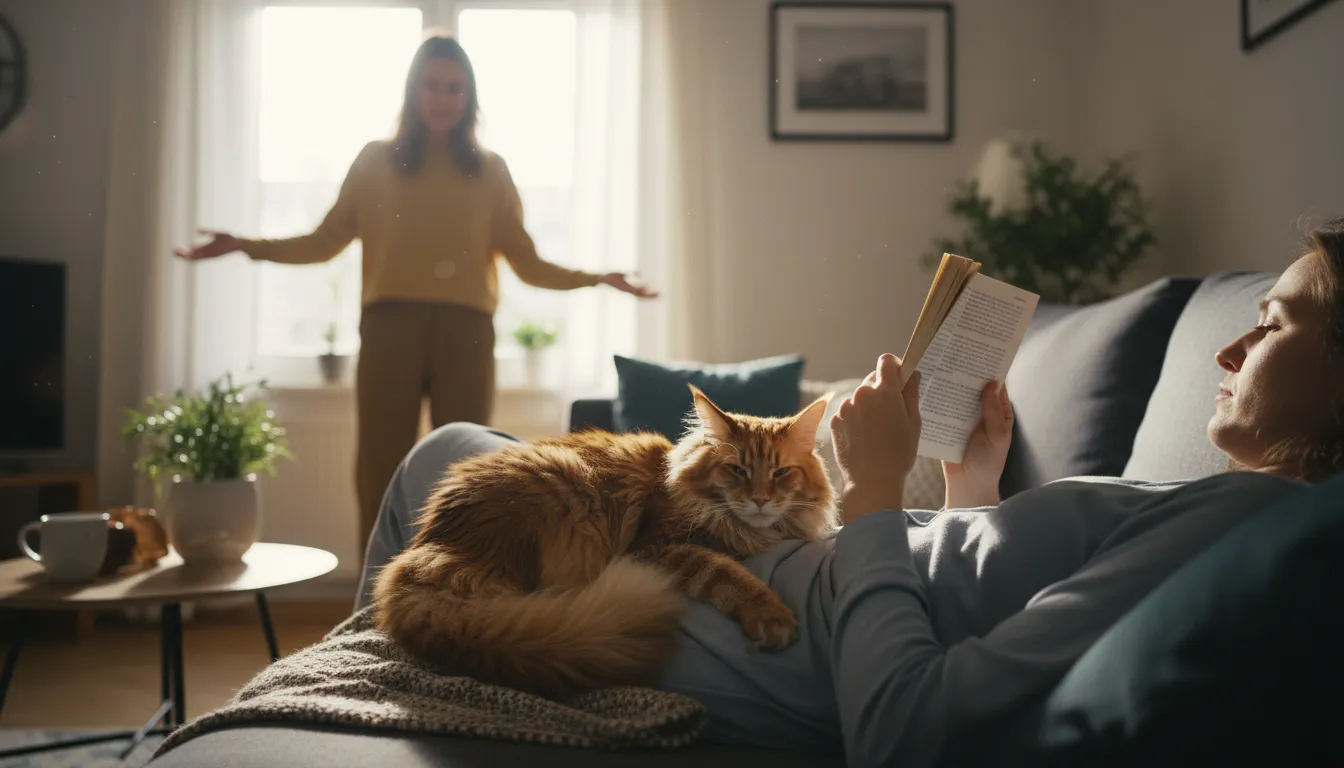
Here's the counterintuitive one: the more certain people in a household try to force affection, the more the cat retreats - and the tighter it bonds to the one person who doesn't.
Cats consistently approach people who give them control over the interaction. The person reading quietly who lets the cat come to them will, over time, win that cat's loyalty over the person who scoops it up uninvited.
Researcher Udell notes that temperament or past history can make it harder for some cats to form a secure attachment, even with a warm, responsive person.
But that cuts both ways - a cat's chosen person is often the one who accidentally got the approach right, not the one who tried hardest.
In multi-person households, this becomes a self-reinforcing cycle. Person A gives the cat space, so the cat approaches - trust builds, and the bond deepens.
Person B keeps reaching out, so the cat avoids them - and that avoidance only gets reinforced. The bond never gets a chance to form.
This dynamic is especially sharp in purebreds with reserved or selective temperaments - like the Russian Blue or Scottish Fold. And it feeds directly into the next factor, which is almost entirely invisible.
#3 - Voice Frequency and Tone Create a Signature
This one genuinely surprises people. Cats don't just recognize their person visually or by scent - they also recognize them by the specific tone, rhythm, and frequency of their voice.
Studies have confirmed that cats distinguish their owner's voice from a stranger's and respond differently to it - even when the words are identical. Purebreds bred for heightened social sensitivity, like the Siamese or Burmese, show this most dramatically.
Some owners have reported that their purebred will stir from sleep, change rooms, or vocalize in response to their voice - but not to anyone else's in the house. That's not coincidence. That's a deeply embedded auditory signature the cat has spent months calibrating.
Research found shelter cats changed their behavior based on how much attention a person gave them - proof cats pay close attention to humans and respond emotionally.
For a purebred already primed toward one-person bonding, that attentiveness becomes laser-focused on a single voice.
And what happens when that voice disappears? The next section explains exactly why the bond becomes most visible in its absence.
#2 - Separation Triggers the Bond's Full Depth
You may not realize how deeply your purebred cat is bonded to you until you're gone. Separation is when the full weight of a one-person bond becomes undeniable.
The young cats in attachment research responded much like dogs - or human infants - would. Alone in an unfamiliar place, they became visibly distressed.
For a purebred whose entire social world orbits one person, even a short absence can trigger real behavioral changes - pacing, vocalizing, loss of appetite, or retreating to spaces that carry that person's scent.
This is attachment behavior in its purest form - the same mechanism driving an infant to cry when its caregiver leaves the room, now playing out in an animal most people still dismiss as "aloof." The cat isn't performing. It's experiencing genuine distress.
At a Glance
- 65% of tested cats and kittens showed secure attachment to their owner
- Adult cats (65.8%) and kittens (64.3%) showed nearly identical attachment patterns
- Feline secure-attachment rates closely mirror the 65% rate found in human infants
- Insecure cats are more likely to hide, avoid, or seem "aloof" under stress
Early experiences teach kittens that people are safe and household life is predictable. Well-socialized kittens grow into confident cats who form strong, trusting relationships with humans.
But when that trust is concentrated in one person, that person's absence removes the entire architecture of the cat's sense of safety.
Everything we've covered so far - genetics, scent, routine, voice, attachment style - funnels into the #1 reason. And it's the one that almost nobody talks about.
#1 - Consistent Emotional Presence Is the Real Lock-In
All the other reasons on this list are accelerants. This is the fuel.
The single most powerful driver behind a purebred cat bonding hard with one person is sustained, consistent emotional presence - showing up the same way, every day, without drama.
The amiability of the cat is associated with higher owner satisfaction, attachment, and quality of bond - but the reverse is equally true.
The consistency of the human is what ultimately determines how deep and exclusive the purebred cat's bond becomes.
Cats don't bond with the person who loves them most. They bond with the person who is most predictably present - same energy, same patterns, same responses.
Over weeks and months, that person stops feeling like a companion to the cat. They start feeling like part of its psychological infrastructure.
Studies provide scientific evidence that cats don't simply tolerate humans - they often seek out companionship and form genuine emotional connections. With a purebred already wired toward selective bonding, that connection narrows down to one person with almost inevitable precision.
This is why the "cat person" in a household almost always ends up being the cat's person. Not because they did anything special - but because they showed up, calmly and consistently, until the cat's brain had no other conclusion to reach.
The Bottom Line
Purebred cats bond hard with one person because of a layered, self-reinforcing system: heritable genetics, a narrow socialization window, breed-specific temperament, scent imprinting, routine, voice recognition, and consistent emotional presence.
The differences in cat behavior really are inherited - personality traits like extraversion and fearfulness are genetically correlated and moderately to highly heritable. The science backs it up.
That devotion your purebred shows you - and only you - isn't random. It's biology meeting behavior meeting daily habit.
So which of these 13 reasons is doing the most heavy lifting with your cat? Drop your answer in the comments - and tell us which breed you have.