16 Home Dangers That Shorten an Indoor Cat's Life Without Warning
Most cat owners do everything right - or so they think. They keep their cats indoors, away from traffic and predators, and quietly congratulate themselves on a job well done.
But here's what the data actually shows: the inside of your home is riddled with quiet, invisible hazards that chip away at your cat's health for years before a single symptom appears. Obesity, dental disease, kidney disease, and stress-related illness build slowly and often stay hidden until they're advanced.
The danger isn't out there. It's right at home - and some of what's coming will surprise you.
#16 - Toxic Houseplants You Think Are Harmless
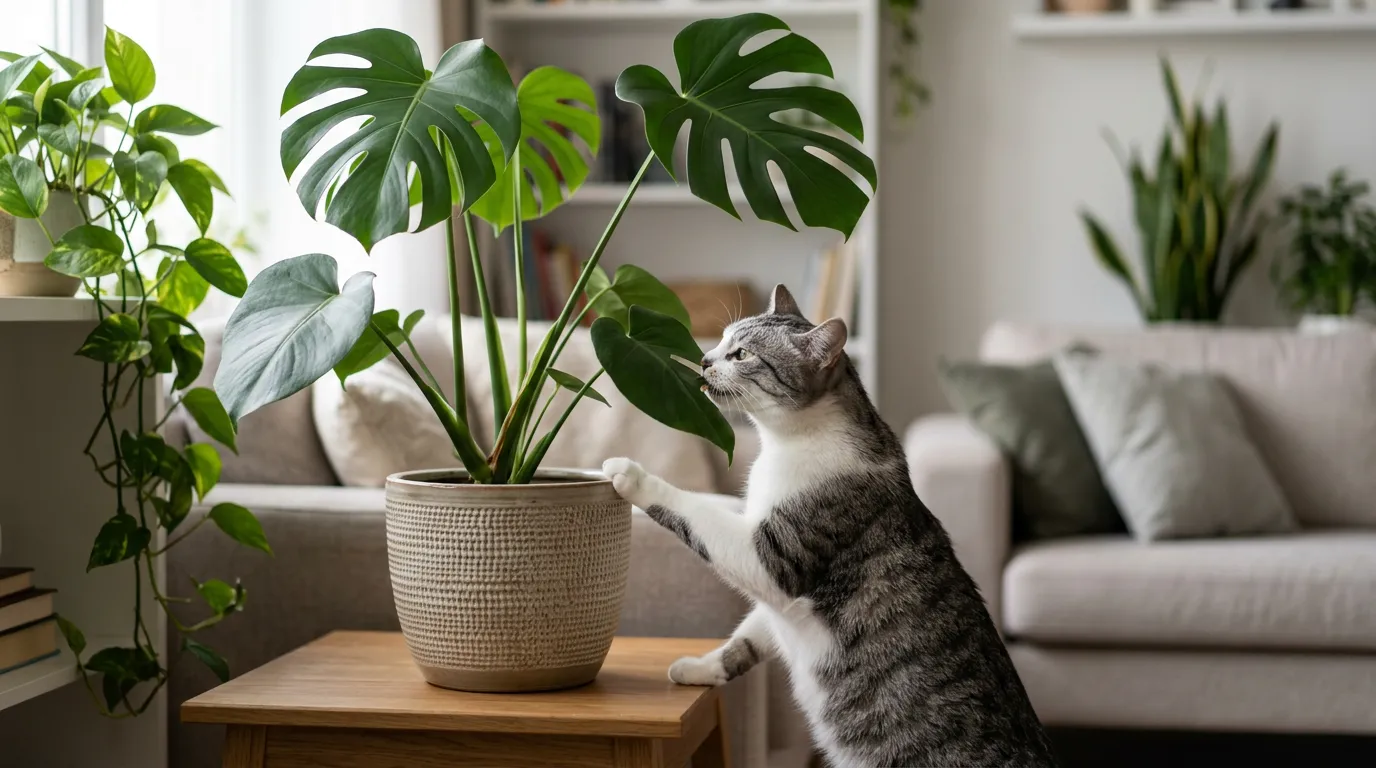
Most cat owners know to avoid poisonous plants - and then buy a beautiful monstera anyway.
Dieffenbachia, jade plant, kalanchoe, monstera, pothos, sago palm, and snake plant are all toxic to cats. These are Instagram-era favorites sitting in millions of living rooms right now.
Easter lilies are especially deadly. A cat only needs to chew one or two petals, lick pollen off its fur, or drink from the vase water to trigger fatal kidney failure.
Your cat doesn't even have to eat the plant to be poisoned. Many owners never connect a vague illness episode to a plant nibbled three days earlier, and by the time kidney failure is obvious, the window for treatment is already closing.
But that's nothing compared to what's lurking in your cleaning cabinet at #15.
#15 - Everyday Cleaning Products Left Within Reach
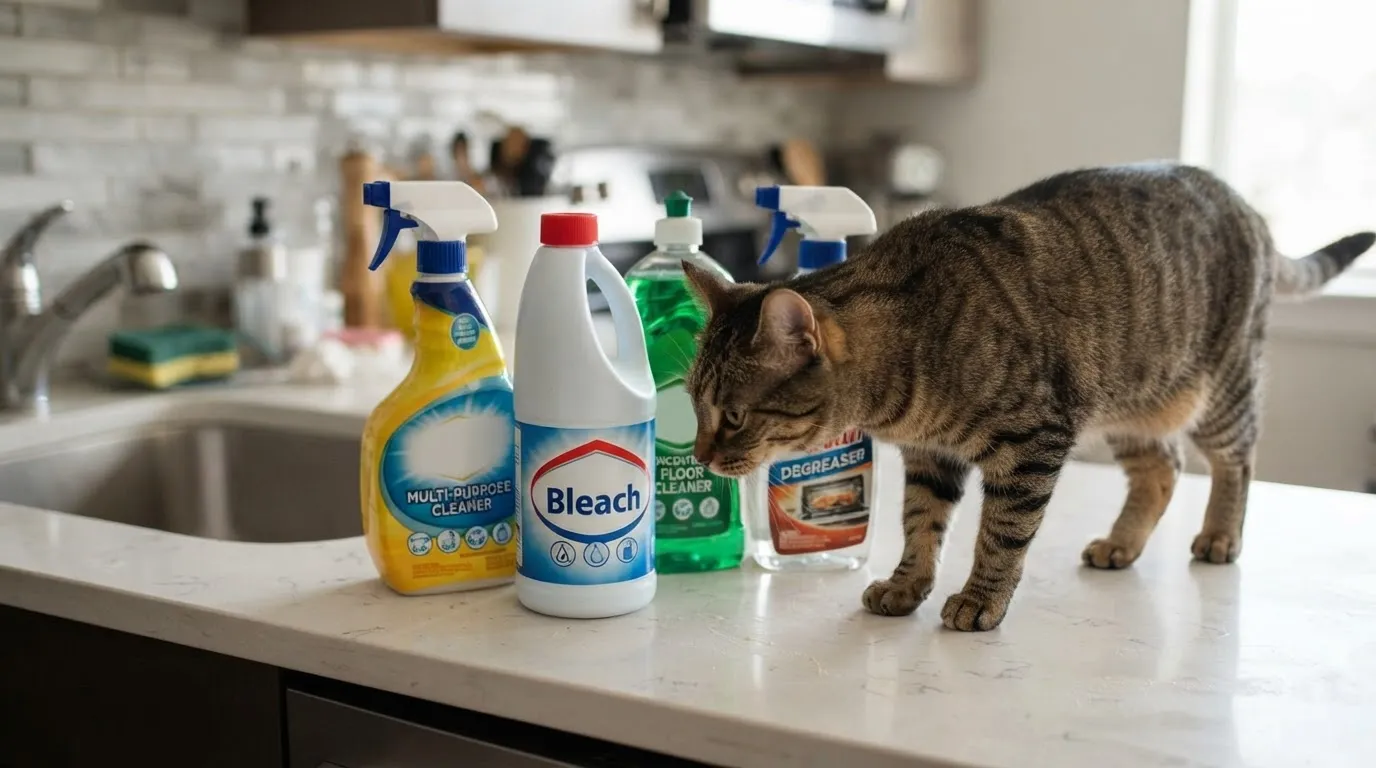
You clean your home to keep it safe. Turns out, the products you're using could be doing the opposite.
Bleach can damage a cat's mouth, throat, stomach, and intestines. Ammonia-based cleaners irritate skin and eyes on contact.
Phthalates, formaldehyde, and hydrogen peroxide are also common offenders - and they're not exotic. They're in your bathroom spray and your oven cleaner.
The real problem is residue. Cats walk across a freshly mopped floor, then groom their paws, which means they're ingesting whatever you just used on that surface without ever touching the bottle.
What's sitting on your kitchen counter right now could be doing the same damage - #14 covers exactly that.
#14 - Human Medications Left on Counters
A single pill can kill a cat. That's not hyperbole - it's basic feline physiology.
Cats lack key liver enzymes that let humans and even dogs safely break down many common compounds. A dose of plain acetaminophen that's harmless to you can cause fatal red blood cell damage in a cat within hours.
Ibuprofen, antidepressants, and sleep aids are just as lethal at tiny doses. A single tablet dropped on the floor and batted under the couch is all it takes.
Most owners assume their cat "wouldn't eat that." Cats are curious and bored, and a rolling pill looks exactly like a toy - never leave medication on a counter or nightstand.
Fast Facts
- Acetaminophen: one regular-strength pill can cause fatal red blood cell damage within hours.
- Ibuprofen: even a single tablet can trigger kidney failure in a cat.
- Antidepressants and sleep aids: small human doses can cause severe sedation or death.
- Safe storage rule: closed cabinets only - never a nightstand, purse, or counter.
The next danger is one almost nobody suspects, and it's sitting right in your living room at #13.
#13 - Recliners and Rocking Chairs
This one shocks people every time, but veterinary emergency rooms see it regularly.
Cats love curling up in the dark, warm space beneath and inside a recliner's mechanism. When someone sits down and reclines without checking, the internal frame crushes whatever is hiding inside.
Internal injuries from recliners are often fatal, and owners never see it coming. The same risk applies to rocking chairs, sofa beds, and pull-out couches - anything with a moving mechanical part.
A cat sleeping silently in the wrong spot has no way to warn you. This is completely preventable with a two-second visual check every single time.
Speaking of hidden spaces - the appliance at #12 is even more dangerous than a recliner.
#12 - Washing Machines and Dryers
This is the household danger most owners refuse to believe is real - until it happens to them.
Cats climb into washing machines and dryers and get trapped, and accidental deaths happen when the machine is switched on without anyone knowing the cat is inside. Dryers are especially inviting: warm, enclosed, and full of familiar laundry scents.
A cat that slips in while you're loading clothes can be buried under a pile of fabric in seconds. Checking the drum should be a non-negotiable rule, not an occasional precaution.
The few seconds it takes to look inside is genuinely the difference between life and death. Make it a habit before every single cycle.
Now here's a slow-burn killer that doesn't announce itself at all - #11 is something you're probably doing right now.
#11 - Secondhand Smoke and Poor Indoor Air Quality
You already know secondhand smoke is bad for people. What most owners don't realize is that cats may be even more vulnerable.
Cats spend most of their lives close to the floor, where particulate matter and smoke residue settle and concentrate. Then they groom constantly, which means whatever lands on their fur gets ingested directly.
Tobacco smoke exposure in cats has been linked to higher rates of lymphoma and oral cancers, likely because of this dual-exposure route through breathing and grooming combined.
Candles, air fresheners, and plug-in diffusers can degrade indoor air quality too, since a cat's respiratory system is far more sensitive than ours. If it smells strong to you, assume your cat is getting a much stronger hit.
The next slide covers something almost universally misunderstood - and the numbers are alarming.
#10 - Obesity From Overfeeding
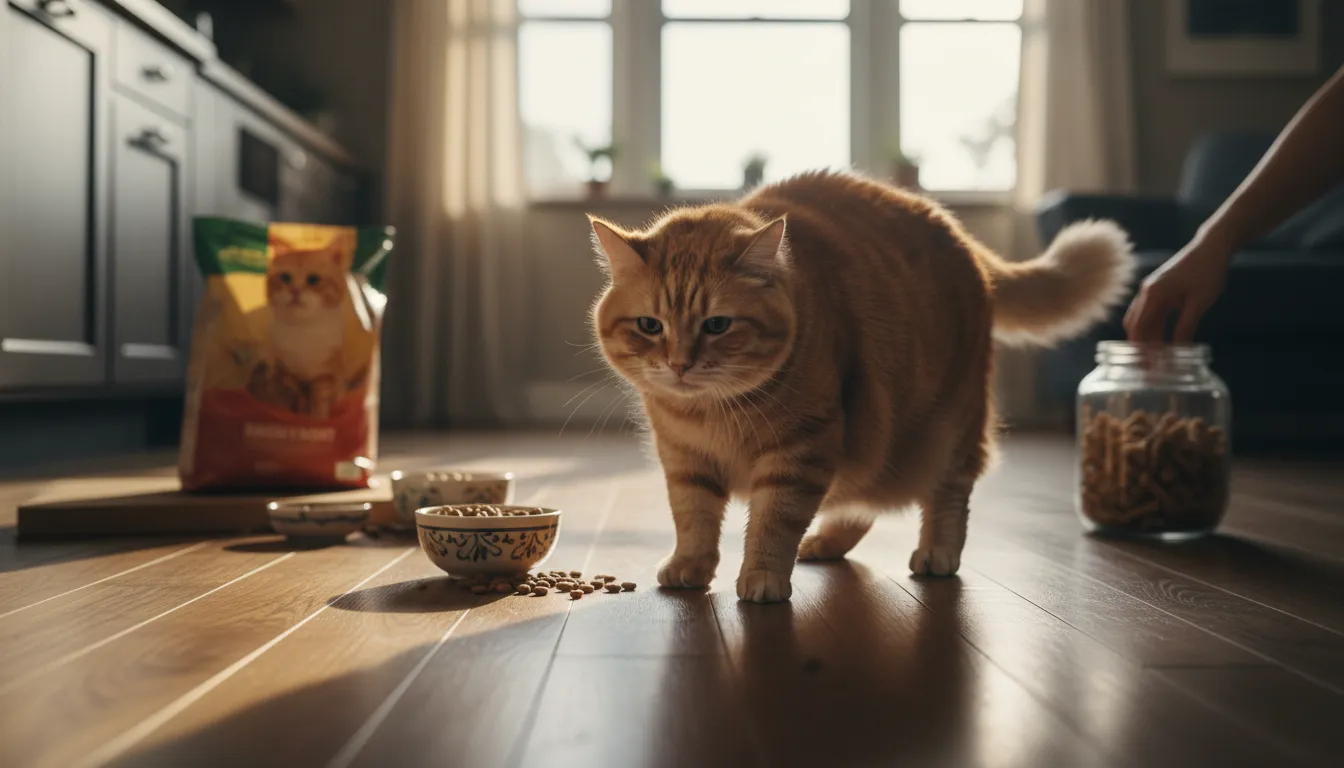
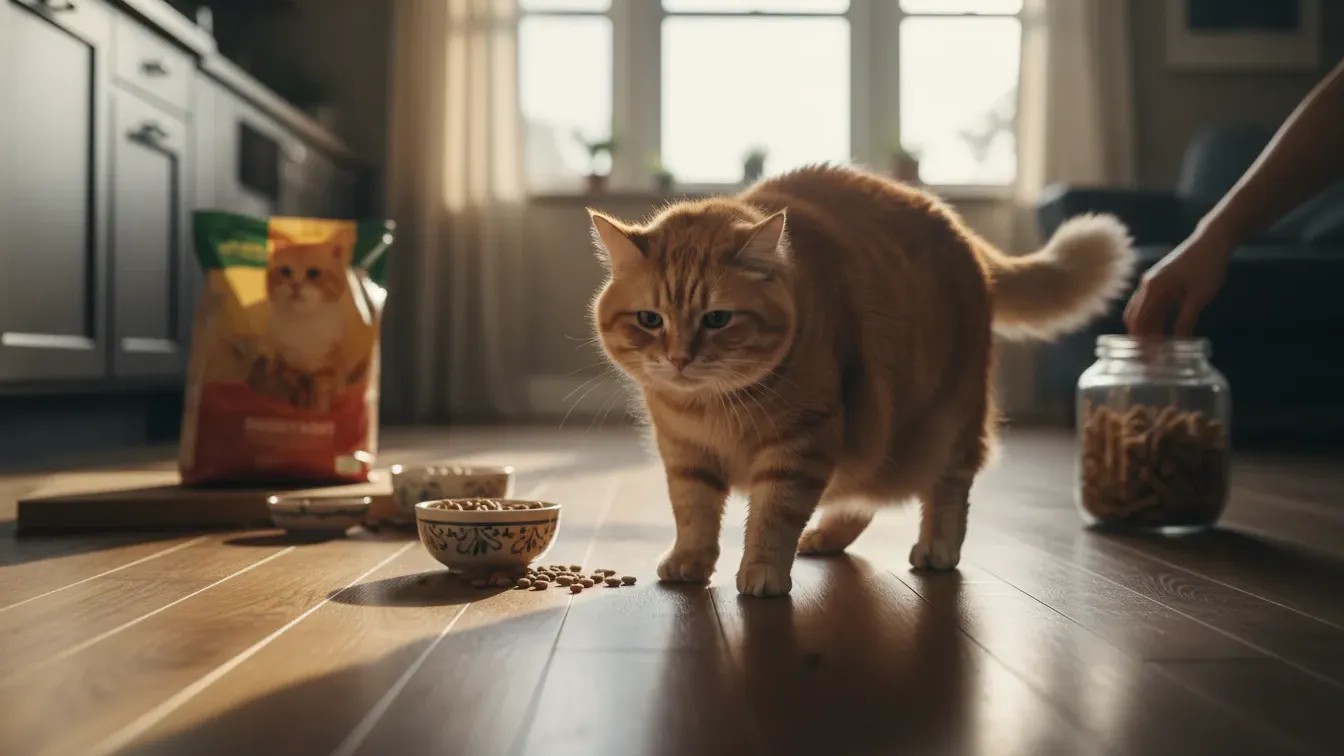
Nearly three in five indoor cats are carrying too much weight - and most owners don't even know it.
The Association for Pet Obesity Prevention estimates that 57.9 percent of cats are overweight or obese. That's the majority, not an edge case.
Without the activity that comes from roaming and hunting, many indoor cats become sedentary. Extra weight strains joints, raises diabetes risk, and can shorten a cat's life just as much as any outdoor danger.
The domino effect is what makes obesity so dangerous. Once joint pain slows a cat down, weight gain accelerates further, and owners often mistake the slowdown for simple aging.
A danger that accelerates all of this is hiding in your cat's mouth at #9.
#9 - Untreated Dental Disease
Vets consistently rank this among the most underestimated threats to indoor cat longevity - and most owners never see it coming.
Early symptoms like tartar and inflamed gums are easy to overlook. Advanced symptoms include drooling, decay, and tooth loss.
It's not just about a pretty smile - periodontal disease is a known precursor to heart and kidney disease. Cats are hardwired to hide pain, a survival instinct from their wild ancestors.
A cat with severe dental disease keeps eating and keeps acting "fine" while bacteria from infected gums quietly circulate through the bloodstream. An annual dental check isn't a luxury - it's a life-extender.
At a Glance
- 70% of cats and 80% of dogs have some form of gum disease by age 3, according to veterinary dental researchers.
- Left untreated, the infection and bacteria in a cat's mouth can spread throughout the body, damaging the kidneys, liver, and heart.
- Many cats do not display signs of dental disease that their owners can detect.
- Dental x-rays let a veterinarian detect hidden disease early in a cat's life, long before it's visible to the naked eye.
Now for a danger that's both totally silent and completely invisible - #8 will change how you look at your kitchen.
#8 - Toxic Human Foods Left Out
Most cat owners know chocolate is bad for dogs. Far fewer know that some of the most dangerous foods for cats are things you'd never guess.
Grapes, onions, raisins, avocados, chocolate, and anything with xylitol are all toxic to cats. Onions and garlic, in any form, destroy red blood cells and cause a slow-developing anemia that isn't obvious until it's severe.
Xylitol is the most underestimated offender. It's in sugar-free gum, peanut butter, baked goods, and even some toothpaste, and a single lick can be genuinely dangerous.
Unlike dogs, cats don't steal food dramatically - they nibble quietly and unobserved. Never assume something is safe just because it's "natural."
The next hazard is one nearly every cat owner has in their home - and it's usually not on any danger list.
#7 - Essential Oils and Diffusers
The wellness trend that swept through millions of homes has a dark side for cats that nobody advertises.
Cats are particularly susceptible to essential oils because they struggle to metabolize them. Tea tree, eucalyptus, peppermint, cinnamon, and citrus oils are especially problematic.
Diffusers put these compounds into the air continuously, so your cat inhales them all day while you just smell a pleasant scent. A cat's liver simply cannot process these compounds the way a human liver can, leading to a slow toxic buildup.
Even "natural" oils carry this risk - the word means nothing when the chemistry doesn't match feline biology. If you use a diffuser, keep it in a room your cat can't access.
What's at #6 might be the most emotionally difficult danger on this entire list to accept.
#6 - Chronic Stress and Understimulation
Most cat owners think a safe, warm home is enough. Veterinarians know it often isn't.
Stress and boredom in indoor cats can directly cause physical illness: feline idiopathic cystitis, over-grooming and skin lesions, gastrointestinal upset, and immune suppression. Cats are natural hunters and explorers, and without outlets for those instincts they become frustrated and anxious.
Chronic stress quietly dismantles immune function, making your cat more vulnerable to nearly every other danger on this list. A bored, under-stimulated cat isn't just unhappy - it's physiologically compromised.
Daily interactive play, vertical space, and window access aren't extras. They're medicine.
Worth Knowing
- Sudden over-grooming or bald patches can be a physical sign of stress, not just a coat issue.
- Hiding more than usual, avoiding the litter box, or eating less are common red flags.
- Vertical space like cat trees and shelves gives cats a sense of security many homes lack.
- Short daily bursts of interactive play can meaningfully lower stress behaviors over time.
The next danger lives in your pest control cabinet and is far more common than people realize.
#5 - Dog Flea Treatments and Pesticides
This one sends cats to emergency rooms every week - and it's almost always an accident made by a loving, well-intentioned owner.
Never use dog-only flea treatments on cats. Many contain permethrins, which are safe for dogs but cause tremors, seizures, and death in cats even at small doses.
Rodent poisons and insecticides are just as risky. They can cause internal bleeding or seizures if ingested, even by accident.
The paw absorption route is the one most owners overlook. A cat walking across a recently treated floor picks up residue on its paw pads, then grooms and swallows it without ever touching a bottle.
Now for a danger that's invisible, odorless, and building up in your cat's body as you read this - #4 is sobering.
#4 - Linear Foreign Bodies (String, Ribbon, Hair Ties)
Vets have a specific name for this category of killer: linear foreign bodies. It is a genuine surgical emergency.
A swallowed string or ribbon can anchor under the tongue while the intestines bunch and saw against it as they try to move it along. That can perforate the bowel within hours.
Hair ties are the most common culprit in veterinary emergency cases involving string ingestion. They're stretchy, unpredictable, and trigger a cat's hunting instinct like almost nothing else.
The rule is simple but strict: no string, ribbon, tinsel, rubber bands, or hair ties left on the floor, ever. It's not an overreaction - it's exactly proportionate to the risk.
The next slide covers something that accumulates in the body over time, and the damage is irreversible.
#3 - Unscreened Windows and "High-Rise Syndrome"
Here's a fact that surprises almost everyone: falling from a great height is not the primary danger. Falling from a medium height is.
Cats are supremely confident in their balance, and that confidence is exactly what gets them killed near open windows and unstable balconies. Vets call the resulting injury pattern "high-rise syndrome."
Counterintuitively, falls from two to six stories can be worse than falls from much higher up, because the cat doesn't have time to fully right itself before impact. A screen that pops out under a cat's weight is effectively no screen at all, and standard screens were never designed to hold a cat's push.
Invest in purpose-built cat screens or window guards, especially above the ground floor. This is a danger that takes three seconds to prevent and a lifetime to regret.
And the #1 danger? It's the one most cat owners are actively, confidently doing wrong right now.
#2 - Skipping or Delaying Veterinary Checkups
Most cat owners only visit the vet when something looks visibly wrong. That's the exact wrong approach for a species that hides illness as a survival strategy.
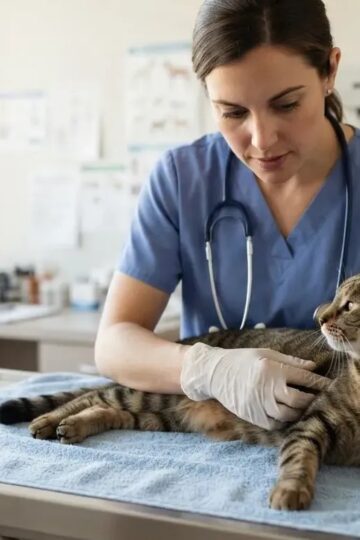
An annual wellness exam with bloodwork catches what cats are actively hiding: early kidney disease, hyperthyroidism, diabetes, and dental disease can all show up on routine testing before a single visible symptom appears.
By the time a cat "looks sick," the disease is often advanced. Chronic kidney disease, for example, can destroy up to 75 percent of kidney function before a cat shows any outward sign of illness.
A once-a-year appointment is the single highest-return investment you can make in your cat's lifespan.
But the #1 danger? It's the one that ties every other item on this list together, and it's happening silently, right now.
#1 - Chronic Dehydration From a Dry-Food-Only Diet
This is the indoor cat killer that almost nobody talks about, and it's sitting in a bowl in millions of homes today.
Cats evolved as desert predators who got most of their moisture from prey, so their thirst drive is naturally low. A cat fed exclusively dry kibble lives in a state of mild, chronic dehydration for most of its life.
That puts constant, low-grade strain on the kidneys - the organ cats are already genetically predisposed to losing. Many vets believe the epidemic of feline kidney disease in middle-aged and senior cats is at least partly tied to widespread dry-only diets that started in kittenhood.
Quick Compare
- Dry kibble typically has about 10 to 12 percent moisture.
- Wet, canned food has a moisture content of around 70 to 80 percent water.
- Natural prey - what a cat's body evolved to eat - is roughly 70 percent water, close to a can of wet food.
- Cats fed only dry food tend to drink more water to compensate, but their total daily water intake still ends up lower than cats fed wet or mixed diets.
Wet food, cat water fountains, and moisture-rich toppers aren't pampering. They're a physiological correction for an animal whose water intake was never meant to come from a bowl.
The Bottom Line
Your indoor cat is far safer than an outdoor one. Indoor cats commonly live 15 to 17 years, while outdoor cats often live only 2 to 5, according to veterinary lifespan research.
But "safer" is not the same as "safe." These dangers don't announce themselves - they accumulate quietly in your cat's kidneys, joints, mouth, and stress response, over years.
The good news: every item on this list is either preventable or catchable early with the right habits. Check the dryer, swap the lily for a spider plant, and book that annual bloodwork appointment.
These aren't dramatic gestures. They're the difference between a cat that makes it to 12 and one that makes it to 19.
Did we miss one your vet warned you about? Drop it in the comments.