14 Things a Cat Learns About Your Routine That Nobody Ever Taught It
Most people think their cat is just following instinct - but science tells a completely different story. Your cat has been quietly profiling your every move, building an internal model of your day that would embarrass a private detective.
Studies show cats adapt their entire biological rhythm to match their owner's schedule, recognize your individual voice out of a crowd, and track time-stamped cues nobody ever deliberately taught them. They're not aloof - they're observing, and here's what the research actually reveals.
#14 - Your Exact Wake-Up Time
Your cat doesn't guess when you're about to get up - it knows.
Cats tend to wake their owners at roughly the same time every morning because they want to be fed. They have a strong internal clock and track when you rise, when you leave for work, and when you come home.
Household sounds like coffee makers and alarm clocks, shifting temperature, and your own movement all work as cues. That's why cats often "demand" food 15 minutes before your usual feeding time - they've learned the sequence of your morning, not just the clock on the wall.
Your cat isn't waking you up randomly. It has reverse-engineered your alarm.
But that's nothing compared to what we found about #13...
#13 - When You're About to Leave the House
Watch your cat the next time you grab your keys. It already knows.
Cats are intelligent animals with a long memory. They watch and learn from us, noting the patterns of our actions - knowing what time to expect to be fed, how to open a cupboard door that's been improperly closed, and where their feeding and toileting areas are.
Jane Brunt, DVM, executive director of the CATalyst Council
Cats read departure cues - shoes going on, bags being picked up, jackets rustling - and connect them to your absence. They rely on environmental patterns to feel secure, so sudden changes can trigger stress.
That stress can show up as hiding, aggression, or a sudden loss of appetite. That pre-departure anxiety you sometimes see isn't separation anxiety - it's pattern recognition.
But that's nothing compared to what we found about #12...
#12 - The Sound of Your Specific Footsteps
Your cat can hear you coming from down the hallway - and it knows it's you, not a stranger.
Cats are remarkably good at inferring physical presence from sound alone. In one study, cats expected to see their owner's face the moment they heard their owner's voice - proof they can predict visual events from sound.
Cats also understand pointing, read facial expressions, and use social referencing when a situation feels uncertain. Combine that with hearing that picks up frequencies as high as 64,000 Hz, and your footstep pattern becomes as unique to your cat as a fingerprint.
Fast Facts
- Human hearing tops out around 20,000 Hz - cat hearing stretches roughly three times higher.
- That extended range lets cats detect sounds four to five times farther away than people can.
- A healthy cat can pinpoint a sound's exact source to within a few inches from several feet away.
- That precision is exactly what turns your gait into a sound signature only your cat reads instantly.
But that's nothing compared to what we found about #11...
#11 - Your Voice Tone, Not Just Your Words
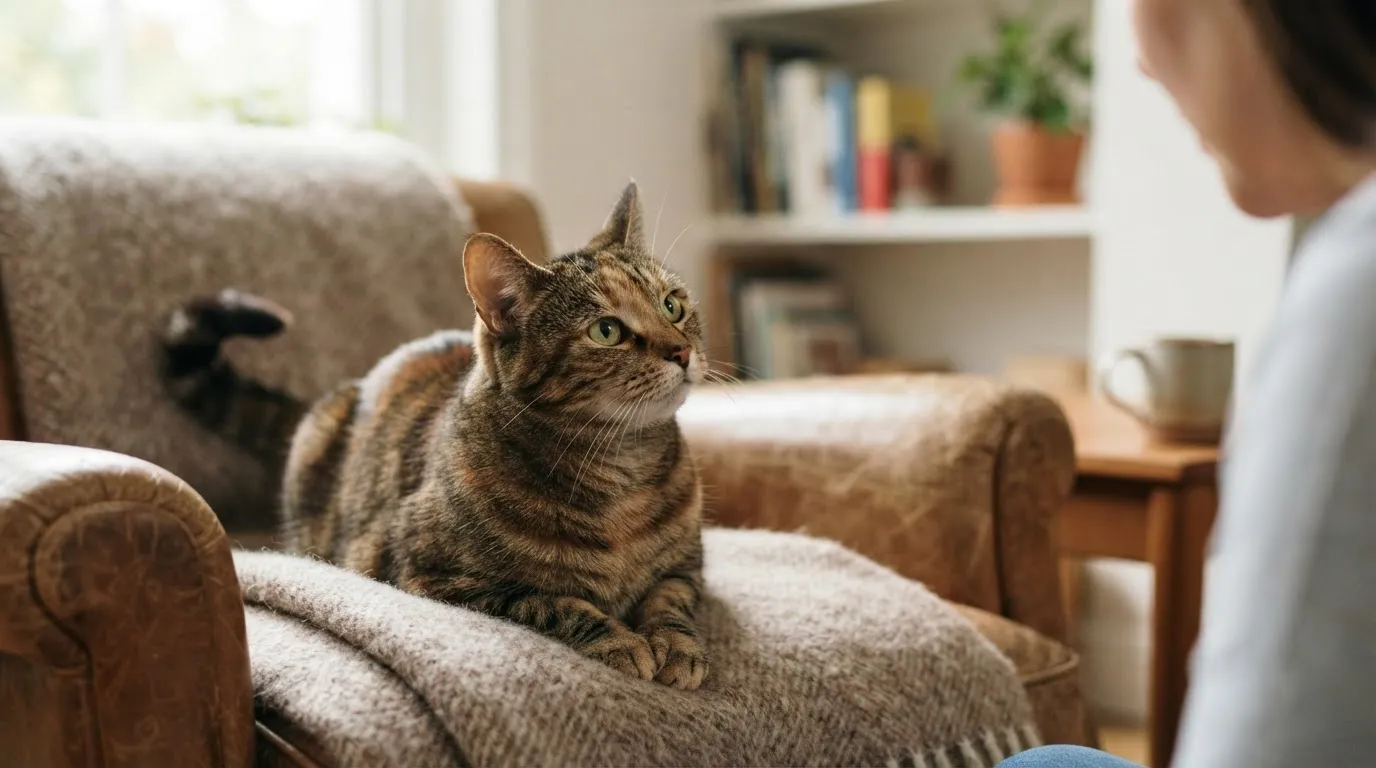
Your cat doesn't just recognize that you're speaking. It knows how you're speaking - and it adjusts accordingly.
Research shows cats can distinguish their owner's voice from a stranger's. They can also tell the difference between the various tones an owner uses, responding differently each time.
When cats hear a familiar voice, they respond in subtle ways - a swishing tail, a pivoting ear, a pause mid-groom. They show none of that when the voice belongs to someone else.
They're not just hearing you. They're reading your emotional register in real time.
But that's nothing compared to what we found about #10...
#10 - Your Entire Biological Sleep-Wake Cycle
Here's one most people find genuinely unsettling: your cat has restructured its own biology around yours.
Indoor cats living with humans - creatures who are highly diurnal - shift their own rhythm to match. This isn't a preference; it's a measurable physiological change.
Unowned cats stayed more nocturnal and showed higher overall activity than owned cats. Owned cats instead peaked in the early morning and evening, exactly when their owners get ready for work and come home.
Your cat has quietly reprogrammed its circadian clock to sync with yours, without being asked.
But that's nothing compared to what we found about #9...
#9 - Your Weekend Schedule vs. Your Weekday Schedule
Turns out your cat knows what day it is - or close enough to it.
Research shows cats adapt to changes in an owner's schedule from one day to the next. Activity peaks sharply in the morning throughout the week, when feeding and care happen on a strict, repeated schedule.
Quick Compare
- Weekday mornings: One tight activity spike lined up with your alarm and feeding time.
- Weekend mornings: Activity shifts later or doubles up as your cat waits out the delay.
- Weekday evenings: Predictable excitement timed almost exactly to your return.
- Weekend evenings: Looser, less anticipatory behavior when your routine breaks pattern.
When your weekend sleep-in breaks that pattern, your cat's behavior shifts noticeably too. Most owners assume the cat is just being demanding on Saturday mornings.
Actually, it's running last week's weekday program and flagging an anomaly.
But that's nothing compared to what we found about #8...
#8 - The Names of Everyone in Your Household
Your cat hasn't just learned your name. It has learned the names of everyone else it lives with - human and animal.
Research shows cats link a companion's name to their face without any explicit training. Cats in larger households looked significantly longer at a mismatched face when a name was called, and the effect grew stronger the longer they'd lived there.
Nobody sat down and drilled vocabulary with the cat. It simply watched, over time, which human responded to which sound - and filed the answer away.
But that's nothing compared to what we found about #7...
#7 - Your Emotional State Before You Even Walk In the Door
Your cat often reads the room before you've said a word - and possibly before you've opened the door.
Cats pull social information from sound alone. They can match vocalizations to facial expressions, recognizing emotional cues in both humans and other cats.
They also use social referencing - checking your face for information whenever a situation feels uncertain. A bad day at work may be something your cat clocked the moment your key hit the lock.
But that's nothing compared to what we found about #6...
#6 - Where You Keep the Food - and How to Get More of It
Your cat knows exactly where food lives in your home. And it has been quietly testing the edges of that knowledge.
Cats track patterns in human behavior, including where food is stored and how to open a cupboard door that isn't latched properly. They solve these problems through the same trial-and-error process humans use.
Strong long-term memory helps them learn routines and remember places, and they can pick up tricks just by watching other cats or people. The cat that "accidentally" opens the treat cabinet has been running experiments on that door for weeks. It just waited until one worked.
But that's nothing compared to what we found about #5...
#5 - Your Feeding Sequence, Step by Step
It's not just when you feed the cat. It's the exact sequence of movements leading up to it.
Cats don't understand clock time, but they track sequences - sounds, movements, smells. The can opener, the cupboard, the specific drawer you open first: each is a link in a chain your cat has memorized.
They remember feeding times, favorite napping spots, even the specific sound of the can opener. Disrupt one step in that sequence - say, feeding from a different room - and watch how confused your cat becomes.
But that's nothing compared to what we found about #4...
#4 - Your Activity Level - and It Mirrors You
This one has surprised even veteran cat researchers: cats don't just observe your energy level, they copy it.
Studies published in Applied Animal Behaviour Science found that cats' activity levels closely tracked the humans around them. Outdoor cats with less human contact drifted toward nocturnal habits, mimicking feral farm cats instead.
Our findings underline the high influence of human presence and care on the amount of activity and daily rhythm in cats.
Giuseppe Piccione, University of Messina Faculty of Veterinary Medicine
Piccione also found that a cat's eating habits track its owner's eating habits. A sedentary owner tends to produce a sedentary cat - an active owner, a more active one.
But that's nothing compared to what we found about #3...
#3 - Your Return Time - Down to the Minute
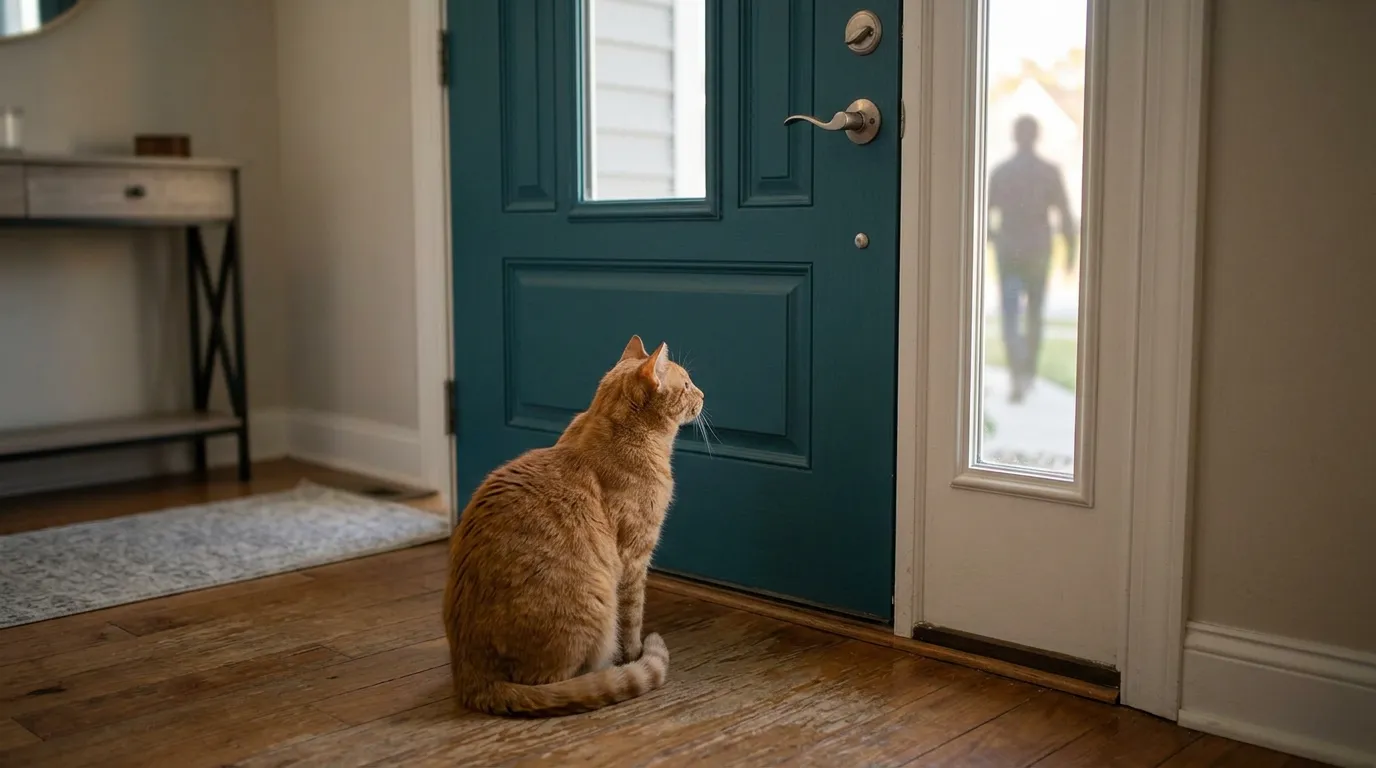
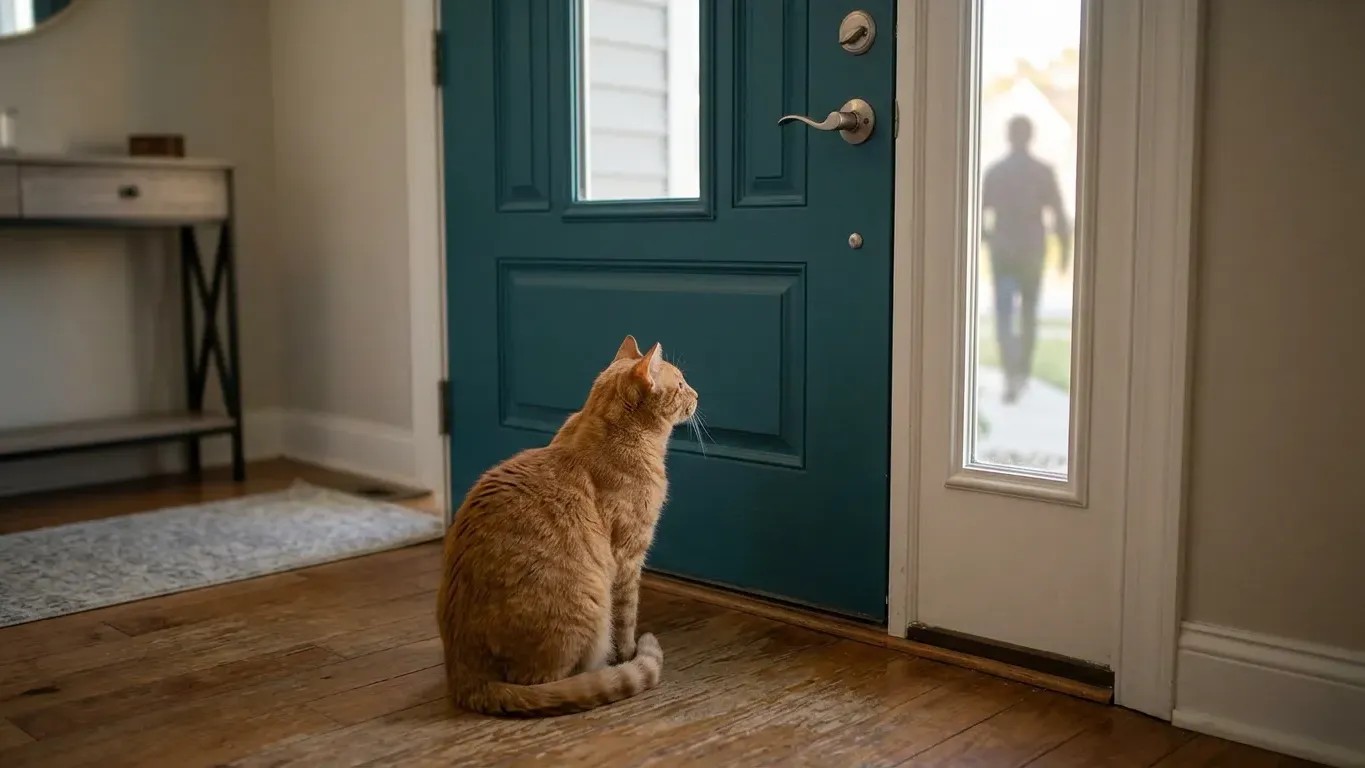
Ask any cat owner and they'll tell you the same thing: the cat is often sitting by the door before they arrive home.
Cats are creatures of habit with a strong internal clock. They track when you wake up, when you leave, and when you're due back.
Routines like this mimic a cat's natural hunting and resting cycles, giving it a sense of control over its environment. Your cat isn't psychic - it has simply logged enough data points that your return has become a predictable event on its internal calendar.
Arrive 40 minutes late and you'll see the consequences: a more agitated, more vocal cat than usual.
But that's nothing compared to what we found about #2...
#2 - Your Stress, Your Personality - Reflected Back at You
Here's the one that makes people genuinely uncomfortable: your cat may be mirroring your psychological traits.
A study in Applied Animal Behaviour Science found that personality traits in cats - curiosity, excitability, timidness, friendliness - often mirror the humans they spend the most time with.
Cats are constantly learning, not just from their environment but from their social partners. Over months and years of close observation, a cat absorbs your demeanor along with your schedule.
An anxious owner is statistically more likely to have an anxious cat. The cat you raised is, in many ways, a portrait of you.
But that's nothing compared to what we found about #1...
#1 - That You're the Center of Its Entire World Model
This is the one nobody talks about - and the research makes it undeniable.
Cats expect to see their owner's face the moment they hear their owner's voice, evidence they hold a persistent mental map of where you are. They aren't passively sitting in a room; they're tracking you.
Cats thrive on routine, and that attachment isn't just preference - it's a reflection of memory and bond-building. The more attention an owner gives, the more a cat learns it can rely on them.
Your cat has built an entire internal model of the world, and you are the fixed point everything else is organized around. Every routine it has learned, every sound it has mapped, radiates outward from you.
The Bottom Line
Your cat hasn't been indifferent. It has been studying you.
Research confirms cats rewire their sleep cycles, map your schedule to the minute, tell your voice apart from a stranger's, mirror your personality, and mentally track your location in the house - all without a single lesson.
At a Glance
- Your cat's internal clock tracks wake-up, departure, and return times without being taught.
- Its hearing and voice-recognition skills let it identify you specifically, not just "a human."
- Its sleep-wake rhythm physically shifts to match your daily schedule.
- Its personality and activity level often mirror your own over time.
The animal most people write off as aloof is running one of the most sophisticated passive-observation systems in the animal kingdom. The real question isn't whether your cat knows your routine - it's how much of yours it has quietly shaped too.
Did we miss one of the things your cat clearly knows about your daily routine? Drop it in the comments - we want to hear the eeriest ones.