15 Breed Quirks Only Owners Understand After Years Together
Most people think a pet is a pet - you learn the basics and move on. Long-term owners know better: every breed hides behavioral blueprints no brochure ever mentions.
Science backs this up - breed explains a real slice of behavior, but the specific quirks only show up after months or years together. Here's what the data and veteran owners actually say about the fifteen quirks nobody warns you about.
#15 - The Ragdoll's "Power-Down" Switch
Pick up a Ragdoll cat and something almost eerie happens - it goes completely limp.
The breed gets its name from that exact trait, and since Ragdolls run large, the effect is striking. First-time owners assume it's a fluke.
It isn't. Ragdolls follow owners from room to room, forming attachments that feel more like dog loyalty than feline independence.
The power-down limp isn't passivity - it's trust, fully expressed. Years in, owners realize it only happens with people the cat has decided it owns.
But that's nothing compared to #14 - a breed that turns its entire emotional vocabulary into noise.
#14 - The Siamese "Conversation"
Everyone knows Siamese cats are vocal. What they don't tell you is that "vocal" is a dramatic understatement.
Siamese cats use several distinct vocalizations to talk to their owners, and they crave constant affection. New owners think it's cute.
Veteran owners know it's a full-time negotiation. They don't meow at you - they argue with you.
After years together, owners learn to read the pitch that means "feed me now" versus "I disapprove of your life choices."
But that's nothing compared to #13 - a dog breed wired with a job it never stops doing.
#13 - The Border Collie's "Stare"
You've seen the Border Collie stare. What you haven't understood - until you've lived with one - is what it means.
Border Collies consistently rank as the most intelligent breed, with intense focus that needs an outlet. Without one, they get bored and destructive.
That unblinking gaze isn't affection - it's the herding instinct locked onto a target. The breed can fixate on cats, bicycles, and joggers, and it's also prone to sound sensitivity.
Fast Facts
- Ranked the #1 most intelligent dog breed in Stanley Coren's classic obedience-and-working intelligence rankings.
- Can learn a brand-new command in fewer than 5 repetitions.
- Obeys a known command on the first try at least 95% of the time.
- The average dog needs roughly 25 to 40 repetitions to reach that same reliability.
Long-term owners learn the stare is a request for a job. Ignore it, and the Border Collie will invent work - usually involving your furniture.
But that's nothing compared to #12 - a giant cat breed hiding a dog personality.
#12 - The Maine Coon's Fetch Obsession
Maine Coon owners try to explain this to non-owners and get blank stares: their cat plays fetch.
Maine Coons are dubbed "gentle giants" for their size and easygoing temperament, and many genuinely enjoy fetch. It sounds trained. It isn't.
Some males reach nearly 9 kilograms and still act like a retriever puppy. They're intelligent enough to pick up on human emotions quickly, too.
Years in, owners stop being surprised when the cat drops a toy at their feet and waits. They just throw it.
But that's nothing compared to #11 - the couch dog that secretly runs on 40-mph legs.
#11 - The Greyhound's Indoor Paradox
Everyone pictures Greyhounds as high-energy racing machines. Long-term owners laugh at that assumption.
In one study, 90 percent of greyhounds didn't bury toys - yet multiple owners still identified their own dog as a frequent toy-burier. The breed constantly defies its own stereotype.
They are genuinely one of the laziest breeds indoors, sprinting in explosive bursts, then crashing for hours. No one believes it until they own one.
Outsiders assume Greyhounds need a farm. They actually thrive in apartments with two short runs a day.
But that's nothing compared to #10 - a breed whose nose controls its brain completely.
#10 - The Beagle's Nose-Brain Takeover
Beagle owners don't train their dog. They negotiate with a nose that occasionally has a dog attached to it.
Beagles are patient and good with other pets, but their scent drive overrides everything else. When a Beagle locks onto a smell, commands and recall become temporarily irrelevant.
Dogs experience the world mostly through scent, and for Beagles that instinct runs at an almost absurd intensity. A slow sniff-walk is mentally richer for them than a fast power-walk.
Years in, owners stop calling "come" mid-sniff and start positioning themselves downwind instead.
But that's nothing compared to #9 - the breed that actually heats itself with you.
#9 - The Sphynx Cat's Body-Heat Dependency
Sphynx owners don't just have a cat. They have a warm-blooded accessory that is genuinely always cold.
Without fur, Sphynx cats run about 4 degrees warmer than other cats and actively seek human body heat as their primary heat source. Lying on people isn't occasional - it's survival strategy.
Worth Knowing
- Often described as running about 4 degrees warmer to the touch than fully-coated cats.
- A faster metabolism means more frequent meals to keep up with the energy they burn.
- Without fur to block UV rays, sunburn is a real risk even indoors near sunny windows.
- Regular bathing is a must, since there's no fur to soak up the skin's natural oils.
Veteran owners stop using blankets alone, because the cat is already there. A Sphynx left in a cold room will find its way under the covers with almost mechanical determination.
But that's nothing compared to #8 - a breed that turns separation into theater.
#8 - The Golden Retriever's Emotional Collapse at the Door
Golden Retrievers don't just miss you. They stage a full production about it.
Goldens are famous for the greeting when you return, but the separation is what surprises new owners. They communicate distress with a level of drama that feels almost human.
Long-term owners know the specific whimper that means "you've been gone 12 minutes and I have notes." They also learn to keep departures low-key - big goodbyes make re-entry chaos twice as intense.
But that's nothing compared to #7 - the world's most dramatic bath-time opponent.
#7 - The Husky's Argument Voice
Huskies don't bark when they disagree with you. They deliver a monologue.
That vocal soundtrack sits somewhere between a howl, a moan, and a full sentence. Non-Husky owners assume the dog is in pain - Husky owners know it's an opinion.
Huskies were bred to communicate across distances in sled teams, and that vocal wiring doesn't disappear in a suburban home. Years in, owners can translate the tone that means "I don't want the crate" from the one that means "I disagree with this walk route."
But that's nothing compared to #6 - a dog whose intelligence becomes a liability.
#6 - The Jack Russell's Vertical Ambition
Jack Russell Terriers don't think of themselves as small dogs. Owners learn this the hard way.
One quirk is their obsession with jumping over obstacles and hopping on furniture. The other is an unyielding need to dig, often in places you'd never expect - including under the couch or in your bed.
The jumping isn't excitement - it's a Jack Russell testing the structural limits of your home. Cabinet latches, shelf heights, even the inside of the fridge become fair game once one decides it's interested.
But that's nothing compared to #5 - a cat that bonds with exactly one human and treats everyone else as a guest.
#5 - The Chartreux's One-Person Loyalty
Chartreux cats are rare enough that most people have never met one. Owners will tell you you're missing one of the most intense bonds in the pet world.
Chartreux cats are sweet and gentle, but fiercely loyal - they often bond with just one human, without being clingy about it. The cat isn't cold to others; it's just clearly, unmistakably yours.
Years in, owners find the cat knows their schedule and moods better than most humans do. It sits beside you, not on you, with a steady, watchful presence that feels more like a silent companion than a pet.
But that's nothing compared to #4 - a breed that carries a hidden anxiety no one warns you about.
#4 - The Velcro Dog Effect: Vizslas and Weimaraners
Some breeds are called "Velcro dogs." Vizsla and Weimaraner owners will tell you that phrase doesn't cover it.
For these breeds, proximity means the same room, ideally the same cushion, and preferably the same lap regardless of body size. Both were bred as personal hunting companions who worked alongside one person all day, every day, for centuries.
Quick Compare
- Vizsla: Hungarian pointer bred to work all day at a single hunter's side.
- Weimaraner: German breed developed to track big game shoulder-to-shoulder with one handler.
- Shared trait: Both can develop genuine separation anxiety when left alone too long.
That wiring doesn't come with an off switch. New owners think it's cute - three years in, they realize they haven't used the bathroom alone since adoption day.
But that's nothing compared to #3 - a breed whose "stubbornness" is actually something far more interesting.
#3 - The Basset Hound's Selective Hearing
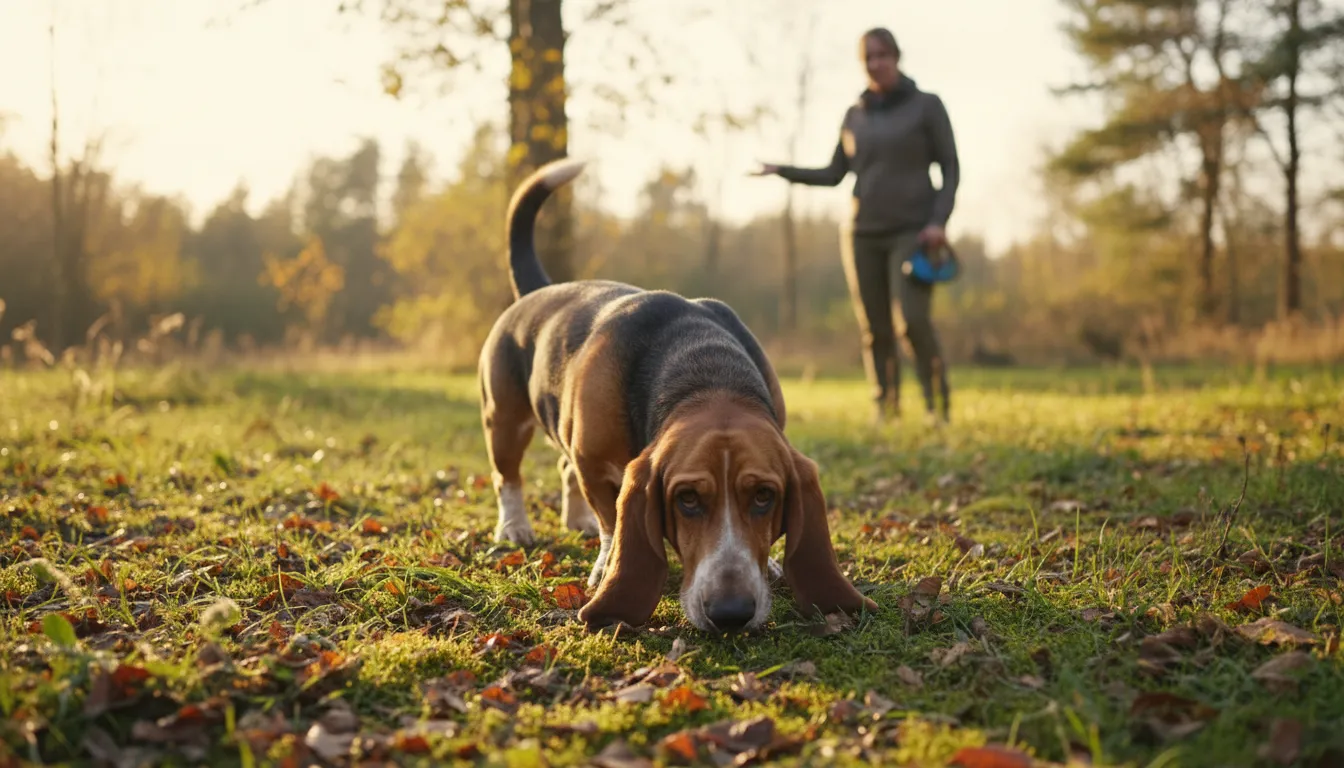
Basset Hound owners will tell you their dog isn't stubborn. It's just running on a completely different priority system.
Basset Hounds are sweet-tempered scent hounds with a nose that rivals a Bloodhound's. When that nose engages, everything else - commands, your voice, the concept of "stay" - gets suspended.
Long-term owners stop issuing commands mid-sniff and start redirecting before the nose locks on. A Basset Hound that glances up at you and then back down isn't ignoring you - it's making a deliberate choice.
But that's nothing compared to #2 - a research-backed truth about breed behavior most owners get completely wrong.
#2 - The Breed Behavior Myth That Trips Up Everyone
Here's the one no one wants to hear: the behaviors you think are guaranteed by breed are far less reliable than you believe.
Research found that breed explains only 9 percent of behavioral variation among dogs. Traits that seem breed-linked are often leftovers of ancestral breeding for functions like hunting or herding.
Fast Facts
- Breed accounts for only about 9% of behavioral variation among dogs, according to genetic research.
- Roughly 8% of Labrador owners reported a howling habit, despite the breed's reputation for staying quiet.
- Early life experience and individual temperament often outweigh breed stereotypes.
Researchers even found that 8 percent of Labrador owners reported their dog had a propensity for howling - despite Labs rarely being known for it. The quirks that feel most "breed-typical" are often shaped by individual experience and early life instead.
Veteran owners figure this out around year two or three, when their "typical" Labrador does something completely off-script. That's usually when they stop blaming the breed.
But that's nothing compared to #1 - the quirk that almost every long-term multi-pet owner eventually notices.
#1 - The Schedule Keeper: When Your Pet Runs the Clock
Every long-term owner eventually realizes the same thing: their pet knows what time it is. And they're not subtle about it.
One owner reported their dog sat in the doorway making small sounds every night around 10 p.m. until she was followed to bed - for years, without exception. Owners across breeds, from Collies to Maine Coons to Beagles, report the same pattern.
Dogs and cats bond closely with routines, and they notice instantly when something changes. After years together, your pet isn't just reacting to your schedule - it's actively enforcing it.
Feeding time, walk time, bedtime: the animal knows, and it will remind you. Owners who think they're running the household eventually realize they haven't made a free decision about their evening routine in years.
The Bottom Line
The real quirks - the ones nobody puts in breed guides - only surface after years of daily life together. Ragdolls go limp on cue, Border Collies stare down joggers like wayward sheep, and Basset Hounds make a deliberate choice to ignore you mid-sniff.
Science confirms that breed alone explains less of your pet's behavior than you'd think - individual experience and early bonding shape these quirks just as powerfully. The one truth that holds across every breed: your pet knows your routine better than you do, and it will hold you to it.
Which quirk does your pet have that no one else would believe? Drop it in the comments - we'd love to know.