16 Everyday Household Items Vets Warn are Dangerous for Indoor Cats

Most cat owners think their home is completely safe for their feline. They're wrong - and the ASPCA's poison hotline fields roughly a quarter-million calls a year to prove it.
The scary part isn't some rare chemical hiding in a garage. It's the stuff sitting on your kitchen counter, in your medicine cabinet, and on your living room shelf right now.
Being "indoors" doesn't protect your cat - it's actually where most of the danger lives. Here's what vets want every cat owner to know, starting with something that looks completely innocent.
16. Lily Flowers (Yes, Even a Vase of Them)
Lilies look harmless sitting in a vase. They are anything but.
Easter, tiger, and Asiatic lilies are all part of the Lilium family, and every part of them can trigger kidney failure in cats. Even a tiny amount of pollen is enough to cause a crisis.
Pet Poison Helpline experts flag lilies as one of the most under-recognized dangers in any home. A cat doesn't even need to chew a petal - grooming pollen off a paw is enough.
Fast Facts
- All true lilies - Easter, tiger, Asiatic, and Day lilies - are highly toxic to cats
- Kidney failure can begin within 12 to 24 hours of exposure
- Pollen, leaves, stems, and even vase water are all dangerous
- No amount is considered "safe" - a single lick is treated as an emergency
Cut flowers aren't safer than potted ones, either. A single vase on your table can shed pollen across an entire room.
This next one is just as sneaky - but it's hiding in a bottle under your sink.
15. Everyday Household Cleaners
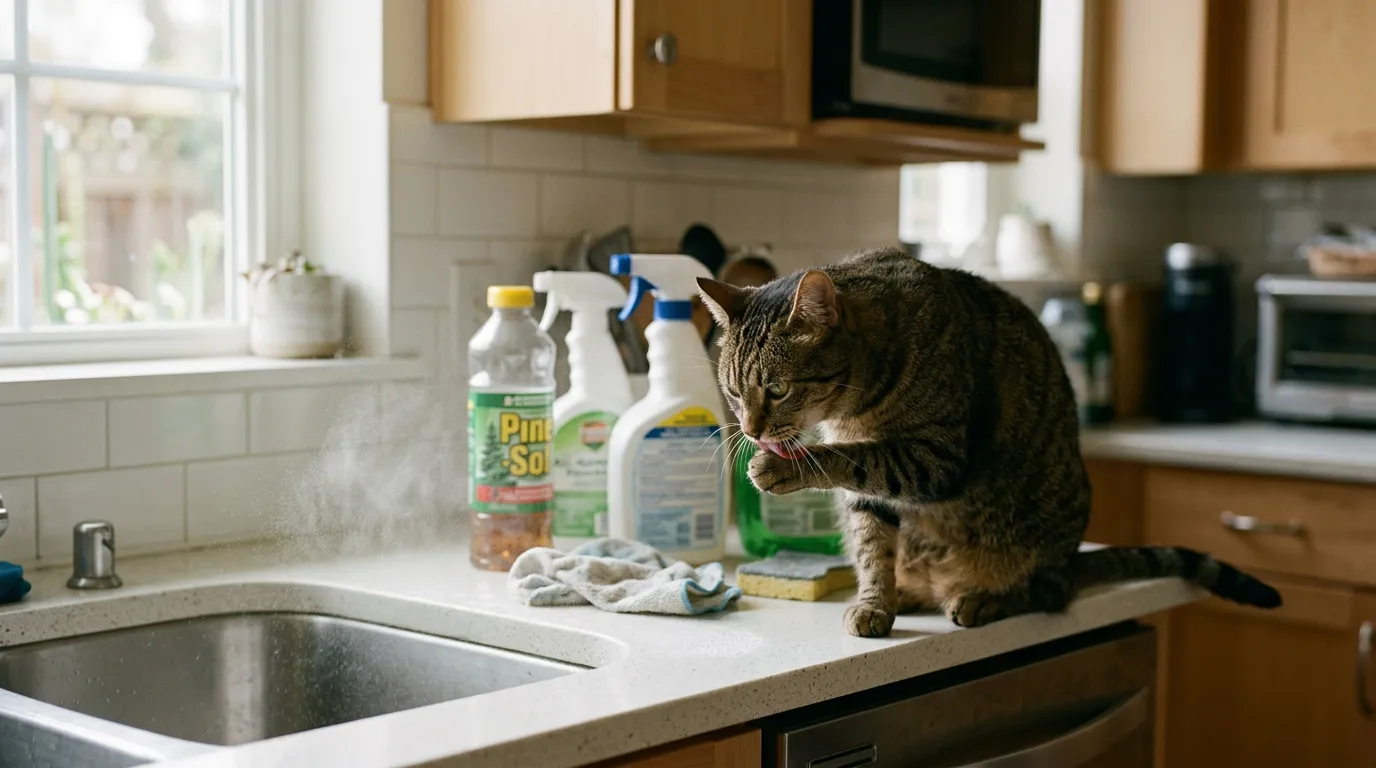
You use them every day. So does your cat - just not on purpose.
Kitchen sprays, carpet cleaners, and toilet bowl cleaners can cause stomach upset, chemical burns, and even organ damage in cats. Because cats groom themselves constantly, anything that touches their paws usually ends up in their mouth.
Ammonia-based cleaners and phenol disinfectants like Pine-Sol are especially risky. Even some "natural" scented cleaners contain phenols, so check the label before assuming anything is safe.
The fix is simple - keep your cat out of any room until the floor or counter is completely dry. Cleaning supplies are only the start, though; #14 might already be sitting on your bookshelf.
14. Sago Palm (The Trendy Houseplant That Kills)
This one is criminally under-discussed.
Sago palms are sold everywhere as stylish indoor décor, and they can cause acute liver failure in cats. Every single part of the plant is toxic - the seeds, the leaves, even the roots.
As indoor plants have surged in popularity, so has accidental exposure. Most owners who bring one home have no idea it's dangerous at all.
If you own one, the safest move is to rehome it entirely. A high shelf won't stop a determined cat - and #13 is something running in almost every home right now.
13. Essential Oils and Oil Diffusers
The wellness trend that your cat definitely didn't sign up for.
Peppermint, clove, eucalyptus, tea tree, cinnamon, and citrus oils are all toxic to cats. That's because cats lack a liver enzyme called glucuronyl transferase, which helps break these compounds down safely in other animals.
Diffusers make this worse - the oil settles invisibly on fur, then gets groomed off and swallowed. Weeks of low-level exposure can cause drooling, lethargy, or breathing trouble before anyone connects the dots.
If you use essential oils, keep the room ventilated and your cat out of it while the diffuser runs. Next up, #12 is sitting in nearly every bathroom cabinet in America.
12. Acetaminophen (Tylenol)
One tablet. That's genuinely all it takes.
Cats lack the enzymes to safely process acetaminophen, and even a single standard tablet can be fatal depending on their weight. It destroys red blood cells until blood can no longer carry oxygen, followed by liver failure.
This isn't only about someone giving it on purpose. Cats knock pill bottles off nightstands, chew through blister packs, and lick up dropped tablets.
Store every medication behind a closed, latched door - no exceptions. But pills aren't the only threat; #11 is something people spray or apply without a second thought.
11. Flea Products Designed for Dogs
Sounds obvious. It still happens constantly.
Many dog flea treatments contain permethrin, a chemical dogs tolerate but cats cannot. Even one small application can trigger severe muscle tremors or seizures.
Cats can also be poisoned secondhand - by grooming a dog that was just treated, or by catching a mouse that ate rodent poison. Vets call this one of the most preventable emergencies they see.
Always read the label before treating any pet. Never assume a product safe for a dog is safe for a cat - and #10 is hiding in your kitchen pantry right now.
10. Onions, Garlic, and Chives

Not just a food concern - a genuine toxicology issue.
Onions, garlic, chives, and leeks all contain compounds that destroy red blood cells and can cause severe anemia. Garlic is roughly five times more potent than onion, even in small amounts.
The scary part is the delay - a cat that snags a bite of seasoned food might seem fine for days. By the time symptoms show up, real damage has already occurred.
Broths, baby food, and table scraps count too, even without visible pieces. The next item, #9, is stored right next to millions of people's vitamins.
9. Ibuprofen (Advil) and Naproxen
Left on a nightstand. Dropped on the floor. Chewed through foil.
Cats are even more sensitive to ibuprofen and naproxen than dogs are. Vomiting, seizures, and collapse are all possible, and kidney damage can progress fast.
Treatment within 24 hours gives a cat its best shot at recovery, but most owners don't connect the symptoms to a pill until it's too late.
Treat every pill bottle like a loaded hazard - stored away, never left on a counter. Up next, #8 is a common kitchen item most people never think twice about.
8. Xylitol-Containing Products
It's in more things than most people realize.
Xylitol shows up in sugar-free gum, peanut butter, toothpaste, and chewable vitamins - and it can trigger liver failure and dangerously low blood sugar in cats. The risk isn't just direct ingestion from a packet, either.
A dropped cracker with sugar-free peanut butter, or a chewable vitamin batted around like a toy, is enough. Always check the label before leaving these products within reach.
Households with kids need extra vigilance - kids drop things, and cats find them. The #7 item is something people use freely, never imagining it could be dangerous at all.
7. String, Ribbon, and Hair Ties
Not a toxin - something far more mechanically sinister.
Hair ties, ribbon, rubber bands, and stringy items can lodge in a cat's digestive system and cause a blockage. Vets regularly perform surgery to remove what's called a "linear foreign body."
In these cases, the string anchors in the stomach while the intestine bunches around it - a slow, life-threatening injury. Tinsel, sewing thread, Easter grass, and dental floss all carry the same risk.
Worth Knowing
- Vomiting that won't stop, or repeated straining, can signal a blockage
- Never pull visible string from a cat's mouth or rear end - it can cause more internal damage
- Linear foreign body surgery often means multiple incisions along the intestine
- Kittens under a year old are especially prone to swallowing string while playing
Never leave these items where a bored cat can play with them unsupervised. And #6 isn't dangerous in the way you'd expect - the threat here is completely counterintuitive.
6. Scented Candles and Air Fresheners
Your home smells great. Your cat's lungs disagree.
Cats have highly sensitive respiratory systems, and concentrated synthetic fragrances from candles, plug-ins, and sprays can cause ongoing irritation. Many candle formulas rely on essential oil derivatives that carry the same risks when burned or diffused.
Cats with asthma or other respiratory issues are especially vulnerable. Coughing, wheezing, or sneezing after you light a candle is a signal worth taking seriously.
Low-level irritation adds up over time, even without one dramatic incident. The #5 item on this list surprises almost every cat owner the first time they hear it.
5. Pothos and Philodendron (The "Easy" Houseplants)
Recommended to beginners everywhere. Toxic to cats everywhere.
Pothos, philodendron, and monstera are marketed as the easiest houseplants alive - and they're all dangerous to cats. They contain calcium oxalate crystals that cause intense oral pain and swelling when chewed.
In bad cases, that swelling can spread far enough to affect breathing. The irony is brutal - these are the exact plants recommended to people who "can't keep anything alive."
Quick Compare
- Toxic: pothos, philodendron, monstera, peace lily
- Cat-safe: Boston fern, African violet, spider plant, cat grass
- Rule of thumb: if a plant is marketed as "impossible to kill," check the ASPCA toxic plant list first
If you own them, swap them for a Boston fern or African violet, both confirmed safe by the ASPCA. Wait until you see #4 - most people have this sitting in a pretty pot right on their windowsill.
4. Aloe Vera
The natural remedy that isn't natural for cats.
Aloe vera contains saponins and anthraquinones that can cause vomiting, diarrhea, lethargy, and tremors if a cat chews the leaves or licks the gel. It's a staple on windowsills - exactly the low-traffic shelf a curious cat gravitates toward.
Most owners are genuinely shocked this plant is on the toxic list. Its reputation as a gentle healing remedy makes it feel impossible that it could hurt anything.
Even gel from a broken leaf left on a counter is enough for a curious cat to lick up. Number #3 is something you might use in your home regularly - with no idea your cat is at risk.
3. Rodenticides (Mouse and Rat Bait)
Used to eliminate pests. Genuinely capable of eliminating your cat.
Rat and mouse bait is intentionally made to smell and taste appealing, which is exactly what makes it dangerous. It can cause life-threatening bleeding disorders if a cat eats it directly.
Secondary poisoning is more common than people think - a cat that catches a dying, poisoned mouse has effectively eaten the poison too. Anticoagulant rodenticides can cause internal bleeding with no outward symptoms for days.
At a Glance
- Anticoagulants - block blood clotting, symptoms often delayed for days
- Bromethalin - attacks the nervous system, sometimes within hours
- Cholecalciferol (Vitamin D3) - triggers dangerous calcium spikes and kidney failure
- All three types are sold over the counter, no prescription required
By the time weakness, pale gums, or breathing trouble show up, the damage can already be severe. Use snap or safety traps instead of poison if you have pest control needs.
The second most dangerous item on this list comes from something you almost certainly use every single morning.
2. Caffeine (Coffee, Tea, Energy Drinks)
You start every day with it. It can end your cat's day permanently.
Coffee, tea, soda, and energy drinks all contain caffeine, which can trigger heart arrhythmias and seizures in cats. Cats are significantly more sensitive to it than humans or dogs.
The risk isn't just a full mug left out - used coffee grounds, teabags, and energy drink residue all count. Restlessness, rapid breathing, and muscle tremors are early warning signs.
Most owners never think of caffeine as dangerous because it feels so ordinary. Don't leave your morning brew unattended on a low table - and now, the item that tops every vet's list.
1. Over-the-Counter Cough, Cold, and Allergy Medications
This is the one vets warn about most urgently - and most people ignore it completely.
Many cough, cold, and allergy medications contain acetaminophen, which destroys red blood cells and causes liver failure in cats. These products often come in blister packs cats can puncture, or bottles left on a nightstand during someone's illness.
Cats simply don't have the enzymes to process acetaminophen safely, even at tiny doses. Symptoms can appear within just 1 to 4 hours of exposure - an extremely narrow window to get help.
Acetaminophen toxicity in cats can progress from mild stomach upset to fatal liver failure faster than most owners realize.
Pet Poison Helpline
What makes this #1 is the combination: it's everywhere, almost nobody knows the risk, and the consequences move fast. Every blister pack and liquid remedy belongs behind a closed, latched cupboard - no exceptions.
The Bottom Line
Your cat is sharing a home full of hidden hazards, and most of them look completely ordinary. Curiosity is what makes cats cats - but it's also what puts them in the path of a lily petal, a dropped pill, or a half-drunk cup of coffee.
Cats lack a specific liver enzyme most other animals rely on to break down everyday chemicals safely. That's why substances harmless to us can turn dangerous fast once they're in a cat's bloodstream.
The good news is that almost every item on this list is preventable with one simple change - a locked cabinet, a swapped-out plant, a closed door. Walk through your home room by room; you'll probably find at least one surprise.
Did we miss something that shocked you? Drop it in the comments - your experience might save another cat's life.