13 Things Your Aging Cat Does That Prove It Chose You on Purpose
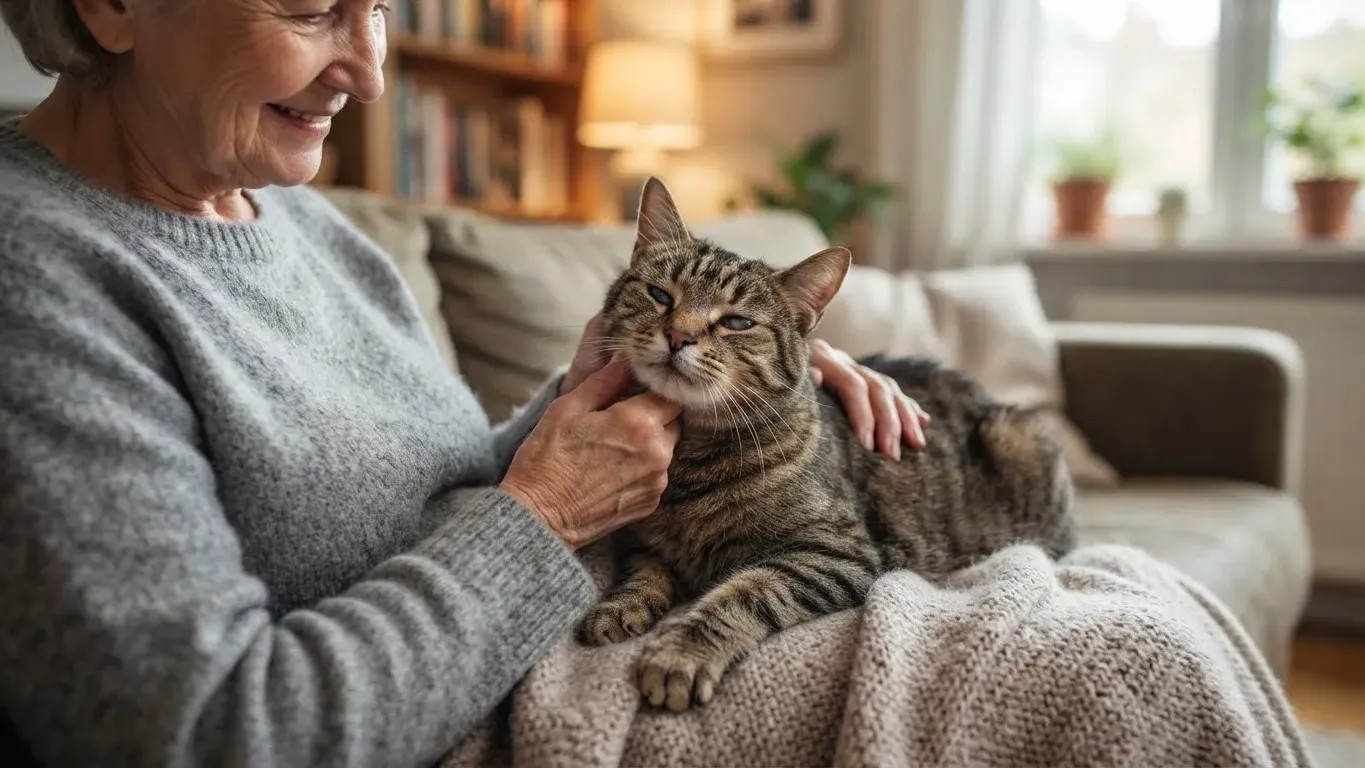
Most cat owners assume their old cat is just slowing down, getting clingy, or turning into a homebody. That's not what's actually happening.
Scientists studying the cat-human bond have found that as cats age, their attachment behaviors don't fade at all. They get sharper, more deliberate, and aimed at one specific person - you. Here's what the research actually shows, counted down to the one behavior that says it all.
#13 - It Walks Straight to You in a Room Full of People
Your aging cat doesn't do anything by accident, especially not where it plants itself.
Cats who are securely attached will approach their person and ask for attention, even in a crowded room. A senior cat has had years to study every human it meets, and walking past three warm laps to reach yours is not random.
Like dogs, cats display social flexibility in regard to their attachments with humans. The majority of cats are securely attached to their owner and use them as a source of security in a novel environment.
Kristyn Vitale, Oregon State University
An older cat has had years to cement that preference, and it shows in exactly who it walks toward.
Your senior cat is running a quiet, lifelong loyalty test - and you passed. But that's nothing compared to what we found about #12...
#12 - It Gives You the Slow Blink - and Only You
Most people write this off as sleepiness. It isn't.
The slow blink is a real form of communication between cats and humans - a sequence of half-closed eyes that signals safety, not fatigue. When your aging cat does this deliberately, from across the room, it's speaking directly to you.
Researchers believe the slow blink shows a cat is open to interaction and has no intention of intimidating anyone. Think of it as the feline equivalent of a warm, genuine smile.
Every slow blink your old cat sends you is a conscious signal of trust built over years. Watch who else in the house gets that look regularly - probably nobody.
But that's nothing compared to what #11 reveals...
#11 - It Seeks You Out When Something Strange Happens
Your cat could hide under the bed. Instead, it finds you, and that's not coincidence.
Confronted with something upsetting, cats turn to their person for reassurance. Some retreat to a corner; others climb straight into a lap and stay there.
A senior cat that's lived through a decade of thunderstorms, vacuum cleaners, and strange guests has learned exactly one reliable answer: you. Cats with secure attachment settle down faster once their person is back in the room.
Your aging cat using you as a "safe base" mirrors the same psychological mechanism studied in human infants. The science is that direct.
Fast Facts
- Adult cats mirror kittens almost exactly, with roughly two-thirds showing secure attachment to their owner.
- That rate lines up closely with the 65% secure-attachment level seen in human infants, and it edges out what's typically measured in dogs.
- Secure attachment means the cat trusts its person to meet its needs, which is why it feels safe exploring even in a strange room.
But wait until you see what #10 means...
#10 - It Kneads You Even at an Age When It "Shouldn't" Need To
Kneading looks like a cute quirk. It's actually a window into how your cat classifies you emotionally.
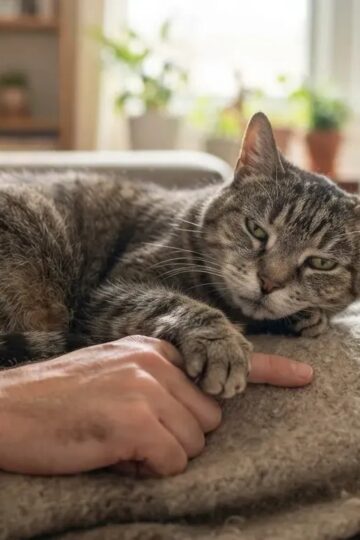
Kittens knead while nursing to stimulate milk, and the comfort that follows sticks with them for life. Many cats keep kneading well into old age simply because it still feels like safety.
If your cat kneads on your lap specifically, take it as a compliment. An aging cat kneading you is placing you in the same emotional category as the very first source of comfort it ever knew.
That's not something cats hand out lightly. And #9 takes this even further...
#9 - It Chooses to Sleep on You, Not Just Near You
There's a big difference between a cat that naps in the same room and one that sleeps directly on your body. Most owners miss it completely.
Exposing the belly, or sleeping in a deep, vulnerable position on a person, is a trust signal. The abdomen is one of a cat's most exposed areas, so choosing to rest on it near you means something.
Senior cats sleep more overall, which makes the location of that sleep even more telling. An aging cat that consistently picks your body over every other surface in the house is telling you something specific.
It's chosen its safe haven. But #8 is the behavior most people completely misread...
#8 - It Head-Bunts You With Surprising Force
That little headbutt might look like your cat just wants attention. It's actually a territorial declaration - and a compliment.
Cats have scent glands on their foreheads and cheeks, and head-bunting deposits their scent directly onto you. When an aging cat presses its head into your hand or your face, it's marking you as its own.
This is your cat announcing to the world - and to itself - that you belong to it. Younger cats headbutt too, but senior cats tend to do it more selectively.
They've stopped wasting the gesture on people who aren't worth the effort. And #7 is the one that genuinely surprises most cat owners...
#7 - It Talks to You More Than It Talks to Anyone Else
Senior cats get more vocal with age, but the direction of that vocalizing is rarely random.
Research shows adult cats develop most of their meowing specifically in response to humans - they barely meow at each other at all. They're not talking to the room. They're talking to you.
An aging cat that's built a specific vocabulary of chirps, trills, and meows used only with you has essentially invented a private language for your relationship. Other people in the house get a generic meow at best.
Worth Knowing
- Adult cats rarely meow at other cats at all - the sound is believed to have evolved almost entirely as a way to talk to humans.
- Beyond the basic meow, cats can produce chirps, trills, and murmurs, each shaped slightly differently depending on what they want.
- Many owners can tell their cat's "feed me" meow from its "pick me up" meow without even looking.
The nuance is reserved for you. And then there's #6, which might be the quietest proof of all...
#6 - It Grooms You
Mutual grooming, called allogrooming, is something cats reserve for those they genuinely accept as family.
Grooming is affection in action - if your cat licks your hair or your hand, that's not an accident. For an aging cat with stiffer joints, the effort of reaching up to groom you costs real energy.
It spends that energy on purpose. When your senior cat grooms you, it has placed you inside its inner circle.
That's earned, not given. But the behavior at #5 is the one that hits hardest...
#5 - It Greets You at the Door Every Single Time
Forget the idea that only dogs get excited at the door. A senior cat that consistently meets you at the entrance has made an active decision.
Cats notice your absence, track your patterns, and respond specifically to your return - that's not timing, that's attachment. A cat with secure attachment stays calmer and more attentive during reunions than one that isn't bonded.
An aging cat waiting by the door isn't confused - it has been anticipating you. The length of that wait, and the consistency of it, reflects how deep the bond really runs.
Quick Compare
- Securely bonded cat: greets its owner calmly, then goes back to what it was doing.
- Insecurely bonded cat: shows anxiety at reunion, including tail twitching, lip licking, or avoiding its owner entirely.
And #4 is something that's only possible after years together...
#4 - It Knows Your Mood Before You Show It
This one sounds like folklore. It isn't.
Senior cats that have spent years reading one specific person's expressions, voice, and daily rhythms get remarkably good at predicting mood shifts. Often, they respond before the emotional cue is even obvious to you.
Common misconceptions that cats need less social interaction, or are more independent, can impact both the amount and quality of social interactions we offer cats.
Monique Udell, animal behavior researcher
An aging cat that climbs into your lap specifically when you're stressed - without being called - is showing years of accumulated emotional observation. It has studied you, closely.
And #3 makes that point undeniable...
#3 - It Tolerates Things From You That It Won't Allow From Anyone Else
Your aging cat lets you pick it up awkwardly, touch its belly, or clip its nails without a fight. Watch what happens when someone else tries the exact same thing.
Exposing the belly is already a trust signal on its own. Physical tolerance in a senior cat goes further - it's a full acceptance of your specific presence and your specific hands.
Cats that allow only one person to perform certain touches are making a security decision, not just a preference. Behaviorists consider this kind of selective tolerance one of the clearest signs of a truly chosen bond.
But #2 might be the behavior you've seen every day without understanding what it means...
#2 - It Purrs Differently With You Than With Anyone Else
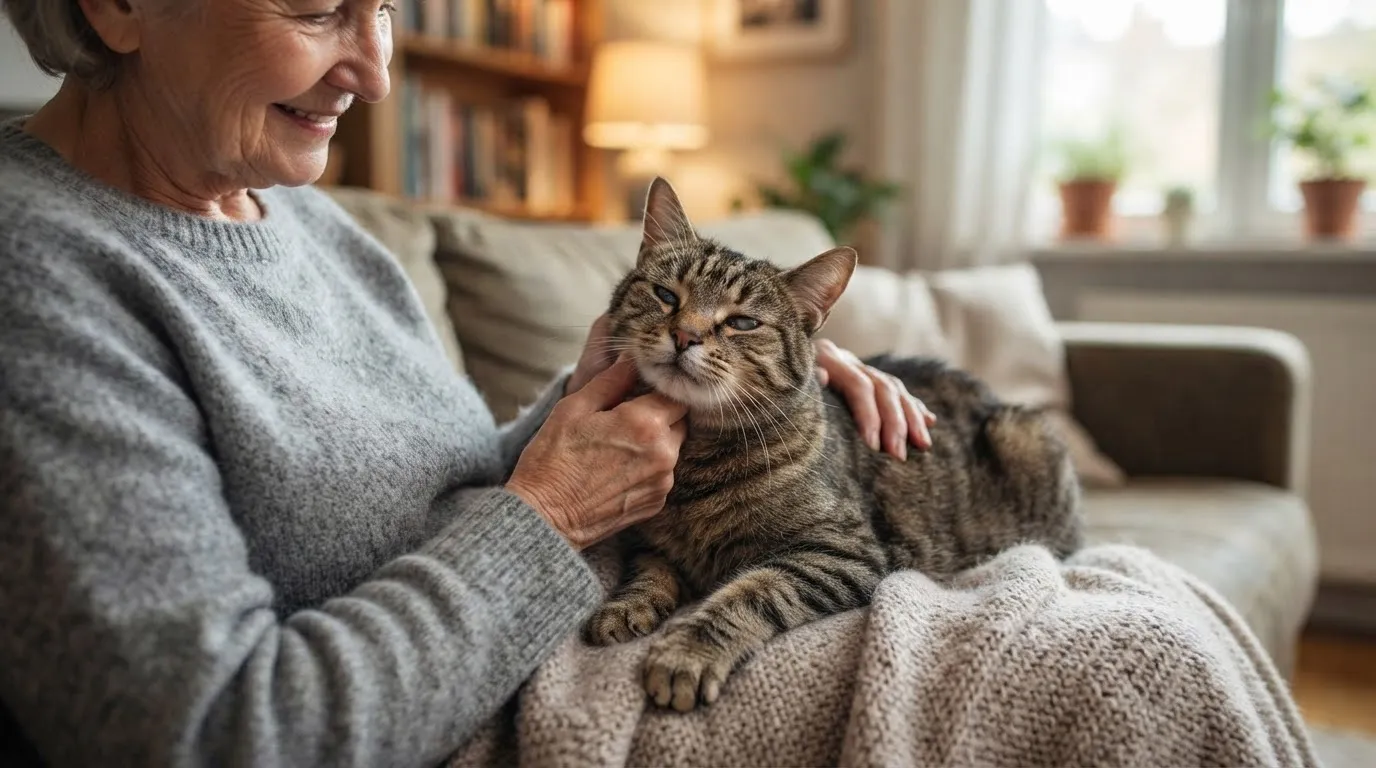
Not all purrs are equal. Senior cats, in particular, carry layers in their purring that most owners never consciously notice.
Cats are believed to have evolved more than a dozen distinct purr patterns, each carrying a different meaning. The low, deep, rolling purr your aging cat gives you on the couch is categorically different from the polite purr it might offer a stranger.
When kneading, purring, slow blinking, and a relaxed posture all fire at once - and only with you - that's one of the most reliable signs of a chosen, secure bond. That full-body commitment isn't random.
At a Glance
- Domestic cat purrs typically fall between roughly 25 and 150 Hz, with the strongest concentration on the low end.
- That low-frequency range is also linked to calming effects and stress relief in the humans sitting close enough to feel it.
- The couch purr you feel through your chest is a different experience entirely than the polite purr a stranger might hear from across the room.
And now, #1 - the behavior that ties everything together...
#1 - It Still Chooses to Be Near You, Even When It Doesn't Have To
This is the one that matters most, and the easiest one to take for granted.
Given a real choice between interacting with a person or something else, most cats choose the person. Food comes in second.
Your senior cat isn't glued to you out of confusion or dependency. It has had years of total freedom - any room, any sunny windowsill, any quiet corner - and it keeps choosing the one where you are.
That's not habit. That's a decision, made again, every single day. Cats retain several juvenile traits into adulthood and stay dependent on their caretakers the way many domesticated animals do, but the attachment your aging cat shows you goes beyond biology.
It's personal.
The Bottom Line
Most people assume cats are indifferent. The data says otherwise - roughly 65 percent of cats are classified as securely bonded to their people, and in senior cats, that bond has had years to sharpen into something remarkably deliberate.
The slow blinks, the specific purr, the door greetings, the selective tolerance - none of it is random. Your aging cat has quietly, consistently, and deliberately chosen you as its person.
The question is whether you've been paying close enough attention to notice. Which behavior on this list does your cat do the most? Drop it in the comments - we read every one.