13 Quiet Ways an Aging Cat Asks for Help When It Cannot Say So
Most cat owners assume their senior pet is "just getting old" - a little slower, a little more distant, nothing to worry about. Turns out, that surface-level read misses almost everything hiding underneath.
Studies show most owners believe their cat is perfectly healthy right up until a vet finds disease that's been building for months. Your cat isn't being aloof - it's sending quiet, specific signals that something is wrong, and nobody ever taught you how to read them.
Here's what veterinary experts and behavioral specialists say those signals actually mean - starting with the one hiding in plain sight.
#13 - Sleeping More Than Usual (But Not in Their Usual Spots)
Most owners notice the extra sleep and shrug. The location change is what they miss.
Senior cats naturally sleep more than younger cats. But a sudden, dramatic increase paired with reduced appetite or weight loss is a different story entirely.
It's the combination that signals trouble - not the nap itself.
A senior cat that suddenly starts hiding under beds, in closets, or in rooms it never used before may be isolating itself in response to pain or illness. That withdrawal from the family is a real behavioral signal - especially when it's a total break from the cat's usual habits.
The spot your cat chooses to rest in is a clue. If they've abandoned their favorite sunny window for a dark corner behind the washing machine, that shift is deliberate - and worth paying attention to.
But that's nothing compared to what we found about #12...
#12 - A Coat That Looks "Just a Bit Off"
Everyone blames old age. Vets blame something else entirely.
Healthy cats are meticulous groomers, and grooming is often one of the first behaviors to slip when a cat is in pain or feeling unwell.
An elderly cat that was always well-kept and suddenly develops a dull, matted, or greasy coat is telling you something has changed in how they feel.
The early signs are subtle - greasy or clumpy fur along the lower back or behind the ears, dandruff flakes near the tail base, overgrown nails that snag on blankets or carpet.
Most owners call this "unkempt." Vets call it a red flag.
Coat changes around the lower back and hips are especially telling - those are the hardest areas for an arthritic cat to reach.
If the front of your cat looks fine but the back end doesn't, that asymmetry is the message.
But that's nothing compared to what we found about #11...
#11 - That Tiny Pause Before a Jump
No limp. No cry. Just a hesitation that lasts half a second - and that half-second is everything.
In cats, arthritis usually shows up as a pause. Your cat stands at the couch, judges the jump, circles once, then takes a lower route or gives up altogether.
That tiny hesitation is classic feline joint pain - and it's almost always dismissed as laziness.
Many owners insist their cat "isn't in pain" because they never hear crying. Feline specialists will tell you bluntly: cats rarely vocalize pain until it's unbearable.
By the time your cat cries out, the situation has already been serious for a while.
Fast Facts
- 70-90% of cats over age 12 show signs of osteoarthritis on imaging.
- Joint changes can start far earlier than most owners assume - roughly 60% of cats over age 6 already show signs.
- By age 14, a cat's odds of having arthritis in at least one joint climb to about 82%.
- Most arthritic cats never limp or cry out - they just move differently.
Geriatric cats almost always have some degree of osteoarthritis - meaning this sign is far more common than most people realize. Watch for a chair being used as a "step," or your cat jumping down in stages instead of one clean leap.
But that's nothing compared to what we found about #10...
#10 - Litter Box Accidents That "Come Out of Nowhere"
This is the sign owners are most likely to misread as behavioral. It's almost never behavioral.
As cats age, they may experience a decline in litter box habits, such as urinating outside the box, which can signal urinary tract infections, kidney disease, or cognitive dysfunction. A gradual change can be normal, but sudden accidents should not be ignored.
One easily overlooked connection is the relationship between arthritis and litter box issues. When arthritic cats find it painful to step over a high-sided box, or must reach a box on a different floor, they may start avoiding it entirely.
Your cat isn't being defiant - it may simply hurt too much to climb in.
Before scolding or switching litter brands, rule out the physical causes first. A low-sided box on the same floor can make an immediate difference.
But that's nothing compared to what we found about #9...
#9 - Unexplained Weight Loss (Even With a Good Appetite)
This one fools even attentive owners. The cat is still eating - how can something be wrong?
A senior cat losing weight despite a maintained appetite is a classic sign of hyperthyroidism, diabetes, or malabsorption conditions like inflammatory bowel disease. The body is burning calories faster than it can absorb or use them.
Progressive weight loss is one of the most common and reliable indicators that something is wrong in an elderly cat.
Run your hands along your cat's spine and ribs. If you can feel each vertebra or rib distinctly under light pressure, that's a clinical warning sign - not just "getting lean."
Significant weight loss in senior cats should be taken seriously - cats may lose weight due to hyperthyroidism, diabetes, or cancer.
Early bloodwork catches these conditions before the damage compounds.
But that's nothing compared to what we found about #8...
#8 - Suddenly Drinking a Lot More Water
Most owners notice the water bowl is emptying faster and assume it's the weather. It usually isn't.
Increased thirst in senior cats can be a sign of kidney disease, diabetes, or hyperthyroidism. These are among the most common age-related diseases in cats, and increased water intake is often the very first symptom that appears - months before anything else.
Kidney disease can develop gradually, particularly in older cats. Increased thirst, more frequent urination, weight loss, decreased appetite, vomiting, or changes in energy can all appear as kidney function declines.
Unfortunately, noticeable symptoms may not appear until the condition has already progressed.
Worth Knowing
- Vets generally mark 7-10 as "mature," 11-14 as "senior," and 15+ as "geriatric" for cats.
- Most veterinary guidelines recommend wellness exams twice a year once a cat turns 7 - not just annually.
- A senior bloodwork panel typically screens kidney values, thyroid hormone, and blood sugar in a single visit.
- Catching abnormal numbers early often turns a life-threatening disease into a manageable one.
Don't wait for other symptoms to confirm your suspicion. Cats over 7 should ideally see the vet twice a year.
Blood work can catch kidney disease, thyroid issues, and diabetes early - the water bowl is just your first warning system.
But that's nothing compared to what we found about #7...
#7 - Changes in Appetite - Either Direction
A cat eating less is worrying. A cat suddenly eating far more is equally worrying - and owners almost always celebrate the second one.
A meaningful, persistent drop in appetite is a serious indicator of health problems in elderly cats. Cats that stop eating or eat far less are often dealing with nausea, oral pain, or systemic illness.
Because cats are vulnerable to a dangerous liver condition called hepatic lipidosis when they go without food, appetite loss in a senior cat should never be something you just wait out.
A more sudden loss or increase in thirst and hunger might indicate pain, nausea, metabolic issues, or poor internal organ function. Excessive hunger can be seen with diseases like hyperthyroidism.
A cat raiding bowls, begging constantly, or finishing food faster than ever - after years of being a picky eater - is not a good sign.
It's a thyroid alarm bell. Track both directions of appetite change with equal urgency.
But that's nothing compared to what we found about #6...
#6 - Unexplained Irritability or New Aggression
Your sweet cat hisses when you pick them up. You think they're grumpy. They're actually telling you something hurts.
Your elderly cat may display real personality changes as they age. A once-docile cat may start biting, scratching, or hissing when you or another pet gets close.
This is not personality drift. This is a pain response.
Common signs a cat is in pain include increased vocalization, unusual aggression, withdrawal, pacing, lethargy, and limping.
Quick Compare
- Typical crankiness: tied to a known trigger like nail trims or car rides, and stays consistent over time.
- Pain-driven aggression: appears suddenly, often tied to touch in one specific spot.
- Typical crankiness: doesn't get worse from week to week.
- Pain-driven aggression: tends to escalate alongside other changes like appetite or grooming shifts.
Aggression triggered by touch is particularly telling. If your cat specifically reacts when you touch a certain spot - their back, their belly, their hips - that location is where the pain lives.
Some cats become more irritable when handled, or less tolerant of any change in routine.
A sudden personality shift in an older cat is never "just attitude." It deserves a vet visit.
But that's nothing compared to what we found about #5...
#5 - Staring at Walls or Getting "Stuck" in Familiar Rooms
Your cat stops in the middle of the hallway. Stares at nothing. Seems lost in a house they've lived in for years.
This is one of the most haunting signs on this list - and one of the most commonly dismissed.
Cats may appear lost in parts of the home they've known for years. They might wander, stare at walls, approach the wrong side of a door, or get stuck behind furniture.
These behaviors suggest real difficulty processing spatial information.
Feline cognitive dysfunction, or cognitive decline, is common in elderly cats and tends to appear later in life.
The main symptom is confusion and disorientation - exactly what that hallway freeze looks like.
Think of it as cat dementia - and it's more common than most owners ever suspect. Forgetfulness, disorientation, and confusion are all common signs of feline cognitive dysfunction syndrome.
It can be managed. But only if it's caught.
But that's nothing compared to what we found about #4...
#4 - Hiding in Places They Never Used Before
There's a reason cats instinctively hide when they're sick - and it goes back thousands of years.
Cats are masters of disguise. Evolution hardwired them to hide pain and illness so they don't look like an easy target for predators.
That instinct is still fully intact in your domestic cat. When your senior cat disappears for hours into a closet or under a bed, their ancient brain is telling them to be invisible.
Some increased rest is expected in senior cats, but genuine withdrawal looks different from simply sleeping more. A cat who avoids interaction when approached, no longer responds to being called, or moves away from gentle touch is showing signs that warrant closer attention.
The critical difference: a sleeping cat wakes and engages; a withdrawing cat doesn't want to be found at all. This behavior is also linked to feline cognitive dysfunction, as cats experiencing neurological changes may feel disoriented and seek quiet, enclosed spaces to manage that confusion.
But that's nothing compared to what we found about #3...
#3 - A New, Hunched Posture at Rest
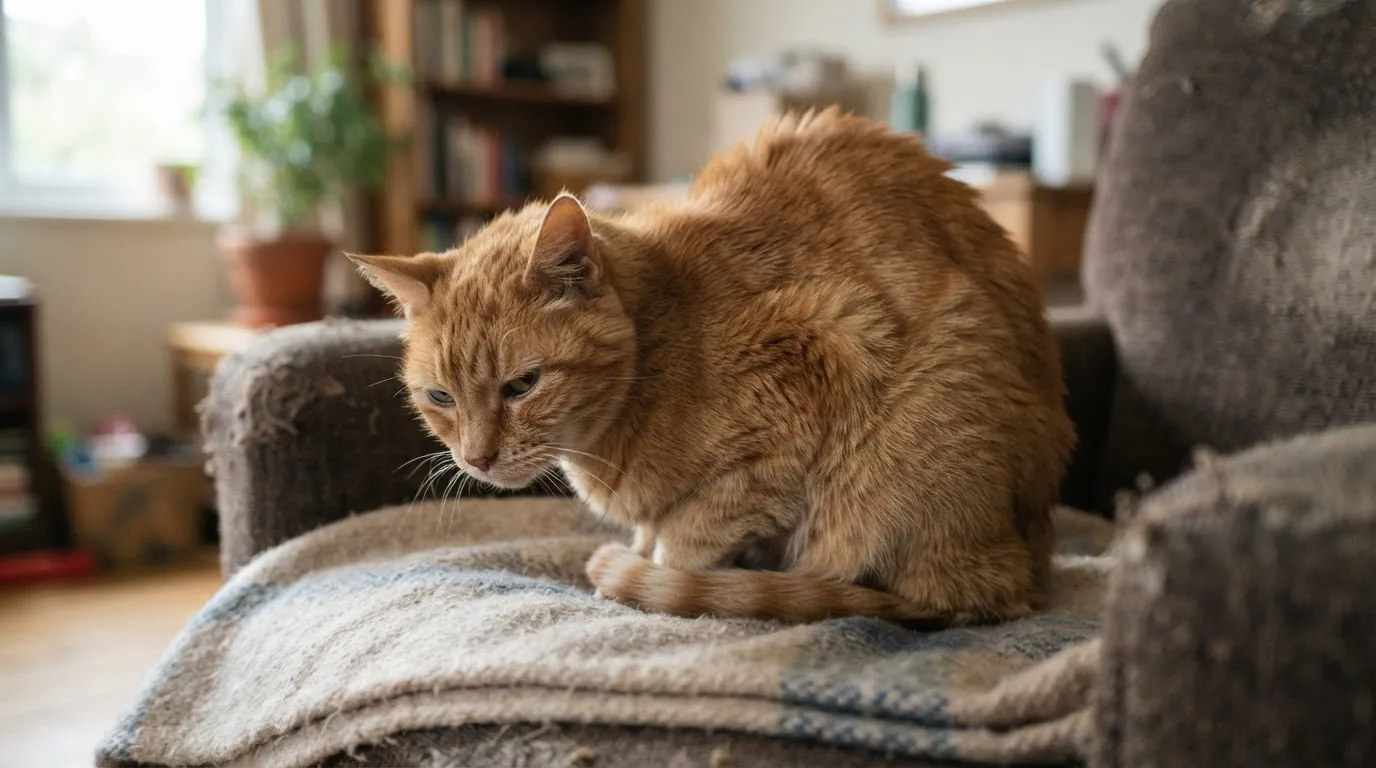
Your cat isn't sitting differently because they found a more comfortable position. They're bracing.
A cat in pain often adopts postures designed to protect the affected area. They may hunch their back, tuck their abdomen, hold their head lower than usual, or sit with their legs tucked tightly beneath their body instead of a relaxed loaf.
At a Glance
- Hunched back with a tucked abdomen
- Head held lower than the normal resting height
- Legs tucked tightly instead of a relaxed "loaf" position
- Reluctance to stretch fully after waking
Cats with abdominal pain often adopt a characteristic hunched posture that's easy to overlook if you aren't actively looking for it. Changes in how a cat holds itself at rest are among the most consistent physical indicators of discomfort, and worth mentioning to your vet.
Compare photos of your cat from two years ago to today. If their resting posture has changed - shoulders raised, belly tucked, head lower - that's a measurable, documentable change worth showing your vet.
The body doesn't lie when words aren't available.
But that's nothing compared to what we found about #2...
#2 - Nighttime Crying or Yowling
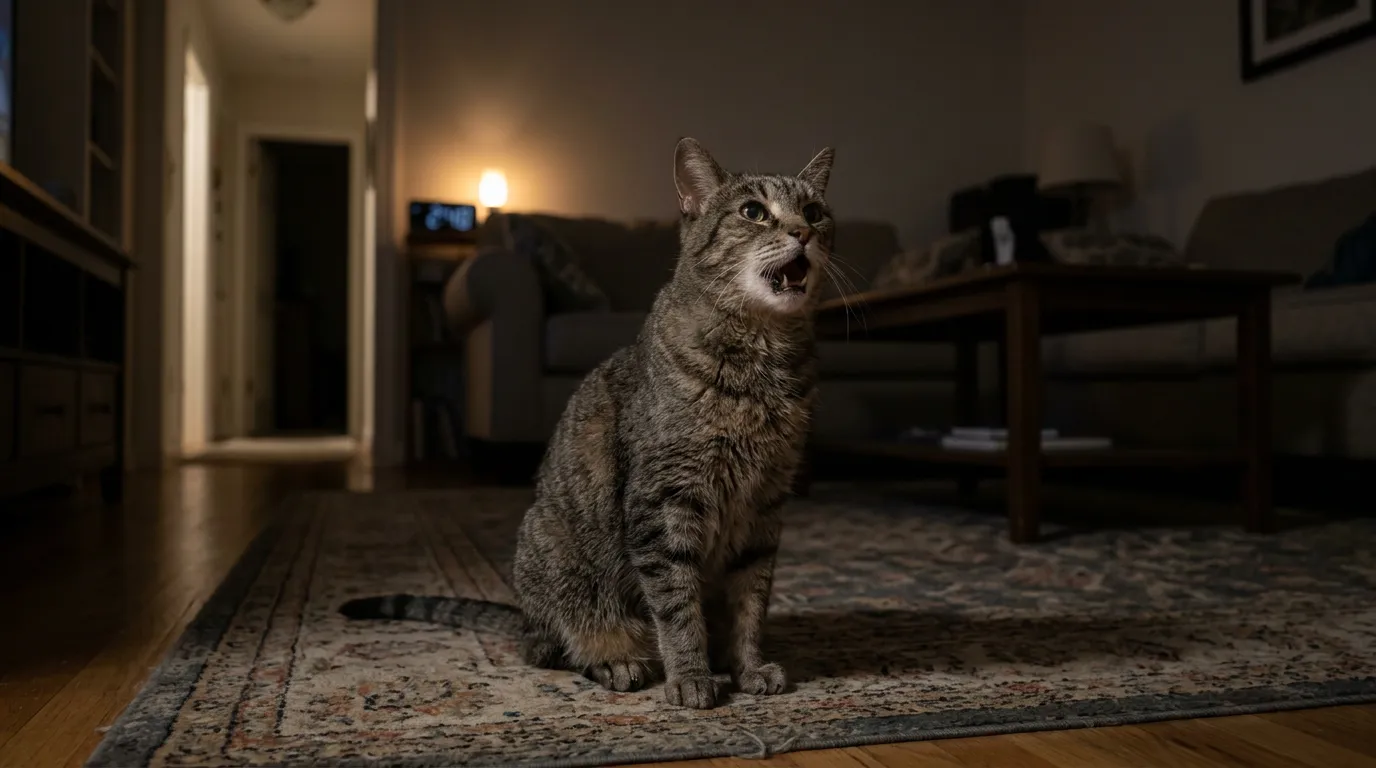
This is the sign most owners explain away as attention-seeking. It's often the most urgent signal on this entire list.
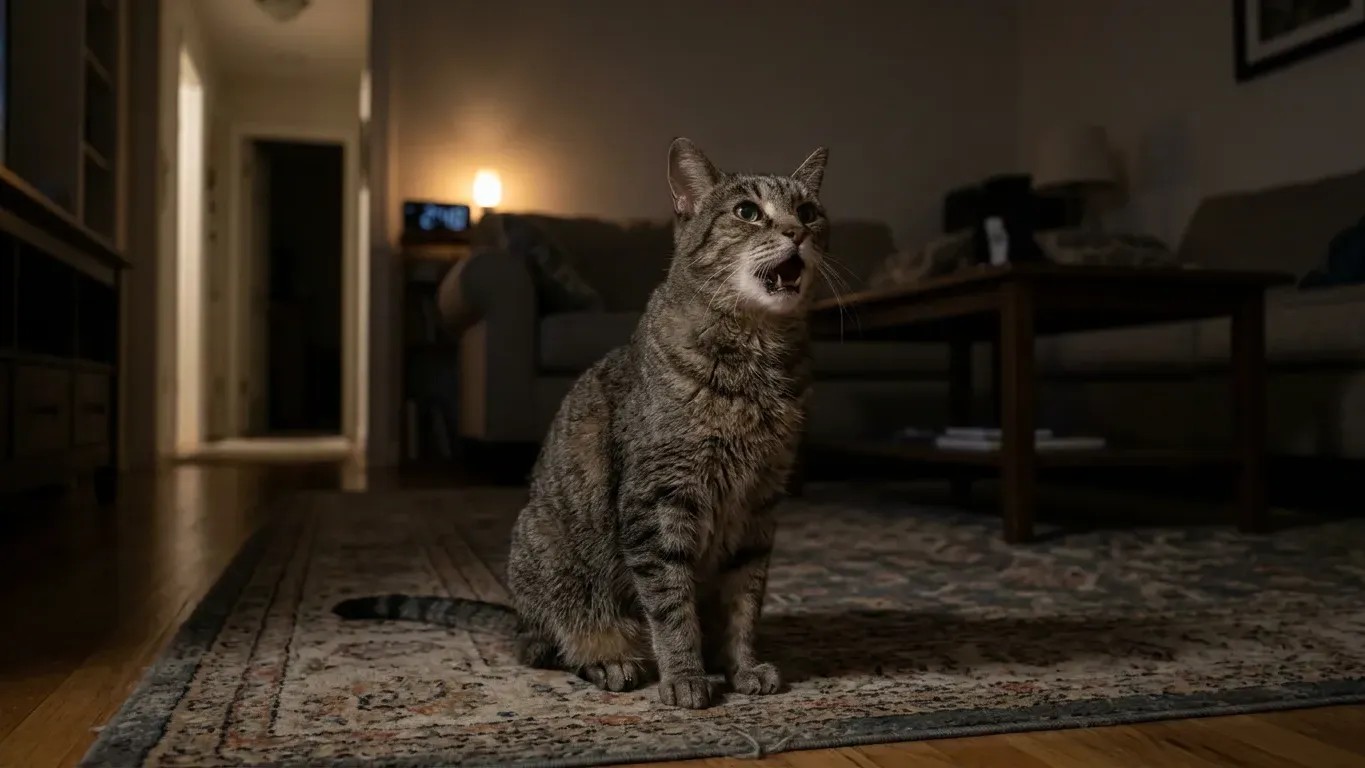
Nighttime vocalization in senior cats is commonly linked to cognitive dysfunction, hyperthyroidism, pain, hearing loss, or disorientation. Every one of those causes is a medical issue - not a behavioral quirk.
In an aging cat, new or louder night-time vocalizing is often a sign of confusion, pain, or age-related hearing loss that makes them over-project their voice. Those cries can be the equivalent of a senior person calling out into the dark because they're not sure where they are.
If your cat was quiet for years and is now calling out at 2 or 3 a.m., do not wait.
That kind of vocalization, especially paired with weight loss, thirst, vomiting, or litter box problems, is a combination that needs veterinary attention fast.
But that's nothing compared to what we found about #1...
#1 - Becoming Either Suddenly Clingy or Completely Withdrawn
This is the sign that cuts deepest - and the one most owners never connect to illness at all.
Senior cats may become more clingy, more withdrawn, or more vocal than they used to be. Both extremes matter, and both are easy to misread.
The cat that follows you room to room and cries when you leave isn't just needy - it may be frightened, disoriented, or in pain, seeking the only comfort it knows.
Cats are stoic - even more stoic than dogs - so it takes a lot for them to show us that all is not well. They hide their discomfort extremely well.
When that stoicism finally breaks, when they seek you out more than ever before, something has shifted significantly in how they feel.
They hide their discomfort extremely well. It takes a lot for a cat to show us that all is not well.
Common veterinary observation on feline pain behavior
Because cats conceal pain so instinctively, recognizing suffering means learning to read subtle changes in posture, appetite, and emotional engagement - not waiting for obvious signs.
A sudden, unexplained change in how much - or how little - your cat wants to be near you is the clearest window into how they actually feel.
Don't dismiss it as personality. Hear it for what it is: a quiet ask for help from someone who has no other way to ask.
The Bottom Line
What looks like stubbornness, neediness, or "just being an old cat" is often a precise signal. It's a body quietly asking for warmth, safety, or relief from pain it has no words for.
Hiding, hesitating, shifting posture, crying at night, drinking more, losing weight, grooming less - none of it is random. It's a language.
The earlier these changes are caught, the better the chance of protecting your cat's comfort and quality of life. You don't need to see every sign at once - one is enough to act on.
Which of these did you spot in your cat before you knew what it meant - or wish you had? Drop it in the comments.