There’s something almost unfair about watching a cat tumble off a shelf, spin once in the air, and stick the landing like a gymnast who’s been training for years. You probably do a double take. Your cat, meanwhile, walks away without a single glance back, entirely unbothered.
This ability has puzzled scientists, physicists, and curious cat owners for centuries. What looks like magic or luck is actually a precise, elegantly engineered interplay between biology, neurology, and classical physics. The closer you look, the more remarkable it becomes.
The Righting Reflex: Nature’s Built-In Safety Net
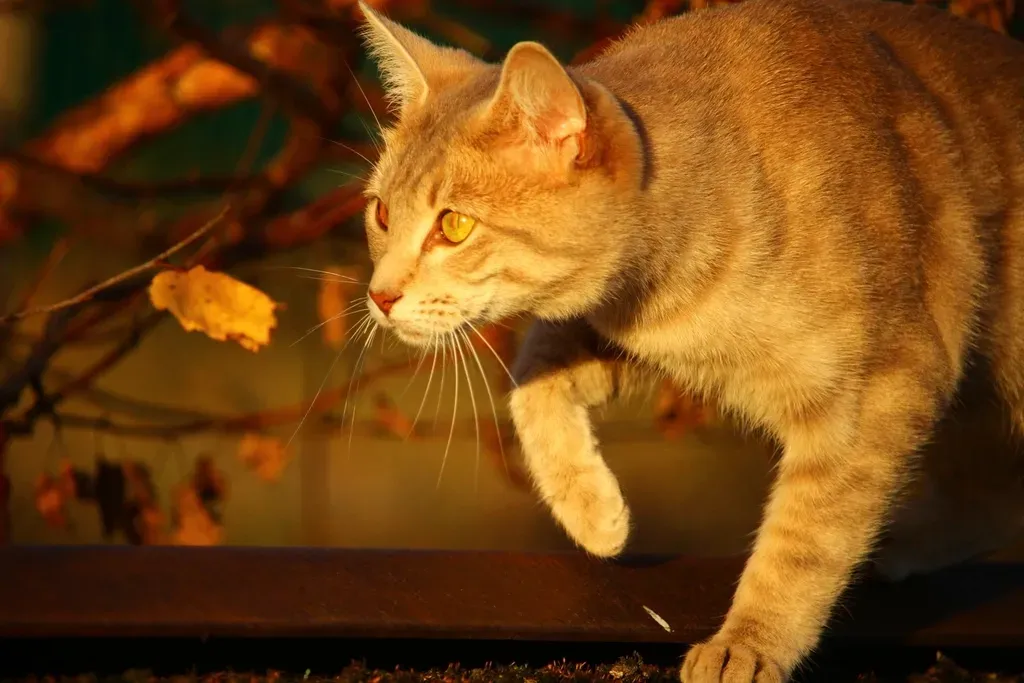
The cat righting reflex is a cat’s innate ability to orient itself as it falls in order to land on its feet. It’s not a trained skill, not a trick, and not something your cat consciously decides to perform mid-tumble. The righting reflex is an automatic response, not a learned trick. Kittens begin developing it as early as three to four weeks of age, long before they ever attempt daring leaps onto countertops.
The righting reflex begins to appear at three to four weeks of age and is perfected at six to nine weeks. Cats are able to do this because they have an unusually flexible backbone and no functional clavicle, or collarbone. Even before a kitten has earned its climbing privileges, the reflex is already quietly wiring itself into place. It’s one of the most quietly impressive facts about early feline development.
The Inner Ear: Your Cat’s Built-In Compass
Righting is a behavioral response to gravity that relies on the vestibular system. Otoliths in a cat’s inner ear detect changes in its acceleration and position relative to the ground, prompting its muscles to move in a way that helps it land on its paws. Think of it as your cat carrying a highly sensitive gyroscope inside its skull, one that never needs calibration.
This balance hardware, called the vestibular apparatus, includes semicircular canals and tiny dense structures that sense acceleration, helping the cat realize it is falling even before your own brain reacts. The speed of this system is genuinely startling. This happens faster than conscious thought. Your cat is not planning the landing in midair; their nervous system is simply reacting. That split-second response is why even startled or sleepy cats can often recover mid-fall.
The Spine That Makes It All Possible
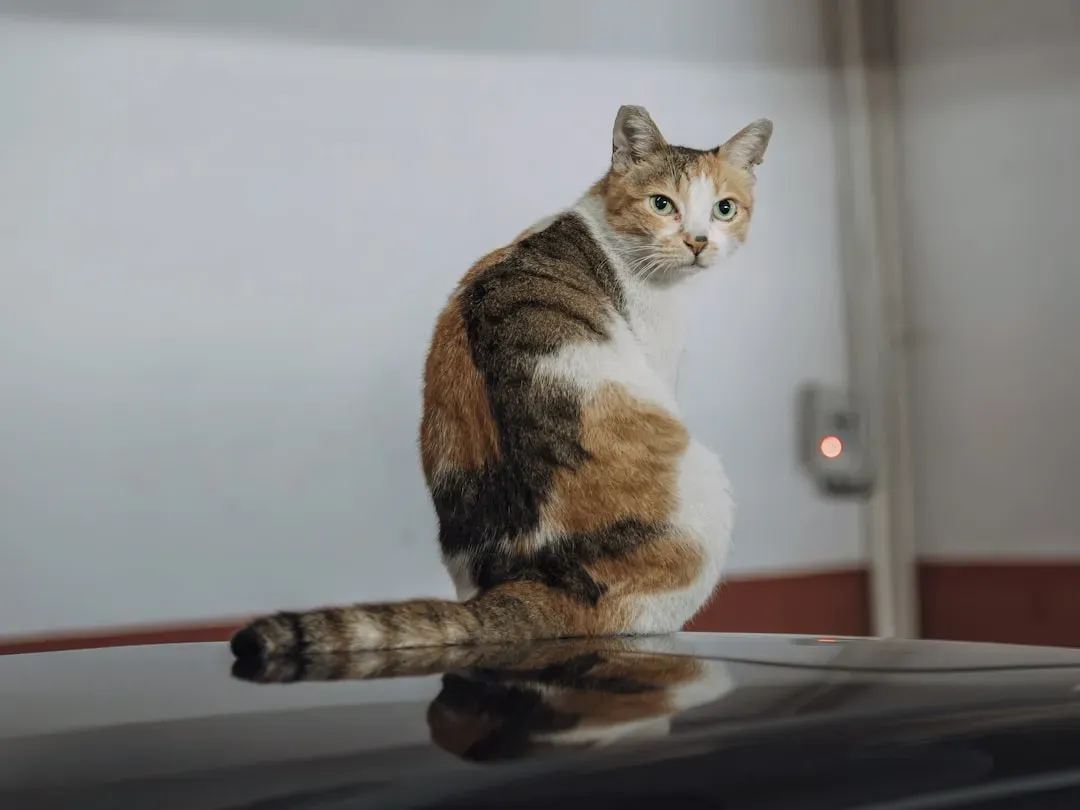
The 30 exceptionally flexible vertebrae in the spine enable felines to stretch out, compress, arch the back, and rotate, bend, and twist the front half of the body independently from the back half. This is the structural key to everything. No other common domestic animal has quite this degree of spinal independence, which is a large part of why cats look so fluid in motion.
A cat’s flexible spine is a major player in this acrobatic feat. Unlike humans, cats have an exceptionally elastic backbone that allows for dramatic twisting without injury. This flexibility gives them the range of motion needed to reposition midair. Combined with the absence of a rigid collarbone, the front and rear halves of the body can rotate at different rates, which is the physical foundation of the whole maneuver.
The Physics Behind the Flip: Angular Momentum Explained
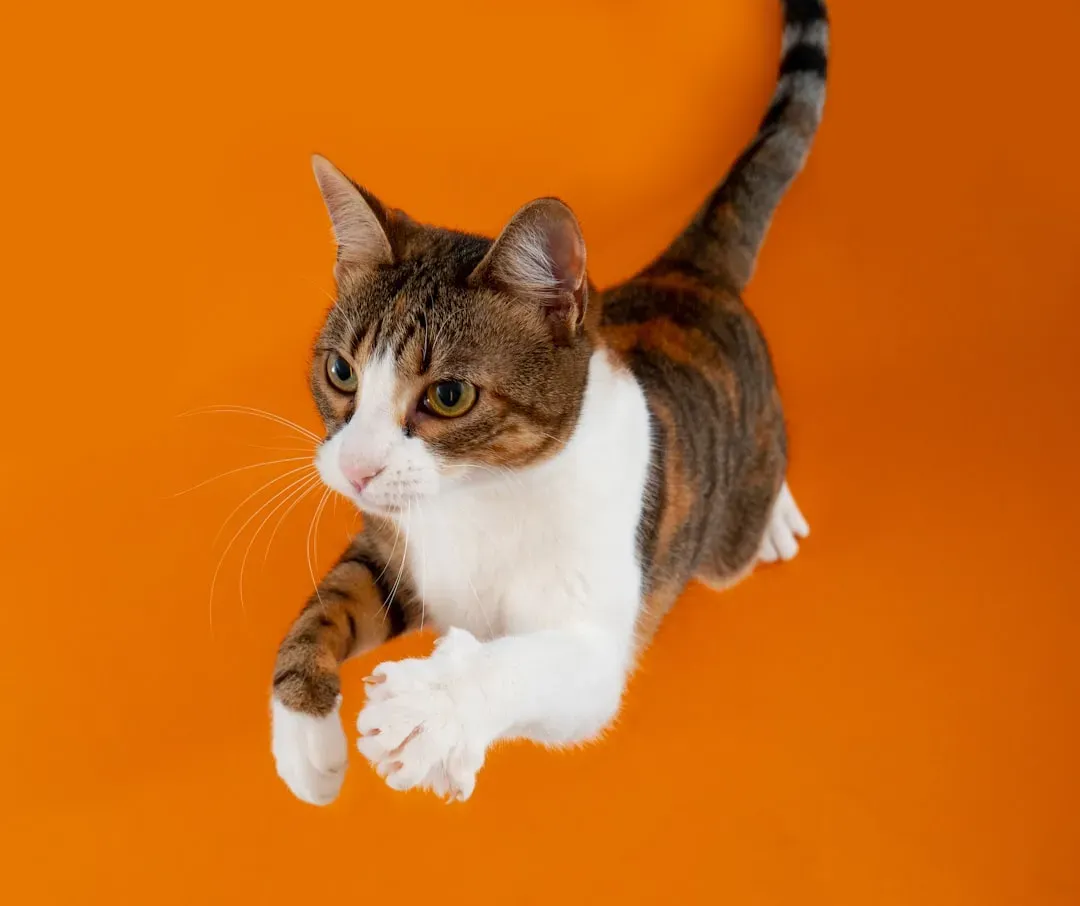
Several factors affect how a cat is able to land on all fours, but simply put, there are two main forces at play: physics and neurology. “One of the reasons that physicists were surprised that cats could rotate to always land on their feet is the conservation of angular momentum,” according to Greg Gbur, a physicist at the University of North Carolina at Charlotte. In simpler terms, a freely falling object is not supposed to be able to change its rotation without something to push against.
Researchers imagined the cat as fundamentally consisting of two cylinders, representing the front and rear halves of the feline. If the cat bends at the waist, it can then twist the two halves of its body in opposite directions, causing their opposing angular momenta to largely cancel. By pulling in its legs, the cat can considerably reduce its rotational inertia about the same axis and thus considerably increase its angular speed. Stretching out its legs increases its rotational inertia and thus slows the cat’s angular speed. The conservation of angular momentum allows the cat to rotate its body and slow its rate of rotation enough so that it lands on its feet safely.
The Bend and Twist: How the Maneuver Actually Works
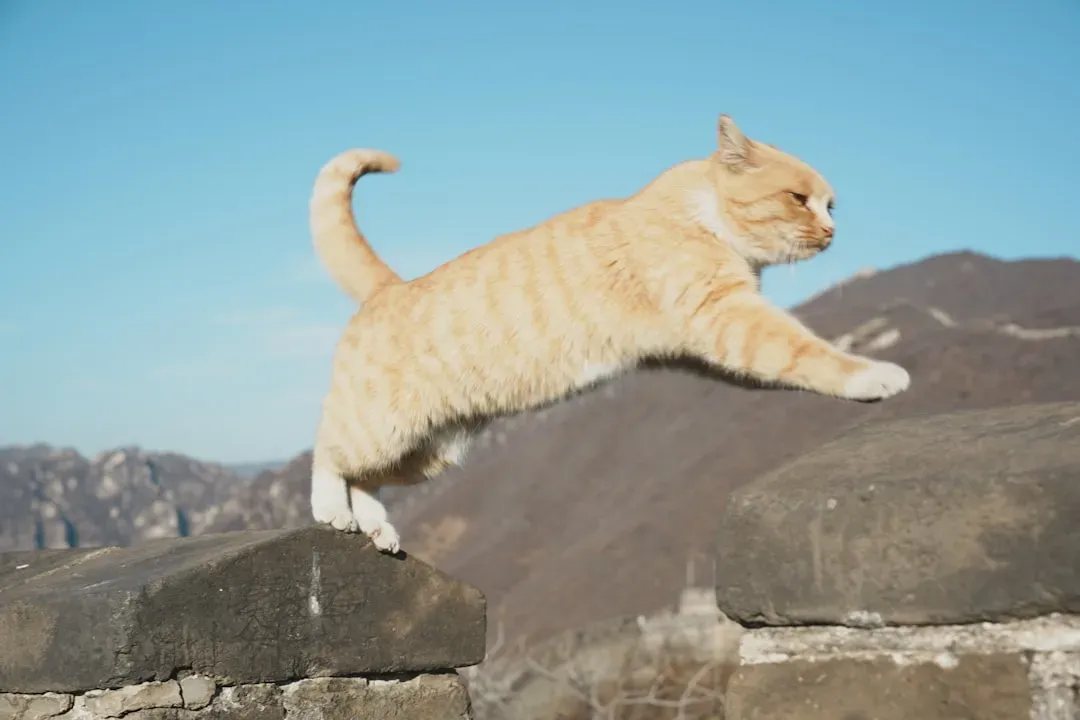
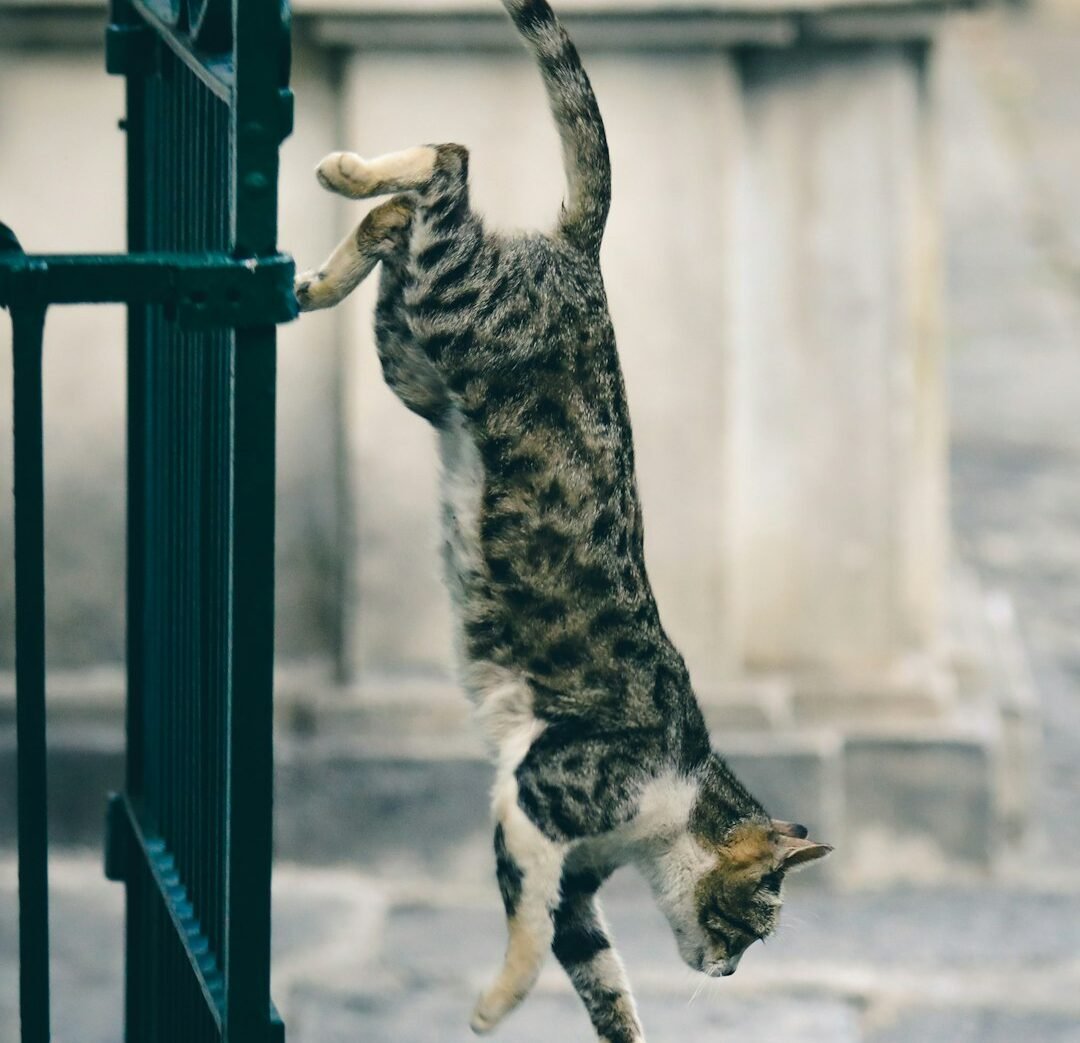
Imagine a cat falling from a stationary upside-down position. By bending at the waist, the cat can twist the front half of its body in one direction and the back half in the opposite direction. By the time it unfolds at the waist, the cat is rightside-up. What sounds almost simple in description happens in a fraction of a second with remarkable precision.
In the “tuck and turn” method, a cat extends its front legs and tucks in its back legs, giving the backside a lower moment of inertia, meaning a lower amount of resistance to changes in rotational motion. Then, it does the opposite, tucking in its front legs and extending the hind legs. The result is a controlled, sequential rotation that sidesteps the apparent limitations of Newtonian physics. What perplexed researchers for so long about the righting reflex is that cats don’t push off from a surface but rather use torque from the body. It’s a physics conundrum that’s perfectly feline.
The Role of the Tail and Whiskers
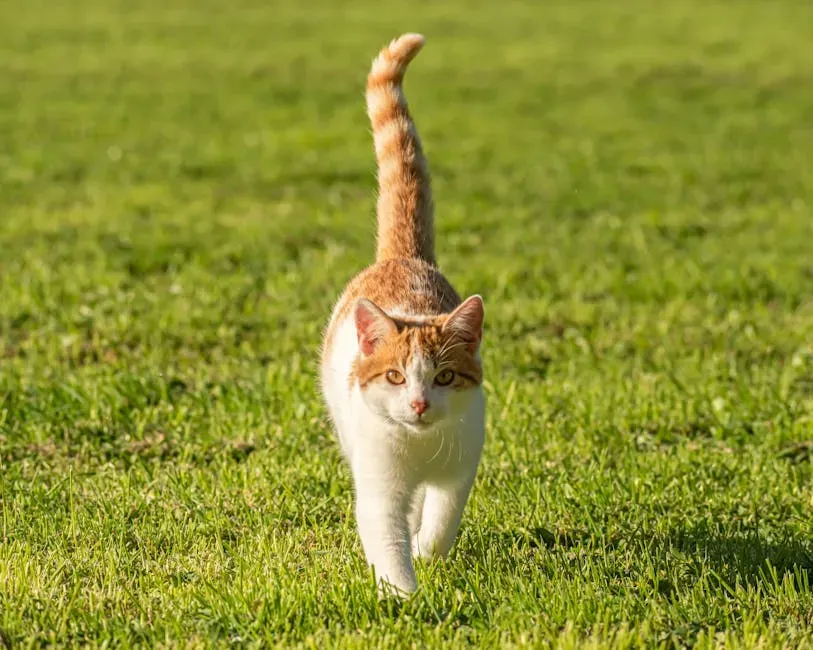
While the tail is not strictly required for the righting reflex, it acts like a stabilizer. The tail helps fine-tune balance and direction, especially during longer falls or awkward jumps. That is why tailless cats can still right themselves, but may appear a bit less precise. Think of the tail as a fine-tuning mechanism rather than the main engine.
Whiskers add another layer of spatial awareness. These highly sensitive hairs help cats judge distance and positioning, even in low light. Together, the inner ear and whiskers provide a constant stream of information that guides the righting reflex from start to finish. Your cat’s face is, in a sense, a precision instrument for navigating space, helping the body execute what the inner ear has already set in motion.
High-Rise Syndrome: When Physics Has Its Limits
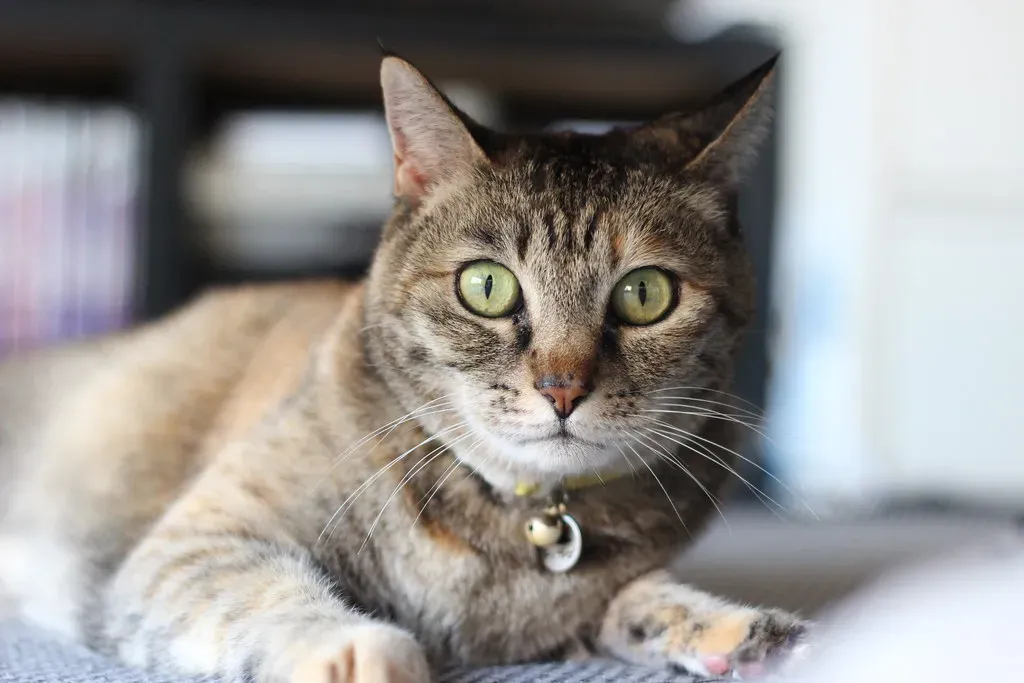
Cats do sustain injuries from falls; it happens so often the cluster of injuries has a name: “high-rise syndrome.” Researchers discovered that cats who fall from seven stories or higher more often land on their feet than from falls of shorter heights but experience more severe injuries. The most common injuries include chest trauma, broken bones, and facial and dental injuries.
In a 1987 study published in the Journal of the American Veterinary Medical Association, of 132 cats brought into the New York Animal Medical Center after having fallen from buildings, it was found that injuries per cat increased positively with altitude until a height of seven stories, at which point injuries decreased. The study’s authors speculated that, after falling five stories, the cats reached terminal velocity, at which point they relaxed and spread their bodies out to increase drag. However, critics of the study have questioned the conclusion that mortality rates decrease as height increases due to survivorship bias; falls that resulted in instant death were not included as a deceased cat would not be brought to a vet.
Terminal Velocity and the Feline Parachute Effect
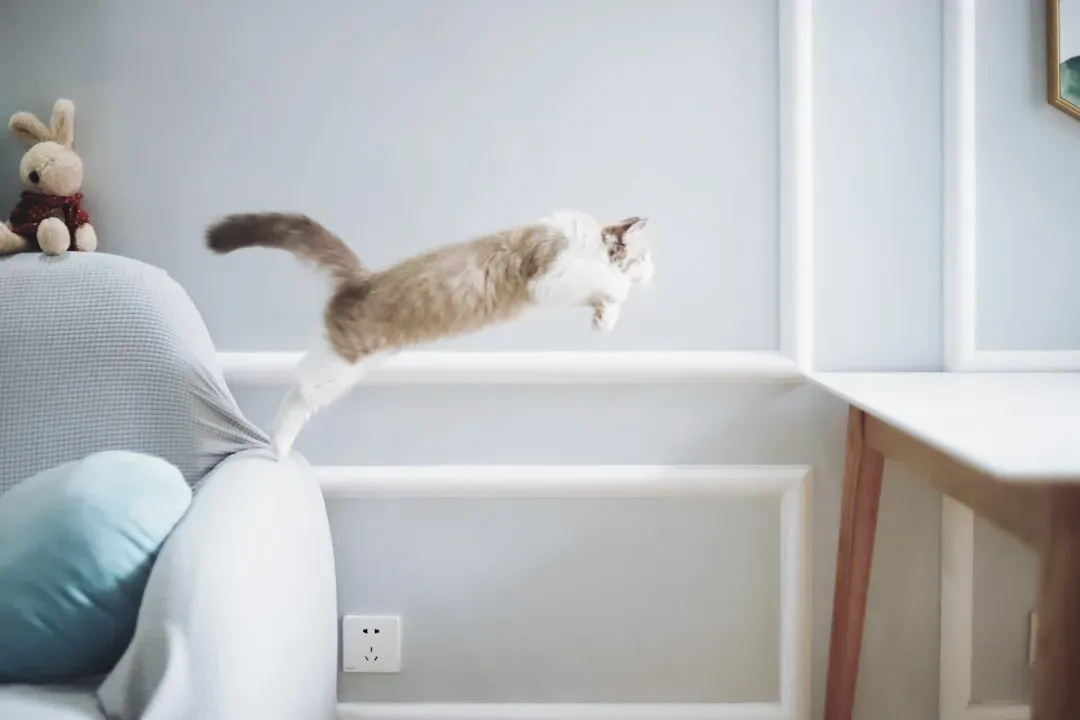
Their small size, light bone structure, and thick fur decrease their terminal velocity. While falling, a cat spreads out its body to increase drag. An average-sized cat with its limbs extended achieves a terminal velocity of about 60 mph, around half that of an average-sized man, who reaches a terminal velocity of about 120 mph. That’s a meaningful physical advantage. Falling at half the speed means significantly less kinetic energy to absorb on impact.
Once they reach this stage they begin to relax and stretch their legs out, much like how a flying squirrel does, which expands their body size and creates air resistance. It’s almost like cats can turn themselves into little parachutes, which increases drag resistance. Where their legs may appear long and slender, they’re actually very muscular and work to reduce the impact and act as shock absorbers when they land.
Evolution, Instinct, and What This Reflex Really Tells You
The righting reflex likely evolved as a survival mechanism. Cats are natural climbers, often scaling trees or high structures in search of prey or safety. Falling from a height is a common risk, and the ability to land on their feet increases their chances of survival. Over evolutionary time, those who landed well survived to pass the trait on. For cats, the most plausible evolutionary explanation is their tendency to climb trees and other spots high off the ground.
The righting reflex is innate so all cats have it, as well as superior vestibular systems, no matter their physical makeup. Even a blind cat will right itself upon experiencing a fall. That last detail is worth sitting with for a moment. Vision plays no essential role. Research shows that the development of the air righting reflex in kittens blinded since birth is the same as in normal kittens with vision: mature by 33 days. This confirms that the air righting reflex is primarily a vestibular controlled reaction.
Conclusion: Remarkable, But Not Invincible
The saying that cats always land on their feet is more nuanced than it sounds. What your cat actually has is a finely tuned, neurologically driven, biomechanically sophisticated system that gives it a remarkable survival advantage. It’s a product of millions of years of evolutionary pressure, built into every fiber of a kitten’s developing nervous system before it even opens its eyes.
The righting reflex is remarkable, but as experts note, “cats are not invincible.” If a cat doesn’t have enough time or height to adjust its body in midair, or if they’re caught off guard, they may not land properly. Even a well-executed landing can result in injury. Cats need enough time and space to achieve this grace in motion. The righting reflex can take less than a second, and a cat needs at least two and a half feet to stick the landing.
Understanding the physics behind what your cat does mid-air doesn’t make it any less impressive. If anything, knowing that it involves angular momentum, a 30-vertebra spine, and a sensory system faster than conscious thought makes that casual walk-away after a tumble all the more extraordinary. Nature built something genuinely clever here, and your cat carries it around like it’s nothing special at all.
Kristina is a young writer from India. An arts graduate and an avid content creator, Kristina is passionate about animals and wildlife. She enjoys exploring topics related to pet care, animal behavior, conservation, and nature, combining thorough research with engaging storytelling.